
자료
세계시민교육에 대한 이해를 넓히고 연구, 옹호 활동, 교수, 학습 등을 향상시킬 수 있는 다양하고 유용한 자료를 찾아보세요.
1,726 건의 결과가 검색되었습니다
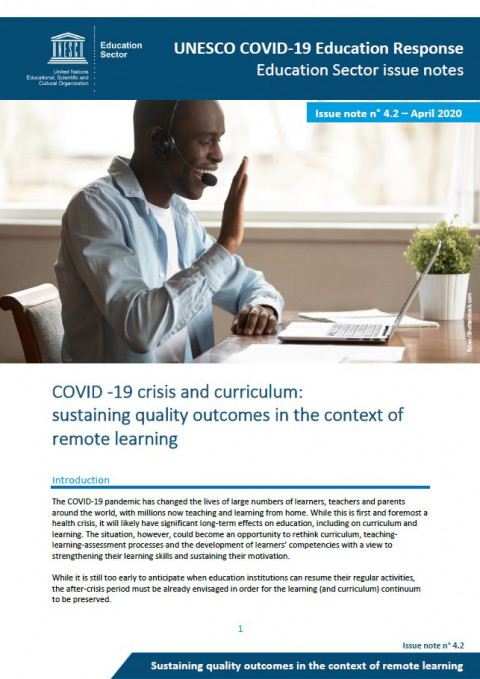 Crisis y currículo durante el COVID-19: mantención de los resultados de calidad en el contexto del aprendizaje remoto (Nota temática No. 4.2 – Abril 2020) 발행 연도: 2020 단체 저자: Organización de las Naciones Unidas para la Educación, la Ciencia y la Cultura (UNESCO) La pandemia del COVID-19 ha cambiado la vida de una gran cantidad de estudiantes, docentes, padres y madres a lo largo del mundo y millones actualmente enseñan y aprenden desde sus hogares. Aunque se trata principalmente de una crisis sanitaria, es probable que tenga importantes secuelas a largo plazo en la educación, incluso en el currículo y el aprendizaje. No obstante, la situación puede transformarse en una oportunidad para reexaminar el currículo, los procesos de evaluación de la enseñanza y del aprendizaje y el desarrollo de las competencias de las y los estudiantes, en vista de fortalecer sus habilidades de aprendizaje y mantener su motivación.Es probable que la crisis ofrezca una oportunidad para que las escuelas fortalezcan sus vínculos con las familias y para que las y los docentes se comuniquen y cooperen mejor con los padres y las madres en beneficio de las y los estudiantes. En la misma línea, la crisis significa que docentes, madres y padres podrían participar más en las decisiones respecto de la idoneidad del currículo. Esto puede servir como apoyo al paradigma de aprendizaje inclusivo, participativo y centrado en la y el estudiante, que considera tanto los intereses de las y los estudiantes como sus entornos y aspiraciones.
 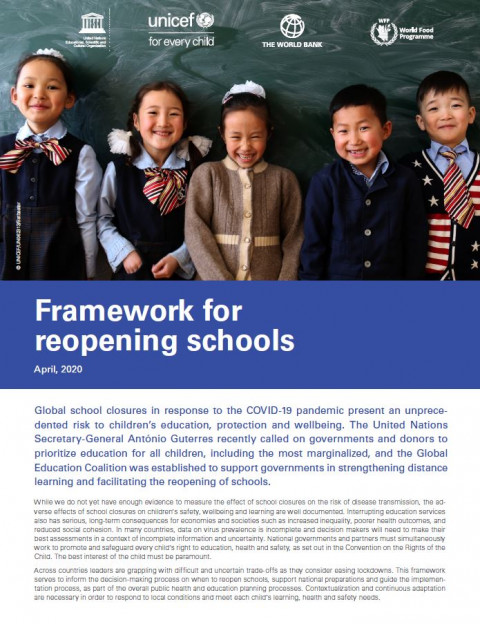 Framework for Reopening Schools; April, 2020 발행 연도: 2020 단체 저자: UNESCO | United Nations Children's Fund (UNICEF) | World Bank | World Food Programme By late April, nationwide school closures were still disrupting the learning of more than 73 per cent of students, or more than 1.2 billion children and youth. When deciding whether to reopen schools, authorities should look at the benefits and risks across education, public health and socio-economic factors, in the local context, using the best available evidence. The best interest of every child should be paramount.The guidelines aim to inform the decision-making process regarding school reopening, support national preparations and guide the implementation process, as part of overall public health and education planning processes. It is designed to be a flexible tool that can be adapted to each context and updated as the situation changes. The guidelines outline six key priorities to assess the readiness of those schools and inform planning.
 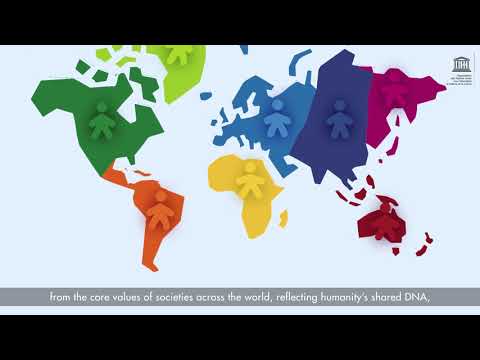 Éducation à la citoyenneté mondiale: Pour une approche locale 발행 연도: 2018 단체 저자: Organisation des Nations Unies pour l'éducation, la science et la culture (UNESCO) Les sociétés à travers le monde ont longtemps vécu selon les principes de la solidarité, le dialogue et le respect de la diversité. Le programme d’éducation à la citoyenneté mondiale (ECM) de l’UNESCO est inspiré de ces savoirs, en inculquant aux apprenants les compétences, les valeurs et les attitudes pour vivre ensemble et construire un monde plus durable et pacifique. L’ECM n’est pas un nouveau concept, mais une aspiration de longue date à travers les continents.
  UNESCO's work on education for peace and non-violence: building peace through education 발행 연도: 2008 단체 저자: UNESCO The promotion of peace through education is at the heart of UNESCO’s mission. As stated in its constitution of 1945, UNESCO advances international peace and the common welfare of humanity through educational, scientific and cultural relations between peoples of the world. Though the world has changed over the past sixty years and continues to change at an ever increasing rate, UNESCO’s mission - a commitment to promoting universal values of peace and nonviolence, human rights and social justice, intercultural dialogue and mutual understanding – persists with growing urgency. UNESCO’s approach to educating for peace is multidimensional, in that it links education with a range of activities that address the root causes of violence, from human security to sustainable development. The goal of UNESCO’s education programmes and partnerships is the development of comprehensive systems of education that embrace the values of human rights, intercultural understanding and tolerance. Education for peace and non-violence promotes the knowledge, skills, attitudes and behaviours that reflect and inspire these values. As the lead agency within the UN system for the International Decade for a Culture of Peace and Non-Violence for the Children of the World, 2001- 2010, UNESCO is responsible for coordinating and directly implementing activities that promote the objectives of the Decade through education, the sciences, culture, communication and information. The culture of peace is defined as a set of values, attitudes, modes of behaviour and ways of life that reject violence and aim to prevent conflicts by tackling their root causes through dialogue and negotiation between individuals, groups and nations. UNESCO promotes the culture of peace through an intersectoral platform. This platform involves all five sectors of UNESCO: education, natural sciences, social and human sciences, culture, and communication and information. It seeks to mainstream intercultural dialogue in policies and actions with the aim of promoting mutual understanding, tolerance and respect, all of which are considered to be creative forces for a sustainable future. The intersectoral platform will also develop tools based on good practices in intercultural dialogue. UNESCO's work on education for peace and non-violence: building peace through education 발행 연도: 2008 단체 저자: UNESCO La promotion de la paix par l'éducation est au cœur de la mission de l'UNESCO. Comme indiqué dans sa constitution de 1945, l'UNESCO fait avancer la paix internationale et le bien-être commun de l'humanité à travers les relations éducatives, scientifiques et culturelles entre les peuples du monde. Bien que le monde a changé au cours des soixante dernières années et continue de changer à un rythme de plus en plus élevé, la mission de l'UNESCO - un engagement à la promotion des valeurs universelles de paix et de non-violence, les droits de l’homme et la justice sociale, le dialogue interculturel et la compréhension mutuelle - persiste avec une urgence croissante . L'approche de l'UNESCO à l'éducation pour la paix est multidimensionnelle, en ce qu'il lie l'éducation avec une gamme d'activités qui abordent les causes profondes de la violence, de la sécurité humaine au développement durable. L'objectif des programmes et des partenariats de l'éducation de l'UNESCO est le développement de systèmes complets d'éducation qui embrassent les valeurs des droits de l'homme, de la compréhension interculturelle et la tolérance. L'éducation pour la paix et la non-violence favorise les connaissances, les compétences, les attitudes et les comportements qui reflètent et inspirent ces valeurs. En tant qu'organisme responsable au sein du système de l’ONU pour la Décennie internationale pour une culture de la paix et de la non-violence pour les enfants du monde, 2001- 2010, l'UNESCO est chargée de coordonner et mettre en œuvre directement des activités qui favorisent les objectifs de la Décennie par l'éducation , les sciences, la culture, la communication et de l'information. La culture de la paix est définie comme un ensemble de valeurs, attitudes, modes de comportement et des modes de vie qui rejettent la violence et visant à prévenir les conflits à leurs causes profondes par le dialogue et la négociation entre les individus, les groupes et les nations. L'UNESCO promeut la culture de la paix à travers une plate-forme intersectorielle. Cette plate-forme comprend les cinq secteurs de l'UNESCO: l'éducation, les sciences naturelles, les sciences sociales et humaines, la culture et la communication et de l'information. Il cherche à intégrer le dialogue interculturel dans les politiques et les actions dans le but de promouvoir la compréhension mutuelle, la tolérance et le respect, qui sont tous considérés comme des forces créatives pour un avenir durable. La plate-forme intersectorielle développera également des outils basés sur les bonnes pratiques dans le dialogue interculturel.
  Cadre pour une stratégie de communication en appui à la décennie des Nations Unies pour l'éducation en vue du développement durable 발행 연도: 2007 단체 저자: UNESCO The following framework for a DESD Communication Strategy seeks to provide guidelines for different stakeholders to come together and work on a joint harmonious communication strategy, dedicated to furthering the exchange of information on ESD issues in order to: • share ESD information and resources between and among partners; • promote better cooperation among partners doing ESD work and create synergies; • reduce duplication of efforts in programme planning, design, and ESD advocacy; • strengthen individual partner's ability to help create a viable future by working together with others, with each partner contributing its own "piece of the puzzle". Minimum elements of a DESD communication strategy include an appropriate emphasis on: • dissemination of basic ESD information to all partners; • dissemination of available information sources pertinent to partners’ needs in ESD; • sharing prototype training materials, experiences of demonstration activities and related resources for testing, adapting and translating them to other cultural contexts; • dissemination of information about the experiences of project participants, emphasizing openness and clarity about problems encountered, in order to allow others to benefit from the lessons learned in practice.
  Framework for a DESD communication strategy in support of the UN decade of education for sustainable development 발행 연도: 2007 단체 저자: UNESCO The following framework for a DESD Communication Strategy seeks to provide guidelines for different stakeholders to come together and work on a joint harmonious communication strategy, dedicated to furthering the exchange of information on ESD issues in order to: • share ESD information and resources between and among partners; • promote better cooperation among partners doing ESD work and create synergies; • reduce duplication of efforts in programme planning, design, and ESD advocacy; • strengthen individual partner's ability to help create a viable future by working together with others, with each partner contributing its own "piece of the puzzle". Minimum elements of a DESD communication strategy include an appropriate emphasis on: • dissemination of basic ESD information to all partners; • dissemination of available information sources pertinent to partners’ needs in ESD; • sharing prototype training materials, experiences of demonstration activities and related resources for testing, adapting and translating them to other cultural contexts; • dissemination of information about the experiences of project participants, emphasizing openness and clarity about problems encountered, in order to allow others to benefit from the lessons learned in practice.
  UNESCO education strategy 2014-2021 발행 연도: 2014 단체 저자: UNESCO This publication is a result of extensive collective work by my colleagues in UNESCO’s Education Sector over the past two years. It elaborates on UNESCO’s Medium-Term Strategy (2014–2021), which was drafted by the Organization’s Secretariat and approved by the 37th session of its General Conference in November 2013. This publication elaborates on the education component of the Medium-Term Strategy. While continuing to focus efforts on the ‘unfinished business’ of EFA, such as literacy, teachers and vocational skills development, UNESCO will lead and advocate for strengthened action towards empowering learners to be creative and responsible citizens. In a world of change, when individuals are increasingly called upon to make a positive contribution to their communities through the promotion of peace, solidarity, and respect for others and the environment, I am convinced that Education for Sustainable Development and Global Citizenship Education must also be considered crucial elements for well-rounded educational systems. UNESCO education strategy 2014-2021 발행 연도: 2014 단체 저자: Organisation des Nations Unies pour l'éducation, la science et la culture (UNESCO) Cette publication est le résultat d'une vaste travail collectif par mes collègues dans le secteur de l'éducation de l'UNESCO au cours des deux dernières années. Il élabore sur la stratégie à moyen terme de l'UNESCO (2014-2021), qui a été élaboré par le Secrétariat de l'Organisation et approuvé par la 37e session de la Conférence Générale en Novembre 2013. Cette publication développe sur le volet éducation de la Stratégie à Moyen Terme. Tout en continuant à concentrer les efforts sur le «travail inachevé» de l'EPT, tels que l'alphabétisation, les enseignements et le développement des compétences professionnelles, l'UNESCO dirigera et plaider pour une action renforcée vers l'autonomisation des apprenants à être des citoyens créatifs et responsables. Dans un monde de changement, lorsque les individus sont de plus en plus appelés à apporter une contribution positive à leurs communautés par la promotion de la paix, la solidarité et le respect des autres et de l'environnement, je suis convaincu que l'Éducation pour le Développement Durable et de l'Éducation à la Citoyenneté Mondiale doivent aussi être considérés comme des éléments cruciaux pour les systèmes éducatifs bien arrondis. Education for sustainable development and climate change 발행 연도: 2009 단체 저자: UNESCO The Intergovernmental Panel on Climate Change (IPCC), in its 2007 report, stated unequivocally that humans are contributing to climate change. People’s actions are intensifying the climate’s natural variability, and the Earth’s temperature is rising. Scientists make a distinction between climate variability (where climatic variations are attributable to natural causes) and climate change (where human activities are altering the atmospheric composition). Human induced (or anthropogenic) climate change is caused by increased production of greenhouse gases, including carbon dioxide (CO2), methane and nitrous oxide. Carbon dioxide, the main contributor, is produced primarily by the burning of fossil fuels — oil, gas and coal. Although methane occurs in smaller quantities than CO2, it has higher warming effects. Increased methane production is linked to increased levels of livestock farming for meat production. Warming of permafrost areas in Siberia and Canada may also contribute significantly to an increase of methane emissions, since permafrost lakes store methane gases. Increases in greenhouse gas production are directly linked to the post-1750 period of industrialisation in Western countries. These gases now far exceed the natural rate of greenhouse gas production as measured in pre-industrial era ice cores spanning many thousands of years. The IPCC projects that global average temperatures are likely to rise by 1.8 - 4 degrees Celsius by 2100. This might sound small, but the difference between today’s temperatures and the last Ice Age is around 4-5%. A small temperature rise is likely to have a substantial impact. It may also take many years for the real impact of current rises in temperature to show. Even if people substantially reduced CO2 emissions tomorrow, the atmosphere would go on warming for a long time to come. Changes in temperature will impact on the whole of the Earth’s system, and on human activities everywhere. Projected impacts include warming of the oceans, melting of the icecaps, sea level rise, unpredictable weather patterns, increased flooding and droughts, loss of biodiversity, changes in agricultural productivity, increased health risks, massive human migration and economic decline. Scientists are worried that change will be faster than expected due to ‘positive feedback’, which is a process where the warming fuels itself, causing accelerated temperature increase. The acceleration of climate change needs to be reduced urgently, and everyone everywhere needs to be involved.