
자료
세계시민교육에 대한 이해를 넓히고 연구, 옹호 활동, 교수, 학습 등을 향상시킬 수 있는 다양하고 유용한 자료를 찾아보세요.
1,402 건의 결과가 검색되었습니다
 Teacher Policy Development Guide 발행 연도: 2019 단체 저자: UNESCO | International Task Force on Teachers for Education 2030 Countries will need to have a broad perspective on teacher issues in order to meet Sustainable Development Goal 4 and address the provisions on Teachers in the Incheon Declaration with the Framework for Action of Education 2030. A system to orient the elaboration and/or review of national teacher policies will be a useful tool. The International Teacher Task Force builds on its comparative advantage as a global multiple-stakeholder alliance joining hands to address the global teacher challenges, to offer the present Teacher Policy Development Guide.Users will find relevant definitions of concepts, description of the different dimensions of teacher issues and how they correlate, and suggestions of phases in the process of developing a national teacher policy. Of utmost importance is the involvement of all stakeholders, especially the teachers, in the process.
  International Conference on School Bullying: Recommendations by the Scientific Committee on Preventing and Addressing School Bullying and Cyberbullying 발행 연도: 2020 단체 저자: UNESCO | France. Ministère de l'éducation nationale, de la jeunesse et des sports UNESCO and the French Ministry of Education, Youth and Sports organize an International Conference on School Bullying on 5 November 2020. The conference builds on commitments made at the July 2019 meeting of education ministers of the G7, under the French Presidency, and marks the celebration of the first-ever International Day Against Violence and Bullying at School including Cyberbullying.This document presents a summary of a first set of recommendations made by the Scientific Committee on three key issues:- How should the definition of school bullying be revisited to develop more comprehensive and targeted initiatives to tackle bullying in all its forms? What aspects should be considered for a more inclusive definition?- How effective national responses to bullying should look like, based on existing evidence? What are the key components and characteristics of a comprehensive approach to bullying and cyberbullying?- What additional or specific strategies and actions should be taken into consideration when planning and implementing responses to cyberbullying? Conférence internationale sur la lutte contre le harcèlement entre élèves: Recommandations du Comité scientifique sur la lutte contre le harcèlement et cyber-harcèlement 발행 연도: 2020 단체 저자: Organisation des Nations Unies pour l'éducation, la science et la culture (UNESCO) | France. Ministère de l'éducation nationale, de la jeunesse et des sports L’UNESCO et le Ministère français de l’Éducation nationale, de la Jeunesse et des Sports organisent une Conférence internationale sur la lutte contre le harcèlement entre élèves le 5 novembre 2020. La conférence s’appuie sur les engagements pris lors de la réunion des ministres de l’Éducation du G7 sous la présidence française en juillet 2019, et marque la célébration de la première Journée internationale contre la violence et le harcèlement à l’école, y compris le cyber-harcèlement.Ce document présente un résumé d’une première série de recommandations formulées par le Comité scientifique sur trois questions clés :- Comment revisiter la définition du harcèlement en milieu scolaire afin d’élaborer des réponses plus complètes et mieux ciblées pour lutter contre le harcèlement sous toutes ses formes ? Quels sont les aspects à prendre en considération pour une définition plus inclusive ?- Sur la base des données existantes, à quoi devraient ressembler des réponses nationales efficaces au harcèlement ? Quelles sont les principales composantes et caractéristiques d’une approche holistique pour lutter contre le harcèlement et le cyber-harcèlement ?- Quelles stratégies et actions supplémentaires ou spécifiques devraient être prises en considération lors de la planification et de la mise en œuvre des réponses au cyber-harcèlement ?
 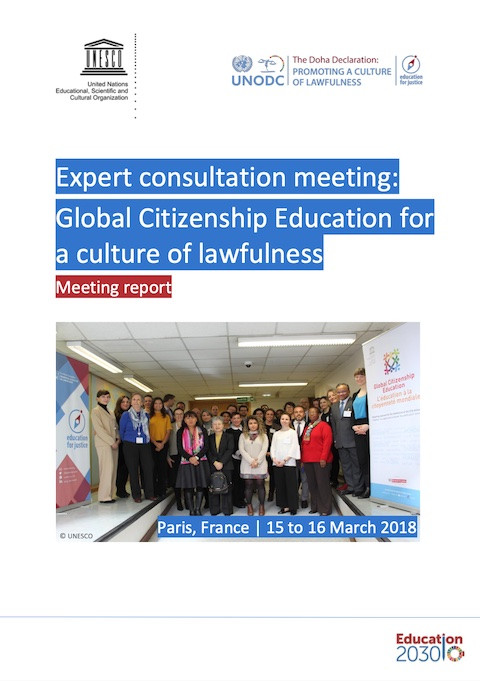 Expert Consultation Meeting: Global Citizenship Education for a Culture of Lawfulness; Meeting Report 발행 연도: 2018 단체 저자: UNESCO | UN. Office on Drugs and Crime (UNODC) In the context of a UNESCO/UNODC partnership on “Global Citizenship Education for a Culture of Lawfulness”, an expert consultation meeting was held in Paris on March 15 and 16 of 2018. The purpose of the partnership is to strengthen the capacities of educational systems to promote the rule of law. To this end, the partnership aims to empower and equip learners to act and engage in society as constructive and ethically responsible agents of change, supporting peace, justice, and strong institutions. This notably contributes to the achievement of the 2030 Agenda for Sustainable Development, and in particular Sustainable Development Goals 4 and 16. Additionally, the partnership intends to enable learners to be both motivated and capable to respond resiliently to crime and violence. The meeting had three broad objectives: To help clarify the conceptual foundation of the partnership; to identify the measures that can be taken in the education sector to promote a culture of lawfulness; and to identify effective educational approaches. Thus, the meeting is meant to elucidate core concepts and identify promising educational approaches in the promotion of a culture of lawfulness by asking fundamental questions, including: What constitutes the rule of law and a culture of lawfulness? How do we create demand for the rule of law? How do we ensure learners apply these principles? How do we ensure they survive in a context where there is no rule of law?
  Social Contract Pedagogy: A Dialogical and Deliberative Model for Global Citizenship Education (Background paper for the Futures of Education initiative) 발행 연도: 2020 저자: Richard Desjardins | Carlos Alberto Torres | Susan Wiksten 단체 저자: UNESCO We propose that together Social Contract Pedagogy (SCP) and Global Citizenship Education (GCE) offer a comprehensive vision including key principles and core elements that are important for rethinking education and shaping the future of the world. We introduce the novel concept of Social Contract Pedagogy (SCP) as a means to adapt the social contract in liberal democracies which has been (conceptually) located at the level of the state, to the level of the classroom and other pedagogically relevant contexts. A key feature of this pedagogy is the negotiation of values and norms in ways that maintain cohesion and inclusion and avoids too much power in the hands of sectarian extremes (of any kind) which tend to impose their views on others, oppress and exclude. This includes using fake news, denying scientific debates and/or any extremely politicized interpretations of evidence and facts to obfuscate or deny consequences of individual and group choices and behavior, but also ‘othering’ of any kind whether from the political right or the political left. In our view, this is an essential premise for the education of democratic citizens. Citizenship education of this kind is seen as essential for the survival and growth of liberal democracies in the future.
  Survey on Privacy in Media and Information Literacy With Youth Perspectives 발행 연도: 2017 저자: Sherri Hope Culver | Alton Grizzle 단체 저자: UNESCO This report aims to provide conceptual, development and policy recommendations to foster privacy in MIL, while enabling the critical engagement of people, including young women and men, in an environment conducive to sustainable development and to freedom of expression online and offline. It seeks to provide clarity on the complex issue of how MIL and privacy intersect.
 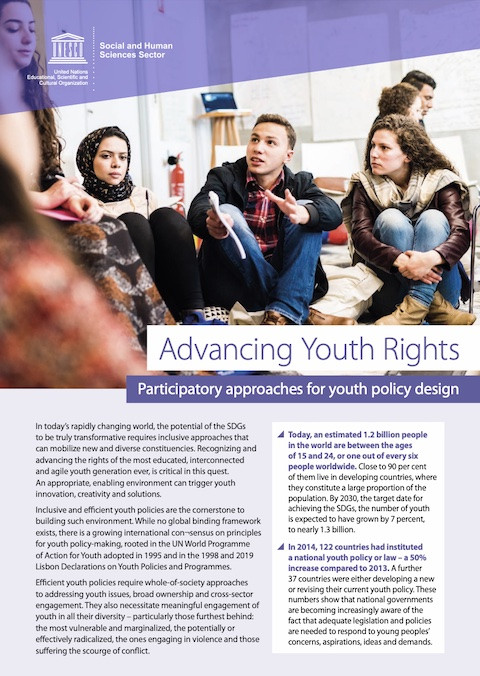 Advancing Youth Rights: Participatory Approaches for Youth Policy Design 발행 연도: 2019 단체 저자: UNESCO Inclusive and efficient youth policies are the cornerstone to building such environment. While no global binding framework exists, there is a growing international con¬sensus on principles for youth policy-making, rooted in the UN World Programme of Action for Youth adopted in 1995 and in the 1998 and 2019 Lisbon Declarations on Youth Policies and Programmes. Efficient youth policies require whole-of-society approaches to addressing youth issues, broad ownership and cross-sector engagement. They also necessitate meaningful engagement of youth in all their diversity – particularly those furthest behind: the most vulnerable and marginalized, the potentially or effectively radicalized, the ones engaging in violence and those suffering the scourge of conflict. Promover los derechos de las personas jóvenes: Enfoques participativos para diseñar políticas de juventud 발행 연도: 2019 단체 저자: Organización de las Naciones Unidas para la Educación, la Ciencia y la Cultura (UNESCO) Para crear este entorno, es esencial contar con políticas públicas de juventud inclusivas y eficientes. Si bien no existe un marco vinculante a nivel mundial, existe un consenso internacional cada vez mayor en lo que respecta a los principios que deben guiar la formulación de políticas de juventud. Dicho consenso dimana del Programa de Acción Mundial de las Naciones Unidas para los Jóvenes, aprobado en 1995, y de las Declaraciones de Lisboa sobre Políticas y Programas relativos a la Juventud de 1998 y 2019. Para que las políticas públicas de juventud sean eficientes, los enfoques deben englobar a toda la sociedad para abordar los problemas de la juventud y contar con una colaboración intersectorial. También se requiere la verdadera participación e inclusión las juventudes en toda su diversidad incluyendo quienes que han quedado atrás: jóvenes en situación de vulnerabilidad, marginado/as, que podrían radicalizarse o ya lo han hecho, que cometen actos violentos y quienes sufren el flagelo de los conflictos. Faire progresser les droits des jeunes: Approches participatives pour la conception des politiques de jeunesse 발행 연도: 2019 단체 저자: Organisation des Nations Unies pour l'éducation, la science et la culture (UNESCO) Des politiques de jeunesse inclusives et efficaces sont la pierre angulaire du développement d’un tel environnement. Bien qu’il n’existe pas de cadre mondial contraignant, il y a un consensus international grandissant sur les principes de l’élaboration des politiques de jeunesse, enracinés dans le Programme d’action mondial des Nations Unies pour la jeunesse, adopté en 1995 et dans les Déclarations de Lisbonne de 1998 et 2019 sur les politiques et programmes en faveur de la jeunesse. Pour être efficaces, les politiques en faveur de la jeunesse doivent s’appuyer sur une approche globale de la société pour traiter les problèmes des jeunes, une large appropriation et un engagement intersectoriel. Elles nécessitent également un engagement significatif envers les jeunes dans toute leur diversité - en particulier envers les plus démunis : les plus vulnérables et marginalisés, ceux qui sont potentiellement ou effectivement radicalisés, ceux qui s’engagent dans la violence et ceux qui souffrent des situations de conflit.
 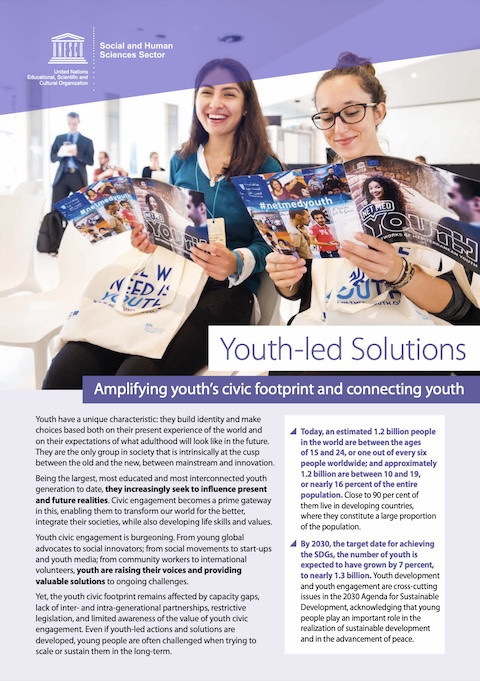 Youth-Led Solutions: Amplifying Youth’s Civic Footprint and Connecting Youth 발행 연도: 2019 단체 저자: UNESCO UNESCO believes in the value of youth civic engagement and youth‐led solutions. In line with our Operational Strategy on Youth (2014‐2021), our approach to meaningfully engaging with youth entails working with youth as change‐makers and partners, and not solely as beneficiaries. We apply cutting‐edge approaches and programmes that contribute to shaping an enabling ecosystem for meaningful, effective and sustainable youth civic engagement.