
자료
세계시민교육에 대한 이해를 넓히고 연구, 옹호 활동, 교수, 학습 등을 향상시킬 수 있는 다양하고 유용한 자료를 찾아보세요.
2,781 건의 결과가 검색되었습니다
 Global education in Lithuania: challenges and opportunities 발행 연도: 2014 저자: Indrė Augutienė | Zina Baltrėnienė 단체 저자: Lithuanian Development Education and Cooperation Network of Non-governmental Institutions (Association LITDEA) | Lithuanian National Non-Governmental Development Cooperation Organisations‘ Platform (NGDO Platform) The publication has been produced implementing the project ‘‘Quality Partnership for Development-EU Presidency project for the Lithuanian EU Presidency, 2013“ (no. DCINSA ED/2013/319-124). Today we live in a constantly changing world which is bound by the spirit of relations between people, countries and cultures and which presents various challenges and opportunities. Every day we have to solve numerous economic, social and environmental issues connecting us with other countries, their cultures and citizens and providing an opportunity for all of us to become part of a global society.In order to accept the opportunities provided by the globalisation processes and cope with the emerging challenges it is necessary to create the conditions for people to acquire the knowledge on global realities, emerging global development problems and to relate them with their own life. It is also important to provide the opportunities for people to acquire the skills and enhance own values facilitating active global citizenship and responsibility. Global problems increasingly impact on the lives of everybody throughout the world, therefore we must realise that we are part of the world with the still prevailing poverty, social inequality, climate change and global warming problems. In the current society it is especially important to ensure that different forms of education enhance people‘s understanding about the above challenges and their impact on personal, communal, national and global development.Global Education is directed toward formation and development of people‘s skills, knowledge and values facilitating understanding and response to the challenges of the 21st century. So far the concept of Global Education was not validated in any national documents. Today non-governmental organisations are actively discussing this issue with the academic society and with the Ministries of Foreign Affairs/and Education and Science representing the state in the above area. Besides, Lithuania has not developed a uniform Global Education strategy yet, but the dimension of Global Education is included in several specific national policy documents. In view of this, this article reviews the prerequisites for integration of global education set forth in the main legal acts defining Lithuania‘s sustainable development, development cooperation and education. This document provides a review of the Global Education concept, prerequisites for its implementation and description of the current situation in Lithuania. It also includes the proposals for a successful development of Global Education activities in our country. Éducation globalein Lithuania: challenges and opportunities 발행 연도: 2014 저자: Indrė Augutienė | Zina Baltrėnienė 단체 저자: Lithuanian Development Education and Cooperation Network of Non-governmental Institutions (Association LITDEA) | Lithuanian National Non-Governmental Development Cooperation Organisations‘ Platform (NGDO Platform) La publication a été réalisée la mise en œuvre du projet « Partenariat Qualité pour le projet de développement de l'UE Présidence de la présidence lituanienne de l'UE, 2013 »(no. DCINSA ED / 2013 / 319-124). Aujourd'hui, nous vivons dans un monde en constante évolution qui est lié par l'esprit des relations entre les peuples, les pays et les cultures, et qui présente divers défis et opportunités. Chaque jour, nous devons résoudre de nombreux problèmes économiques, sociaux et environnementaux qui nous relie avec d'autres pays, leurs cultures et leurs citoyens et de fournir une occasion pour nous tous de faire partie d'une société mondiale. Pour acept les possibilités offertes par les processus de mondialisation et faire face aux nouveaux défis, il est nécessaire de créer les conditions pour les gens à acquérir les connaissances sur les réalités mondiales, les problèmes de développement mondiaux émergents et à les relier à leur propre vie. Il est également important de fournir les possibilités pour les personnes à acquérir les compétences et de renforcer les valeurs propres à faciliter la citoyenneté mondiale active et la responsabilité. Les problèmes mondiaux de plus en plus d'impact sur la vie de tout le monde à travers le monde, nous devons donc réaliser que nous faisons partie du monde avec la pauvreté qui prévaut encore, les inégalités sociales, le changement climatique et les problèmes de réchauffement planétaire. Dans la société actuelle, il est particulièrement important de veiller à ce que les différentes formes d'éducation d'améliorer la compréhension des gens sur les défis ci-dessus et de leur impact sur le développement personnel, communautaire, national et mondial. Éducation globaleis dirigée vers la formation et le développement des compétences, les connaissances des personnes et des valeurs qui facilitent la compréhension et la réponse aux défis du 21e siècle. Jusqu'à présent, le concept de l'éducation globalewas pas validée dans les documents nationaux. Aujourd'hui, les organisations non-gouvernementales discutent activement de cette question avec la société académique et avec les Ministères des Affaires Étrangères / et de l'éducation et de la science représentant l'état dans la zone ci-dessus. Par ailleurs, la Lituanie n'a pas encore mis au point une formation globalestrategy uniforme, mais la dimension de l'éducation globaleis inclus dans plusieurs documents spécifiques de la politique nationale. Compte tenu de cela, cet article examine les conditions préalables à l'intégration de l'éducation globaleset énoncées dans les principaux actes juridiques définissant le développement durable, la coopération au développement et de l'éducation de la Lituanie. Ce document fournit un examen de la globaleconcept Éducation, conditions préalables à sa mise en œuvre et la description de la situation actuelle en Lituanie. Il comprend également les propositions pour un développement réussi d’activités mondiales de l'éducation dans notre pays.
  Rethinking Learning: A Review of Social and Emotional Learning for Education Systems 발행 연도: 2020 저자: Nandini Chatterjee Singh | Anantha Duraiappah 단체 저자: Mahatma Gandhi Institute of Education for Peace and Sustainable Development (MGIEP) This publication titled ‘Rethinking Learning: A Review of Social and Emotional Learning for Education Systems’, published by the UNESCO Mahatma Gandhi Institute of Education for Peace and Sustainable Development (MGIEP) reviews the latest research on Social and Emotional Learning (SEL), its impact on student health and school climate and its transformative role in building happier classrooms. It seeks to inform and impress upon Member States the urgent need to mainstream social and emotional learning in education systems.
  Ensuring High Quality Primary Education for Children from Mobile Populations: A Desk Study 발행 연도: 2017 저자: Stephanie Bengtsson | Caroline Dyer 단체 저자: Educate A Child (EAC) | German Federal Ministry for Economic Cooperation and Development (GIZ) This study focuses on provision for primary school-aged children amongst communities of refugees and Internally Displaced People (IDPs), mobile pastoralists and seasonally migrating workers. For refugee and IDP children, policy, coordination and implementation challenges include: inconsistent ratification and enforcement of conventions and agreements protecting refugees and IDPs; the disproportionate impact of forced displacement on low and middle income countries (LMICs); the lack of a shared agenda among a wide range of stakeholders with differing mandates; and inadequate forced displacement terminology. Promising and emerging policy, coordination and implementation strategies include: expanding existing rights documents and agreements and building policy from the ground up; enshrining forcibly displaced people’s rights to education in national laws and policy; genuine engagement with affected communities; utilising the Education Cluster and other existing multi-stakeholder networks for knowledge sharing and collaboration; and collaborating across sectors to address the needs of the whole child. Financing challenges include: unpredictable and low funding for refugee and IDP education; weak capacity to absorb funds at the national and local level; an over-reliance on short-term financing mechanisms; donor dependence and a lack of funding sustainability; and inappropriate distribution of funds within education programming.
 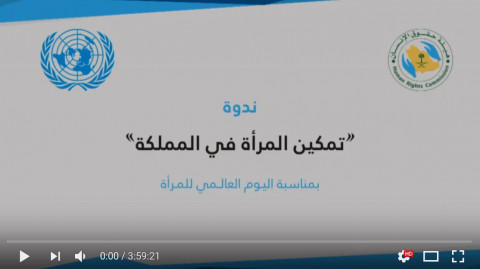 Women Empowerment in Saudi Arabia - Human Rights Commission 발행 연도: 2019 단체 저자: HRCSaudi The symposium on women's empowerment in the Kingdom was held on Thursday, 03/30/1440 H, organized by the Human Rights Commission and in cooperation with the United Nations Office in Riyadh at the Ritz Carlton Hotel.
  When Feeling and Action Come Together in Educational Practice. Relations Between Development Education and Learning Service for a Global Citizenship 발행 연도: 2016 저자: Yolanda Fernández Carrión | Mª Jesús Martínez Usarralde The difficulties based on the development are a usual topic in education. After emphasizing the relevance of the development education as an essential element for the construction of the global citizenship, the challenge stands out by its innovative intention of trying to implicate it with service learning. This one tries to be an explorative and interpretative theoretic analyses about the potentialities which can be provided by service learning in the achievement of the objectives planned by the development education. This correlation not only affects the substantial improvement of both practices by building positive synergies but also its universalization forms a clear positive influence in the endogenous development of the village people, carrying out the real empowerment of the critical, sensible and global citizenship. The possibility of giving the main role as a human developmental engine to education is within our reach and the union between development education and service learning teaches us the keys. Cuando sentimiento y acción confluyen en la práctica educativa. Alianzas entre educación para el desarrollo y aprendizaje servicio para una ciudadanía global 발행 연도: 2016 저자: Yolanda Fernández Carrión | Mª Jesús Martínez Usarralde Las problemáticas basadas en el desarrollo constituyen un tema recurrente en educación. Tras resaltar la relevancia de la Educación para el Desarrollo (EpD) como elemento fundamental en la construcción de una ciudadanía global, el objetivo de este artículo consiste en relacionarla con una cultura educativa, el Aprendizaje Servicio (ApS). Éste pretende ser, así, un análisis teórico exploratorio e interpretativo sobre las potencialidades que puede aportar el ApS en la consecución de las metas planteadas por la EpD. Esta vinculación no sólo repercute en la mejora substancial de la práctica de ambas creando sinergias positivas, sino que su universalización constituye una clara incidencia positiva en el desarrollo endógeno de los pueblos, llevando a la práctica el empoderamiento real de la ciudadanía crítica, reflexiva y global. La posibilidad de otorgar el papel relevante que posee la educación como motor de desarrollo humano está a nuestro alcance: la alianza entre EpD y APS nos muestran las claves.
 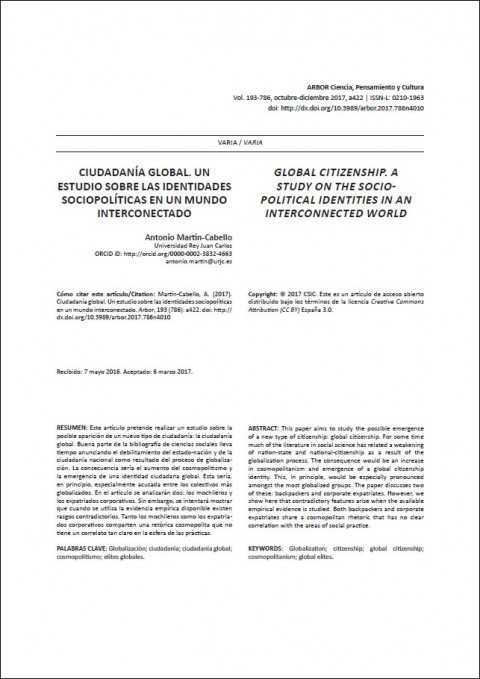 Global Citizenship: A Study on the Socio-political Identities in an Interconnected World 발행 연도: 2017 저자: Antonio Martín-Cabello This paper aims to study the possible emergence of a new type of citizenship: global citizenship. For some time much of the literature in social science has related a weakening of nation-state and national-citizenship as a result of the globalization process. The consequence would be an increase in cosmopolitanism and emergence of a global citizenship identity. This, in principle, would be especially pronounced amongst the most globalized groups. The paper discusses two of these: backpackers and corporate expatriates. However, we show here that contradictory features arise when the available empirical evidence is studied. Both backpackers and corporate expatriates share a cosmopolitan rhetoric that has no clear correlation with the areas of social practice. Ciudadanía global. Un estudio sobre las identidades sociopolíticas en un mundo interconectado 발행 연도: 2017 저자: Antonio Martín-Cabello Este artículo pretende realizar un estudio sobre la posible aparición de un nuevo tipo de ciudadanía: la ciudadanía global. Buena parte de la bibliografía de ciencias sociales lleva tiempo anunciando el debilitamiento del estado-nación y de la ciudadanía nacional como resultado del proceso de globalización. La consecuencia sería el aumento del cosmopolitismo y la emergencia de una identidad ciudadana global. Esta sería, en principio, especialmente acusada entre los colectivos más globalizados. En el artículo se analizarán dos: los mochileros y los expatriados corporativos. Sin embargo, se intentará mostrar que cuando se utiliza la evidencia empírica disponible existen rasgos contradictorios. Tanto los mochileros como los expatria- dos corporativos comparten una retórica cosmopolita que no tiene un correlato tan claro en la esfera de las prácticas.
  What is Global Citizenship? 발행 연도: 2017 단체 저자: Spanish Agency for International Development Cooperation (AECID) | Spain. Ministry of Education, Culture and Sport Inteviews carried out to experts that participated in a debate regarding global citizenship during the V National Teachers' Meeting for development. Coordinated by AECID and MECD (Spain).