
자료
세계시민교육에 대한 이해를 넓히고 연구, 옹호 활동, 교수, 학습 등을 향상시킬 수 있는 다양하고 유용한 자료를 찾아보세요.
518 건의 결과가 검색되었습니다
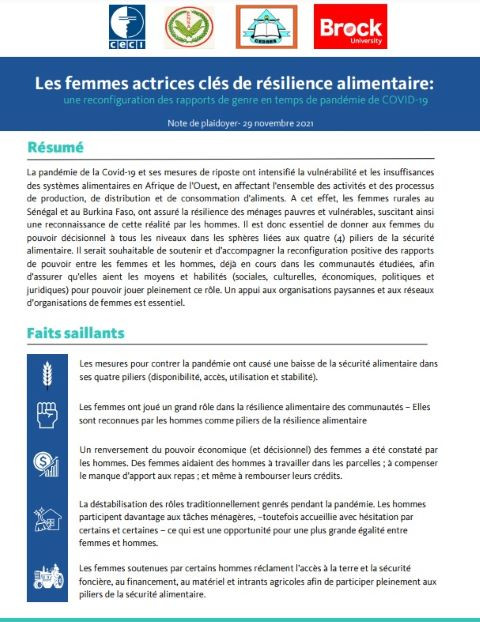 Women Key Actors of Food Resilience: A Reconfiguration of Gender Relations in Times of the COVID-19 Pandemic 발행 연도: 2021 단체 저자: Centre for International Cooperation and Study (CECI) The Covid-19 pandemic and its response measures have intensified the vulnerability and shortcomings of food systems in West Africa, affecting all activities and processes of production, distribution, and consumption of food. To this end, rural women in Senegal and Burkina Faso, ensured the resilience of poor and vulnerable households, thus generating recognition of this reality by men. It is therefore essential to give women decision-making power at all levels in the spheres related to the four pillars of security eating. It would be desirable to support and accompany the positive reconfiguration of relationships of power between women and men, already in progress in the communities studied, to ensure that they have the means and skills (social, cultural, economic, political, and legal) to be able to fully play this role. Support for farmer organizations and networks of women's organizations is essential. Les femmes actrices clés de résilience alimentaire: Une reconfiguration des rapports de genre en temps de pandémie de COVID-19 발행 연도: 2021 단체 저자: Centre for International Cooperation and Study (CECI) La pandémie de la Covid-19 et ses mesures de riposte ont intensifié la vulnérabilité et les insuffisances des systèmes alimentaires en Afrique de l’Ouest, en affectant l'ensemble des activités et des processus de production, de distribution et de consommation d'aliments. A cet effet, les femmes rurales au Sénégal et au Burkina Faso, ont assuré la résilience des ménages pauvres et vulnérables, suscitant ainsi une reconnaissance de cette réalité par les hommes. Il est donc essentiel de donner aux femmes du pouvoir décisionnel à tous les niveaux dans les sphères liées aux quatre (4) piliers de la sécurité alimentaire. Il serait souhaitable de soutenir et d’accompagner la reconfiguration positive des rapports de pouvoir entre les femmes et les hommes, déjà en cours dans les communautés étudiées, afin d'assurer qu'elles aient les moyens et habilités (sociales, culturelles, économiques, politiques et juridiques) pour pouvoir jouer pleinement ce rôle. Un appui aux organisations paysannes et aux réseaux d’organisations de femmes est essentiel.
  Disinformation and Peacebuilding in Sub-saharan Africa: Security Implications of AI-Altered Information Environments; Research Report 발행 연도: 2024 저자: Eduardo Albrecht | Eleonore Fournier-Tombs | Rebecca Brubaker 단체 저자: United Nations University | Interpeace This report aims to further explore the way in which AI technologies as they currently stand impact peace and conflict, and what methods might be used to mitigate their adverse effects - through the development of better tools and the inclusion of peace and conflict considerations in AI governance frameworks. The report proposes the following recommendations: 1. More funding and support should be provided to civil society organization efforts to expand media literacy and fact-checking initiatives using AI tools to enhance capabilities. 2. Governments need to work with civil society to develop and implement comprehensive, transparent legal frameworks combating disinformation. These legislative measures need to support digital and media literacy campaigns and fact-checking organizations. 3. Social media companies need to expand investment and research into understanding local information environments, so they can better identify and respond to instances of disinformation in all contexts in which they operate and enhance transparency. 4. Peacebuilding organizations need to carefully consider local media ecosystems and information environments when conducting conflict analyses, and factor these dynamics into their projects' frameworks.
  Transformative pedagogy for learning to live together in Southern Africa: a practical guide 발행 연도: 2022 단체 저자: UNESCO International Institute for Capacity-Building in Africa (IICBA) IntroductionEducation is a powerful force for peacebuilding and transformation: it can contribute to changing individuals and communities, promoting a more just and equitable world fostering inclusion, social cohesion and ultimately contributing to creating peaceful societies. Teachers play a central role in the establishment of knowledge, attitudes and values among young people; they also empower them to propose alternative narratives, to engage with their communities and to contribute to building peaceful societies through their actions.This work can be done through subject areas, e.g., history, civic and moral education, art, music, sports etc., or through dedicated subjects. In any case, there is a need to equip teachers with specific skills and knowledge and this guide can also be used in science subjects.This work cannot begin or take place in the school environment only. It is important to establish a continuum between the school and its surrounding environment. This requires knowledge of the local context and mobilization of organizations and/or community stakeholders. All these aspects are building blocks of transformative pedagogy, which is the central element of this Guide. Chapter One provides concrete elements of analysis to help understand violence and its root causes in the SADC region and to identify prevention strategies. Chapter Two discusses the importance of education, highlighting key elements that contribute to education for peace building and transformation. Chapter Three focuses on the importance of fostering ethical reflections as spaces for dialogue and identity building to develop a sense of purpose and belonging. Chapter Four provides concrete approaches for teachers to adopt Transformative Pedagogy .Chapter Five highlights core competences for Learning to Live Together understood as the combination of knowledge, skills and attitudes essential to promote mutual understanding and social cohesion (the core competencies presented do not constitute an exhaustive list). Chapter Six discusses learners empowerment and participation in community engagement, equipping teachers with concrete tools and approaches to support learners as active change-makers to transform their communities. Chapter seven focuses on assessment as a key component of the transformative learning process allowing both teachers and learners to self-reflect, make connections, understand where they are in the learning process, how they arrived there and what questions they may still have. Chapter Eight introduces concrete activities for learners that can inspire teachers, as well as provide some ideas of initiatives that can be organised. A table at the beginning of Chapter Eight connects the relevant contents of the Guide with each activity presented.
 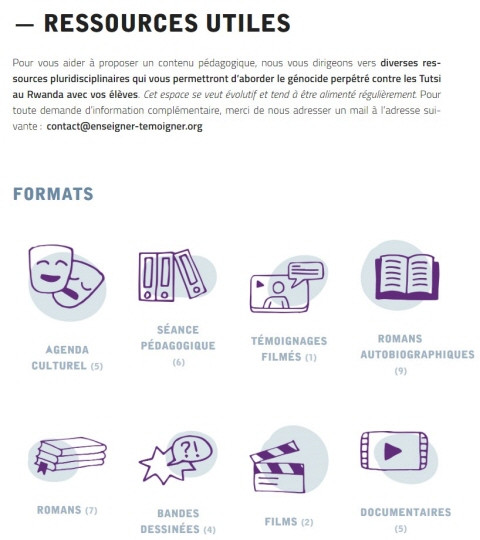 Enseigner Témoigner 발행 연도: 2024 단체 저자: Ligue de l'enseignement, Fédération de Paris & Ibuka France En 1994, environ 1 million de Tutsi ont été tués au Rwanda. Le génocide perpétré contre les Tutsi au Rwanda constitue l’une des principales tueries du XXème siècle. Elle a été rendue possible par l’action d’extrémistes qui ont, pendant des années, attisé la haine anti-tutsi au sein de la population rwandaise à coup de préjugés, de fausses informations, d’accusations en miroir, de stratégie de manipulation et de conditionnement des esprits à la peur, à la haine et à la violence meurtrière.Avec l’inscription récente de son enseignement dans les programmes scolaires, de plus en plus d’enseignants travaillent avec leurs élèves sur cet événement majeur de l’histoire du XXème siècle. Parallèlement, des rescapés ressentent le besoin de témoigner pour partager leur histoire avec la jeune génération et prévenir ainsi les mécanismes qui ont rendu ce drame possible. Dans ce contexte, l’association Ibuka France et la Ligue de l’enseignement engagent une action commune pour proposer un accompagnement dans l’organisation et la gestion pédagogique d’une rencontre avec un témoin-rescapé en classe. Cet accompagnement vise à créer un cadre à la fois utile et sécurisant pour l’ensemble des acteurs engagés et impactés par le témoignage en classe. In 1994, around 1 million Tutsis were killed in Rwanda. The genocide perpetrated against the Tutsis in Rwanda is one of the major killings of the twentieth century. It was made possible by the actions of extremists who, for years, stirred up anti-Tutsi hatred among the Rwandan population by means of prejudice, false informations, mirror-image accusations, a strategy of manipulation and the conditioning of minds to fear, hatred and murderous violence.With the recent inclusion of the subject in school curricula, more and more teachers are working with their pupils on this major event in the history of the 20th century. At the same time, survivors are feeling the need to share their stories with the younger generation and prevent the mechanisms that made this tragedy possible. Against this backdrop, Ibuka France and the Ligue de l'enseignement have joined forces to offer support in organising and managing a meeting with a survivor-witness in the classroom. The aim of this support is to create a framework that is both useful and reassuring for all those involved and affected by the testimonial in the classroom.
 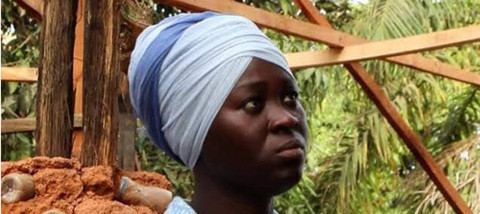 《专题报道》互联网把人口贩运受害者“救出火坑” ——一位幸存者的讲述 발행 연도: 2022 단체 저자: 联合国 本专题报道中,一位曾经被贩卖的冈比亚女士讲述了自己被贩卖以及获救的经历,揭露人口贩卖问题的普遍性与严重性,并谈及互联网如何可能帮助受害者摆脱人口贩运的厄境。
  Education Investments in Middle East, Eastern and Southern Africa: Gaps & Opportunities Towards Sustainable Financing Beyond GPE Commitments 발행 연도: 2022 단체 저자: Plan International To achieve the goals of the global and continental agendas of repositioning access, equity, quality education and skills development as key drivers of inclusive growth and sustainable development, African governments must provide a level of predictable and sustainable investment in education. With these strategic investments, African countries can change the status quo, accelerate the pace of catching up with the developed countries and be able to compete in an increasingly technology and knowledge-based world where skills have become the “global currency of the 21st century”. Plan International in Middle East, Eastern and Southern Africa commissioned a study to assess the extent to which the Education Sector budget is adequate, gender-responsive and inclusive and to analyse education budget trends between 2019 and 2021. The focus was to generate concrete evidence regarding trends in education sector budget allocations and expenditure. Furthermore, due to the recent pandemic, the study aimed to compare current and previous allocations to detect trends/patterns in allocations and any reallocations due to COVID-19. Specifically, the study sought to: Analyse allocations (and expenditure) to the education sector with a particular focus on initiatives aimed at supporting the provision of gender-responsive and disability-inclusive education in line with the country policies; Assess the efficiency of resource allocation and use against planned expenditure; and Recommend effective strategies for CSOs and citizens to advocate for education budget increase to or above 20% of the national budget and 6% of GDP. The study focused on 10 countries in the region – Kenya, Uganda, Zambia, Malawi, Zimbabwe, South Sudan, Tanzania, Egypt, Somalia and Rwanda. With a multi-pronged research process of budget tracking and analysis, policy analysis, political economy analysis and varied data collection methods – the research findings and recommendations are ready for wider dissemination and use.
 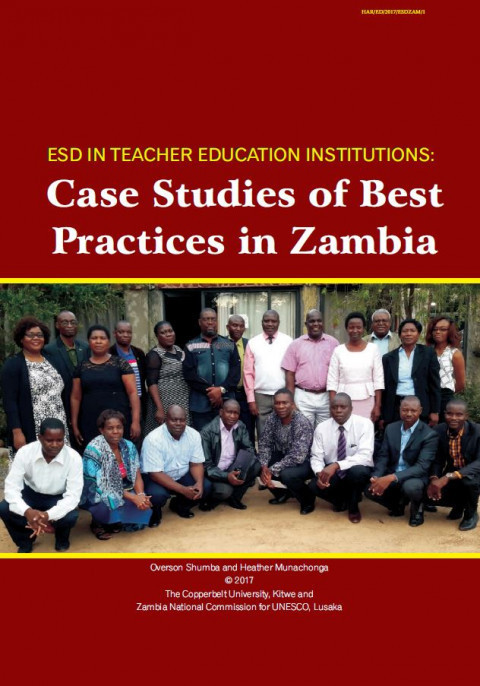 ESD in Teacher Education Institutions: Case Studies of Best Practices in Zambia 발행 연도: 2017 저자: Overson Shumba | Heather Munachonga 단체 저자: Zambia National Commission for UNESCO | Copperbelt University This book is a compilation of case studies on best practices in education for sustainable development in teacher education institutions in Zambia. It contributes to the dissemination of the best practices among the institutions and the wider society. It adds to examples of practices that are relevant to the UNESCO Global Action Programme on Education for Sustainable Development (GAP). The project was coordinated by Professor Overson Shumba at the Copperbelt university in Kitwe and Heather Munachonga, Programme Officer at the Zambia National Commission for UNESCO in Lusaka. The book was made possible with funding and support from UNESCO, Paris, the Ministry of General Education, the Copperbelt University, and the Zambia National Commission for UNESCO. All the institutions were supported by the teacher education institutions and their partners. The book illustrates some of the actions undertaken consistent with pursuit of the education SDG4 target 7. It is expected that this book will lead teacher educators and teachers to come up with further innovations and to integrate them in their professional work. Whole institution actions are encouraged so that best practices as found in this book can permeate and transform all aspects of the institution: the curriculum, teaching, assessment, research, extra-curricular activities, and operations, and must involve everyone, students, workers, lecturers, and the surrounding community.
  SDG 4 Data Digest 2018: Data to Nurture Learning 발행 연도: 2018 단체 저자: UNESCO Institute for Statistics (UIS) The world is facing a crisis of learning, with many children leaving school without the basic skills they need for a prosperous and productive adult life. Two-thirds of the estimated 617 million children and adolescents who cannot read a simple sentence or manage a basic mathematics calculation are in the classroom. Too many are waiting for a quality education that never comes.As the 2018 SDG 4 Data Digest shows, it is not enough to hope that they will stay in school and somehow acquire skills in reading and mathematics. It is critical to monitor those skills as children progress through school. That requires comparable data, over time, to ensure that children – and the education systems that serve them – are on track.Given the critical importance of learning for the achievement of all the Sustainable Development Goals (SDGs), from poverty reduction to peaceful societies, this year’s edition of the SDG 4 Data Digest is dedicated to the theme of learning outcomes. It showcases the most comprehensive and up-to-date compilation of work to inform the learning indicators of SDG 4.The Digest discusses learning evidence on early child development, mathematics and reading skills among school-aged children, and digital and work-related skills among youth and adults. It highlights the conceptual frameworks and tools developed by leading authors and institutions to understand, measure, monitor and support learning for all. It also considers the implications of reporting for SDG 4. ЦУР 4 Дайджест данных 2018: данные для обучения 발행 연도: 2018 단체 저자: UNESCO Institute for Statistics (UIS) Мир сталкивается с кризисом обучения, когда многие дети покидают школу без базовых навыков, необходимых для процветающей и продуктивной взрослой жизни. Две трети из примерно 617 миллионов детей и подростков, посещающих школу, не могут прочитать простое предложение или произвести элементарные математические вычисления. При этом качественное образование для очень многих продолжает оставаться недоступным.Как показывает Дайджест данных ЦУР 4 2018 года, недостаточно просто надеяться, что они, оставаясь в школе, каким-то образом приобретут навыки чтения и математики. Очень важно следить за развитием этих навыков по мере того, как дети учатся в школе. Сопоставление данных с течением времени является необходимым фактором, гарантирующим, что дети и системы образования, которые их обслуживают, находятся на правильном пути.Учитывая исключительную важность обучения для достижения всех Целей в области устойчивого развития (ЦУР), от сокращения бедности до мирных обществ, выпуск Дайджеста данных ЦУР 4 в этом году посвящен теме результатов обучения. Он демонстрирует наиболее полную и актуальную подборку работ для информирования об учебных показателях ЦУР 4.В Дайджесте обсуждаются фактические данные о раннем развитии детей, математике и навыках чтения среди детей школьного возраста, а также трудовые навыки и навыки работы с цифровыми технологиями среди молодежи и взрослых. В нем освещаются концептуальные основы и инструменты, разработанные ведущими авторами и учреждениями для понимания, измерения, мониторинга и поддержки обучения для всех. В нем также рассматриваются результаты отчетности для ЦУР 4.