
자료
세계시민교육에 대한 이해를 넓히고 연구, 옹호 활동, 교수, 학습 등을 향상시킬 수 있는 다양하고 유용한 자료를 찾아보세요.
2,781 건의 결과가 검색되었습니다
 ¿Qué es la ciudadanía global? 발행 연도: 2017 단체 저자: Agencia Española de Cooperación Internacional para el Desarrollo (AECID) | Ministerio de Educación, Cultura y Deporte (España) Entrevistas realizadas a los expertos que colaboraron en la mesa de debate sobre Ciudadanía global llevada a cabo durante la realización del V Encuentro nacional de Docentes para el desarrollo: creando redes coordinada por la AECID y el MECD.
  Promoting Global Citizenship in the Chilean Classrooms 발행 연도: 2016 저자: Cinzia Bizama Borotto | Nicolás Lobo Carrasco This article focuses on the analysis and clarification of the term "global citizenship". For this, different ways in which this concept is applied in canadian classrooms is analysed while suggesting ways of integrating it in chilean classrooms bearing in mind the educational history of the country and the benefits this would bring not only for teachers and students, but also for families, educational institutions and the country itself. La enseñanza de una ciudadanía global en el aula chilena 발행 연도: 2016 저자: Cinzia Bizama Borotto | Nicolás Lobo Carrasco En este artículo se busca analizar y aclarar el termino “ciudadanía global”. Para esto se sugieren maneras en que este concepto aplicado en aulas canadienses puede ser integrado a la sala de clases chilena, tomando en cuenta los antecedentes educacionales del país y los posteriores beneficios que su uso traería no solo para docentes y los alumnos, sino que también para los padres, las instituciones educacionales y el país como tal.
  Education for Global Citizenship in Colombia: Opportunities and Challenges 발행 연도: 2018 저자: Nicolás AguilAr Forero | Ana María Velásquez This article seeks to contribute to the critical analysis of education for global citizenship in Colombia, as a concept and strategy still under construction. First, the article reflects on four focuses that describe the debates on the strategy. Then it analyzes the opportunities for implementation, especially those associated with the peace agreement between Colombia’s government and revolutionary armed forces, and with the characteristics of a decentralized educational system. To conclude, the study presents the challenges linked to the nation’s political polarization and the need to strengthen education for environmental protection, sexual diversity and gender studies, and the construction of democracy. Educación para la ciudadanía mundial en Colombia. Oportunidades y desafíos 발행 연도: 2018 저자: Nicolás AguilAr Forero | Ana María Velásquez El presente artículo busca contribuir al análisis crítico sobre la educación para la ciudadanía mundial en Colombia, como concepto y estrategia aún en construcción. En primer lugar, expone una reflexión sobre cuatro enfoques que dan cuenta de los debates sobre dicha estrategia. Posteriormente, analiza las oportunidades de su implementación, asociadas especialmente al acuerdo de paz entre el gobierno y las Fuerzas Armadas Revolucionarias de Colombia, así como a las característi- cas de un sistema educativo descentralizado. Finalmente, el trabajo presenta los desafíos ligados, entre otros, a la polarización política del país y a la necesidad de fortalecer la educación para la protección ambiental, la diversidad sexual y de género, y la construcción de democracia.
  Citizenship and Development in the XXI Cities: Polis and Civitas or Just Urbs? 발행 연도: 2016 저자: Joselito Fernández Tapia The article aims to determine the problems of the city as polis, civitas and urbs, to identify its characteristics and emphasize the serious problem that means the centrality of the urbs in the modern city. It analyzes aspects of public space, citizenship and city, as interrelated, recovering from urban studies, political and social analysis of the city, to better characterize their problems. From the literature and existing studies we found that civitas and polisare in crisis, and reduced danger of disappearing, to result in a urbs, utilitarian and less and less symbolic value. The result is poverty, greater inequality and social fragmentation, fear, insecurity, isolation, weakening of the civitas and polis, disenfranchisement, depoliticization and dehumanization; against the hegemonic and development of real estate market. It is concluded that dominates the urbs, which, as all the problems of the city needs to be rethought from the civitas and polis. Ciudadanía y desarrollo en las ciudades del siglo XXI: ¿polis y civitas o sólo urbs? 발행 연도: 2016 저자: Joselito Fernández Tapia El artículo tiene por objetivo determinar la problemática de la ciudad como polis, civitas y urbs, para identificar sus características y enfatizar el grave problema que significa la centralidad de la urbs en la ciudad moderna. Analiza los aspectos del espacio público, la ciudadanía y la ciudad de forma interrelacional; recupera los estudios desde el análisis urbanístico, político y social de la ciudad para caracterizar mejor la problemática de ésta. A partir de la reflexión teórica y los estudios existentes se encuentra que civitas y polis están en crisis, reducidas y en peligro de desaparición para dar lugar a una urbs utilitaria y con cada vez menos valor simbólico. El resultado de ello es pobreza, mayores desigualdades y fragmentación social; miedo, inseguridad, aislamiento, debilitamiento de la civitas y de la polis como proceso de desciudadanización, despolitización y deshumanización frente a la urbanización hegemónica de las inmobiliarias y el mercado. En conclusión, la urbs es dominante, por tanto, así como la problemática de la ciudad necesita repensarse desde la civitas y la polis.
 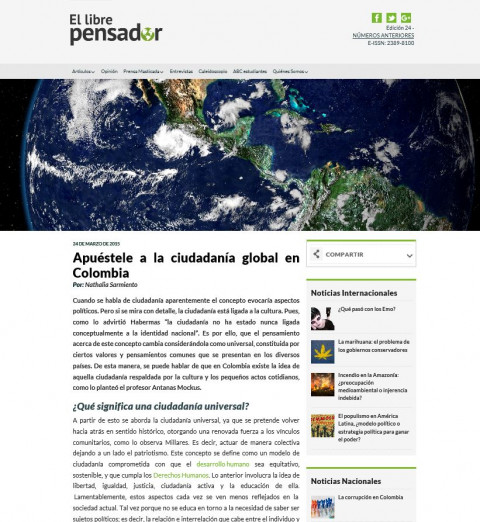 Bring Global Citizenship in Colombia 발행 연도: 2015 저자: Nathalia Sarmiento The blog from the Universidad Extremado from Colombia defines what global citizenship is and its ideals, and promotes a citizenship of this type for Colombia. It states that a humanistic and universal perspective, committed with human development, will foster greater liberty, equality, justice, an active citizenship and the education that goes with it. Apuéstale a la ciudadanía global en Colombia 발행 연도: 2015 저자: Nathalia Sarmiento El blog de la Universidad Externado de Colombia define lo que es la ciudadanía global y sus cometidos, y propone una ciudadanía de este tipo para Colombia. Asegura que desde una perspectiva humanista y universal, comprometida con el desarrollo humano, promoverá mayor libertad, igualdad, justicia, ciudadanía activa y la educación de ella.
 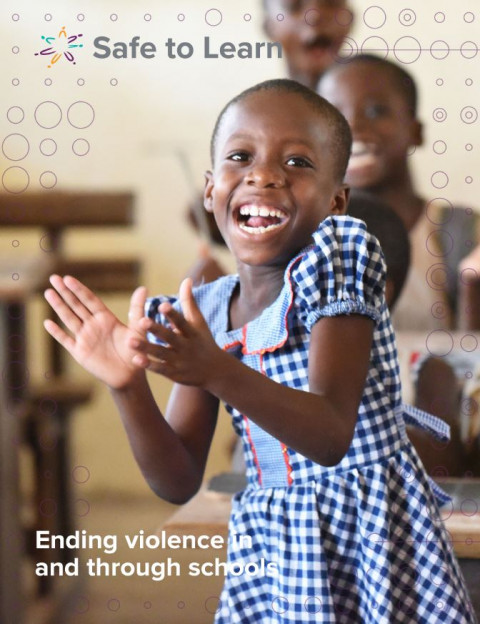 Safe to Learn: Ending Violence in and Through Schools 발행 연도: 2019 단체 저자: End Violence Against Children Safe to Learn – is an initiative dedicated to ending violence in and through schools so children are free to learn, thrive and pursue their dreams. Safe to Learn presents an opportunity to unlock the multiple win of ending violence in schools, improving learning outcomes, better leveraging investments in education, and raising awareness and change attitudes towards violence against children. To date, 11 countries have endorsed Safe to Learn’s Call to Action, which sets out in high-level terms what needs to happen to end violence in schools. These countries include Cambodia, Georgia, Ghana, Honduras, Mexico, Moldova, Nepal, Sierra Leone, South Africa, South Sudan, Uganda and El Salvador.