
자료
세계시민교육에 대한 이해를 넓히고 연구, 옹호 활동, 교수, 학습 등을 향상시킬 수 있는 다양하고 유용한 자료를 찾아보세요.
3,227 건의 결과가 검색되었습니다
 The Importance of Environmental Accounting in the Sustainability of Development 발행 연도: 2013 저자: Jamila aljawzii 단체 저자: Kasdi Merbah University The trend towards disclosure of environmental performance and the introduction of environmental accounting within the general framework of the accounting system has increased as a result of the concern of government and civil organizations for the environment and sustainable development, and the pressure exerted by international, professional and academic bodies on institutions and countries on the environment and the need to protect and develop them through the adoption of the concept of sustainable development. In this context, this paper explains the importance of environmental accounting for sustainable development through the following elements: - Sustainable development. - Environmental accounting. - The role of environmental accounting in sustainable development.
  2019 Arab Region SDG Index and Dashboards Report 발행 연도: 2019 저자: Lara Dahan 단체 저자: Emirates Diplomatic Academy (EDA) | Sustainable Development Solutions Network (SDSN) The Arab Region SDG Index and Dashboards are intended as a tool for governments and other stakeholders to measure progress on the Sustainable Development Goals (SDGs), and to highlight gaps in both implementation and data. The 2019 Arab Region SDG Index is the first in its kind and is therefore also intended as a conversation-opener about priority areas, policies and actions.The 2019 Arab Region SDG Index comprises 105 indicators, each of which have an assigned score (0–100) and a traffic light colour (green, yellow, orange, or red) to indicate performance. In addition, arrows indicate trends in progress towards achieving the goals for those indicators where data for multiple years are available.Compared to the Sustainable Development Report 2019, which contains the SDG Index and Dashboards for all UN Member States, the Arab Region Index introduces 30 new indicators that reflect regional priorities and challenges. The selection of these indicators, along with related thresholds, was greatly informed by two rounds of regional expert consultations, which were conducted in May and August 2019 and collected more than 200 comments from more than 40 individuals. The regional Index also removes indicators that are not useful or relevant for the region or where data coverage is currently insufficient.In addition, the 2019 Arab Region Index includes Palestine, which has so far not been included in the global SDG Index reports. It also provides a total SDG achievement score for two countries – Libya and Somalia – that did not receive one in the global Index due to low data availability.
  A Transdisciplinary Biomimetic Perspective on Global Citizenship Education 발행 연도: 2016 저자: Javier Collado Ruano 단체 저자: University of the Andes This paper reflects on the Global Citizenship Edu- cation (GCE) and Sustainable Development Goals (SDGs) discussed in 2015 during the Second UNESCO Forum on Global Citizenship Education in January, the Second Global Education Forum in May and the Millenium Summit in September. The study is supported by a transdisciplinary methodolo- gy and the biomimetic principles in order to streng- then the bonds between education and sustainabili- ty. As a result, this research identifies the operational principles that constitute the interdependence of ecosystems in order to make a biomimetic imple- mentation in the social, political and educational structure in human systems. To conclude, three pro- posals to achieve SDGs are given. Una perspectiva transdisciplinar y biomimética de la educación para la ciudadanía mundial 발행 연도: 2016 저자: Javier Collado Ruano 단체 저자: University of the Andes El presente artículo reflexiona sobre la Educación para la Ciudadanía Mundial (ECM) y los Objetivos de Desarrollo Sostenible (ODS) discutidos en 2015 durante el 2o Foro de la UNESCO de ECM de enero, el 2o Foro Mundial de Educación de mayo y la Cumbre del Milenio de septiembre. El estudio se apoya en la metodología transdisciplinar y el principio de biomímesis con el propósito de reforzar los lazos entre la educación y la sostenibilidad. Como resultado, el trabajo identifica los principios operacionales que constituyen la interdependencia de los ecosistemas para hacer una aplicación biomimética en las estructuras sociales, políticas y educativas de los sistemas humanos. Para concluir, se realizan tres propuestas para contribuir a alcanzar los ODS.
  Education for Global Citizenship in Colombia: Opportunities and Challenges 발행 연도: 2018 저자: Nicolás AguilAr Forero | Ana María Velásquez This article seeks to contribute to the critical analysis of education for global citizenship in Colombia, as a concept and strategy still under construction. First, the article reflects on four focuses that describe the debates on the strategy. Then it analyzes the opportunities for implementation, especially those associated with the peace agreement between Colombia’s government and revolutionary armed forces, and with the characteristics of a decentralized educational system. To conclude, the study presents the challenges linked to the nation’s political polarization and the need to strengthen education for environmental protection, sexual diversity and gender studies, and the construction of democracy. Educación para la ciudadanía mundial en Colombia. Oportunidades y desafíos 발행 연도: 2018 저자: Nicolás AguilAr Forero | Ana María Velásquez El presente artículo busca contribuir al análisis crítico sobre la educación para la ciudadanía mundial en Colombia, como concepto y estrategia aún en construcción. En primer lugar, expone una reflexión sobre cuatro enfoques que dan cuenta de los debates sobre dicha estrategia. Posteriormente, analiza las oportunidades de su implementación, asociadas especialmente al acuerdo de paz entre el gobierno y las Fuerzas Armadas Revolucionarias de Colombia, así como a las característi- cas de un sistema educativo descentralizado. Finalmente, el trabajo presenta los desafíos ligados, entre otros, a la polarización política del país y a la necesidad de fortalecer la educación para la protección ambiental, la diversidad sexual y de género, y la construcción de democracia.
 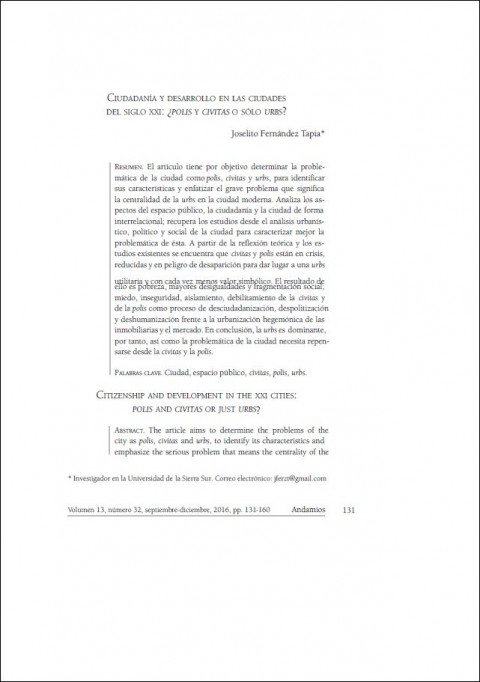 Citizenship and Development in the XXI Cities: Polis and Civitas or Just Urbs? 발행 연도: 2016 저자: Joselito Fernández Tapia The article aims to determine the problems of the city as polis, civitas and urbs, to identify its characteristics and emphasize the serious problem that means the centrality of the urbs in the modern city. It analyzes aspects of public space, citizenship and city, as interrelated, recovering from urban studies, political and social analysis of the city, to better characterize their problems. From the literature and existing studies we found that civitas and polisare in crisis, and reduced danger of disappearing, to result in a urbs, utilitarian and less and less symbolic value. The result is poverty, greater inequality and social fragmentation, fear, insecurity, isolation, weakening of the civitas and polis, disenfranchisement, depoliticization and dehumanization; against the hegemonic and development of real estate market. It is concluded that dominates the urbs, which, as all the problems of the city needs to be rethought from the civitas and polis. Ciudadanía y desarrollo en las ciudades del siglo XXI: ¿polis y civitas o sólo urbs? 발행 연도: 2016 저자: Joselito Fernández Tapia El artículo tiene por objetivo determinar la problemática de la ciudad como polis, civitas y urbs, para identificar sus características y enfatizar el grave problema que significa la centralidad de la urbs en la ciudad moderna. Analiza los aspectos del espacio público, la ciudadanía y la ciudad de forma interrelacional; recupera los estudios desde el análisis urbanístico, político y social de la ciudad para caracterizar mejor la problemática de ésta. A partir de la reflexión teórica y los estudios existentes se encuentra que civitas y polis están en crisis, reducidas y en peligro de desaparición para dar lugar a una urbs utilitaria y con cada vez menos valor simbólico. El resultado de ello es pobreza, mayores desigualdades y fragmentación social; miedo, inseguridad, aislamiento, debilitamiento de la civitas y de la polis como proceso de desciudadanización, despolitización y deshumanización frente a la urbanización hegemónica de las inmobiliarias y el mercado. En conclusión, la urbs es dominante, por tanto, así como la problemática de la ciudad necesita repensarse desde la civitas y la polis.
  Learning to Leapfrog: Innovative Pedagogies to Transform Education 발행 연도: 2019 저자: David Istance | Alejandro Paniagua | Rebecca Winthrop | Lauren Ziegler 단체 저자: Center for Universal Education at Brookings This report follows up on the book “Leapfrogging Inequality: Remaking Education to Help Young People Thrive,” published in 2018 by the Center for Universal Education (CUE) at the Brookings Institution. The book argued the importance of education leapfrogging–creating transformative shifts rather than incremental evolution by harnessing the power of innovation to advance a breadth of skills. The book put forth a framework for leapfrogging that outlined two core elements (teaching and learning, and recognition of learning) and two support elements (people and places, and technology and data).This report focuses on the teaching and learning element of the leapfrog framework, especially on pedagogical approaches and the role of teachers, but draws on the others as relevant. It does not attempt to be exhaustive and does not pretend to address neither all education policy variables, nor critical system factors such as political will and adequate funding, nor demand-side factors such as student and parent support for innovative approaches.
  Education at a Glance 2019: OECD Indicators 발행 연도: 2019 단체 저자: Organisation for Economic Co-operation and Development (OECD) Education at a Glance is the authoritative source for information on the state of education around the world. It provides data on the structure, finances and performance of education systems across OECD countries and a number of partner economies.The 2019 edition includes a focus on tertiary education with new indicators on tertiary completion rates, doctoral graduates and their labour market outcomes, and on tertiary admission systems, as well as a dedicated chapter on the Sustainable Development Goal 4.