
자료
세계시민교육에 대한 이해를 넓히고 연구, 옹호 활동, 교수, 학습 등을 향상시킬 수 있는 다양하고 유용한 자료를 찾아보세요.
2,199 건의 결과가 검색되었습니다
 Basic education curriculum guide: building on strengths (Primary 1 - Secondary 3) 발행 연도: 2002 단체 저자: Curriculum Development Council (Hong Kong) The Basic Education Curriculum Guide – Building on Strengths is prepared by the Curriculum Development Council (CDC) to advise school supervisors, school heads/principals, teachers, parents and those concerned on how to realise both the aims of education (EC, 2000) and the recommendations made in the report on Learning to Learn – The Way Forward in Curriculum Development (CDC, 2001) for life-long learning and the whole-persons development of students. This Guide replaces the Guide to the Primary 1 to 6 Curriculum (CDC, 1993) and the part on junior secondary level of the Guide to the Secondary 1 to 5 Curriculum (CDC, 1993). It aims to provide:• Recommendations of a central curriculum for schools and time allocation which all schools to adopt at primary and junior secondary levels• Suggestions for actions in school curriculum planning, learning and teaching and assessment to improve the quality of education, and for school-based adaptations to build on the strengths of Hong Kong schools as well as to meet the needs of students• Illustrative examples in authentic school contexts• Opportunities for reflection by school heads/principals, teachers and related parties Guide de Programme d'Éducation de Base: construire sur les forces (primaire 1 - secondaire 3) 발행 연도: 2002 단체 저자: Curriculum Development Council (Hong Kong) Guide de Programme d'Éducation de ㅠase - Construire sur les Forces est préparé par le Curriculum Development Council (CDC) pour conseiller les superviseurs scolaires, les directeurs d'école / directeurs, les enseignants, les parents et les personnes concernées sur la façon de réaliser les objectifs de l'éducation (EC, 2000) et les recommandations formulées dans le rapport sur Apprendre à apprendre - Aller de l'avant dans le développement du curriculum (CDC, 2001) pour l'apprentissage à vie et le développement des personnes sistes des étudiants. Ce guide remplace la <cite> Guide du primaire 1 à 6 Curriculum (CDC, 1993) et la partie au niveau secondaire du premier cycle de la balise <cite> Guide du secondaire 1 à 5 Curriculum (CDC, 1993). Il vise à fournir: • Les recommandations d'un programme central pour les écoles et la répartition du temps qui toutes les écoles adoptent à des niveaux primaire et secondaire juniors • Suggestions pour des actions dans la planification des programmes scolaires, l'apprentissage et l'enseignement et l'évaluation pour améliorer la qualité de l'éducation, et pour adaptations scolaires pour construire sur les points forts des écoles de Hong Kong, ainsi que pour répondre aux besoins des élèves • des exemples illustratifs dans des contextes scolaires authentiques • Possibilités de réflexion par les chefs d'établissement / directeurs, les enseignants et les parties liées 基础教育课程指引——各尽所能 发挥所长 (小一至中三) 발행 연도: 2002 단체 저자: Curriculum Development Council (Hong Kong) The Basic Education Curriculum Guide – Building on Strengths is prepared by the Curriculum Development Council (CDC) to advise school supervisors, school heads/principals, teachers, parents and those concerned on how to realise both the aims of education (EC, 2000) and the recommendations made in the report on Learning to Learn – The Way Forward in Curriculum Development (CDC, 2001) for life-long learning and the whole-persons development of students. This Guide replaces the Guide to the Primary 1 to 6 Curriculum (CDC, 1993) and the part on junior secondary level of the Guide to the Secondary 1 to 5 Curriculum (CDC, 1993). It aims to provide:• Recommendations of a central curriculum for schools and time allocation which all schools to adopt at primary and junior secondary levels• Suggestions for actions in school curriculum planning, learning and teaching and assessment to improve the quality of education, and for school-based adaptations to build on the strengths of Hong Kong schools as well as to meet the needs of students• Illustrative examples in authentic school contexts• Opportunities for reflection by school heads/principals, teachers and related parties World citizenship education and teacher training in a global context: Canada, India and South Africa 발행 연도: 2011 저자: George Cappelle | Gary Crippin | Ulla Lundgren 단체 저자: Children's identity and Citizenship in Europe (CICE) In this study we change our focus from a European setting to a global one. We were interested to see how our observations from the first study would be reflected in a more global context with focus on the cases of Canada, India and South Africa looking at both the models for world citizenship education and the influence of contextual factors.In choosing these countries we were interested in:Countries on different continentsCountries in different stages of national, social and economic developmentCountries in which there was considerable diversity in the populationCountries in which citizenship and world citizenship education was seen as an important priorityCountries, because of the limitations of researchers, which used English as a primary language.In addition to background research we asked for assistance from professors in the field of teacher education in the three countries to provide us with information on key questions related to citizenship education and teacher training. Mondiale l'éducation civique et la formation des enseignants dans un contexte mondial: le Canada, l'Inde et l'Afrique du Sud 발행 연도: 2011 저자: George Cappelle | Gary Crippin | Ulla Lundgren 단체 저자: Children's identity and Citizenship in Europe (CICE) Dans cette étude, nous changeons notre objectif d'un cadre européen pour une approche globale. Nous nous sommes intéressés de voir comment nos observations de la première étude serait reflétée dans un contexte plus global en mettant l'aCECnt sur les cas du Canada, l'Inde et l'Afrique du Sud qui cherchent à la fois les modèles pour l'éducation à la citoyenneté mondiale et l'influence des facteurs contextuels. Dans le choix de ces pays, nous étions intéressés à: ● Les pays sur différents continents ● pays à différents stades de développement national, social et économique ● Les pays dans lesquels il y avait une grande diversité dans les populations ● Les pays dans lesquels la citoyenneté et la citoyenneté mondiale l'éducation a été considérée comme une priorité ● importants pays, en raison des limitations des chercheurs, qui ont utilisé l'anglais comme langue principale. Outre la recherche de fond, nous avons demandé l'aide de professeurs dans le domaine de la formation des enseignants dans les trois pays pour nous fournir des informations sur des questions clés liées à l'éducation à la citoyenneté et à la formation des enseignants.
 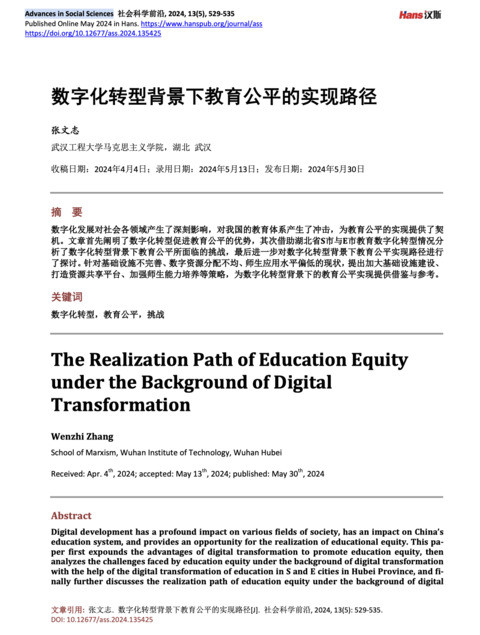 数字化转型背景下教育公平的实现路径 (社会科学前沿 第13卷 第5期) 발행 연도: 2024 저자: 张文志 단체 저자: 汉斯出版社 数字化发展对社会各领域产生了深刻影响,对我国的教育体系产生了冲击,为教育公平的实现提供了契 机。文章首先阐明了数字化转型促进教育公平的优势,其次借助湖北省S市与E市教育数字化转型情况分 析了数字化转型背景下教育公平所面临的挑战,最后进一步对数字化转型背景下教育公平实现路径进行 了探讨。针对基础设施不完善、数字资源分配不均、师生应用水平偏低的现状,提出加大基础设施建设、 打造资源共享平台、加强师生能力培养等策略,为数字化转型背景下的教育公平实现提供借鉴与参考。
 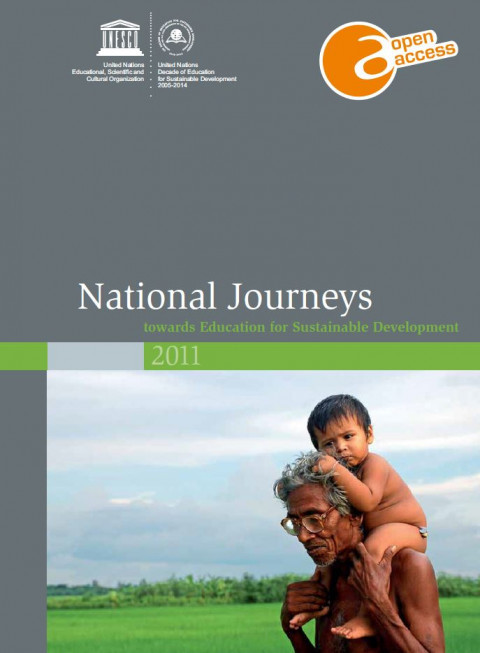 National journeys towards education for sustainable development, 2011: reviewing national experiences from Chile, Indonesia, Kenya, the Netherlands, Oman 발행 연도: 2011 저자: I. Mulà | Daniella Tilbury 단체 저자: UNESCO This publication has sourced information from a series of national reviews commissioned by UNESCO in 2010 and written by authoritative stakeholders in Chile, Indonesia, Kenya, the Netherlands and Oman. The selection of countries was based on: i) work showcased at the 2009 World Conference on Education for Sustainable Development held in Bonn, Germany; ii) submissions to the monitoring and evaluation process for the Decade of Education for Sustainable Development (DESD); as well as iii) through evaluation material submitted by UNESCO staff in regional bureaux of education.The countries showcased in this report are not necessarily the ‘best’ examples of the region, as many other countries are also progressing effectively towards implementing ESD. Rather, the countries selected illustrate the wide diversity of ESD approaches and initiatives taking place in different parts of the learnt world. The national studies were then edited and harmonized before common themes and lessons learned were identified to support other national efforts in moving towards the second half of the UN Decade of Education for Sustainable Development. Education for sustainable development lens: a policy and practice review tool 발행 연도: 2010 단체 저자: UNESCO The Education for Sustainable Development (ESD) Lens has been prepared to support UN Member States to respond to these challenges through implementation of the United Nations Decade of Education for Sustainable Development (DESD, 2005- 2014). The ESD Lens supports the goals of the DESD, and encourages policy-makers and practitioners in Member States to initiate the process of re-orienting education, particularly the formal education system, towards sustainable development. The overall goal of the UN Decade of Education for Sustainable Development (DESD) is for countries to integrate the understandings, skills and values inherent in sustainable development into all aspects of national education plans to encourage changes in lifestyles and behaviour that allow for a more sustainable and just society for all. This complements existing Education for All initiatives, and strengthens the objectives of the Millennium Development Goals. Education for Sustainable Development has the potential to improve the quality and relevance of education everywhere. 지속가능발전교육 렌즈: 정책 및 실행 평가도구 발행 연도: 2013 단체 저자: 유네스코 The Education for Sustainable Development (ESD) Lens has been prepared to support UN Member States to respond to these challenges through implementation of the United Nations Decade of Education for Sustainable Development (DESD, 2005- 2014). The ESD Lens supports the goals of the DESD, and encourages policy-makers and practitioners in Member States to initiate the process of re-orienting education, particularly the formal education system, towards sustainable development. The overall goal of the UN Decade of Education for Sustainable Development (DESD) is for countries to integrate the understandings, skills and values inherent in sustainable development into all aspects of national education plans to encourage changes in lifestyles and behaviour that allow for a more sustainable and just society for all. This complements existing Education for All initiatives, and strengthens the objectives of the Millennium Development Goals. Education for Sustainable Development has the potential to improve the quality and relevance of education everywhere. ESD レンズ政策および実践のためのリビュー・ツール 발행 연도: 2010 단체 저자: UNESCO The Education for Sustainable Development (ESD) Lens has been prepared to support UN Member States to respond to these challenges through implementation of the United Nations Decade of Education for Sustainable Development (DESD, 2005- 2014). The ESD Lens supports the goals of the DESD, and encourages policy-makers and practitioners in Member States to initiate the process of re-orienting education, particularly the formal education system, towards sustainable development. The overall goal of the UN Decade of Education for Sustainable Development (DESD) is for countries to integrate the understandings, skills and values inherent in sustainable development into all aspects of national education plans to encourage changes in lifestyles and behaviour that allow for a more sustainable and just society for all. This complements existing Education for All initiatives, and strengthens the objectives of the Millennium Development Goals. Education for Sustainable Development has the potential to improve the quality and relevance of education everywhere.