
자료
세계시민교육에 대한 이해를 넓히고 연구, 옹호 활동, 교수, 학습 등을 향상시킬 수 있는 다양하고 유용한 자료를 찾아보세요.
3,396 건의 결과가 검색되었습니다
 UNESCO-UNEVOC Study on the Trends Shaping the Future of TVET Teaching (Trends Mapping Studies) 발행 연도: 2020 저자: Gita Subrahmanyam 단체 저자: UNESCO International Centre for Technical and Vocational Education and Training (UNEVOC) This report presents the results of the trends mapping study on the future of technical and vocational education and training (TVET) teaching, conducted by UNESCO-UNEVOC. The study aimed to engage the international TVET community to: (i) improve the understanding of the implications of global disruptions; (ii) gather knowledge, insights, experiences; and (iii) highlight promising practices in preparing TVET teaching staff to deliver the skills needed in the 21st century and beyond. Coordinated by UNESCO-UNEVOC, trends mapping studies aim to further the international community's understandings on contemporary key issues concerning TVET. The studies review existing literature and policies, and engage TVET stakeholders from around the world through surveys and virtual conferences.
  Education in the Time of COVID-19 (COVID-19 Report; ECLAC-UNESCO) 발행 연도: 2020 단체 저자: Economic Commission for Latin America and the Caribbean (ECLAC) | UNESCO Santiago The coronavirus disease (COVID-19) pandemic has caused an unprecedented crisis in all areas. In the field of education, this emergency has led to the massive closure of face-to-face activities of educational institutions in more than 190 countries in order to prevent the spread of the virus and mitigate its impact. The Economic Commission for Latin America and the Caribbean (ECLAC) has argued that even before the pandemic hit, the social situation in the region was deteriorating, owing to rising rates of poverty and extreme poverty, the persistence of inequalities and growing social discontent. In this context, the crisis will have a profoundly negative impact on the various social sectors, particularly health and education, as well as on employment and poverty. Meanwhile, UNESCO has identified major gaps in educational outcomes, which are related to the unequal distribution of teachers in general, and of the best qualified teachers in particular, to the detriment of lower-income countries and regions and of rural areas, where indigenous and migrant populations tend to be concentrated.In the sphere of education, many of the measures that the region’s countries have adopted in response to the crisis are related to the suspension of face-to-face classes at all levels, which has given rise to three main areas of action: the deployment of distance learning modalities through a variety of formats and platforms (with or without the use of technology); the support and mobilization of education personnel and communities; and concern for the health and overall well-being of students.The aim of this document is to shed light on various consequences that these measures will have on educational communities in the short and medium term, and to offer key recommendations on how to manage those consequences in the best possible manner, drawing attention to opportunities for learning and innovation in the post-pandemic education system. La educación en tiempos de la pandemia de COVID-19 (Inform COVID-19; CEPAL-UNESCO) 발행 연도: 2020 단체 저자: Economic Commission for Latin America and the Caribbean (ECLAC) | UNESCO Santiago La pandemia de enfermedad por coronavirus (COVID-19) ha provocado una crisis sin precedentes en todos los ámbitos. En la esfera de la educación, esta emergencia ha dado lugar al cierre masivo de las actividades presenciales de instituciones educativas en más de 190 países con el fin de evitar la propagación del virus y mitigar su impacto.La Comisión Económica para América Latina y el Caribe (CEPAL) ha planteado que, incluso antes de enfrentar la pandemia, la situación social en la región se estaba deteriorando, debido al aumento de los índices de pobreza y de pobreza extrema, la persistencia de las desigualdades y un creciente descontento social. En este contexto, la crisis tendrá importantes efectos negativos en los distintos sectores sociales, incluidos particularmente la salud y la educación, así como en el empleo y la evolución de la pobreza. Por su parte, la UNESCO ha identificado grandes brechas en los resultados educativos, que se relacionan con una desigual distribución de los docentes, en general, y de los docentes mejor calificados, en particular, en desmedro de países y regiones con menores ingresos y de zonas rurales, las que suelen concentrar además a población indígena y migrante.En el ámbito educativo, gran parte de las medidas que los países de la región han adoptado ante la crisis se relacionan con la suspensión de las clases presenciales en todos los niveles, lo que ha dado origen a tres campos de acción principales: el despliegue de modalidades de aprendizaje a distancia, mediante la utilización de una diversidad de formatos y plataformas (con o sin uso de tecnología); el apoyo y la movilización del personal y las comunidades educativas, y la atención a la salud y el bienestar integral de las y los estudiantes.El objetivo de este documento es visibilizar la diversidad de consecuencias que estas medidas tendrán sobre las comunidades educativas a corto y mediano plazo, así como plantear las principales recomendaciones para sobrellevar el impacto de la mejor manera posible, proyectando oportunidades para el aprendizaje y la innovación en la educación posterior a la pandemia.
  How Children Living in Poor Informal Settlements in the Greater Accra Region, Ghana, Perceive Global Citizenship (International Journal of Development Education and Global Learning; Vol. 12, No. 1) 발행 연도: 2020 저자: Jane Leithead | Steve Humble 단체 저자: UCL Press This investigation looks at the antecedents and outcomes of 141 children living in poor informal settlements in the Greater Accra Region of Ghana identifying with global citizenship. It finds that the model of global citizenship devised by Reysen and Katzarska-Miller (2013) is a moderately good fit for this group of children. Structural equation modelling demonstrates that antecedents of global awareness as well as friends and family supporting global citizenship (normative environment) predict the child’s self-identification as a global citizen. This in turn predicts six prosocial traits: intergroup empathy, valuing diversity, social justice, environmental sustainability, intergroup helping and responsibility to act. The research suggests that there may be other elements to a global citizenship model that could be investigated in future research.
  ICT융합교육 글로벌 동향: 초·중등교육 글로벌 동향 (2020년 5호 통권 128호) 발행 연도: 2020 저자: 김민 | 이민주 | 윤환선 단체 저자: 한국교육학술정보원 이 자료는 코로나 19로 인한 학교 폐쇄와 재개에 대한 글로벌동향과 사례를 미주, 유럽, 아시아 등 각 지역별로 나누어 정리하고 학교 재개에 대하여 국제기구가 제시하는 프레임 워크에 대해서 설명하고 있다. 또한 코로나 19에 대응하는 교육대책으로 ICT를 활용한 온라인 교육과 원격 수업에 대한 방안과 현황을 제시한다.
  Development Education in Theory and Practice: An Educator’s Resource 발행 연도: 2016 저자: Michal Cenker | Louiza Hadjivasiliou | Patrick Marren | Niamh Rooney 단체 저자: UNIDEV | NGO Support Centre (Cyprus) | Pontis Foundation (Slovakia) | Kimmage Development Studies Centre (Ireland) This publication has been produced to provide a new teaching resource for academics and educators active in the field of Development Education and related disciplines. It covers twelve themes, each chapter includes both a conceptual overview and a teaching methodology section. The conceptual overview introduces the topic, explores the key concepts, theories and current debates. The teaching methodology section gives educators a set of tools that could help them introduce the topic in both formal and non-formal settings.
  Personalized Learning within Teacher Education: A Framework and Guidelines 발행 연도: 2020 단체 저자: UNESCO International Bureau of Education (IBE) This paper explores the theoretical and practice elements that together inform the concept of personalised learning. These insights are then used to develop a Framework for Personalized Learning within Teacher Education. In addition, the final chapter outlines pedagogical strategies to support the development of personalised learning that were tested during the project within the participating universities.The Framework and Guidelines are intended for use by to teacher educators and their students, as well as by teachers and students in schools, to support the on‐going shift towards a personalised learning and collaborative paradigm which forefronts learner agency and autonomy and encourages learners of all ages to assume increased responsibility for their own learning and achievements.
  The Colourful World of Tomatoes: A Teaching Resource for Primary Schools 발행 연도: 2016 단체 저자: Südwind | Cumbria Development Education Centre(CDEC) This resource allows children from 6 to 10 years to get to know the tomato from different perspectives. All exercises are based on the principle of global learning and are varied, interactive and experience-oriented.Thus it is possible for the children not only to look at this diverse topic from different perspectives, but also to immerse themselves in the tomato world. Activity’ objectives:• The students expand their knowledge about tomatoes and vegetables growing in times of globalisation.• Students learn about unknown types of tomatoes.• They recognise why different varieties are important.
 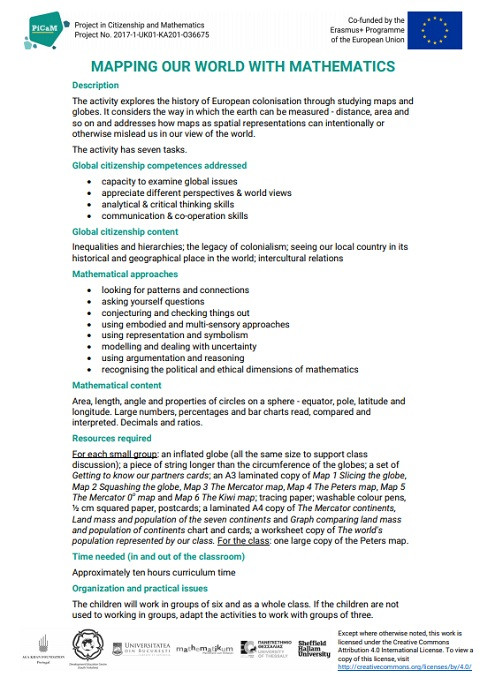 Mapping our World with Mathematics 발행 연도: 2019 단체 저자: Project in Citizenship and Mathematics(PiCaM) | Erasmus+ This activity explores the history of European colonisation through studying maps and globes. It considers the way in which the earth can be measured - distance, area and so on and addresses how maps as spatial representations can intentionally or otherwise mislead us in our view of the world. The activity has seven tasks.
 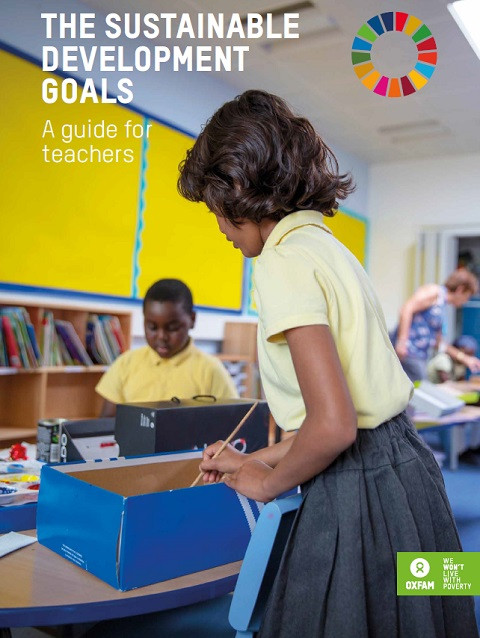 The Sustainable Development Goals: A Guide for Teachers 발행 연도: 2019 단체 저자: Oxfam GB This guide supports teachers and educators working with young people to deepen their understanding of education about and for the SDGs and to see how global citizenship education (GCE) approaches and methodologies can underpin good practice. The guide also explores the benefits and challenges of using the SDG framework with learners in schools.