
자료
세계시민교육에 대한 이해를 넓히고 연구, 옹호 활동, 교수, 학습 등을 향상시킬 수 있는 다양하고 유용한 자료를 찾아보세요.
2,194 건의 결과가 검색되었습니다
 지속가능발전교육 렌즈: 정책 및 실행 평가도구 발행 연도: 2013 단체 저자: 유네스코 The Education for Sustainable Development (ESD) Lens has been prepared to support UN Member States to respond to these challenges through implementation of the United Nations Decade of Education for Sustainable Development (DESD, 2005- 2014). The ESD Lens supports the goals of the DESD, and encourages policy-makers and practitioners in Member States to initiate the process of re-orienting education, particularly the formal education system, towards sustainable development. The overall goal of the UN Decade of Education for Sustainable Development (DESD) is for countries to integrate the understandings, skills and values inherent in sustainable development into all aspects of national education plans to encourage changes in lifestyles and behaviour that allow for a more sustainable and just society for all. This complements existing Education for All initiatives, and strengthens the objectives of the Millennium Development Goals. Education for Sustainable Development has the potential to improve the quality and relevance of education everywhere. ESD レンズ政策および実践のためのリビュー・ツール 발행 연도: 2010 단체 저자: UNESCO The Education for Sustainable Development (ESD) Lens has been prepared to support UN Member States to respond to these challenges through implementation of the United Nations Decade of Education for Sustainable Development (DESD, 2005- 2014). The ESD Lens supports the goals of the DESD, and encourages policy-makers and practitioners in Member States to initiate the process of re-orienting education, particularly the formal education system, towards sustainable development. The overall goal of the UN Decade of Education for Sustainable Development (DESD) is for countries to integrate the understandings, skills and values inherent in sustainable development into all aspects of national education plans to encourage changes in lifestyles and behaviour that allow for a more sustainable and just society for all. This complements existing Education for All initiatives, and strengthens the objectives of the Millennium Development Goals. Education for Sustainable Development has the potential to improve the quality and relevance of education everywhere. La Lente de la educación para el desarollo sostenible: una herramienta para examinar las políticas y la práctica 발행 연도: 2010 단체 저자: Organización de las Naciones Unidas para la Educación, la Ciencia y la Cultura (UNESCO) The Education for Sustainable Development (ESD) Lens has been prepared to support UN Member States to respond to these challenges through implementation of the United Nations Decade of Education for Sustainable Development (DESD, 2005- 2014). The ESD Lens supports the goals of the DESD, and encourages policy-makers and practitioners in Member States to initiate the process of re-orienting education, particularly the formal education system, towards sustainable development. The overall goal of the UN Decade of Education for Sustainable Development (DESD) is for countries to integrate the understandings, skills and values inherent in sustainable development into all aspects of national education plans to encourage changes in lifestyles and behaviour that allow for a more sustainable and just society for all. This complements existing Education for All initiatives, and strengthens the objectives of the Millennium Development Goals. Education for Sustainable Development has the potential to improve the quality and relevance of education everywhere. Le Prisme de l'éducation pour le développement durable: un outil d'analyse des politiques et des pratiques 발행 연도: 2010 단체 저자: Organisation des Nations Unies pour l'éducation, la science et la culture (UNESCO) The Education for Sustainable Development (ESD) Lens has been prepared to support UN Member States to respond to these challenges through implementation of the United Nations Decade of Education for Sustainable Development (DESD, 2005- 2014). The ESD Lens supports the goals of the DESD, and encourages policy-makers and practitioners in Member States to initiate the process of re-orienting education, particularly the formal education system, towards sustainable development. The overall goal of the UN Decade of Education for Sustainable Development (DESD) is for countries to integrate the understandings, skills and values inherent in sustainable development into all aspects of national education plans to encourage changes in lifestyles and behaviour that allow for a more sustainable and just society for all. This complements existing Education for All initiatives, and strengthens the objectives of the Millennium Development Goals. Education for Sustainable Development has the potential to improve the quality and relevance of education everywhere.
  Dialogue: cultural diversity and globalization, the Arab-Japanese experience; proceedings 발행 연도: 2005 단체 저자: UNESCO The symposium on “Cultural Diversity and Globalization: the Arab-Japanese Experience, a Cross-Regional Dialogue”, organized on 6 - 7 May 2004 at UNESCO in Paris with the purpose of promoting dialogue and cooperation between the Arab world and Japan, gave its participants an opportunity to lay the groundwork for thinking about the key concepts enshrined in the UNESCO Universal Declaration on Cultural Diversity adopted by the General Conference at its 31st session, on 2 November 2001. عدسة التعليم من أجل التنمية المستدامة أداة استعراض السياسات والممارسات 발행 연도: 2010 단체 저자: UNESCO The UN Decade of Education for Sustainable Development (DESD) calls on the Governments to consider the inclusion of measures to implement the Decade in their respective education systems and strategies and, where appropriate, into national development plans’.2 This ESD Lens provides tools to start this process. It can be adapted to different educational contexts, and country specific policy and practice needs. It is not prescriptive, but provides guidelines and starting points for reviewing education policy and practice using an ESD perspective. ESD Lens Review Tools are provided for planning, for building knowledge of ESD, for reviewing national policy and the aims of education, for reviewing quality learning outcomes, and for reviewing more specific and detailed aspects of the education system such as curriculum, learning materials, assessment and teacher education. The tool is flexible and can be used at different levels of the system.Some of the tools are more suited to policy-makers, while others can be used by teachers and principals in schools. Ideally they should all be used to ensure a more systemic re-orientation of the education system in a country, province, region or district.The pilot testing of the ESD Lens showed that it helps to build synergy for understanding and implementing ESD at national level and at sub-regional levels. The key question being addressed by the ESD Lens is:How can education policies, curriculum and other support processes sufficiently integrate the principles of ESD to inform and strengthen the quality of learning experiences for sustainable development?
  Conceptualizing Intercultural Understanding within International Contexts: Challenges and Possibilities for Education 발행 연도: 2017 저자: Fethi Mansouri, Ruth Arber 단체 저자: UNESCO This chapter interrogates the ways in which intercultural conception has been defined in diverse contexts, providing the framing context for policy and curriculum measures to work with the manifestations of global population movement, diversity and change. It asks questions the ways in which conversations about intercultural understanding can be broadened to consider how entrenched systemic inequalities, the underlying notional and institutional frameworks that support them, and the mono-cultural and specific privileges and oppression, which are so often their enduring outcome, can be dismantled. To that end, it examines how policy and notional and practical work, in relation to intercultural understanding, can better encompass structural and cultural change regarding the ways in which cross cultural encounters and intercultural relations are shaped and take place. From insult to inclusion: Asia-Pacific report on school bullying, violence and discrimination on the basis of sexual orientation and gender identity 발행 연도: 2015 단체 저자: UNESCO This review recognises the complexity in terminology globally, and within the region, on sex, sexuality and gender. For simplicity, ‘SOGIE-based bullying, violence and discrimination’ is used to refer to the various anifestations of violence and exclusion based on gender discrimination, gender role expectations and stereotypes, intersex prejudice, and societal expectations for heterosexual relationships. This is sometimes referred to as homophobic or transphobic bullying, violence and discrimination. This report considers violence experienced by children and young people because of actual or perceived sexual orientation and gender identity or expression, or because their bodies differ from typical definitions of male or female. The term ‘LGBTI people/youth’ is used in this report when inclusive of intersex persons, and LGBT when the situation or needs of intersex people/ youth have not been considered. Local terms and those from original studies are also included, and the glossary provides information for readers on concepts and terms in this report. De l'insulte à l'inclusion: Rapport sur l'Asie-Pacifique sur les brimades à l'école, la violence et la discrimination sur la base de l'orientation sexuelle et l'identité de genre 발행 연도: 2015 단체 저자: Organisation des Nations Unies pour l'éducation, la science et la culture (UNESCO) Cet avis reconnaît la complexité de la terminologie au niveau mondial, et dans la région, sur le sexe, la sexualité et le genre. Par souci de simplicité, ‘sur la base Sogie l'intimidation, la violence et la discrimination’ est utilisé pour désigner les différents anifestations de violence et d'exclusion fondées sur la discrimination entre les sexes, les attentes de rôle de genre et les stéréotypes, les préjugés intersexe et attentes de la société pour les relations hétérosexuelles. Ceci est parfois désigné comme homosexuels ou les transsexuels intimidation, la violence et la discrimination. Ce rapport considère la violence vécue par les enfants et les jeunes en raison de l'orientation et l'identité ou l'expression sexuelle réelle ou perçue, ou parce que leurs corps diffèrent des définitions typiques de sexe masculin ou féminin. Le terme «personnes LGBTI / jeunesse» est utilisé dans ce rapport lorsque compris les personnes intersexuées et LGBT lorsque la situation ou les besoins des personnes intersexuées / jeunes n'ont pas été pris en considération. Les termes locaux et ceux des études originales sont également inclus, et le glossaire fournit des informations pour les lecteurs sur les concepts et termes utilisés dans ce rapport.
 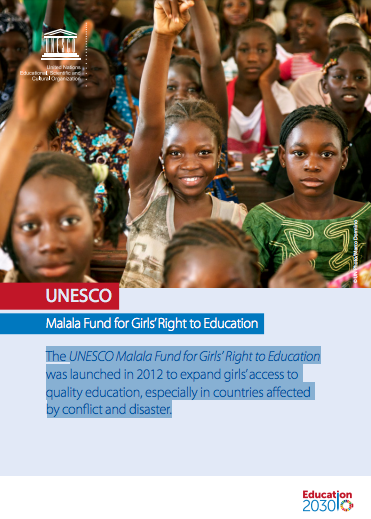 UNESCO Malala Fund for Girls' Right to Education 단체 저자: UNESCO The UNESCO Malala Fund for Girls’ Right to Education was launched in 2012 to expand girls’ access to quality education, especially in countries affected by conflict and disaster.