
자료
세계시민교육에 대한 이해를 넓히고 연구, 옹호 활동, 교수, 학습 등을 향상시킬 수 있는 다양하고 유용한 자료를 찾아보세요.
2,657 건의 결과가 검색되었습니다
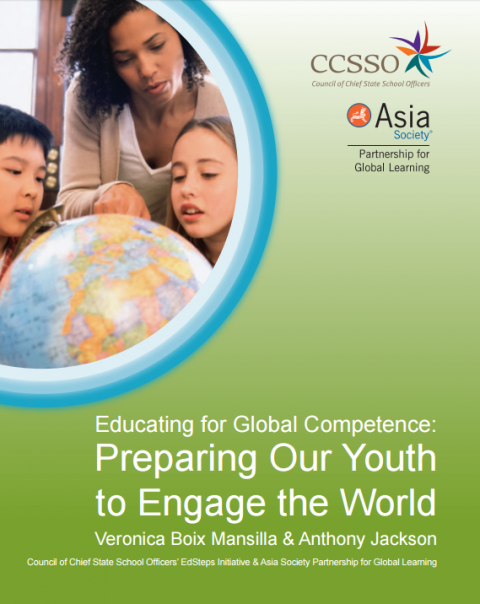 Educating for global competence: preparing our youth to engage the world 발행 연도: 2011 저자: Veronica Boix Mansilla | Anthony Jackson 단체 저자: Asia Society | Council of Chief State School Officers (CCSSO) Contemporary societies are marked by new global trends - economic, cultural, technological, and environmental shifts that are part of a rapid and uneven wave of globalization. The growing global interdependence that characterizes our time calls for a generation of individuals who can engage in effective global problem solving and participate simultaneously in local, national, and global civic life. Put simply, preparing our students to participate fully in today's and tomorrow's world demands that we nurture their global competence.This document introduces a definition of global competence developed by the Global Competence Task Force - a group of state education agency leaders, education scholars, and practitioners - under the auspices of the Council of Chief State School Officers EdSteps initiative (CCSSO-EdSteps) and the Asia Society Partnership for Global Learning (see page (iv) for task force participants). The definition builds on seminal work within the states and a broad range of organizations working to advance global knowledge and critical thinking skills. A process of careful articulation and vetting yielded the definition of global competence here proposed:Global competence is the capacity and disposition to understand and act on issues of global significance.Globally competent individuals are aware, curious, and interested in learning about the world and how it works. They can use the big ideas, tools, methods, and languages that are central to any discipline (mathematics, literature, history, science, and the arts) to engage the pressing issues of our time. They deploy and develop this expertise as they investigate such issues, recognize multiple perspectives, communicating their views effectively, and taking action to improve conditions.Educating for Global Competence: Preparing Our Youth to Engage the World is intended for classroom teachers, administrators, informal educators, policymakers, community leaders, researchers, parents, students, and all other stakeholders interested in preparing our youth for the 21st century. Becoming better at education for global competence involves rethinking practices and recognizing that there are no simple recipes for success. As such, this book is meant to be used flexibly - browse, make connections, and concentrate on the chapters that you find most pertinent to your work. Experiment with ideas, challenge concepts, and share with colleagues. Ultimately this book must work for you. It is meant to be read in the way that best meets your needs, inspires your curiosity, and proves fruitful in the classroom.Chapter one offers a rational for global education in our nation and worldwide. Chapter two introduces a conceptual framework for global competence and explains the key role of disciplinary and interdisciplinary foundations in student learning. Chapter three, four, five and six focus, respectively, on four core capacities associated with global competence: investigating the world, recognizing perspectives, communicating ideas, and taking action. Chapter seven considers core principles of instruction for teaching global competence. Chapter eight looks at what students and education institutions can do to promote global competence - and how they might create a culture of global competence for youth and adults. Finally, chapter nine places global competence in the larger framework of public education systems in and beyond the United States. Eduquer pour compétence globale: préparer nos jeunes à engager le monde 발행 연도: 2011 저자: Veronica Boix Mansilla | Anthony Jackson 단체 저자: Asia Society | Council of Chief State School Officers (CCSSO) Les sociétés contemporaines sont marquées par de nouvelles tendances mondiales - changements économiques, culturels, technologiques et environnementaux qui font partie d'une vague rapide et inégal de la mondialisation. L'interdépendance mondiale croissante qui caractérise notre temps appelle à une génération de personnes qui peuvent se livrer à la résolution de problème mondial efficace et participer simultanément à la vie civique locale, nationale et mondiale. Simplement, la préparation de nos étudiants de participer pleinement au monde les exigences d'aujourd'hui et de demain que nous entretenons leur compétence mondiale. Ce document présente une définition de la compétence globale développée par le Groupe de travail mondial Compétence - un groupe de chefs d'Etat de l'agence de l'éducation, spécialistes de l'éducation, et les praticiens - sous les auspices du Conseil de l'école Chief State initiative des officiers de EdSteps (CCSSO-EdSteps) et la Asia Partnership Society for global Learning (voir page (iv) pour les participants du groupe de travail). La définition se fonde sur le travail séminal dans les états et un large éventail d'organisations de travail pour faire avancer les connaissances mondiales et de la pensée critique. Un processus d'articulation minutieuse et vetting a abouti à la définition de la compétence globale proposée ici: la compétence globale est la capacité et la disposition pour comprendre et agir sur les questions d'importance mondiale. Globalement les personnes compétentes sont au courant, curieux et intéressés à en apprendre sur le monde et comment il fonctionne. Ils peuvent utiliser les grandes idées, des outils, des méthodes et des langues qui sont au cœur de toutes les disciplines (mathématiques, la littérature, l'histoire, la science et les arts) pour engager les questions pressantes de notre temps. Ils déploient et développer cette expertise comme ils enquêtent sur ces questions, reconnaissent de multiples points de vue, de communiquer leurs points de vue de manière efficace, et prendre des mesures pour améliorer les conditions. Eduquer pour Global Competence: Préparer les jeunes d'engager le monde est destiné aux enseignants, administrateurs, éducateurs informels, les décideurs, les leaders communautaires, les chercheurs, les parents, les étudiants et toutes les autres parties intéressées à préparer nos jeunes pour le 21e siècle. Devenir meilleur à l'éducation pour la compétence globale implique de repenser les pratiques et en reconnaissant qu'il n'y a pas de recettes simples pour le succès. En tant que tel, ce livre est destiné à être utilisé avec souplesse - parcourir, faire des liens, et de se concentrer sur les chapitres que vous trouverez les plus pertinents pour votre travail. Expérience avec des idées, des concepts de défi, et de partager avec des collègues. En fin de compte ce livre doit travailler pour vous. Il est destiné à être lu de la manière qui répond le mieux à vos besoins, inspire votre curiosité, et prouve fructueuse dans la salle de classe. Le premier chapitre offre un rationnel pour l'éducation mondiale dans notre pays et dans le monde. Le deuxième chapitre présente un cadre conceptuel pour la compétence globale et explique le rôle clé des fondations disciplinaires et interdisciplinaires dans l'apprentissage des élèves. Chapitre trois, quatre, cinq et six focus, respectivement, sur quatre capacités essentielles associées à la compétence mondiale: enquête dans le monde, reconnaissant les perspectives, communiquer des idées, et de prendre des mesures. Le chapitre sept considère les principes de base de l'enseignement pour l'enseignement de la compétence globale. Chapitre huit examine ce que les étudiants et les établissements d'enseignement peuvent faire pour promouvoir la compétence globale - et comment ils pourraient créer une culture de compétence globale pour les jeunes et les adultes. Enfin, le chapitre neuf places compétence globale dans le cadre plus large des systèmes d'éducation du public dans et au-delà des États-Unis.
  Education à la citoyenneté et aux droits de l'homme: manuel pour les jeunes en Mauritanie 발행 연도: 2015 저자: Sidi Mohamed Ould Mohamed Abdellahi | Bamariam Koita | Mohamed El Moctar Ould Sidina | Abdel Wedoud 단체 저자: Mauritania. Ministère de la culture et de l'artisanat | Mauritanian National Commission for Education, Science and Culture | UNESCO Rabat Prepared by UNESCO in cooperation with the Mauritanian Ministry of Culture and Crafts, and with the support of the Spanish Agency for International Development Cooperation (AECID), this manual aims to - with the active help of trainers and facilitators - sensitize young Mauritanians to the fundamental concepts of citizenship and human rights. This educational tool, which includes practical exercises adapted to a young audience, consists of 20 didactic cards that describe and explain Mauritania national legislation on human rights.Ce Manuel, composé de 20 fiches thématiques, offre de manière inédite des connaissances sur les conventions et standards internationaux en matière de démocratie et de droits de l’homme, ainsi qu’une contextualisation aux cadres normatifs nationaux de la Mauritanie. Des questions clés, des exercices interactifs, et des références pour aller plus loin sont autant d’outils pédagogiques pour familiariser les jeunes avec des notions fondamentales, dans le cadre de l’éducation aussi formelle que non formelle. Car Si l’éducation à la citoyenneté est rattachée à un territoire national dans la mesure où est citoyenne toute personne disposant de droits et de devoirs attachés à une nationalité, à un État, à une histoire sociale et culturelle, l’éducation aux droits de l’homme se réfère quant à elle à un cadre normatif universel et déterritorialisé : sa mission est de cultiver le sentiment d’appartenance de chacun(e) à l’humanité, caractérisée par une dignité propre. Dans une démarche éducative, ce Manuel conjugue les deux dimensions, les interpé- nètre et les met en perspective. L’objectif est de permettre aux jeunes, avec l’aide de formateurs et d’animateurs, d’approfondir et de mettre en perspective leurs connaissances relatives aux valeurs de citoyenneté et aux principes de droits de l’homme, à travers un va-et vient constant entre l’idéal universel et le contexte politique, social, culturel et environnemental dans lequel ils se trouvent.Fruit de la collaboration entre l’UNESCO et le Ministère de la Culture et de l’Artisanat de Mauritanie, et bénéficiant du soutien de l’Agence espagnole pour la coopération internationale pour le développement (AECID), ce Manuel propose des pistes pour explorer et interroger les conditions d’exercice de la citoyenneté, ainsi que des problématiques sociétales émergeantes. Mieux comprendre, pour mieux agir, c’est aussi cela être un agent de changement, de paix et de développement.
  Experiential learning of history through youth journeys to Poland Keren (1985), who examined the centrality of the Holocaust in five different periods in the history of the state of Israel, claims that the turning point for the educational system was an outcome not only of increased public awareness, but of the events 'receding' into history, which allowed an objective, and more balanced and detached, perspective. The study revealed that children whose parents were born in Europe or in Western countries were more eager to learn about the Holocaust than those of non-European origin, indicating a relationship between origin and desire to know about the Holocaust period. The journey experience had not yet matured and shaped into a deeper understanding that could be attributed to the personal identity of the participant and to examining it after the journey using accepted research tools. (By the author) Israeli and Diaspora Students Travel to the Holocaust Sites in Poland: The Impact on the Perceptions of the Holocaust, Jewish Identity, and Israel-Diaspora Ties The Ministry of Education encourages Israeli students to visit sites of historic Jewish communities in Poland and the sites of Nazi death camps. The trip is designed to reinforce the youngsters’ sense of belonging to the Jewish people, their connection to and identification with Jewish heritage and history, and their commitment to the future of Jewish life in Israel and its sovereignty. This study explores the impact of trips to Poland, organized by Tachlit Center, on Israeli and overseas university students. The vast majority of participants confirm that the trip emphasizes the important role of the Holocaust memory and commemoration. Findings on the impact of Holocaust education on other Israeli and Jewish values (e.g., the significance of immigration to Israel and ties to the Jewish Diaspora) are discussed, along with the implications for future Holocaust education programs. (By the author) Does vicarious experience of suffering affect empathy for an adversary? The effects of Israelis’ visits to Auschwitz on their empathy for Palestinians Empathy for the adversary is part of peace education. Does the vicarious experience of suffering affect empathy towards the suffering of an adversary? Specifically, does the visit of Israeli youth to Auschwitz affect their empathy toward the Palestinians? Three hundred and nine high school students participated in the study: One half went on the journey, while the other, comparable half, served as a control group. Findings tended to support the hypotheses. The journey increased empathy among participants with initially more positive attitudes toward the Palestinians but it also decreased empathy among those with initially more negative ones. The choice of nationalistic lessons about the holocaust affected feelings of pride and identification with the victims but not empathy. The choice of universalistic lessons affected feelings of fear and helplessness and contributed to increased empathy. Conclusions are drawn pertaining to peace education programs aiming at increasing empathy toward an adversary. (By the author) "Why Do We Always Have to Say We're Sorry?" A Case Study on Navigating Moral Expectations in Classroom Communication on National Socialism and the Holocaust in Germany Against the background of the pedagogization and internationalization of Holocaust memory discourse, this contribution focuses on the specific conditions of history classes on National Socialism and the Holocaust in Germany. Using a case study, this article shows both how the meanings of these subjects are communicatively negotiated in history classes and how these classroom discourses relate to the specific context of the culture of memory in Germany. Particular attention is given to the question of guilt and the concomitant moral expectations—which can be interpreted as a specific condition of the memory of the Holocaust in the successor state of the Third Reich. Within this context, the central questions of my study are: (1) How do today's youth in Germany navigate the moral expectations that are implicit within the established historical narratives on the Holocaust? (2) How do ethnically and nationally linked conceptions of memory play a role in youth's sense-making about the Holocaust? (By the author) Bilder, Gefühle, Erwartungen : Über die emotionale Dimension von Gedenkstätten und den Umgang von Jugendlichen mit dem Holocaust What role do emotions play in the way in which young people confront the history of the Holocaust? This article examines memorial sites and video interviews of survivors as interfaces of the representation and appropriation of the past. These contact zones satisfy the need for emotional participation and for information. Videos uploaded by youngsters on the internet following their visit to memorial sites, and short films extracted by pupils from survivor's video interviews, were used as examples in order to examine emotional strategies. These products of involvement point to stored images and ideas mediated by mass media. This repertoire of cultural knowledge and feelings can serve as a template for understanding how young people process the Holocaust emotionally. (By the author)
  Generation Z: Global Citizenship Survey 발행 연도: 2017 단체 저자: Varkey Foundation The Varkey Foundation commissioned Populus to carry out research on a global scale into the attitudes of 15- to 21-year-olds on a variety of ethical, personal, community and political issues. We chose twenty countries to poll: Argentina, Australia, Brazil, Canada, China, France, Germany, India, Indonesia, Israel, Italy, Japan, New Zealand, Nigeria, Russia, South Africa, South Korea, Turkey, the UK and the US. We chose a range of countries that would give a geographic spread, include some of most populous nations, and would also include those that have particular political significance – as rising powers and/or countries that are important in global geopolitics and cultural influence.The first part of the survey asked about young people’s wellbeing, hopes and ambitions – from their relationships and future careers, to their physical and mental health.. The second part focused on their personal, community and religious values – from their attitudes towards abortion, same sex marriage and transgender rights, to the importance of religion in their lives and whether they feel equipped to contribute to their own community. Finally, it covered issues of global citizenship – attitudes towards migrants, the factors that make young people hopeful and fearful for the future, and their views on whether the world is becoming a better or worse place. This is the first time that there has been an international comparative study of the attitudes of young people on these matters. Not only have we asked them how they feel, what their attitudes are, and who influenced them: we have also reflected on what differences and similarities there may be in terms of their wellbeing, fears, hopes and views across the world.With this survey, we do not aim to document the events that loomed large in young people’s lives or the social forces that have shaped their emotions and opinions. That is a huge subject for expert analysis. Rather, we wanted to hold up a mirror to Generation Z and simply record the reflection that they give us – providing some illumination to help us all understand them better. Peace education in formal schools of West Africa: an implementation guide 발행 연도: 2012 단체 저자: West Africa Network for Peacebuilding (WANEP) This guide, first and foremost, seeks to bring hope and provide opportunity for practitioners to use tried and tested techniques to develop capacities of young people to build requisite knowledge and skills to become credible and responsible leaders. It provides both a conceptual and practical framework of peace education and confirms the potential benefits of Peace Education, particularly in the formal sector. It has been developed based on the extensive experience of WANEP’s Peace Education programme across West Africa and this experience has been outlined in great detail throughout the manual. The guide lays emphasis on entry points for developing and initiating Peace Education programmes in schools and provides practical tools for engaging various stakeholders and the wide range of potential roles they can play. In terms of the content of a peace education programme, guidelines are provided on developing a comprehensive programme that integrates effectively key concepts such as Gender and Human Rights. Critical issues of sustainability, resource mobilisation and monitoring and evaluation are covered using practical case studies based on the WANEP experience. The concluding chapter is devoted to addressing some Frequently Asked Questions. This laudable initiative and recommend this guide for adoption by West African states and institutions especially the educational sector as a tool for inculcating a culture of peace and nonviolence amongst children.The guide is divided into six chapters.Chapter 1 consists of introduction and the conceptual definition of basic philosophy that influenced the peace education program of WANEP. It also examines the role of peace education on the psycho social behaviour of youths in West Africa.Chapter 2 highlights WANEP’s guiding principles to the development of its peace education in the sub region and also the basic steps it took to implement its program in the seven (7) pilot states.Chapter 3 looks at how to mobilise resources to sustain the peace education program especially within the context of West Africa.Chapter 4 highlights the challenges that WANEP encountered in implementing the program.Chapter 5 emphasises the importance of monitoring and evaluation for impact and success of a peace education program.Chapter 6 deals with frequently asked questions by interested stakeholders.