
자료
세계시민교육에 대한 이해를 넓히고 연구, 옹호 활동, 교수, 학습 등을 향상시킬 수 있는 다양하고 유용한 자료를 찾아보세요.
3,454 건의 결과가 검색되었습니다
 Enjeux contemporains éducation aux droits humains 발행 연도: 2011 단체 저자: Organisation des Nations Unies pour l'éducation, la science et la culture (UNESCO) Le format de cette publication présente les principaux volets concernant le rôle de l'éducation des droits de l'homme ainsi que les éléments clés de sa mise en œuvre. Chaque adresses de brins enjeux et les défis actuels auxquels sont confrontés lors de l'incorporation d'une culture des droits de l'homme, illustrant également l'importance collective de l'éducation aux droits de l'homme comme base fondamentale pour une société juste et pacifique. Sous chaque brin, une liste d'exemples inspirés par des initiatives de pays est proposé. Education aux droits de l'homme 발행 연도: 2013 단체 저자: Organisation des Nations Unies pour l'éducation, la science et la culture (UNESCO) The Education Sector is called to implement a significant and broad mandate, covering many challenging issues in education in a diverse and fast-changing world. More than ever, we need to better focus and ensure greater cohesion in implementing this mandate. This document is part of a series of Technical Notes that have been developed by colleagues in the Education Sector in order to facilitate programme delivery in thematic areas related to the work of the Sector. The Technical Notes are meant to serve as a quick reference tool for UNESCO staff, providing a brief overview including basic knowledge, key priorities for UNESCO and future directions as well as practical information on each topic. Education sector technical notes: human rights education 발행 연도: 2013 단체 저자: UNESCO Human rights are enshrined in international law, and states have an obligation to respect, protect and fulfil them. Despite this, human rights violations remain widespread. ◗ Educating children and adults on human rights is essential. Individuals and groups must understand their rights in order to see them upheld and to ensure that their own behavior does not compromise the rights of others. ◗ States have an obligation to promote human rights and human rights education is now recognized as a right in itself. ◗ UNESCO, along with the Office of the United Nations High Commissioner for Human Rights, co-leads the World Programme for Human Rights Education (2005-ongoing).
 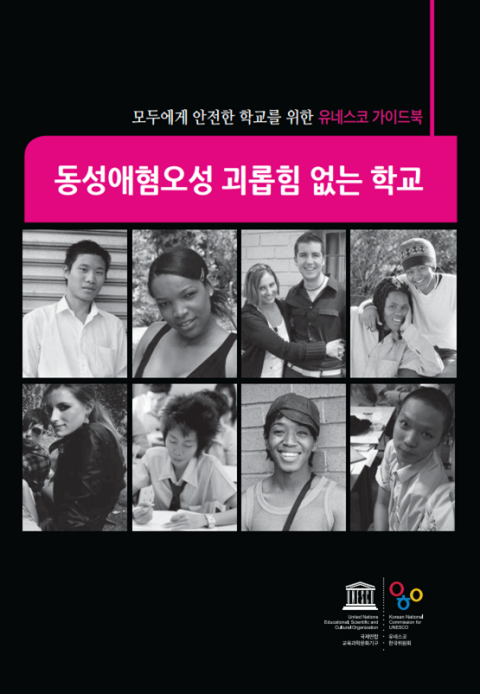 동성애혐오성 괴롭힘 없는 학교 발행 연도: 2013 단체 저자: 유네스코 이 책은 2012년 유네스코가 발간한 ‘HIV 및 보건 교육 우수 정책과 사례’ 시리즈(전8권) 중 제8권 『Education Sector Responses to Homophobic Bullying』을 번역한 것입니다. 이 책은 동성애혐오성 괴롭힘을 '모두를 위한 교육'을 실현하기 위해 해소해야 하는 걸림돌 중 하나로 지적하면서 그 해결방법을 제시하고 있습니다. Le Risposte del settore educativo al bullismo omofobico 발행 연도: 2014 단체 저자: UNESCO This publication is part of a Good Policy and Practice series that addresses key themes of UNESCO’s work with the education sector including HIV and AIDS and safe, healthy educational environments for all learners. This volume, on the theme of homophobic bullying in educational institutions, builds on UNESCO’s work on gender, discrimination and violence in schools. Respostas do Setor de Educação ao bullying homofóbico 발행 연도: 2013 단체 저자: UNESCO This publication is part of a Good Policy and Practice series that addresses key themes of UNESCO’s work with the education sector including HIV and AIDS and safe, healthy educational environments for all learners. This volume, on the theme of homophobic bullying in educational institutions, builds on UNESCO’s work on gender, discrimination and violence in schools.
 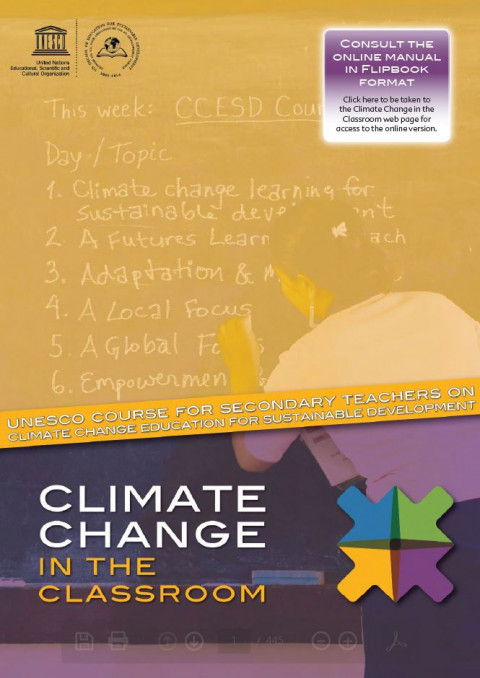 Climate change in the classroom: UNESCO course for secondary teachers on climate change education for sustainable development 발행 연도: 2013 저자: David Selby | Fumiyo Kagawa 단체 저자: UNESCO This course has been created with the goal of bringing climate change education outside the science classroom into the many other subject areas upon which climate change now has an impact, or will impact in the future, such as ethics, social studies, economics, political science, among others. The course materials are organized into four parts: 1. Course Framework and Overview, 2. Teachers’ Education Course daily materials, 3. Regional Resource Packs, 4. Daily Classroom Materials for teachers. These materials are all described in more detail and can be accessed from the Start Menu found on the following pages. This course is designed to enable teachers at the secondary level from diverse subject areas to introduce climate change education for sustainable development (CCESD) across the curriculum. UNESCO has identified the professional development of teachers in education for sustainable development as the top priority in recognition of the transformative role that teachers and teacher educators need to play in re-orienting education to help realize a sustainable future (UNESCO, 2005, p. 19). But good intentions for the professional development of teachers have fallen short in practice. Although taken up by enthusiasts, teacher education for sustainable development has rarely been mainstreamed, and, where there are courses, is often approached within a disciplinary as opposed to an interdisciplinary frame (Wals, A., 2009). If professional development in education for sustainable development is at an adolescent stage, teacher education in climate change education for sustainable development is in its infancy. For instance, according to a 2009 international comparative study on climate change education and sustainable development in ten countries, climate change education has peripheral status in educational research and practice, and when it is addressed it is only within science education (Læssøe,J. Schnack, K., Breiting, S. & Rolls, S., 2009). There is a clear and present need to respond to climate change challenges through systematic teacher education programmes that are not restricted to a single subject area. This teacher education course is an attempt to fill the current gap and is in line with one of UNESCO’s key objectives for climate change education for sustainable development, that is, to support teacher training on climate change for sustainable development (UNESCO, 2010, p. 9). The programme has four distinctive features: 1. It helps teachers to understand the causes, dynamics and impacts of climate change through a holistic approach. 2. Teachers are exposed to, and experience, a range of pedagogical approaches and techniques, that they can use in their own school environment. This includes engagement of themselves and their students in whole school and school-in-community approaches. 3. Teachers will develop their capacities to facilitate students’ community based learning. 4. Teachers will develop future-oriented and transformative capacities in facilitating climate change mitigation, adaptation, and disaster risk reduction learning. Les changements climatiques dans la salle de classe: Cours de l'UNESCO pour les enseignants du secondaire sur le changement climatique éducation au développement durable 발행 연도: 2013 저자: David Selby | Fumiyo Kagawa 단체 저자: Organisation des Nations Unies pour l'éducation, la science et la culture (UNESCO) Ce cours a été créé avec l'objectif d'amener le changement climatique l'éducation en dehors de la salle de classe de la science dans les nombreux autres domaines sur lesquels le changement climatique a maintenant un impact, ou aura un impact à l'avenir, comme l'éthique, les études sociales, l'économie, la science politique , parmi d'autres. Les supports de cours sont organisés en quatre parties: 1. Structure du cours et aperçu, cours d'éducation matières quotidiennes 2. Enseignants, Packs 3. Ressources régionales, 4. Quotidiennes Matériel didactique pour les enseignants. Ces matériaux sont décrits plus en détail et sont accessibles à partir du menu démarrer trouvé dans les pages suivantes. Ce cours est conçu pour permettre aux enseignants au niveau secondaire de domaines divers pour introduire l'éducation sur le changement climatique pour le développement durable (ECCDD) à travers le curriculum. L'UNESCO a identifié le développement professionnel des enseignants dans l'éducation pour le développement durable comme priorité absolue dans la reconnaissance du rôle transformateur que les enseignants et les formateurs d'enseignants doivent jouer dans l'éducation de réorientation pour aider à réaliser un avenir durable (UNESCO, 2005, p. 19 ). Mais les bonnes intentions pour le développement professionnel des enseignants sont tombés à court dans la pratique. Bien pris par les amateurs, la formation des enseignants pour le développement durable a rarement été intégré, et où il y a des cours, est souvent abordé dans une discipline, par opposition à un cadre interdisciplinaire (Wals, A., 2009). Si le développement professionnel en éducation pour le développement durable est à un stade adolescent, la formation des enseignants en éducation au changement climatique pour le développement durable est à ses débuts. Par exemple, selon une étude comparative internationale 2009 sur le changement climatique l'éducation et le développement durable dans dix pays, éducation au changement climatique a un statut périphérique dans la recherche et la pratique éducative, et quand elle est adressée, il est seulement dans l'enseignement des sciences (Laessoe, J. Schnack , K., Breiting, S. & Rolls, S., 2009). Il y a un besoin clair et présent pour répondre aux défis du changement climatique par le biais de programmes de formation des enseignants systématiques qui ne se limitent pas à une seule matière. Ce cours de formation des enseignants est une tentative de combler le vide actuel et est en ligne avec l'un des principaux objectifs de l'UNESCO pour le changement climatique éducation pour le développement durable, qui est, pour soutenir la formation des enseignants sur le changement climatique pour le développement durable (UNESCO, 2010, p. 9). Le programme comporte quatre traits distinctifs: 1.Il aide les enseignants à comprendre les causes, la dynamique et les impacts du changement climatique à travers une approche holistique. 2.Les enseignants sont exposés, et de l'expérience, une gamme d'approches et de techniques pédagogiques, qu'ils peuvent utiliser dans leur propre milieu scolaire. Cela comprend l'engagement d'eux-mêmes et de leurs élèves à l'école ensemble et approches écoles en communauté. 3.Les enseignants développeront leurs capacités pour faciliter base communautaire d'apprentissage des élèves. 4. Les enseignants développeront les capacités de tournées vers l'avenir et de transformation pour faciliter l'atténuation des changements climatiques, l'adaptation et l'apprentissage de la réduction des risques de catastrophe. Notes techniques du secteur de l'éducation: education au changement climatique 발행 연도: 2013 단체 저자: Organisation des Nations Unies pour l'éducation, la science et la culture (UNESCO) Climate change is a major challenge to sustainable development. The ten hottest years on record have occurred since 1998. Sea-levels are rising. Rainfall patterns are changing, causing droughts and floods. Extreme weather events such as storms, cyclones and heat waves are becoming more frequent and intense. Climate change poses a number of interconnected challenges, including water security, rising pressures on food production and health and disaster risks. ◗ Climate change disproportionately affects developing countries and vulnerable people within those countries, thereby seriously threatening progress towards the Millennium Development Goals (MDGs) and Education for All (EFA). It is already having a reverse impact on enrolment rates, the delivery of quality education and safe learning environments. ◗ Education has a key role to play in concerted local and global climate change mitigation and adaptation efforts. ◗ UNESCO promotes climate change education within the overall context of Education for Sustainable Development (ESD). ◗ UNESCO supports Member States in building the capacity of policy makers and educators to enhance the education sector response to climate change. ◗ Closer alignment of Climate Change Education with Disaster Risk Reduction (DRR) education contributes to safeguarding development gains and building resilience in countries vulnerable to the negative impacts of climate change. Education sector technical notes: climate change education 발행 연도: 2013 단체 저자: UNESCO Climate change is a major challenge to sustainable development. The ten hottest years on record have occurred since 1998. Sea-levels are rising. Rainfall patterns are changing, causing droughts and floods. Extreme weather events such as storms, cyclones and heat waves are becoming more frequent and intense. Climate change poses a number of interconnected challenges, including water security, rising pressures on food production and health and disaster risks. ◗ Climate change disproportionately affects developing countries and vulnerable people within those countries, thereby seriously threatening progress towards the Millennium Development Goals (MDGs) and Education for All (EFA). It is already having a reverse impact on enrolment rates, the delivery of quality education and safe learning environments. ◗ Education has a key role to play in concerted local and global climate change mitigation and adaptation efforts. ◗ UNESCO promotes climate change education within the overall context of Education for Sustainable Development (ESD). ◗ UNESCO supports Member States in building the capacity of policy makers and educators to enhance the education sector response to climate change. ◗ Closer alignment of Climate Change Education with Disaster Risk Reduction (DRR) education contributes to safeguarding development gains and building resilience in countries vulnerable to the negative impacts of climate change.