
자료
세계시민교육에 대한 이해를 넓히고 연구, 옹호 활동, 교수, 학습 등을 향상시킬 수 있는 다양하고 유용한 자료를 찾아보세요.
3,454 건의 결과가 검색되었습니다
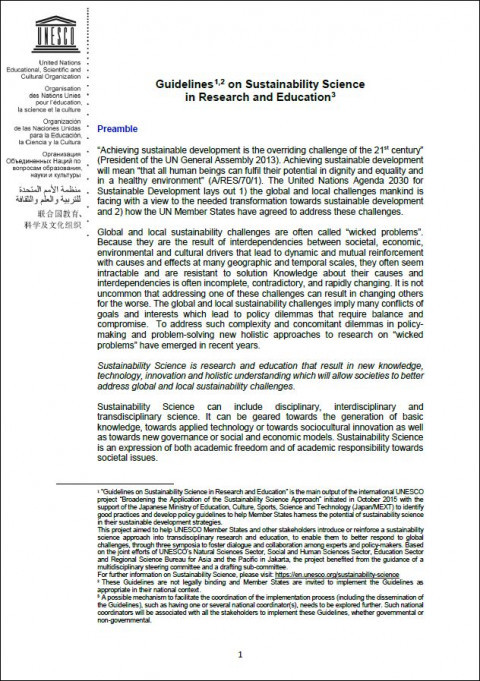 Guidelines on Sustainability Science in Research and Education 발행 연도: 2017 단체 저자: UNESCO “Guidelines on Sustainability Science in Research and Education” is the main output of the international UNESCO project “Broadening the Application of the Sustainability Science Approach” initiated in October 2015 with the support of the Japanese Ministry of Education, Culture, Sports, Science and Technology (Japan/MEXT) to identify good practices and develop policy guidelines to help Member States harness the potential of sustainability science in their sustainable development strategies.This project aimed to help UNESCO Member States and other stakeholders introduce or reinforce a sustainability science approach into transdisciplinary research and education, to enable them to better respond to global challenges, through three symposia to foster dialogue and collaboration among experts and policy-makers. Based on the joint efforts of UNESCO’s Natural Sciences Sector, Social and Human Sciences Sector, Education Sector and Regional Science Bureau for Asia and the Pacific in Jakarta, the project benefited from the guidance of a multidisciplinary steering committee and a drafting sub-committee.For further information on Sustainability Science, please visit: https://en.unesco.org/sustainability-science
 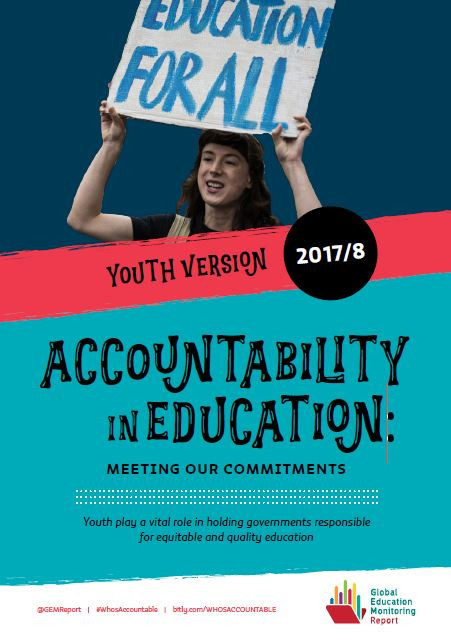 Accountability in Education: Meeting our Commitments; Global Education Monitoring Report, Youth Version, 2017/8 발행 연도: 2017 단체 저자: UNESCO This Youth Report, based on findings and conclusions from the 2017/8 Global Education Monitoring report, asks how young people are involved in the process of accountability in education. As students, what are we responsible for in our education and how are we held accountable? How can we make sure other actors – like schools, universities and governments – are held accountable for their responsibilities? These are critical questions, because we know that there’s a long way to go before all young people around the world have access to a quality education: absent teachers, overcrowded classrooms, illegitimate diplomas, unregulated private schools and truancy are all issues that education systems are struggling to overcome.It’s sometimes tempting to say that these problems aren’t ours to fix, that the responsibility lies with the government or with an older generation. But this simply isn’t true: education is a shared responsibility, and young people have an important role to play. In this Report, you’ll hear the stories of young people around the world who have stood up for the right to education in their communities and who have been integral in triggering change. You’ll also read about how you can become involved in our campaign to make sure governments can be held to account for education. This means making sure that citizens can take their governments to court if they are not meeting their education responsibilities. From creating video clips to holding awareness-raising events, there is a range of ways to make your voice heard. Your involvement is integral in making sure the world is on the right path to meeting our education goals. Rendir cuentas en el ámbito de la educación: cumplir nuestros compromisos; Informe de seguimiento de la educación en el mundo, versión para los jóvenes, 2017/8 발행 연도: 2017 단체 저자: Organización de las Naciones Unidas para la Educación, la Ciencia y la Cultura (UNESCO) Esta versión para los jóvenes del Informe GEM, que se basa en los resultados y conclusiones del Informe de Seguimiento de la Educación en el Mundo 2017-2018, se cuestiona acerca de la manera en que los jóvenes participan en el proceso de rendición de cuentas en la educación. En tanto que alumnos, ¿de qué somos responsables en nuestra educación, y cómo se nos responsabiliza? ¿Cómo podemos asegurarnos de que se responsabilice a otros interesados, como las escuelas, las universidades y los gobiernos, por lo que deben hacer? Estas son preguntas fundamentales, porque sabemos que quedan aún muchas cuestiones por resolver para que todos los jóvenes del mundo tengan acceso a una educación de calidad. El ausentismo de los docentes, el hacinamiento de las aulas, los diplomas ilícitos, las escuelas privadas no reglamentadas y el ausentismo de los alumnos son cuestiones que los sistemas educativos se esfuerzan por superar.Sería fácil afirmar que la resolución de esos problemas no está en nuestras manos, y que la responsabilidad es del gobierno o de una generación anterior. Pero esto simplemente no es cierto; la educación es una responsabilidad compartida, y los jóvenes desempeñan en ese sentido un papel importante. En este informe conocerá las historias de jóvenes de todo el mundo que han defendido el derecho a la educación en sus comunidades, y que han contribuido a motivar un cambio. También leerá sobre las maneras en que podrá participar en nuestra campaña para garantizar que se responsabilice a los gobiernos por la educación. Esto significa asegurarse de que los ciudadanos puedan llevar a sus gobiernos ante la justicia si no cumplen sus responsabilidades en materia de educación. Desde grabar vídeos hasta organizar actos de sensibilización, son muchas las maneras de hacerse escuchar. Su participación es indispensable para garantizar que el mundo transite por la vía correcta para alcanzar nuestros objetivos sobre la educación.
 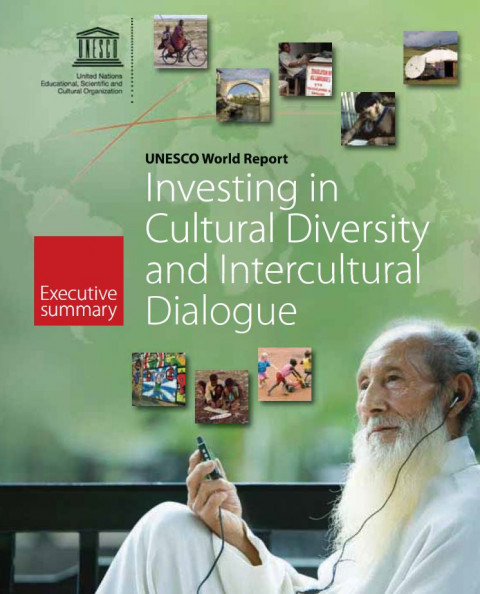 [Summary] Investing in Cultural Diversity and Intercultural Dialogue: UNESCO World Report; Executive Summary 발행 연도: 2009 단체 저자: UNESCO Cultural diversity has emerged as a key concern at the turn of a new century. Yet the meanings attached to this catch-all term are as varied as they are shifting. Some see cultural diversity as inherently positive, insofar as it points to a sharing of the wealth embodied in each of the world’s cultures and, accordingly, to the links uniting us all in processes of exchange and dialogue. For others, cultural differences are what cause us to lose sight of our common humanity and are therefore at the root of numerous conflicts.This second diagnosis is today all the more plausible since globalization has increased the points of interaction and friction between cultures, giving rise to identity-linked tensions, withdrawals and claims, particularly of a religious nature, which can become potential sources of dispute. The essential challenge, therefore, would be to propose a coherent vision of cultural diversity and thereby to clarify how, far from being a threat, it can become beneficial to the action of the international community. This is the essential purpose of the present report.
  Values Education through Sport 발행 연도: 2016 단체 저자: UNESCO Innovative education for developmentEducation in the 21st century increasingly recognizes the role of values and social skills in tackling global challenges, such as inactivity, obesity, unemployment, and conflict. This approach is at the core of the Sustainable Development Goal 4 on quality education, which advocates for inclusive lifelong learning opportunities and innovative content delivery. Dynamic forms of values-based education using sport can be introduced in schools to support teachers deliver curricula actively and cooperatively.What are sport values?Sport can teach values such as fairness, teambuilding, equality, discipline, inclusion, perseverance and respect. Sport has the power to provide a universal framework for learning values, thus contributing to the development of soft skills needed for responsible citizenship.What can Values Education through Sport offer?Values Education through Sport (VETS) programmes support active learning, complement cognitive skills and give students increasing amounts of responsibility, and enhance their level of concentration and participation. VETS programmes are flexible and have a strong cross-curricular potential: they can reinforce existing curricula and can be streamed across different subjects, including physical education, civic and moral education, nutrition, biology, arts. Ultimately, these programmes help students to transfer and put values into action outside the school environment, by getting engaged in their communities, making informed decisions, being sensitive and respecting the others and the environment. VETS contributes to the development of self-confidence, active and healthy lifestyle choices, and an understanding of rights, supporting the delicate transition to the independence of adulthood. Éducation aux Valeurs par le Sport 발행 연도: 2016 단체 저자: Organisation des Nations Unies pour l'éducation, la science et la culture (UNESCO) Éducation innovante pour le développementL'éducation au 21e siècle reconnaît de plus en plus le rôle des valeurs et des compétences sociales pour relever les défis mondiaux, tels que l'inactivité, l'obésité, le chômage et les conflits. Cette approche est au cœur de l'objectif de développement durable 4 sur l'éducation de qualité, qui milite pour des possibilités d'apprentissage inclusifs et la livraison de contenu innovant. Les formulaires dynamiques de l'éducation fondée sur les valeurs en utilisant le sport peuvent être introduits dans les écoles pour aider les enseignants offrent des programmes activement et en collaboration.Quelles sont les valeurs du sport?Le sport peut enseigner des valeurs telles que l'équité, teambuilding, l'égalité, la discipline, l'inclusion, la persévérance et le respect. Le sport a le pouvoir de fournir un cadre universel pour les valeurs d'apprentissage, contribuant ainsi au développement des compétences générales nécessaires à la citoyenneté responsable. Que peut l'éducation aux valeurs par offre de Sport?Valeurs éducation par le sport (VEPS) programmes appuient l'apprentissage actif, compléter les compétences cognitives et donner aux étudiants les montants de responsabilité de plus en plus, et d'améliorer leur niveau de concentration et de participation. programmes VEPS sont flexibles et ont un fort potentiel transdisciplinaire: ils peuvent renforcer les programmes existants et peuvent être écoutés sur différents sujets, y compris l'éducation physique, l'éducation civique et morale, la nutrition, la biologie, les arts. En fin de compte, ces programmes aident les élèves à transférer et de mettre les valeurs en action en dehors du milieu scolaire, en s'engagés dans leurs communautés, prendre des décisions éclairées, étant sensible et en respectant les autres et l'environnement. VEPS contribue au développement de la confiance en soi, des choix de vie sains et actifs, et une compréhension des droits, soutenir la transition délicate à l'indépendance de l'âge adulte.
 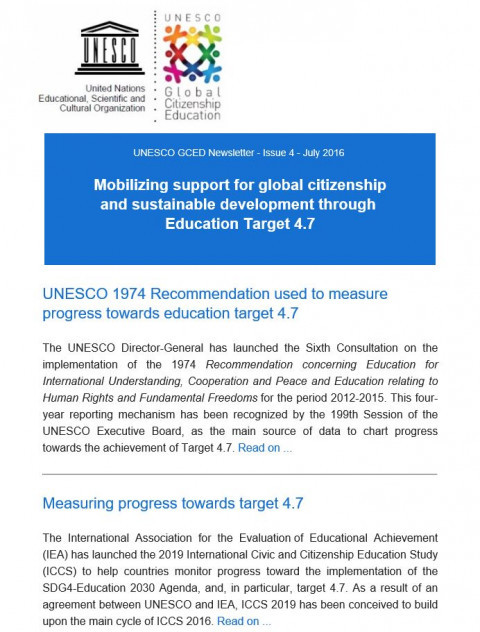 UNESCO GCED eNewsletter Issue 4 발행 연도: 2016 단체 저자: UNESCO Feature: Mobilizing support for global citizenship and sustainable development through Education Target 4.7 UNESCO 1974 Recommendation used to measure progress towards education target 4.7 Measuring progress towards 4.7 Gyeongju Action Plan: NGOs join UNESCO Global capacity-building workshop on GCED organized by APCEIU Southern Africa Regional Meeting on GCED convened in Johannesburg, South Africa UNESCO launches Teacher's Guide on the Prevention of Violent Extremism Expert meeting on the Prevention of Violent Extremism through Education European ministers back education for democracy to counter extremism and racaism UN discusses innovative solutions to prevent violent extremism through education UNESCO's YESPeace Network taps the power of youth worldwide to change the future GCED Topics and Learning Objectives available in seven languages.
 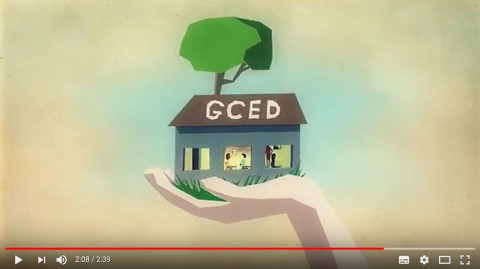 [Video] Learning to live together in peace through Global Citizenship Education 발행 연도: 2016 단체 저자: UNESCO The UNESCO video on “Learning to live together in peace through Global Citizenship Education” explains the importance of Global Citizenship Education (GCED) in a globalized and increasingly interconnected and interdependent world. GCED is key to understand the interconnections between the local and the global and nurture a sense of belonging to a common humanity. It builds motivation to assume active roles to contribute to a more just, peaceful, tolerant and sustainable world. The video also illustrates how GCED can be delivered in and outside of schools. [Vidéo] Apprendre à vivre ensemble dans la paix par l’éducation à la citoyenneté mondiale 발행 연도: 2016 단체 저자: Organisation des Nations Unies pour l'éducation, la science et la culture (UNESCO) La vidéo de l'UNESCO sur le thème "Apprendre à vivre ensemble dans la paix par l’Éducation à la Citoyenneté Mondiale", explique l'importance de l'Éducation à la Citoyenneté Mondiale (ECM) dans un monde globalisé et de plus en plus interconnecté et interdépendant. ECM est essentiel de comprendre les interconnexions entre le local et le global et à favoriser un sentiment d'appartenance à une humanité commune. Il construit la motivation à assumer un rôle actif pour contribuer à un monde plus juste, pacifique, tolérante et durable. La vidéo montre également comment ECM peut être livré dans et à l'extérieur des écoles.
 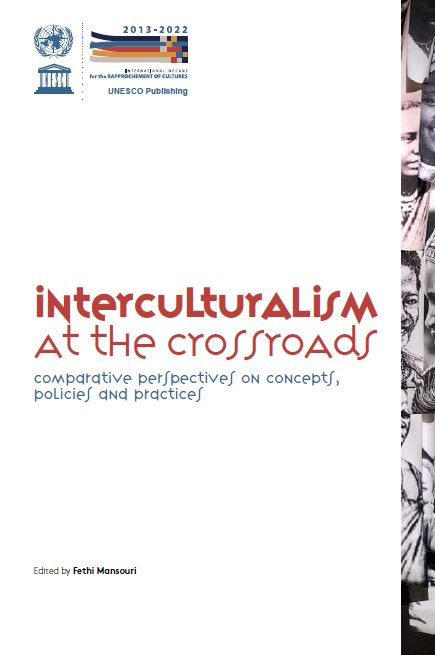 Interculturalism at the Crossroads: Comparative Perspectives on Concepts, Policies and Practices 발행 연도: 2017 저자: Fethi Mansouri 단체 저자: UNESCO Today most societies across the world are witnessing rising levels of social and cultural diversity brought about by globalisation and in particular increased human mobility and significant advances in information and communications technologies. The dilemma, therefore, has been how best to manage the resultant diversity and what optimal social policy paradigms to adopt towards this end.Assimilation, multiculturalism and presently interculturalism have all been proposed as possible policy conduits for managing socio-cultural diversity.This book, in focusing on the latter concept, and in particular in its intercultural dialogue manifestation, offers at once theoretical examinations, policy discussion and practical explorations of its uptake across the world. The core argument connecting the book’s three distinct sections is that whilst assimilation in its racist manifestation is no longer a viable option in today’s world, intercultural dialogue within existing multicultural settings has much to offer.