
자료
세계시민교육에 대한 이해를 넓히고 연구, 옹호 활동, 교수, 학습 등을 향상시킬 수 있는 다양하고 유용한 자료를 찾아보세요.
2,782 건의 결과가 검색되었습니다
 A Guide for Gender Equality in Teacher Education Policy and Practices 발행 연도: 2015 저자: María C. Arango Restrepo | Esther Corona-Vargas 단체 저자: UNESCO Transforming the culture of teacher education institutions and making them gender-sensitive entities is a daunting task. However, it is not an impossible task. Understanding gender and applying gender mainstreaming are critical foundations for fostering social cohesion that goes beyond teacher education institutions and the school. Teachers are increasingly expected to play crucial roles in preparing young people to face the future with confidence, purpose, responsibility and gender sensitivity. Teacher education institutions must be ready to provide the enabling environment and training and continuing education for the development of knowledge, values, skills and gender-responsive practices that the teachers need in the 21st century.This Guide, through its ten Modules, takes the reader through step by step on how gender can be mainstreamed in all areas of teacher education and training: from policy and planning, administration and management, gender-responsive budgeting, social services, the environment, curriculum, pedagogy, research, and to advocacy. Through this Guide, teacher educators are also reminded what teachers must know and be able to do in order to promote gender equality through education. The Modules can be used individually or comprehensively depending on the situation and context of countries.This Guide is dedicated to all teacher educators, whose intellectual rigour and tireless efforts to foster enabling environments for inclusive and gender sensitive education, are indispensable for success in continuing education. Guide pour l'égalité des genres dans les politiques et les pratiques de formation des enseignants 발행 연도: 2015 저자: María C. Arango Restrepo | Esther Corona-Vargas 단체 저자: Organisation des Nations Unies pour l'éducation, la science et la culture (UNESCO) Transformer la culture des institutions de formation des enseignants pour en faire des entités sensibles aux genres est une tâche ardue. Cependant, elle n’est pas impossible. Comprendre les problématiques liées aux genres et savoir comment appliquer l’égalité des sexes se révèlent être des aspects essentiels afin de favoriser une cohésion sociale allant au-delà des institutions de formation des enseignants et de l’école. Les enseignants sont de plus en plus appelés à jouer un rôle crucial dans la préparation des jeunes à faire face à l’avenir avec confiance, décision, responsabilité et sensibilité aux notions de genre. Ainsi, les institutions de formation des enseignants doivent être prêtes à fournir un environnement favorable et une formation continue pour le renforcement des capacités, des valeurs, des compétences et des pratiques sensibles au genre dont les enseignants ont besoin au 21e siècle.À travers ses dix modules, ce guide explique comment intégrer la notion de genre dans tous les domaines de l’éducation et de la formation des enseignants : politiques et planification, gestion et administration, budgétisation sensible au genre, services sociaux, environnement, programmes, pédagogie, recherche et plaidoyer. Ce guide vise à rappeler également aux formateurs d’enseignants ce que ces derniers devraient savoir et être en mesure de faire afin de promouvoir l’égalité des genres à travers l’éducation. Les modules peuvent être utilisés individuellement ou dans leur totalité en fonction de la situation et du contexte des pays.Ce guide est dédié à tous les formateurs d’enseignants, dont la rigueur intellectuelle et les efforts inlassables en vue de favoriser un environnement propice à l’éducation inclusive sensible aux genres, sont indispensables à la réussite de la formation continue. Guía para la igualdad de género en las políticas y prácticas de la formación docente 발행 연도: 2015 저자: María C. Arango Restrepo | Esther Corona-Vargas 단체 저자: Organización de las Naciones Unidas para la Educación, la Ciencia y la Cultura (UNESCO) La Guía para la Igualdad de Género en las Políticas y Prácticas de la Formación Docente, ha sido concebida como una herramienta práctica para impulsar una cultura organizacional con perspectiva de género en los centros de formación docente. Su objetivo es fortalecer las capacidades de los formadores de docentes, directores y estudiantes de pedagogía para reconocer y modificar en sus prácticas cotidianas los elementos que alientan la desigualdad de género.Asimismo, la guía busca contribuir a una mayor comprensión conceptual de la perspectiva de género y sirve de ayuda para identificar necesidades y opciones de cambio en las políticas institucionales, planes, estrategias y prácticas, según las características particulares de cada contexto.Esta guía está estructurada en torno a algunos de los aspectos críticos de la formación docente y el desarrollo temático destaca, en cada caso, las cuestiones de género. Tiene una organización modular y los módulos pueden ser consultados individualmente para una formación específica según la necesidad o el interés particular en un determinado momento. Sin embargo, dada la interconexión entre los temas de género debe considerarse, también, una interrelación entre los diferentes módulos.
  Her Atlas: Girls’ and Women's Right to Education Atlas 발행 연도: 2019 단체 저자: UNESCO Her Atlas, the online atlas of girls’ and women’s right to education, is developed as part of Her education, our future, UNESCO’s initiative to accelerate action for girls’ and women’s education by leveraging political and financial commitments. Her Atlas aims to enhance public knowledge and monitor the status of national constitutions, legislation and regulations related to girls’ and women’s education rights in order to encourage countries to improve their legal and policy frameworks.
  9th Collective Consultation of NGOs on Education 2030: Educating for an Inclusive and Sustainable Future 발행 연도: 2020 단체 저자: UNESCO | Global Campaign for Education (GCE) This includes proceedings and key messages of the 9th Global meeting of the Collective Consultation of NGOs on Education 2030 (CCNGO 2019) organized by UNESCO from 2-5 December 2019 in Hammamet, Tunisia and generously hosted by the Global Campaign for Education (GCE), alongside the Arab Campaign for Education for All (ACEA) and the National Association of the Right to Education (ANDET). The CCNGO 2019 aimed to build on CSOs(Civil Society Organisations) experiences and strong commitments to strengthen collective initiatives towards the realisation of the SDGs and education related targets. The focus and major theme of the Meeting was the role and engagement of civil society organizations in supporting equity and inclusion in the implementation of SDG4-Education 2030 at national, regional and global level. 9e Consultation collective des ONG sur l’Éducation 2030: Éduquer pour un avenir inclusif et durable 발행 연도: 2020 단체 저자: Organisation des Nations Unies pour l'éducation, la science et la culture (UNESCO) | Global Campaign for Education (GCE) Cela comprend les actes et les messages clés de la 9eRéunion mondialede la Consultation collective des ONG sur l’Éducation 2030(CCONG2019) a été organisée par l’UNESCO du 2 au 5 décembre2019 à Hammamet, Tunisie,où elle a été généreusement accueillie par la Campagne mondiale pour l’éducation(CME), la Campagne arabe pour l’éducation pour tous(ACEA) et l’Association nationale du droit à l’éducation(ANDET). La Réunion mondialede la CCONG2019 avait pour but derenforcer les initiatives collectives visant à la mise en œuvre des ODD et des cibles relatives à l’éducation ens’appuyantsur l’expérience des OSC et leur forte mobilisation. La réunion avait pour thèmecentral l’action et l’engagement des organisations de la société civile en faveur de l’équité et de l’inclusion dans le cadre dela mise en œuvre de l’ODD 4 –Éducation 2030aux niveaux national, régional et mondial.
  Tools for Planning and Monitoring Programmes of Multilingual Education in Asia 발행 연도: 2020 단체 저자: UNESCO | UNESCO Bangkok This booklet provides some tools that programme personnel may use in the M&E of their multilingual education (MLE) programmes. This booklet complements the five booklets of UNESCO’s MTB MLE Resource Kit – Including the Excluded: Promoting Multilingual Education (2018).
 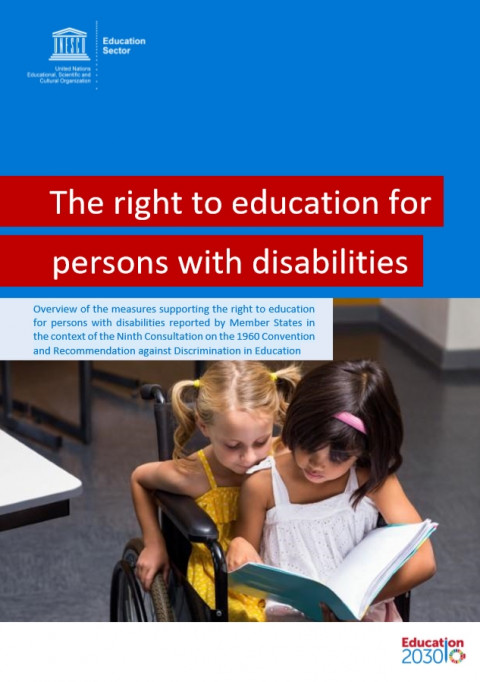 The Right to Education for Persons with Disabilities 발행 연도: 2019 단체 저자: UNESCO Persons with disabilities are often excluded from the education system, whether out-of-school entirely, educated in separate institutions or participating in a mainstream system which is not adapted to their needs and abilities. The 2030 Agenda commitment to ‘leave no one behind’ has reinforced the global discourse towards inclusive, equitable education. As part of its mandate, UNESCO monitors the implementation of the 1960 Convention and Recommendation against Discrimination in Education. During the Ninth Consultation on the implementation of this instrument, almost all Member States reported upon measures that they have taken in relation to the right to education for persons with disabilities. This document compiles practical examples extracted from these reports for information sharing and advocacy.
  Her Education, Our Future 발행 연도: 2019 단체 저자: UNESCO Too many girls and women are still held back by social norms and traditional school practices influencing their educational right and opportunities. But we know that their education is the most powerful investment to make for our collective future. Her education, our future is UNESCO’s new drive to accelerate action for girls’ and women’s education by leveraging political and financial commitments, as well as leadership for women and girls.Join #HerEducationOurFuture and be a part of our collective movement to advance girls’ and women’s education. Learn more: http://on.unesco.org/HerEducation
  World Reference Levels 발행 연도: 2019 단체 저자: UNESCO World Reference Levels (WRL) is a tool that facilitates the comparison of qualifications and skills.It helps those with a stake in the outcomes of learning - authorities, institutions, employers and individuals - to understand, compare and recognize skills, qualifications, other kinds of credential and learning achievements, both on a national level and across borders.The WRL is developed by UNESCO in collaboration with experts, international partners and regional organizations that oversee regional qualification frameworks. The tool is based on research of level descriptors in a wide range of qualification frameworks and job evaluation programmes, and was designed to complement and work together with other systems of managing and recognizing qualifications and outcomes.