
자료
세계시민교육에 대한 이해를 넓히고 연구, 옹호 활동, 교수, 학습 등을 향상시킬 수 있는 다양하고 유용한 자료를 찾아보세요.
32 건의 결과가 검색되었습니다
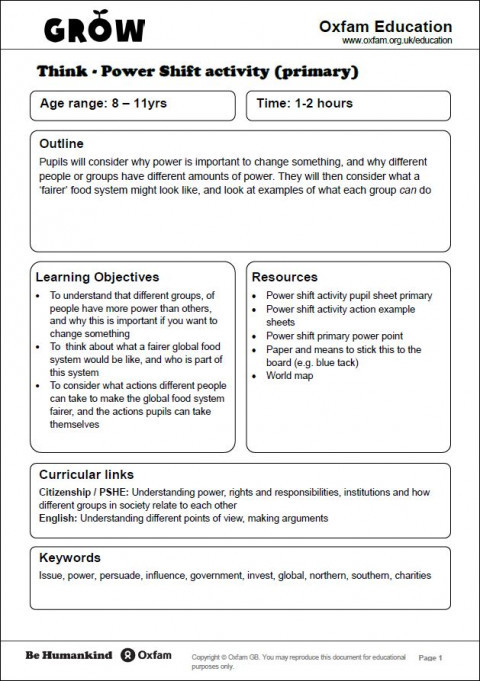 Think: Power-Shift Activity Teachers Guide for Primary Schools 단체 저자: Oxfam GB Linked to Oxfam's GROW campaign, the Food for Thought school resources get young people learning, thinking and taking action for a fairer food system.Through this activity pupils will consider why power is important to change something, and why different people or groups have different amounts of power. They will then consider what a ‘fairer’ food system might look like, and look at examples of what each group can do.
 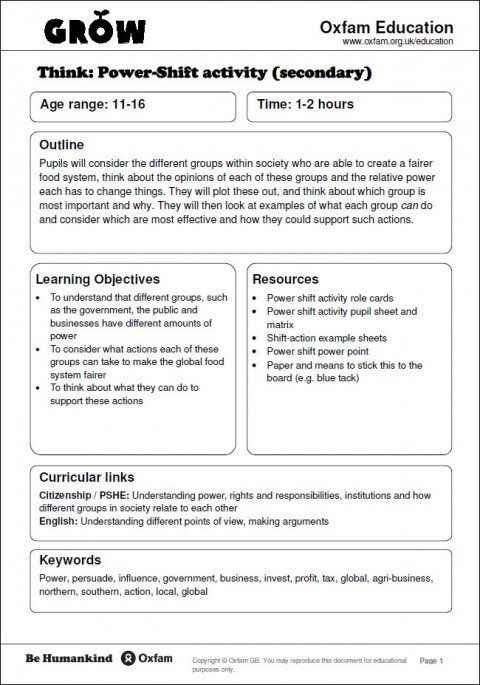 Think: Power-Shift Activity Teachers Guide for Secondary Schools 단체 저자: Oxfam GB Linked to Oxfam's GROW campaign, the Food for Thought school resources get young people learning, thinking and taking action for a fairer food system.Through this activity pupils will consider the different groups within society who are able to create a fairer food system, think about the opinions of each of these groups and the relative power each has to change things. They will plot these out, and think about which group is most important and why. They will then look at examples of what each group can do and consider which are most effective and how they could support such actions.
 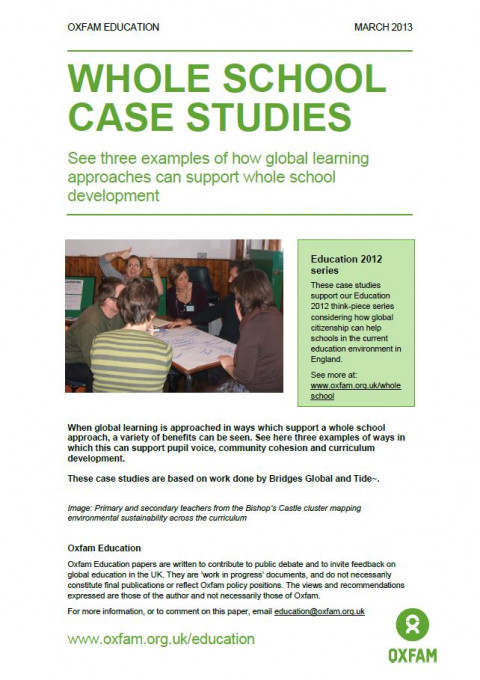 Whole School Case Studies: See Three Examples of How global Larning Approaches Can Support Whole School Development 발행 연도: 2013 단체 저자: Oxfam GB These case studies support our Education 2012 think-piece series considering how global citizenship can help schools in the current education environment in England.When global learning is approached in ways which support a whole school approach, a variety of benefits can be seen. See here three examples of ways in which this can support pupil voice, community cohesion and curriculum development.These case studies are based on work done by Bridges Global and Tide~.See more at: www.oxfam.org.uk/wholeschool
 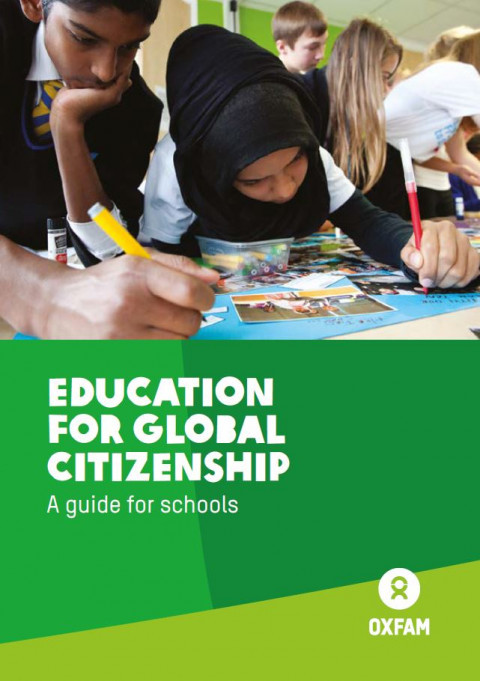 Education for Global Citizenship: A Guide for Schools 발행 연도: 2015 단체 저자: Oxfam GB Education for global citizenship supports young people to explore and question the world around them. It promotes critical thinking, advocates social justice and encourages learners to apply their learning to real-world issues.This guide is packed with practical information for mapping global citizenship across different subject areas and age groups. It also includes inspiring case studies from schools that take a global citizenship approach to teaching and learning.
  Global Citizenship in the Classroom: A Guide for Teachers 발행 연도: 2015 단체 저자: Oxfam GB This guide is packed with practical tools and advice for teachers wanting to embed global citizenship in their classrooms. Learn how to effectively bring a global lens into your teaching with our handy planning framework, participation methods, and tools to assess learning.Develop your teaching practice with both innovative and tried-and-tested approaches. Help your learners ask questions, make connections, and take action as active global citizens.
  Background: Using Photographs in the Classroom 단체 저자: Oxfam GB It's a universal truth that a picture tells a thousand words. Images and artefacts can help bring your lessons to life. They can challenge stereotypes, engender empathy and increase your learners' understanding of other countries and cultures.Explore how to effectively use photographs in your lessons to foster debate and promote positive images of the countries you're learning about.
  Maths and Global Citizenship 단체 저자: Oxfam GB Maths can help your learners better understand different people, places and patterns in the world. Teaching it with a global angle can also give an insight into how maths can be applied and used to address and inform real-world issues.This guide includes creative ideas for how global citizenship can be utilised in core areas of the curriculum like ratios and fractions, probability and number. It's also filled with innovative resources for use in your classroom.
  English and Global Citizenship 단체 저자: Oxfam GB English lessons are an opportunity for your learners to explore new and diverse cultures, hone their language skills and develop empathy.This guide includes ideas for learning about the world whilst improving speaking and listening, reading, writing and media literacy skills. It also contains handy links to further resources and ideas for books which can help capture your learners' imaginations.
 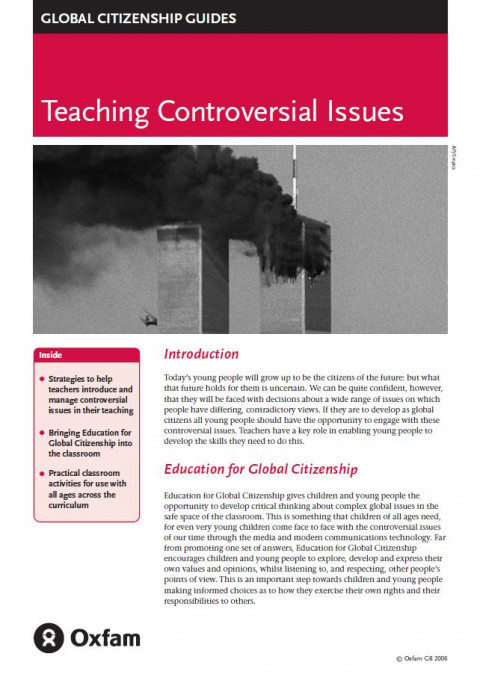 Global Citizenship Guides: Teaching Controversial Issues 발행 연도: 2006 단체 저자: Oxfam GB This guide aims to demonstrate how, by enhancing young people’s ability to handle controversial issues, teachers can support and develop them as global citizens.This guide explores:what controversial issues arewhy controversial issues should be taughtwhy some issues are, or can become, controversialwhat guidance exists for handling controversial issuesclassroom strategies for handling and exploring controversial issuessome practical activities for teaching controversial issues.
 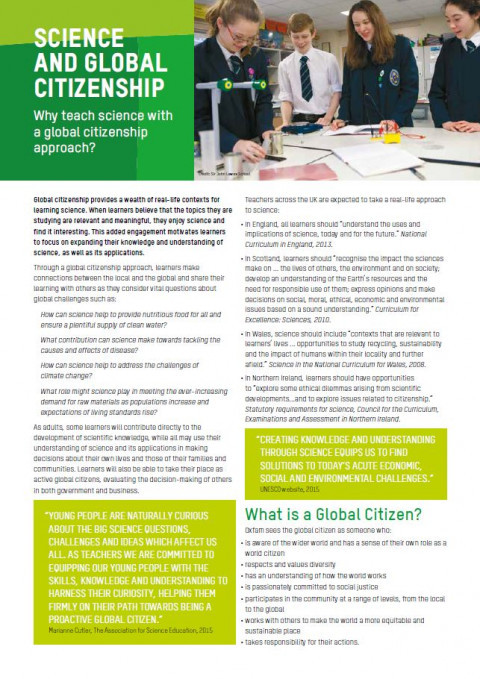 Science and Global Citizenship 단체 저자: Oxfam GB Nurturing global scientists is key to the creation of a clean and fairer world for the future. A global citizenship approach enables learners to appreciate the relevance of science and investigate how it can be used to answer vital questions to global challenges.This guide includes practical advice for embedding global citizenship in topic areas like health and disease, water and climate change. It also has handy links to teaching resources which can be used in your lessons.