
자료
세계시민교육에 대한 이해를 넓히고 연구, 옹호 활동, 교수, 학습 등을 향상시킬 수 있는 다양하고 유용한 자료를 찾아보세요.
518 건의 결과가 검색되었습니다
 National Consultation on the Situation of Prisons in Senegal: Improvement of the Condition of Detention, Social Integration and Prevention of Violent Extremism through Education, 23-24 May 2017, Dakar, Senegal: Report 발행 연도: 2017 단체 저자: UNESCO Dakar Sustainable Development Goal (SDG) 4 on education highlights the need to include our society’s most vulnerable and most margined members, such as prisoners, in order to ensure that all learners acquire the knowledge, skills, values and attitudes that are needed to build just, peaceful, and sustainable societies.The situation in Senegalese prisons is of a major concern given the overall condition of detention as well as the context of insecurity that characterizes the sector. In 2016, the country had 37 penal institutions for a total prison population of 9,422 prisoners (including pre-trial detainees and remand prisoners), of which approximately 200 were minors.1 Despite the efforts to humanize the prisons by adopting the name, “House of Arrest and Corrections” [Maison d'arrêt et de correction (MAC)] instead of the term "prison," and improving the living conditions in prisons, the fate of prisoners is not satisfactory. The reintegration promoted by Senegal's correctional facilities has largely consisted of a series of education programs, such as literacy and painting, developed by a number of organizations, but the space provided by prison administration, line Ministries, and NGOs are limited and the impact so far has been insufficient. A prison is not just a building, but it is also an instrument of rehabilitation to regain a place in society. This obviously requires the development of training, education and vocational guidance to support smooth reintegration into society.In this context, UNESCO's Dakar Regional Multi-Sectoral Office organized, in partnership with the Senegal National Commission for UNESCO and experts, a “National Consultation on the Situation of Prisons in Senegal: Improvement of the Condition of Detention, Social Integration, and Prevention of Violent Extremism through Education” in Dakar, Senegal, from 23 to 24 May 2017.
  Capacity Building Workshop on the Prevention of Violent Extremism through Education in West Africa and the Sahel: Final Report 발행 연도: 2017 단체 저자: UNESCO Dakar | Institut de la Francophonie pour l'éducation et la formation (IFEF) The capacity building workshop for the countries of West Africa and the Sahel, was organized in close collaboration with IICBA and APCEIU from 9 to 11 May 2017 in Dakar. The following countries participated in the meeting: Côte d’Ivoire, Cameroon, Guinea‐Bissau, Liberia, Mali, Mauritania, Niger, Senegal, Sierra Leone and The Gambia.This workshop was organized on the basis of a long‐standing partnership between UNESCO and the International Organization of La Francophonie (OIF), which strengthens its action on PVE. The regional workshop on capacity building for the prevention of violent extremism through education mainly used UNESCO materials and those for youth promoted by OIF. This workshop is a follow‐up to a similar initiative for education stakeholders of East and Southern Africa, organized in Addis Ababa in February 2017 by UNESCO through its International Institute for Capacity Building in Africa (IICBA).The overall objective of the workshop was to guide the countries of West Africa and the Sahel towards the Prevention of Violent Extremism (PVE). This includes familiarization with key issues, challenges, and opportunities identified to implement and further stimulate the implementation of the PVE strategy at the country level.
  Education and Disability: Analysis of Data from 49 Countries (UIS Information Paper No. 49) 발행 연도: 2018 단체 저자: UNESCO Institute for Statistics (UIS) Sustainable Development Goal (SDG) 4 calls for “inclusive and quality education for all”. Persons with a disability are among the population groups most likely to suffer from exclusion from education but data that permit an analysis of the links between disability and education remain scarce.This paper examines educational disparities linked to disability based on data from 49 countries and territories for five education indicators: Proportion of 15- to 29-year-olds who ever attended school Out-of-school rate (primary school age, lower secondary school age) Completion rate (primary education, lower secondary education) Mean years of schooling of the population 25 years and older Adult literacy rate (population 15 years and older)
 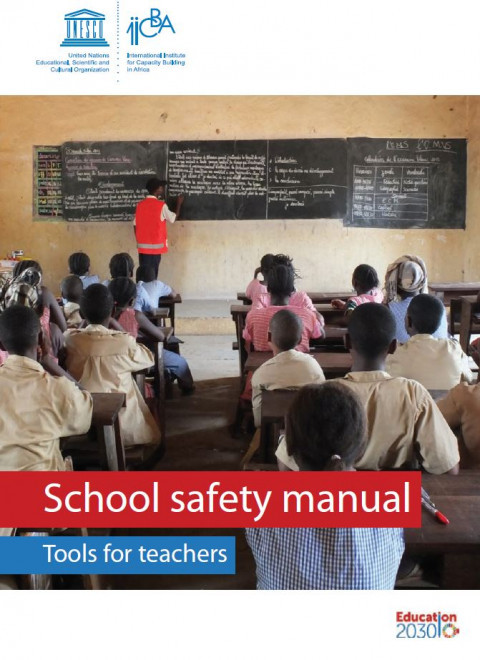 School Safety Manual: Tools for Teachers 발행 연도: 2017 단체 저자: UNESCO International Institute for Capacity-Building in Africa (IICBA) This manual was produced as part of the Teacher Training and Development for Peace-building in the Horn of Africa and Surrounding Countries project and aims to introduce teachers to the knowledge and skills needed for the establishment, maintenance and sustainment of basic school safety. As more children are enrolling in school in Africa, creating a safe and peaceful environment must be a top priority of teachers and educational institutions.The responsibility of schools to provide a safe environment for their students has been affirmed in the United Nations (UN) Sustainable Development Goal (SDG) four on Education.
 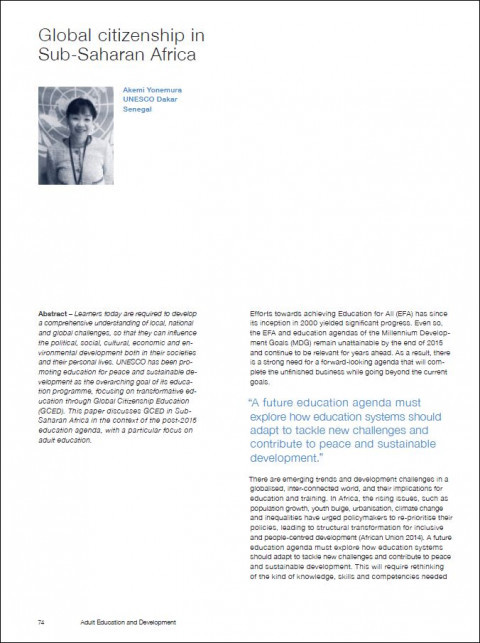 La citoyenneté mondiale en Afrique subsaharienne 발행 연도: 2015 저자: Akemi Yonemura 단체 저자: Éducation des Adultes et Développement Les apprenants doivent aujourd’hui bien comprendre les défis locaux, nationaux et mondiaux afin de pouvoir exercer une infl uence sur le développement politique, social, culturel, économique et environnemental, tant au sein de leurs sociétés que dans la vie privée. L’UNESCO a fait la promotion de l’éducation pour la paix et le développement durable en tant qu’objectifs fondamentaux de son programme d’éducation, se concentrant pour cela sur une éducation transformatrice par le biais de l’éducation à la citoyenneté mondiale (ECM). Cet article se penche sur l’ECM en Afrique subsaharienne dans le contexte du calendrier de l’éducation pour l’après-2015, et s’intéresse tout particulièrement à l’éducation des adultes.
  Dakar Office: Annual Report 2017 발행 연도: 2018 단체 저자: UNESCO Dakar Across the globe, the 2030 Agenda remains the unifying tool of the international community in the construction of a prosperous, peaceful, and sustainable world for all. The 17 Sustainable Development Goals are the expression of a shared global and transformative vision to change the world and improve the well-being of all peoples. UNESCO plays a transformative role in the implementation of this agenda, thanks to its education, culture, sciences and communication and information programmes.This annual report underlines the drive and spirit of our team in promoting innovation to uphold the 2030 and 2063 Agendas. It is a resounding testament to the unwavering forts of our team in 2017, and the depth of their commitment to advance the ideals and objectives of UNESCO.The 2017 Annual Report of the UNESCO Regional Office covers seven countries in the region: Burkina Faso, Cabo Verde, Guinea-Bissau, Niger, Senegal, The Gambia as well as Mali, supported by the national office in Bamako.
 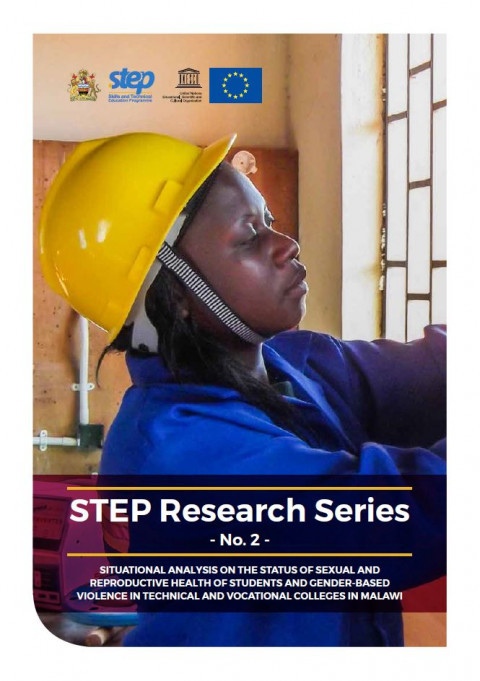 Situational Analysis on the Status of Sexual and Reproductive Health of Students and Gender-based Violence in Technical and Vocational Colleges in Malawi (STEP Research Series No. 2) 발행 연도: 2017 단체 저자: Skills and Technical Education Programme (STEP) Funded by the EU and implemented by UNESCO in collaboration with the Government of Malawi, the Skills and Technical Education Programme (STEP) is dedicated to reinforcing Technical, Entrepreneurial and Vocational Education and Training (TEVET) in Malawi.The programme will run from 2016-2020 and aims to improve TEVET at post-secondary level with a focus on equal access to enrolment, with particular emphasis on female learners; improving quality in the sector; and the establishment of clear governance structures. The STEP Research Series presents the highlights of the research undertaken by the programme.The situational analysis on the status of sexual and reproductive health of students and gender-based violence in technical and vocational colleges in Malawi is the second report in the STEP Research Series.
 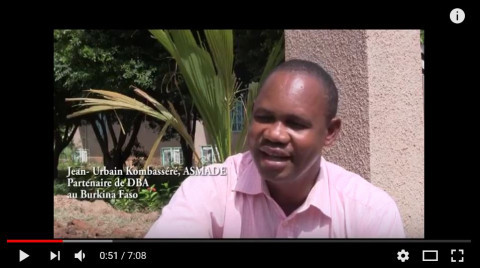 [Vidéo] L'éducation à la citoyenneté au Sud 발행 연도: 2016 단체 저자: ONG Défi Belgique Afrique (DBA) Un projet d'éducation au développement de la jeuness africaine
  [Vidéo] L'école apprend la citoyenneté 발행 연도: 2016 단체 저자: Mission laïque française Organisé au Maroc en mai 2016, le congrès du réseau d'enseignement français à l'étranger mlfmonde a réuni 300 personnes autour du thème "l'école apprend la citoyenneté", élément central du projet éducatif de la Mission laïque française.
 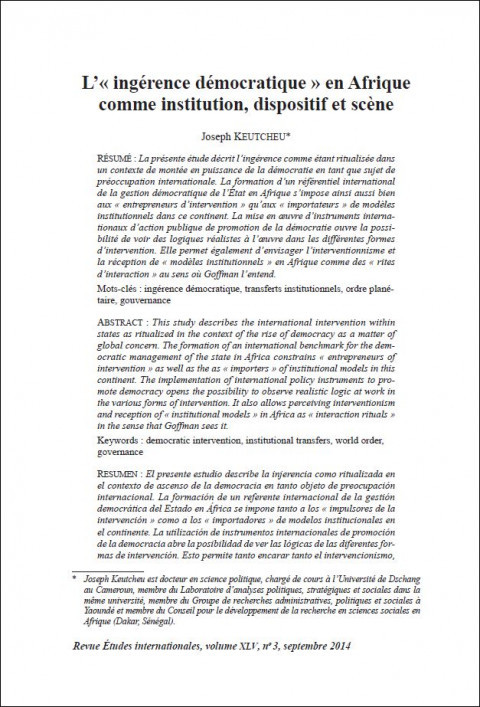 Democratic Interference in Africa as Institution and Context 발행 연도: 2014 저자: Joseph Keutcheu 단체 저자: Études internationales This study describes the international intervention within states as ritualized in the context of the rise of democracy as a matter of global concern. The formation of an international benchmark for the democratic management of the state in Africa constrains « entrepreneurs of intervention » as well as the as « importers » of institutional models in this continent. The implementation of international policy instruments to promote democracy opens the possibility to observe realistic logic at work in the various forms of intervention. It also allows perceiving interventionism and reception of « institutional models » in Africa as « interaction rituals » in the sense that Goffman sees it.