
자료
세계시민교육에 대한 이해를 넓히고 연구, 옹호 활동, 교수, 학습 등을 향상시킬 수 있는 다양하고 유용한 자료를 찾아보세요.
3,448 건의 결과가 검색되었습니다
 Bilingualism Between Mother Tongue (Arabic) Acquisition and Foreign Language (English) Learning 발행 연도: 2015 저자: Fuad Abdul Muttalib | Shafeeq Banat 단체 저자: AlMamon University College This research work considers the importance of learning of foreign languages, especially English, and their role in education, research, knowledge transfer, language and cultural growth. Language overlapping, between English and Arabic, leads sometimes to acute problems. To approach these problems, the work tries to discuss the acquisition of children of their mother tongue, its expansion and its use creatively in different disciplines.The work tackles the attraction of English to some experts in their fields, the thing that drives them to look suspiciously and down at Arabic accusing it of incompetence to catch up with new changes. Since language overlapping is an old problem, this has entailed a reference to Iben Khaldoun’s diagnosis of it with commentary. The work asserts eventually the essential use of Arabic as a language of education, research, culture and knowledge production, without neglecting foreign languages learning, above all English. The work is carried out in the light of the available studies on this issue.
  الأمة .. و اللغة الأم 발행 연도: 2016 저자: Odeh Khalil Abu Odeh يتحدث الكاتب بطريقة مختصرة عن أهمية اللغة الأم للأمم، ووجوب المحافظة عليها. ويشير للغة العربية كلغة يجب الاهتمام بها لما لها من دور في حفظ الثقافة. The Nation .. and the Mother Tongue 발행 연도: 2016 저자: Odeh Khalil Abu Odeh The author talks in a brief way about the importance of the mother tongue of nations, and the need to preserve it. And he refers to the Arabic language as a language that must be taken care of, given its role in preserving culture.
  OECD 학습 나침반 2030: 변혁적 역량과 민주시민교육의 접점 발행 연도: 2019 저자: 김아미 단체 저자: 경기도교육연구원 본 연구는 OECD 학습 나침반 2030(Learning Compass 2030)에서 논하는 변혁적 역량(transformative competencies)이 무엇을 의미하는지 살펴보고, 이에 대한 교육적 해석과 실천을 위해 민주시민교육과의 접점을 찾아 ‘변혁적 역량’을 지원할 수 있는 교육 방향 및 방안을 도출하고자 하였다. 또한 이를 통해 본 연구는 어린이·청소년인 학습자의 사회 변혁적 행동 능력 및 권리가 강조되는 국내외 맥락에서 교육적 대응을 위해 고려해야할 이슈들을 제안하는 것을 목적으로 한다.
  평화교육 사례 분석 및 실행방안 연구 발행 연도: 2017 저자: 김영철 | 김성오 | 박숙영 | 정주진 단체 저자: 경기도교육연구원 우리 사회와 학교 현장의 다양한 차별과 폭력 문제는 평화교육이 절실함을 보여준다. 민주시민을 키워야 할 학교에서는 평화교육을 접목시켜 민주시민교육을 강화하면서, 평화적 감수성과 태도, 능력을 고르게 함양토록 할 필요가 있다. 본 연구에서는 다양한 평화교육의 국내외 사례를 분석하여 창의적이고 포괄적인 실행 방안을 모색하였다.
  Innovating Technical and Vocational Education and Training: A Framework for Institutions 발행 연도: 2020 단체 저자: UNESCO International Centre for Technical and Vocational Education and Training (UNEVOC) Global developments including the transition to greener economies, the application of digital technologies in the world of work, and the COVID-19 pandemic, amongst others, are changing the way we live and work. These developments are driving technical and vocational education and training (TVET) systems to improve their capacity to identify the future skills demands and to expand access to skills development opportunities. As TVET adapts itself to the impacts of significant social, environmental, and economic disruptions, innovative practices emerge with the potential to rejuvenate the future of skills development. Schools, training centres and colleges have the potential to play a leading role to drive innovation in their local skills and innovation ecosystem.This practical guide provides a systematic, institution-wide, measurable and evidence-based methodology that enables TVET institutions to streamline innovation into their strategic planning, products and services, ecosystem engagement, and teaching and learning processes.
 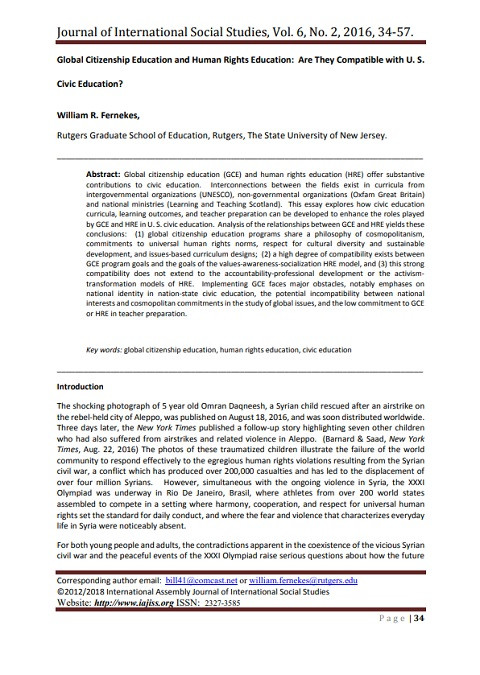 Global Citizenship Education and Human Rights Education: Are They Compatible With U. S. Civic Education? (Journal of International Social Studies; Vol. 6, No. 2) 발행 연도: 2016 저자: William R. Fernekes 단체 저자: International Assembly of the National Council for the Social Studies Global citizenship education (GCE) and human rights education (HRE) offer substantive contributions to civic education. Interconnections between the fields exist in curricula from intergovernmental organizations (UNESCO), non-governmental organizations (Oxfam Great Britain) and national ministries (Learning and Teaching Scotland). This essay explores how civic education curricula, learning outcomes, and teacher preparation can be developed to enhance the roles played by GCE and HRE in U. S. civic education. Analysis of the relationships between GCE and HRE yields these conclusions: (1) global citizenship education programs share a philosophy of cosmopolitanism, commitments to universal human rights norms, respect for cultural diversity and sustainable development, and issues-based curriculum designs; (2) a high degree of compatibility exists between GCE program goals and the goals of the values-awareness-socialization HRE model, and (3) this strong compatibility does not extend to the accountability-professional development or the activismtransformation models of HRE. Implementing GCE faces major obstacles, notably emphases on national identity in nation-state civic education, the potential incompatibility between national interests and cosmopolitan commitments in the study of global issues, and the low commitment to GCE or HRE in teacher preparation.
 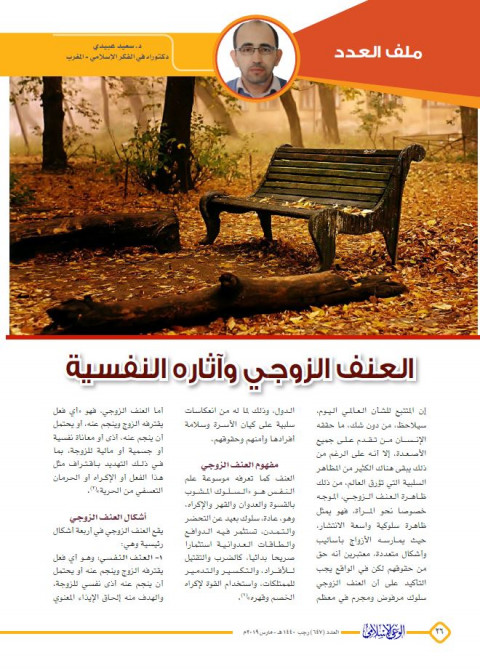 العنف الزوجي وآثاره النفسية 발행 연도: 2019 저자: Saeed Abidi 단체 저자: Journal of Islamic awareness يناقش هذا المقال العنف الأسري من حيث المفهوم والأشكال. ويبحث أيضا في العوامل المسببة للعنف الزوجي. وينتهي المقال بمناقشة الأثار المترتبة على العنف الزوجي. Marital Violence and Its Psychological Impact 발행 연도: 2019 저자: Saeed Abidi 단체 저자: Journal of Islamic awareness This article discusses domestic violence in terms of its concept and forms. It also examines the factors causing marital violence. The article ends with a discussion of the implications of marital violence.
  Research in Teaching and Learning About the Holocaust: A Dialogue Beyond Borders 발행 연도: 2017 저자: Monique Eckmann | Doyle Stevick | Jolanta Ambrosewicz-Jacobs 단체 저자: International Holocaust Remembrance Alliance (IHRA) | Metropol A multilingual expert team of the International Holocaust Remembrance Alliance (IHRA) collected and reviewed research on teaching and learning about the Holocaust in fifteen languages identified nearly 400 studies resulting in more than 600 publications.This systematic review includes research conducted in most IHRA Member Countries as well as several non-member countries. The multilingual focus of the project enables cross-cultural analyses and the transfer of knowledge between various regions and countries. The book’s two parts present the research first by language and then by selected themes. This innovative transnational, trans-lingual study reflects IHRA’s core mission: to shape and advance teaching and learning about the Holocaust worldwide.The second outcome is a set of bibliographies in fifteen languages. These bibliographies comprise references to empirical research on teaching and learning about the Holocaust. They also include abstracts or summaries of most of publications. Each bibliography includes research from a single language or related group of languages.