
자료
세계시민교육에 대한 이해를 넓히고 연구, 옹호 활동, 교수, 학습 등을 향상시킬 수 있는 다양하고 유용한 자료를 찾아보세요.
2,193 건의 결과가 검색되었습니다
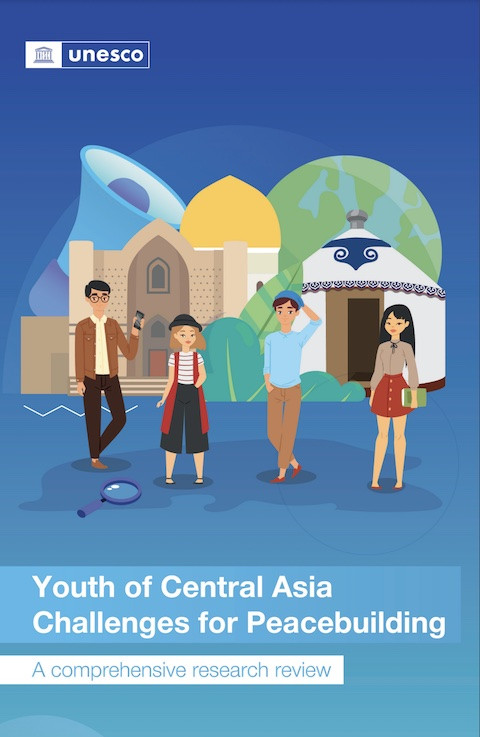 Youth of Central Asia, Challenges for Peacebuilding: A Comprehensive Research Review 발행 연도: 2021 저자: Laura Yerekesheva 단체 저자: UNESCO The estimations are that by 2030, the world will be home to 1.3 billion young people. This speaks about the importance of the youth for development in various parts of the globe, particularly in developing countries which constitute 90% of the global youth population. From comprehensive holistic perspective peace, peacebuilding and dialogue embrace all aspects and dimensions of life – inter-generational, social, economic, political, ethnic, religious, civic, ideological, cultural, and natural. The youth related issues are directly linked with the SDGs agenda. Central Asian states are also on the list of developing countries, with an increasing demographic share of the youth in the general population, meaning that the countries of the region are “young.” As of 2020, the total population of the four countries of Central Asia (Kazakhstan, Kyrgyzstan, Tajikistan and Uzbekistan) was 68.46 million, of which youth comprised 16.55 million or 24,1%. What Challenges for Peacebuilding the Youth of Central Asia Face? This highlights the urgency required for elaborating and implementing special policies on youth development. For Central Asia, the peace and peacebuilding agenda is the development agenda, and vice versa, as neither is possible without the other, and these in turn are intrinsically linked with youth-related issues. This report provides a detailed overview of the existing challenges to the youth of the 4 countries of the region – Kazakhstan, Kyrgyzstan Tajikistan, Uzbekistan – structured around three main themes of peacebuilding: (1) an education and learning environment; (2) economic and social participation; and (3) civic engagement. Governments, international organizations, professionals and policymakers in the youth, peacebuilding and development sectors, academia and NGOs are invited to join forces to accelerate the achievement of youth development for a more just, sustainable and peaceful future. Молодежь Центральной Азии, Вызовы миростроительству : Комплексный исследовательский обзор 발행 연도: 2021 저자: Laura Yerekesheva 단체 저자: Организация Объединенных Наций по вопросам образования, науки и культуры (UNESCO) По оценкам, к 2030 году в мире будут проживать 1,3 миллиарда молодых людей. Это говорит о важной роли, которую будет играть молодежь, особенно в развивающихся странах, в которых проживает 90% общего мирового населения молодежи. В рамках всеобъемлющего системного подхода, мир, миростроительство и диалог подразумевают все аспекты и измерения жизни - межпоколенческие, социальные, экономические, политические, этнические, религиозные, гражданские, идеологические, культурные и природные. Вопросы, связанные с молодежью, напрямую связаны с повесткой в области достижения Целей устойчивого развития (ЦУР). Государства Центральной Азии относятся к развивающимся странам с высокой долей молодежи в общем составе населения, что делает эти страны «молодыми». По состоянию на 2020 год общая численность населения четырех стран Централь ной Азии (Казахстана, Кыргызстана, Таджикистана и Узбекистана) - 68,46 миллиона человек, из которых молодежь составляла 16,55 миллиона человек или 24,1%.Это свидетельствует о важности разработки и реализации специальных стратегий и мер по развитию молодежи. Для Центральной Азии повестка дня в области мира и миростроительства – это, прежде всего, повестка дня в области развития, и наоборот, поскольку обе они взаимосвязаны между собой, а также с проблемами молодежи.В данном отчете представлен подробный обзор существующих вызовов, с которыми сталкивается молодежь четырех стран региона - Казахстана, Кыргызстана, Таджикистана, Узбекистана. Данные вызовы структурированы вокруг трех основных тем миростроительства: (1) образование и обучающая среда; (2) экономическое и социальное участие; и (3) гражданское участие.Правительствам, международным организациям, специалистам и политикам, работающим в сферах молодежи, миростроительства и развития, академическим кругам и неправительственным организациям предлагается объединить усилия для ускорения достижения целей развития молодежи для более справедливого, устойчивого и мирного будущего.
 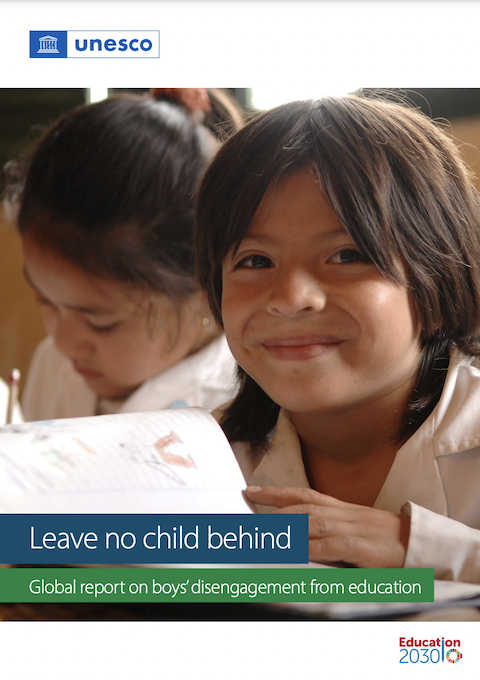 Leave No Child Behind: Global Report on Boys’ Disengagement From Education 발행 연도: 2022 단체 저자: 유네스코 The 2030 Agenda for Sustainable Development makes the promise to leave no one behind. While improving educational opportunities for girls globally continues to be of paramount importance to achieve gender equality in and through education, this focus on achieving gender parity and equality must not ignore boys. No less than 132 million boys of primary and secondary school age are out of school. To leave no child behind, UNESCO developed the first global report of this scope on boys’ disengagement from education, bringing together qualitative and quantitative evidence from over 140 countries. As this report shows, addressing boys’ disengagement from and disadvantage in education is not a zero-sum game. Supporting boys does not mean that girls lose out and vice versa. Addressing boys’ disengagement from and disadvantage in education not only benefits boys’ learning, employment opportunities, income and well-being, but it also benefits girls and the broader society.
 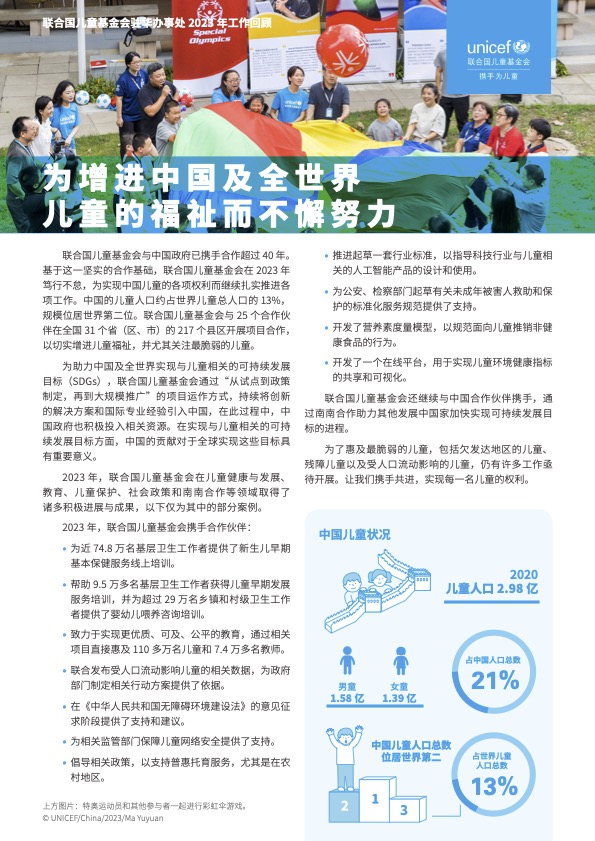 为增进中国及全世界儿童的福祉而不懈努力: 联合国儿童基金会驻华办事处2023年工作回顾 발행 연도: 2024 단체 저자: 联合国儿童基金会 联合国儿童基金会与中国政府已携手合作超过40年。基于这一坚实的合作基础,联合国儿童基金会在2023年笃行不怠,为实现中国儿童的各项权利而继续扎实推进各项工作。中国的儿童人口约占世界儿童总人口的13%,规模位居世界第二位。联合国儿童基金会与25个合作伙伴在全国31个省(区、市)的217个县区开展项目合作,以切实增进儿童福祉,并尤其关注最脆弱的儿童。为助力中国及全世界实现与儿童相关的可持续发展目标(SDGs),联合国儿童基金会通过“从试点到政策制定,再到大规模推广”的项目运作方式,持续将创新的解决方案和国际专业经验引入中国,在此过程中,中国政府也积极投入相关资源。在实现与儿童相关的可持续发展目标方面,中国的贡献对于全球实现这些目标具有重要意义。2023年,联合国儿童基金会在儿童健康与发展、教育、儿童保护、社会政策和南南合作等领域取得了诸多积极进展与成果,以下仅为其中的部分案例。2023年,联合国儿童基金会携手合作伙伴:为近74.8万名基层卫生工作者提供了新生儿早期基本保健服务线上培训。帮助9.5万多名基层卫生工作者获得儿童早期发展服务培训,并为超过29万名乡镇和村级卫生工作者提供了婴幼儿喂养咨询培训。致力于实现更优质、可及、公平的教育,通过相关项目直接惠及110多万名儿童和7.4万多名教师。联合发布受人口流动影响儿童的相关数据,为政府部门制定相关行动方案提供了依据。在《中华人民共和国无障碍环境建设法》的意见征求阶段提供了支持和建议。为相关监管部门保障儿童网络安全提供了支持。倡导相关政策,以支持普惠托育服务,尤其是在农村地区。推进起草一套行业标准,以指导科技行业与儿童相关的人工智能产品的设计和使用。为公安、检察部门起草有关未成年被害人救助和保护的标准化服务规范提供了支持。开发了营养素度量模型,以规范面向儿童推销非健康食品的行为。开发了一个在线平台,用于实现儿童环境健康指标的共享和可视化。联合国儿童基金会还继续与中国合作伙伴携手,通过南南合作助力其他发展中国家加快实现可持续发展目标的进程。为了惠及最脆弱的儿童,包括欠发达地区的儿童、残障儿童以及受人口流动影响的儿童,仍有许多工作亟待开展。让我们携手共进,实现每一名儿童的权利。
 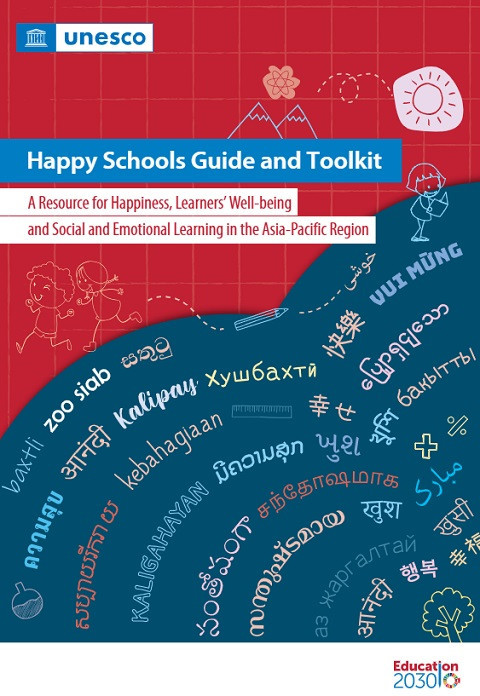 دليل ومجموعة أدوات المدارس السعيدة رافد ومصدر للسعادة ورفاه المتعلم والتعلم الاجتماعي والعاطفي في منطقة آسيا والمحيط الهادئ 발행 연도: 2021 단체 저자: UNESCO | UNESCO Bangkok تم إعداد هذا الدليل بــهدف دعم المعــلمين والقــادة فــي مجالــي التعــليم األساســي والثــانوي فــي جميــع مناطــق آسيــا والمحيط الهــادئ فــي التــفكير فــي كيفيــة إنشــاء مدرســة ســعيدة، وهو بذلك يستند علــى عدة ركائز إلطــار عمل المدارس الســعيدة. وفــي حين أن دليل المدارس الســعيدة يستــهدف قــادة المدارس والمعــلمين فيمــا يتعلــق بــالمستوى اإلداري وتطوير عــلوم التربيــة، فــإن مجموعــة أدوات المدرســة الســعيدة قد صممت للمعــلمين علــى مستوى الصف الدراســي. Happy Schools Guide and Toolkit: A Resource for Happiness, Learners’ Well-Being and Social and Emotional Learning 발행 연도: 2021 단체 저자: UNESCO | UNESCO Bangkok The Happy Schools Guide and Toolkit is designed to support teachers and school leaders in primary and secondary schools across the Asia-Pacific region, in thinking about how they can create their own Happy School. It has therefore drawn from aspects of the Happy Schools Framework, which can be most readily addressed at the school level. While the Happy Schools Guide is targeted towards school leaders and teachers at the school level of administration and pedagogy development, the Happy Schools Toolkit is conceived for teachers at the classroom level.
 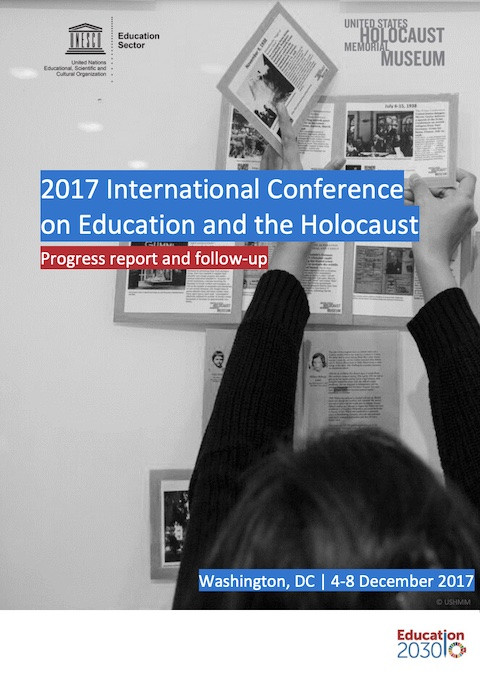 2017 International Conference on Education and the Holocaust: Progress Report and Follow-up 발행 연도: 2018 단체 저자: UNESCO | United States Holocaust Memorial Museum (USHMM) From December 4-8 2017, UNESCO and the United States Holocaust Memorial Museum (USHMM) jointly organized the second International Conference on Education and the Holocaust (ICEH) in Washington, DC. The conference brought together 26 participants from 10 countries with the goal of strengthening their capacities to advance education about the Holocaust and genocide in their respective countries. Of great importance was the relevance of this education within the teams’ national contexts. The conference ultimately led to the development of 10 country-specific initiatives. The 2017 ICEH cohort comprises representatives of institutions from Argentina, Colombia, India, Indonesia, Kenya, Mexico, Namibia, South Africa, Tunisia and Ukraine.
  Перспективы развития сотрудничества республики Узбекистан и ООН в обеспечении экологических прав человека (ORIENS; Выпуск 3, № 5) 발행 연도: 2023 저자: Арзиев Алишер Бахритдинович В данной статье раскрываются основные аспекты направления сотрудничества Республики Узбекистан и ООН в обеспечении экологических прав человека. Рассмотрена и проанализирована деятельность государства в реализации международных проектов и нормативно-правовой активности, направленных на сохранение окружающей среды, экологического климата и здоровья граждан. Определены основные проблемы, являющиеся наиболее актуальными на сегодняшний день в сфере защиты экологических прав человека.
  Technical Note on the Implementation of the Convention on the Rights of Persons with Disabilities in Uzbekistan 발행 연도: 2023 단체 저자: World Bank This compilation of technical briefs lays out the key problems faced by persons with disabilities in Uzbekistan under all areas of life and formulates detailed recommendations, providing the evidence base for a Strategic Note that aims to guide Uzbekistan's next five-year National Action Plan (NAP) for implementing the United Nations Convention on the Rights of Persons with Disabilities (CRPD). Технические справки по имплементации Конвенции о правах инвалидов 발행 연도: 2023 단체 저자: World Bank В этом сборнике девяти отраслевых технических справок очень подробно анализируются проблемы, с которыми сталкиваются лица с инвалидностью в Узбекистане во всех сферах жизни, и формулируются подробные рекомендации, обеспечивающие доказательную базу для Стратегической записки, которая призвана служить ориентиром для следующего пятилетнего Национального плана действий Узбекистана (НПД) по имплементации Конвенции Организации Объединенных Наций о правах инвалидов (КПИ) в стране.