
자료
세계시민교육에 대한 이해를 넓히고 연구, 옹호 활동, 교수, 학습 등을 향상시킬 수 있는 다양하고 유용한 자료를 찾아보세요.
2,161 건의 결과가 검색되었습니다
 Covering Hate Speech: A Guide for Journalists 발행 연도: 2025 저자: Cherian George 단체 저자: UNESCO This guide is the first in a series of guides for journalists prepared jointly by the UNESCO Communication and Information and Education Sectors on covering hate speech and its different manifestations.This guide explains what may count as hate speech, the harms it may cause, the way it works, and how media gatekeepers and other actors can address it. Many debates around hate speech are about law and regulation. Understanding the law, especially international law, can help journalists when reporting incidents where speakers are accused of hate speech. It can also help them analyse whether existing laws, as written and as applied, comply with international human rights approaches for striking the right balance between freedom of expression and the right to dignity, equality and non-discrimination.
  Как писать о языке ненависти: руководство для журналистов 발행 연도: 2025 저자: Cherian George 단체 저자: UNESCO Настоящее руководство — первое из серии, подготовленной совместно Секторами коммуникации и информации и образования ЮНЕСКО, и посвящено освещению журналистами языка ненависти и его различных проявлений.В настоящем руководстве рассматриваются определения языка ненависти, вред, который он может причинять, механизмы его распространения, а также способы, с помощью которых представители СМИ и другие заинтересованные стороны могут ему противодействовать. Вокруг языка ненависти нередко возникают правовые споры. Знание законодательства, особенно международного, помогает журналистам освещать случаи, когда кого-либо обвиняют в использовании языка ненависти, а также анализировать, соответствуют ли действующие нормы — как в теории, так и на практике — международным стандартам прав человека, где необходимо находить баланс между свободой выражения и правами на достоинство, равенство и недопущение дискриминации.
  Strategies to Counter Antisemitism: A Handbook for Educators 발행 연도: 2025 단체 저자: UNESCO Education is the first line of defence against hate and prejudice. By targeting the root causes of hate ideologies, deconstructing the stereotypes that underlie them from an early age, and promoting inclusive models, education is the keystone of a holistic approach to combating discrimination. Tackling antisemitism through education requires tailored content that addresses its complex, shifting and multilayered forms, both past and present.Acknowledging the topic’s complexity and the paucity of resources available to education stakeholders, this concise guide developed by UNESCO and funded by the European Commission aims to provide a roadmap for policymakers, curriculum developers and educators on current approaches and initiatives. It presents ten educational practices, each grounded in academic literature and illustrated by a promising educational initiative that operationalizes core pedagogical principles. The handbook is built around the three core learning domains which inform UNESCO’s approach to Global Citizenship Education: cognitive, socio-emotional, and behavioural learning.Conceived as an accessible operational guide for practitioners, this resource sets out to start a larger conversation about the needs of educators for tackling contemporary forms of antisemitism. It aims to encourage investments in high-quality empirical research that can pave the way for a better approach to combat antisemitism.
  Mainstreaming the General History of Africa into Education Systems: The Curriculum Pathway 발행 연도: 2025 단체 저자: UNESCO Education about the history of Africa in formal, non-formal and informal learning settings continues to be dominated by Eurocentric perspectives, which has led to imbalanced representation of Africa’s history and preconceptions.This publication is a tool to support countries in challenging the skewed perspectives on how African history is taught and how Africa is perceived. It aims to bring to the foreground Africa’s history, cultures and heritage through the curriculum to strengthen knowledge, skills, values and attitudes that contribute towards addressing long-standing hegemonic, colonial thinking and connected racial bias, while forging a united, prosperous and peaceful Africa and world.Stemming from the decolonial vision and content of the volumes of the General History of Africa, the publication proposes guiding principles and approaches for designing and implementing the General History of Africa into the curriculum. It puts forth curriculum outlines for basic and secondary education to offer renewed and broader perspectives on the history of Africa and its diasporas, and their contributions to humanity.The curriculum outlines are structured around nine thematic Learning Units, arranged chronologically from the origins of humanity and civilizations to Africa’s most recent history.
  Building Strong Foundations: How to Include the Whole School in Foundational Education for Health and Well-being (Building Strong Foundations Brief; 3) 발행 연도: 2024 단체 저자: UNESCO | United Nations Children's Fund (UNICEF) In a rapidly changing world, establishing strong foundations for children is vital for their well-being and resilience. Quality education is central to this endeavour and is the key to lifelong health and success. Recognizing that children thrive in the classroom when they are in good health, it is crucial to learn about health and well-being early on in primary schools. The Building Strong Foundations briefs, developed jointly by UNESCO and UNICEF, provide evidence-based guidance to support primary school-aged children to thrive through foundational education for health and well-being. Drawing from extensive research and consultations with leading experts from various fields and across the world, these briefs serve as a roadmap for education stakeholders to equip learners with the requisite knowledge and skills to navigate their current and future health and well-being needs. The present document is the third of four briefs. It explores how a whole-school approach to health and well-being in primary schools generates significant impacts on learners’ health, well-being and education. The brief shares practical guidance and case studies to distill six essential elements for an effective whole-school approach to health and well-being.
 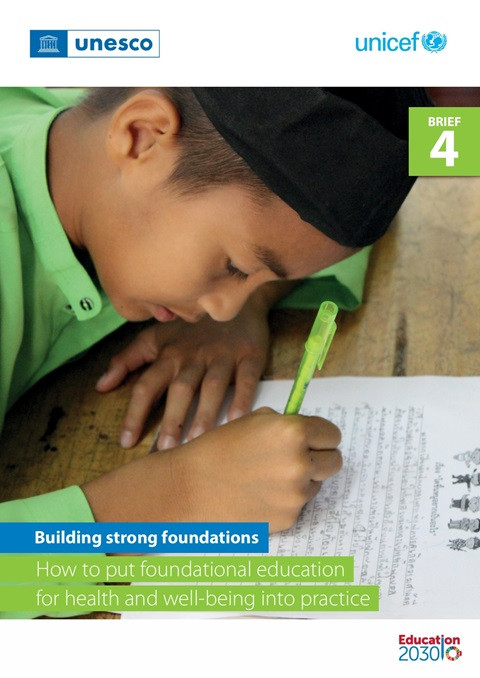 Building Strong Foundations: How to Put Foundational Education for Health and Well-being into Practice (Building Strong Foundations Brief; 4) 발행 연도: 2024 단체 저자: UNESCO | United Nations Children's Fund (UNICEF) The African Union’s designation of 2024 as the Year of Education highlights the critical importance of education for equipping young Africans with the skills essential for their own and for the continent’s development. It is also a recognition of the multiple challenges ahead before every child can complete primary school having acquire the foundational skills that open the door for lifelong learning. Currently the out-of-school population is rising, one in five children do not complete primary school and, of those who do, only about one in five achieve minimum proficiency in reading and mathematics. African countries have set targets on primary completion and foundational learning but to effectively translate their ambitions into results, the 2024 Spotlight continental report emphasizes the importance of coherence between their curricula, textbooks, teacher guides and assessments. It evaluates the alignment of these policy documents with each other but also with a global standard of what students are expected to know and by when. It also assesses how these key documents are used in classrooms and what the implications are for children’s opportunities to learn. This report is the second in a series of three envisaged between 2022 and 2025, each covering some 12 countries of which a selection is examined in depth, in dialogue with education ministries and national stakeholders. The focus countries for this second Spotlight report cycle were Mauritania, Niger, South Africa, Uganda, and Zambia. The statistics and analysis presented in this publication aim to feed into the policy dialogue mechanism under the auspices of the African Union and its Continental Education Strategy for Africa. In particular, the Spotlight series aims to spark debate on foundational learning among African countries and encourage them to identify areas for joined action, given that they share a lot of policy challenges.
  Mainstreaming Social and Emotional Learning in Education Systems: Policy Guide; Highlights 발행 연도: 2024 단체 저자: UNESCO UNESCO’s policy guide unpacks social and emotional learning (SEL) as a broadening of the educational process, from a focus on cognitive aspects to a balance between cognitive, social and emotional, and behavioural dimensions of learning, putting forward initial action ideas to guide its systematic mainstreaming in education. It builds on and extends previous work undertaken by UNESCO on SEL from the perspective of Global Citizenship Education (GCED) and Education for Sustainable Development (ESD), Building Strong Foundations for Health and Well-being Education, the Happy Schools Framework, and in multiple UNESCO Offices and Institutes.
  UNESCO Framework for Culture and Arts Education: Implementation Guidance 발행 연도: 2025 단체 저자: UNESCO Culture and the arts are integral to inclusive, equitable and quality education. They nurture creativity, critical thinking, and respect for cultural diversity, empowering learners to engage meaningfully with the world and to build more just, sustainable and peaceful societies. Yet, countries have not systematically incorporated culture and arts education across all levels of education. This Implementation guidance for the UNESCO Framework for Culture and Arts Education is a collective invitation to reimagine education by placing culture and the arts at its heart and advancing a transformative vision of education for all.Through a holistic approach, the Guidance supports the integration of culture and the arts across formal, non-formal and informal education, throughout life. It offers practical orientations to help Member States fulfil the commitment enshrined in the UNESCO Framework for Culture and Arts Education, adopted by Ministers of Culture and Education in 2024. With a global perspective, this Guidance will equip policy-makers, educators and cultural actors in developing inclusive, context-relevant policies, curricula and learning environments.The Guidance is a milestone on a shared journey, inviting countries to harness their cultural strengths, respond to emerging challenges, and work together towards a more inclusive education for all.
  Solidarity as the Future of Education: Perspectives From the Ibero-American Experience of Service-Learning 발행 연도: 2024 저자: Elena Massat 단체 저자: UNESCO | Latin American Center for Service-Learning (CLAYSS) With this work we have proposed to put into dialogue the recent UNESCO document “Reimagining our futures together. A new social contract for education. Report of the international commission on the futures of education” with the theory and practice of service-learning in Ibero-America. We would like to show how UNESCO's proposal for education for the future can already be verified as a practice in many educational institutions in the region, which develop solidarity service-learning projects even in the most vulnerable contexts. In these experiences, solidarity ceases to be just learning content, to become an educational process, a pedagogy to learn to solve complex problems of reality, and to use the SDGs as a “curriculum” for the education of the future (UNESCO, 2022:54). These practices are deeply innovative, as the experts who comment on them point out, and we hope that they can be inspiring for many other educational institutions. La solidaridad como futuro de la educación: Perspectivas desde la experiencia iberoamericana del aprendizaje-servicio 발행 연도: 2024 저자: Elena Massat 단체 저자: Organización de las Naciones Unidas para la Educación, la Ciencia y la Cultura (UNESCO) | Latin American Center for Service-Learning (CLAYSS) Con esta obra nos hemos propuesto poner en diálogo el reciente documento de la UNESCO “Reimaginar juntos nuestros futuros. Un nuevo contrato social para la educación. Informe de la comisión internacional sobre los futuros de la educación.” con la teoría y práctica del aprendizaje-servicio en Iberoamérica. Quisiéramos evidenciar de qué manera la propuesta de educación para el futuro de UNESCO se puede ya verificar como práctica en muchas instituciones educativas de la región, que desarrollan proyectos de aprendizaje-servicio solidario aún en los contextos de mayor vulnerabilidad. En estas experiencias, la solidaridad deja de ser sólo contenido de aprendizaje, para transformarse en proceso educativo, en pedagogía para aprender a solucionar problemas complejos de la realidad, y usar a los ODS como “currículo” de la educación del futuro (UNESCO, 2022:54). Estas prácticas son profundamente innovadoras, como lo señalan los expertos que las comentan, y esperamos que puedan ser inspiradoras para muchas otras instituciones educativas.