
자료
세계시민교육에 대한 이해를 넓히고 연구, 옹호 활동, 교수, 학습 등을 향상시킬 수 있는 다양하고 유용한 자료를 찾아보세요.
3,395 건의 결과가 검색되었습니다
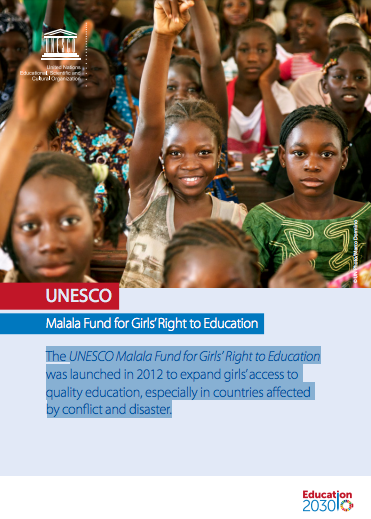 UNESCO Malala Fund for Girls' Right to Education 단체 저자: 유네스코 The UNESCO Malala Fund for Girls’ Right to Education was launched in 2012 to expand girls’ access to quality education, especially in countries affected by conflict and disaster.
  Repenser l'éducation: vers un bien commun mondial? 발행 연도: 2015 단체 저자: Organisation des Nations Unies pour l'éducation, la science et la culture (UNESCO) Les changements dans le monde d'aujourd'hui sont caractérisés par de nouveaux niveaux de complexité et de contradiction. Ces changements génèrent des tensions pour lesquelles il est prévu l'éducation pour préparer les individus et les communautés en leur donnant la possibilité d'adaptation et de réponse. Cette publication contribue à repenser l'éducation et l'apprentissage dans ce contexte. Elle se fonde sur l'une des principales tâches de l'UNESCO comme un observatoire mondial de la transformation sociale dans le but de stimuler le débat sur les politiques publiques. Il est un appel au dialogue entre tous les intervenants. Il est inspiré par une vision humaniste de l'éducation et du développement, fondée sur le respect de la vie et la dignité humaine, l'égalité des droits, la justice sociale, la diversité culturelle, la solidarité internationale et la responsabilité partagée pour un avenir durable. Ce sont les fondements de notre humanité commune. Ce livre améliore la vision fournie par les deux publications de point de repère de l'UNESCO: Apprendre à être: Le monde de l'éducation aujourd'hui et demain (1972), le «Rapport Faure», et l'apprentissage: Le trésor est caché dedans (1996), le «Rapport Delors».
  Replantear la educación: ¿Hacia un bien común mundial? 발행 연도: 2015 단체 저자: Organización de las Naciones Unidas para la Educación, la Ciencia y la Cultura (UNESCO) Los cambios del mundo actual se caracterizan por niveles nuevos de complejidad y contradicción. Estos cambios generan tensiones para las que la educación tiene que preparar a los individuos y las comunidades, capacitándolos para adaptarse y responder. Esta publicación contribuye a replantear la educación y el aprendizaje en este contexto. Parte de una de las tareas principales que tiene encomendada la UNESCO como observatorio mundial de las transformaciones sociales y tiene como objetivo fomentar los debates públicos sobre políticas.Es una llamada al diálogo entre todos los interesados. Se inspira en una concepción humanista de la educación y el desarrollo, basada en el respeto a la vida y a la dignidad humana, la igualdad de derechos, la justicia social, la diversidad cultural, la solidaridad internacional y la responsabilidad compartida de un futuro sostenible. Éstos son los fundamentos de nuestra humanidad común. El presente libro ahonda en la visión que presentaban dos publicaciones memorables de la UNESCO: Aprender a ser: la educación del futuro (1972), el ‘Informe Faure’; y La educación encierra un tesoro (1996), el ‘Informe Delors’.
  Переосмысливая образование: Образование как всеобщее благо? 발행 연도: 2015 단체 저자: Организация Объединенных Наций по вопросам образования, науки и культуры (UNESCO) Происходящие сегодня в мире изменения характеризуются новым уровнем слож-ности и противоречивости. Предполагается, что готовить отдельного человека и сообщества в целом к тому, чтобы жить в этом меняющемся мире, полном противо-речий, должно образование через развитие у людей способности адаптироваться и реагировать на происходящее вокруг. Настоящая публикация является вкладом в усилия, направленные на переосмысление образования и обучения в данном контексте. Ее авторы ставили перед собой цель стимулировать дискуссии по вопросам государственной политики в данной области, руководствуясь одной из основных задач ЮНЕСКО в качестве глобальной обсерватории процессов социальных преобразований.Этот документ является призывом к диалогу между всеми заинтересованными сторонами. Он продиктован гуманистическими представлениями об образовании и развитии на основе принципов уважения человеческой жизни и достоинства, равенства прав, социальной справедливости, разнообразия культур, международной солидарности и коллективной ответственности за устойчивое будущее. Эти принципы являются основой существования человеческого сообщества. Данный документ развивает идеи, содержащиеся в двух важнейших публикациях ЮНЕСКО: «Учиться быть» («Доклад Фора», 1972 г.) и «Образование: сокрытое сокровище» («Доклад Делора», 1996 г.).
  Human rights education in the school systems of Europe, Central Asia and North America: a compendium of good practice 발행 연도: 2009 단체 저자: Council of Europe | UNESCO | UN. Office of the United Nations High Commissioner for Human Rights (UN. OHCHR) | OSCE. Office for Democratic Institutions and Human Rights (ODIHR) “Human Rights Education in the School Systems of Europe, Central Asia and North America: A Compendium of Good Practice” is a compilation of 101 examples of good practice in human rights education in primary schools, secondary schools and teacher training institutions in the Organization for Security and Co-operation in Europe (OSCE) area, which is also covered by the United Nations Educational, Scientific and Cultural Organization (UNESCO), the Office of the United Nations High Commissioner for Human Rights (OHCHR) and, partially, the geographical mandate of the Council of Europe (CoE).The term “human rights education” is often used in this resource in a broader sense, to also include educationfor democratic citizenship and education for mutual respect and understanding, which are all based on internationally agreed human rights standards. These three areas are seen as interconnected and essential within educational systems in order to prepare youth to be active, responsible and caring participants in their communities, as well as at the national and global levels.Human rights education has been defined as education, training and information aimed at building a universal culture of human rights. A comprehensive education in human rights not only provides knowledge about human rights and the mechanisms that protect them, but also imparts the skills needed to promote, defend and apply human rights in daily life. Education for democratic citizenship focuses on educational practices and activities designed to help young people and adults to play an active part in democratic life and exercise their rights and responsibilities in society. Education for mutual respect and understanding highlights self-respect, respect for others, and the improvement of relationships between people of differing cultural traditions.This book aims to support quality teaching in these areas and to inspire educational policymakers (those working in education ministries and local school boards) and administrators, teachers, teacher trainers, non-formal educators and all other interested actors, as well as to facilitate networking and the exchange of experience among education professionals.
  글로벌시민교육: 새로운 교육의제 발행 연도: 2014 단체 저자: 유네스코 본 문서는 2013년 9월 9-10일 서울에서 개최된, 우리 정부(외교부, 교육부)와 유네스코가 공동 주최하고 유네스코 아시아태평양 국제이해교육원이 실행 기관으로 참여한 ‘글로벌 시민교육 전문가회의(Technical Consultation on Global Citizenship Education)에 기초하여 작성되었다. 본 문서에는 a) 사전 설문지에 대한 전문가들의 응답, b) 전문가들의 회의 발표(프레젠테이션) 내용, 3) 회의에서의 토론 내용 및 d) 참고 자료 및 레퍼런스가 수록되어 있다. 본 문서의 최종본은 파리 유네스코 본부의 ‘평화와 지속 가능 발전을 위한 교육(Education for Peace and Sustainable Development)’ 부서가 작성하였다.
  Education for peace: planning for curriculum reform; guidelines for integrating an education for peace curriculum into education sector plans and policies 발행 연도: 2015 단체 저자: UNESCO | UNESCO International Bureau of Education (IBE) | UNESCO International Institute for Educational Planning (IIEP) This Resource and Development Capacity Package was developed based on the belief that, as part of a wider social, economic and political effort, education can play a significant role in a country’s peace-building efforts. Its purpose is to assist Member States in integrating or strengthening peace education programs in their national education systems to promote peace and prevent future conflict. UNESCO, IBE, and IIEP developed this resource within the framework of UNESCO’s Intersectoral Project, Promoting a culture of peace and nonviolence in Africa through education for peace and conflict prevention. The Package contains Technical Guidelines and Capacity Development training modules on policy, program design and curriculum planning to integrate peace and conflict prevention into all aspects of the education system. It is meant for curriculum developers and planners from Africa. The development of the package received the support of the UNESCO Addis-Ababa Office, which assisted in the testing of materials in Addis-Ababa (Ethiopia) and Yaounde (Cameroon).This resource will furthermore help to ensure that curricula, teaching and learning resources and teacher education are in line with the post-2015 vision of education for holistic development. This vision reconceptualises education in terms of global citizenship and responsibility by focusing on inclusion and social cohesion that is global in orientation. In this regard, Global Citizenship Education (GCED) seeks to empower learners with knowledge, skills, values and attitudes that are needed to forge more just and inclusive societies, capable of resolving existing conflicts and emerging global challenges. Éducation pour la paix: la planification de la réforme du curriculum; lignes directrices pour l'intégration d'un programme d'éducation pour la paix dans les plans et politiques du secteur éducatif 발행 연도: 2015 단체 저자: Organisation des Nations Unies pour l'éducation, la science et la culture (UNESCO) | UNESCO International Bureau of Education (IBE) | UNESCO International Institute for Educational Planning (IIEP) Cette trousse de ressources et de développement des capacités a été élaborée sur la base de la conviction que, dans le cadre d'un effort plus large social, économique et politique, l'éducation peut jouer un rôle important dans les efforts de consolidation de la paix d'un pays. Son but est d'aider les États membres à intégrer ou renforcer les programmes d'éducation à la paix dans leurs systèmes nationaux d'éducation pour promouvoir la paix et prévenir les conflits futurs. UNESCO, le BIE, et l'IIPE ont développé cette ressource dans le cadre du projet intersectoriel de l'UNESCO, Promouvoir une culture de la paix et de la non-violence en Afrique par l'éducation pour la paix et la prévention des conflits. Le paquet contient des directives techniques et des modules de formation de renforcement des capacités sur la politique, la conception des programmes et de la planification des programmes pour intégrer la paix et de prévention des conflits dans tous les aspects du système d'éducation. Il est destiné aux concepteurs de programmes et les planificateurs de l'Afrique. Le développement de l'emballage a reçu le soutien du Bureau d'Addis-Abeba de l'UNESCO, qui a participé à l'essai des matériaux à Addis-Abeba (Ethiopie) et Yaoundé (Cameroun).Cette ressource sera en outre aider à faire en sorte que les programmes, les ressources d'enseignement et d'apprentissage et la formation des enseignants sont en ligne avec la vision post-2015 de l'éducation pour le développement holistique. Cette vision reconceptualise l' éducation en termes de citoyenneté et de responsabilité globale en mettant l'accent sur l'inclusion et la cohésion sociale qui est mondiale dans l'orientation. À cet égard, Éducation à la Citoyenneté Mondiale (ECM) vise à habiliter les apprenants des connaissances, des compétences, des valeurs et des attitudes qui sont nécessaires pour forger des sociétés plus justes et inclusives, capables de résoudre les conflits existants et nouveaux défis mondiaux.
  Educación para la ciudadanía mundial: temas y objetivos de aprendizaje 발행 연도: 2015 단체 저자: Organización de las Naciones Unidas para la Educación, la Ciencia y la Cultura (UNESCO) This publication, titled Global Citizenship Education: Topics and learning objectives, is the first pedagogical guidance from UNESCO on global citizenship education. It is the result of an extensive research and consultation process with experts from different parts of the world. This guidance draws on the UNESCO publication Global Citizenship Education: Preparing learners for the challenges of the 21st century and the outcomes of three key UNESCO events on global citizenship education: the Technical Consultation on Global Citizenship Education (September 2013), as well as the First and Second UNESCO Fora on Global Citizenship Education, organized in December 2013 and January 2015 respectively. Before it was finalized, the guidance was field-tested by education stakeholders in selected countries in all regions to ensure its relevance in different geographical and socio-cultural contexts. Following the foundational work of UNESCO to clarify the conceptual underpinnings of global citizenship education and provide policy and programmatic directions, this document has been developed in response to the needs of Member States for overall guidance on integrating global citizenship education in their education systems. It presents suggestions for translating global citizenship education concepts into practical and age-specific topics and learning objectives in a way that allows for adaptation to local contexts. It is intended as a resource for educators, curriculum developers, trainers as well as policy-makers, but it will also be useful for other education stakeholders working in non-formal and informal settings.
  Educação para a cidadania global: preparando alunos para os desafios do século XXI 발행 연도: 2014 단체 저자: UNESCO The United Nations Secretary-General’s Global Education First Initiative (GEFI) has established education as a means to ‘foster global citizenship’ – one of its three priority areas. To support this, UNESCO organized two landmark meetings on GCE in 2013. This publication aims to define the parameters of GCE by using the collective expertise, experience and wisdom of those participants who gathered at these landmark events, and to plan for future action in line with emerging thinking and other ongoing work. The review establishes that GCE has a critical role to play in equipping learners with competencies to deal with the dynamic and interdependent world of the twenty-first century. While GCE has been applied in different ways in different contexts, regions and communities, it has a number of common elements, which include fostering in learners. In formal settings, GCE can be delivered as an integral part of an existing subject (such as civic or citizenship education, social studies, environmental studies, geography or culture), or as an independent subject area. Integrated models appear to be more common. Some less traditional, but at least as effective, pathways for GCE have included the following: the use of information and communication technologies and social media, sport competitions and the use of art and music, and youth-led initiatives employing a wide variety of approaches. Both traditional and new horizons for GCE are profiled in this review. This publication also explores a number of enabling conditions for the promotion and implementation of GCE. These include: the existence of an open environment for universal values, the implementation of transformative pedagogy and support for youth-led initiatives. The review acknowledges that there are a number of ongoing tensions with the concepts of global citizenship and global citizenship education. While these tensions vary, they all point to the fundamental question of how to promote universality (e.g. common and collective identity, interest, participation, duty), while respecting singularity (e.g. individual rights, self-improvement). Some ways forward to resolve these tensions are suggested, whilst maintaining that challenges around theoretical elements of GCE should not undermine its practice. The processes documented in this publication have strengthened partnerships, built coalitions and contributed to improving the evidence base on the theory and practice of global citizenship education. While there are tasks that remain, this foundation bodes well for improving the enabling conditions and the practices highlighted in this review. By preparing learners to fulfil their potential in an increasingly globalized world, we are promoting transformed societies that are also better equipped to deal with the twenty-first century challenges and to seize twenty-first century opportunities.