
자료
세계시민교육에 대한 이해를 넓히고 연구, 옹호 활동, 교수, 학습 등을 향상시킬 수 있는 다양하고 유용한 자료를 찾아보세요.
3,433 건의 결과가 검색되었습니다
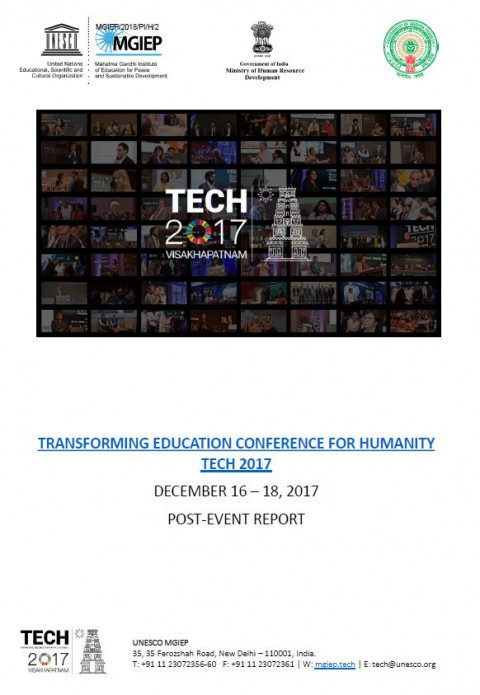 Transforming Education Conference for Humanity: TECH 2017, December 16-18, 2017; Post Event Report 발행 연도: 2018 단체 저자: Mahatma Gandhi Institute of Education for Peace and Sustainable Development (MGIEP) The three-day Transforming Education Conference for Humanity (TECH) 2017 organised by UNESCO Mahatma Gandhi Institute of Education for Peace and Sustainable Development (MGIEP) was held at Novotel Varun Beach, Visakhapatnam City, State of Andhra Pradesh, India from December 16 – 18, 2017. The first edition of TECH focused on digital pedagogies for building peaceful and sustainable societies through 21st century skills, schools and policies, towards achieving the United Nations Sustainable Development Goal 4, Target 7.TECH 2017 was attended by over 1,700 registered participants (including teachers, educators, learners, policy-makers, technology and gaming experts, amongst others) from 75 countries and witnessed highly engaging deliberations on the future of education, particularly on the innovative methods of teaching using technology.The Conference was generously supported by the State Government of Andhra Pradesh, India and the Ministry of Human Resource Development, Government of India and sponsored by Microsoft India (Education Technology Partner), Samsung India, Dassault Systems, Veative (Immersive Learning Partner) and McGraw Hill (Learning Science Partner). The Knowledge Partners of the Conference included NMIMS, Ubisoft, Quebec Government, ISTE, Social Alpha, EDB and IYC.TECH will be held annually over the next five years with a long term aim of affecting global policy change on the usage of digital pedagogies to render quality and inclusive education for all.
  Address by Irina Bokova, Director-General of UNESCO on the occasion of the Geneva Conference on Preventing Violent Extremism – The Way Forward 발행 연도: 2016 단체 저자: UNESCO. Director-General, 2009-2017 (Bokova, I.G.) This address presented by Irina Bokova, Director-General of UNESCO, on the occasion of the Geneva Conference on Preventing Violent Extremism - The Way Forward. Discours de Mme Irina Bokova, Directrice générale de l'UNESCO à l'occasion de l'Genevaconférenceon Prévenir l'extrémisme violent - Aller de l'avant 발행 연도: 2016 단체 저자: UNESCO. Director-General, 2009-2017 (Bokova, I.G.) Cette adresse présentée par Irina Bokova, Directrice générale de l'UNESCO, à l'occasion de la conférence de Genève sur la prévention extrémisme violent - La voie à suivre
 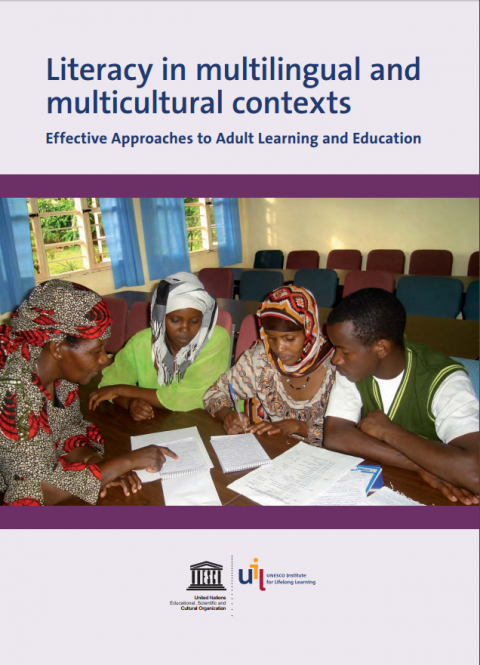 Literacy in multilingual and multicultural contexts: effective approaches to adult learning and education 발행 연도: 2016 저자: Ulrike Hanemann, Cassandra Scarpino All of the literacy programmes featured in this publication offer valuable experiences and lessons on how the challenges posed by linguistic and cultural diversity can be productively addressed by harnessing the potential of language and culture as enriching resources in the process of literacy teaching and learning. A major lesson that has emerged over the years is that the use of local languages as the medium of instruction enhances the effectiveness and efficiency of the learning process in developing literacy, numeracy and (second or more) language skills. However, mother tongue-based literacy not only facilitates the learning process, but is also an important symbol of identity, unity and self-determination. It is closely intertwined with culture and local values, wisdom, worldviews and tradition. A number of the featured programmes demonstrate that language and culture in education are highly political. Respect for all languages and cultures, and their equal treatment, can play a critical role in fostering national cohesion. In some cases, this is contributing to rebuilding peace in post-conflict communities. Literacy programmes that contribute to the preservation of linguistic and cultural diversity should, also, be viewed as integral to sustainable development.
  Generation Z: Global Citizenship Survey 발행 연도: 2017 단체 저자: Varkey Foundation The Varkey Foundation commissioned Populus to carry out research on a global scale into the attitudes of 15- to 21-year-olds on a variety of ethical, personal, community and political issues. We chose twenty countries to poll: Argentina, Australia, Brazil, Canada, China, France, Germany, India, Indonesia, Israel, Italy, Japan, New Zealand, Nigeria, Russia, South Africa, South Korea, Turkey, the UK and the US. We chose a range of countries that would give a geographic spread, include some of most populous nations, and would also include those that have particular political significance – as rising powers and/or countries that are important in global geopolitics and cultural influence.The first part of the survey asked about young people’s wellbeing, hopes and ambitions – from their relationships and future careers, to their physical and mental health.. The second part focused on their personal, community and religious values – from their attitudes towards abortion, same sex marriage and transgender rights, to the importance of religion in their lives and whether they feel equipped to contribute to their own community. Finally, it covered issues of global citizenship – attitudes towards migrants, the factors that make young people hopeful and fearful for the future, and their views on whether the world is becoming a better or worse place. This is the first time that there has been an international comparative study of the attitudes of young people on these matters. Not only have we asked them how they feel, what their attitudes are, and who influenced them: we have also reflected on what differences and similarities there may be in terms of their wellbeing, fears, hopes and views across the world.With this survey, we do not aim to document the events that loomed large in young people’s lives or the social forces that have shaped their emotions and opinions. That is a huge subject for expert analysis. Rather, we wanted to hold up a mirror to Generation Z and simply record the reflection that they give us – providing some illumination to help us all understand them better. Expert group meeting “youth civic engagement:enabling youth participation in political, social and economic life” 16-17 June 2014 UNESCO Headquarters Paris, France: concept note 발행 연도: 2014 단체 저자: UN. Department of Economic and Social Affairs (UN. DESA) From 16-17 June 2014, the Division for Social Policy and Development in the Department of Economic and Social Affairs of the United Nations and UNESCO will organize an Expert Group Meeting at UNESCO Headquarters, Paris, under the theme “Youth Civic Engagement: enabling youth participation in political, social and economic life.” The meeting will bring together experts and representatives of youth organizations, academia, representatives of Member States, United Nations entities, and intergovernmental organizations to discuss the ways in which youth civic engagement can be an enabler for political, social and economic participation, as well as to examine current opportunities and challenges affecting such potential. These topics will be considered under the framework of both the World Programme of Action for Youth1 and of the UN System-Wide Action Plan on Youth which respectively incorporate youth participation and youth civic engagement among their priority areas for action. Réunion du groupe d'experts "engagement civique des jeunes: permettre la participation des jeunes à la vie politique, sociale et économique" 16-17 Juin 2014 Siège de l'UNESCO Paris, France: note conceptuelle 발행 연도: 2014 단체 저자: UN. Department of Economic and Social Affairs (UN. DESA) De 16-17 Juin 2014, la Division des politiques sociales et du développement du Département des affaires économiques et sociales des Nations Unies et l'UNESCO organisera une réunion d'experts au Siège de l'UNESCO, Paris, sous le thème «engagement civique des jeunes: les jeunes permettant participation à la vie politique, sociale et économique. » La réunion rassemblera des experts et des représentants d'organisations de jeunesse, des universitaires, des représentants des États membres, les organismes des Nations Unies et les organisations intergouvernementales pour discuter de la façon dont les jeunes l'engagement civique peut être un catalyseur pour participation politique, sociale et économique, ainsi que d'examiner les possibilités et les défis actuels affectant un tel potentiel. Ces sujets seront examinés dans le cadre à la fois du Programme d'action mondial pour jeunesse1 et du Plan d'action de l'ONU l'échelle du système sur les jeunes qui intègrent respectivement la participation des jeunes et l'engagement civique des jeunes parmi leurs domaines d'action prioritaires. The education we want: youth advocacy toolkit 발행 연도: 2015 저자: James Edleston | Dan Smith, Sumaya Saluja | David Crone | Chernor Bah | Emily Laurie 단체 저자: UN Global Education First Initiative - Youth Advocacy Group (YAG) | Plan | A World at School This toolkit is for anyone who believes passionately in the power of education as a force for good in the world and the right for all children to get a good quality education, no matter where they are and what the circumstances. We hope this toolkit will support you to carry out your own advocacy campaign. If you are just beginning to think about taking action on education, you can work your way through the toolkit from start to finish. But you can also dip in to pick up useful hints or activities to help you carry out your existing plans. We know this toolkit doesn’t cover everything you might need and we’ve tried to sign-post you to other resources where possible. Included in here are lots of real stories of change, led by young people, from all over the world. We hope they inspire you. The young global movement for education is growing, and you can be part of it.
  Curriculum in Transformation Mode: Rethinking Curriculum for the Transformation of Education and Education Systems 발행 연도: 2023 저자: Renato Opertti 단체 저자: UNESCO International Bureau of Education (IBE) Through these pages, Renato Opertti shares a series of reflections that invite us to revisit the curriculum as an opportunity and lever for societies to express their visions and aspirations. Curriculum can serve to position education as the pillar of a renewed social contract grounded on the welfare of all learners as persons and supporting societies and communities give effect to sustainable and better futures for the younger generations. To do so, we need to re-conceptualize curriculum at large: from a mere specification of frequently fragmented learning contents to its understanding as both a process and product of public policy developments in which diversity of stakeholders own and take responsibility for education as a global common good. Curriculum and pedagogy, by going hand-inhand, and supported by effective teaching, learning and assessment processes, can play a key role in fulfilling the right to education for every learner equally, according to their own individual needs. Key ideas in this book help us to rethink curriculum with future-oriented approaches, entailing a stronger involvement of younger generations in the decision-making process and a careful attention to vulnerability and disadvantaged groups. A curriculum that embraces individuality and diversity within collaborative and caring learning settings, nurtures freedom and autonomous thinking, connects meaningfully the global and the local, and assumes the hybridization of education. The book also delves into perspectives for educational transformation prioritizing the development of learners’ foundational and transformative competencies as the barometer of a progressive curriculum. Crucially, this entails rethinking the mindsets and practices of education systems in light of the interconnected challenges posed by the Fourth Industrial Revolution, post COVID-19, generative AI and the sustainability of the planet and the world.
  Preventing Violent Extremism through Sport: Technical Guide; Criminal Justice Handbook Series 발행 연도: 2020 단체 저자: UN. Office on Drugs and Crime (UNODC) The Technical Guide on Preventing Violent Extremism through Sport, developed in consultation with international experts, recognizes the importance of promoting the well-being of children and youth. It applies an approach that encourages prosocial behaviour and good safeguarding and welfare practices, with particular emphasis on educational and social development measures in line with the United Nations Guidelines for the Prevention of Crime.The guide, addressed mainly to policy makers and implementing organizations, has been carefully designed to support effective integration of sport-based learning in primary prevention frameworks. By adopting a five-zone approach to prevent violent extremism namely safe space, empowerment, resilience, social inclusion and education, it supports informed policy development and a Theory of Change that can shape curriculum design and content. To further support global efforts in preventing violent extremism, UNODC is also developing an e-learning module and a practical tool for trainers that will be published soon and will complement this technical guide.