
자료
세계시민교육에 대한 이해를 넓히고 연구, 옹호 활동, 교수, 학습 등을 향상시킬 수 있는 다양하고 유용한 자료를 찾아보세요.
2,668 건의 결과가 검색되었습니다
 Addressing Anti-semitism in Schools: Training Curriculum for Secondary Education Teachers 발행 연도: 2020 단체 저자: UNESCO | OSCE. Office for Democratic Institutions and Human Rights (ODIHR) This OSCE/ODIHR and UNESCO co-publication aims to help secondary school teachers to prevent and respond to anti-Semitism. The curriculum, intended for teacher trainers, is designed to be comprehensive, robust, practical and adaptable. It suggests concrete ways to address anti-Semitism and counter prejudice in and through education, while promoting human rights, global citizenship education, and gender equality.The co-publication is part of a series of four training curricula, designed for trainers of (1) primary school teachers, (2) secondary school teachers, (3) vocational school teachers, and (4) school directors.
  Addressing Anti-semitism in Schools: Training Curriculum for Vocational Education Teachers 발행 연도: 2020 단체 저자: UNESCO | OSCE. Office for Democratic Institutions and Human Rights (ODIHR) This OSCE/ODIHR and UNESCO co-publication aims to help vocational school teachers to prevent and respond to anti-Semitism. The curriculum, intended for teacher trainers, is designed to be comprehensive, robust, practical and adaptable. It suggests concrete ways to address anti-Semitism and counter prejudice in and through education, while promoting human rights, global citizenship education, and gender equality.The co-publication is part of a series of four training curricula, designed for trainers of (1) primary school teachers, (2) secondary school teachers, (3) vocational school teachers, and (4) school directors.
  Addressing Anti-semitism in Schools: Training Curriculum for School Directors 발행 연도: 2020 단체 저자: UNESCO | OSCE. Office for Democratic Institutions and Human Rights (ODIHR) This OSCE/ODIHR and UNESCO co-publication aims to help school directors to prevent and respond to anti-Semitism. The curriculum, intended for school director trainers, is designed to be comprehensive, robust, practical and adaptable. It suggests concrete ways to address anti-Semitism and counter prejudice in and through education, while promoting human rights, global citizenship education, and gender equality.The co-publication is part of a series of four training curricula, designed for trainers of (1) primary school teachers, (2) secondary school teachers, (3) vocational school teachers, and (4) school directors.
 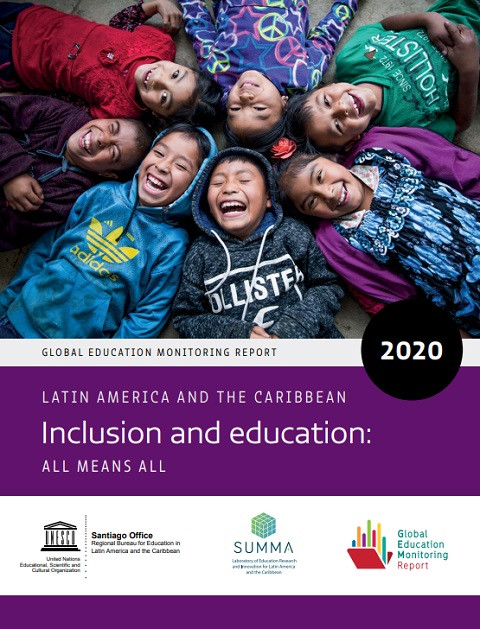 Latin America and the Caribbean 2020: Inclusion and Education; All Means All (Global Education Monitoring Report) 발행 연도: 2020 단체 저자: Global Education Monitoring Report Team | UNESCO | Laboratory of Education Research and Innovation for Latin America and the Caribbean (SUMMA) Latin America and the Caribbean has the largest and most challenging socio-economic inequalities in the world, which have shaped its education systems over the decades. This report looks at everyone both in and excluded from education in the region, pinpointing barriers facing learners, especially when multiple disadvantages intersect. The report also explores challenges in education posed by COVID-19 and the need for urgent action to prevent an exacerbation of inequalities. Produced by the Global Education Monitoring (GEM) Report team, in partnership with the UNESCO Regional Bureau for Education in Latin America and the Caribbean (OREALC) and the Laboratory of Education Research and Innovation for Latin America and the Caribbean (SUMMA), the report assesses key solutions for greater inclusion through several case studies from the region. It provides in-depth analysis on challenges to inclusion in education arising from migration and displacement in Colombia and Costa Rica; remoteness in Brazil and Suriname; disability in Cuba and Nicaragua; gender in Peru and Jamaica; sexual orientation, gender identity and expression in Chile and Mexico; poverty in the Dominican Republic and Honduras; ethnicity in Bolivia and Ecuador; and incarceration in El Salvador and Uruguay. Building on the 2020 Global Education Monitoring Report, this regional edition concludes that strong laws and policies in Latin America and the Caribbean demonstrate a commitment to inclusion, but that the daily realities faced by learners suggest implementation is lagging. Recommendations are aimed at promoting more inclusive education systems to benefit all children and youth, no matter their background, identity or ability. The recommendations provide a systematic framework for identifying and dismantling barriers for vulnerable populations, according to the principle that ‘every learner matters and matters equally’. América Latina y el Caribe 2020: Inclusión y educación; Todos y todas sin excepción (Informe de seguimiento de la educación en el mundo) 발행 연도: 2020 단체 저자: Global Education Monitoring Report Team | Organización de las Naciones Unidas para la Educación, la Ciencia y la Cultura (UNESCO) | Laboratory of Education Research and Innovation for Latin America and the Caribbean (SUMMA) América Latina y el Caribe es la región con las mayores y más tenaces desigualdades socioeconómicas del mundo. Durante decenios estas desigualdades se han reflejado en sus sistemas educativos. El presente informe examina a quiénes incluyen y a quiénes excluyen estos sistemas y llama la atención sobre las barreras que enfrentan los educandos, especialmente cuando están expuestos a múltiples desventajas. El informe también explora los nuevos retos educativos que plantea la pandemia de la Covid-19 y la necesidad de actuar sin dilación para evitar que se agraven las desigualdades. El informe, elaborado por el equipo del Informe de Seguimiento de la Educación en el Mundo (Informe GEM), en colaboración con la Oficina Regional de Educación para América Latina y el Caribe (OREALC/ UNESCO Santiago) y el Laboratorio de Investigación e Innovación en Educación para América Latina y el Caribe -SUMMA, evalúa algunas de las principales iniciativas emprendidas para mejorar la inclusión, basándose en varios estudios de casos de la región. Analiza en profundidad algunos ejemplos de los grandes desafíos que amenazan la inclusión en la educación: migración y desplazamiento en Colombia y Costa Rica; aislamiento rural en el Brasil y Suriname; discapacidad en Cuba y Nicaragua; discriminación de género en el Perú y Jamaica; orientación sexual e identidad y expresión de género en Chile y México; pobreza en la República Dominicana y Honduras; etnicidad en Bolivia y el Ecuador; y jóvenes en situación de privación de libertad en El Salvador y el Uruguay. Esta edición regional del Informe de Seguimiento de la Educación en el Mundo 2020 concluye que, si bien las leyes y políticas de América Latina y el Caribe demuestran la firme determinación de promover la inclusión, la realidad cotidiana de los alumnos y las alumnas sugiere que la aplicación práctica lleva retraso. Se formulan recomendaciones con el objeto de promover sistemas de educación más inclusivos en beneficio de todos los niños, niñas y jóvenes, sin distinción de origen, identidad o capacidad. Las recomendaciones brindan un marco sistemático que permite identificar y eliminar barreras para las poblaciones marginadas, conforme al principio de que “cada alumno es importante y todos los alumnos importan por igual”.
  Human Rights Storytelling: Manual for the Educators 발행 연도: 2018 단체 저자: Huristo Project Consortium Huristo project developed a methodology about awareness and advocacy about the European Human Rights Charter as a part of global citizenship education with low skilled adult learners (refugees and migrants living in the city and natives living in rural places). This methodology is based on digital storytelling: participants work on personal narratives illustrating different topics of the charter.The main result for the adult learners are increased digital skills, reading and writing skills, awareness about the Human Rights Charter and European citizenship. The work on the Charter and the personal narratives also improve participants’ analytic media literacy, interpersonal and intercultural skills, but also core skills for employability, such as teamwork, problem solving, learning to learn and communication. Additionally, the adult trainers who are involved increase their teaching skills using digital media and the methodology of digital storytelling in particular.In the HURISTO project trainers start with the stories of the participants, and afterwards the stories are linked to articles of the Charter. To do so, the methodology is using two concepts:1) PHOTOLANGUAGE SET: a set of 30 flashcards for students with photos that illustrate the European Charter of Human Rights. They have been created as a tool to start up conversations about human rights in Europe and the situations in which these rights may be at risk. Based on these discussions and the sharing of stories, each participant chooses one photo out of the flashcards, as a starting point for a digital story. The HURISTO Photolanguage set for educators contains guidelines for educators who want to use it in a human rights digital storytelling workshop with adult learners.2) STORY CIRCLES: in different rounds participants share their stories with the group and develop them together into short stories for their film.
  Технические справки по имплементации Конвенции о правах инвалидов 발행 연도: 2023 단체 저자: Всемирный банк В этом сборнике девяти отраслевых технических справок очень подробно анализируются проблемы, с которыми сталкиваются лица с инвалидностью в Узбекистане во всех сферах жизни, и формулируются подробные рекомендации, обеспечивающие доказательную базу для Стратегической записки, которая призвана служить ориентиром для следующего пятилетнего Национального плана действий Узбекистана (НПД) по имплементации Конвенции Организации Объединенных Наций о правах инвалидов (КПИ) в стране.
 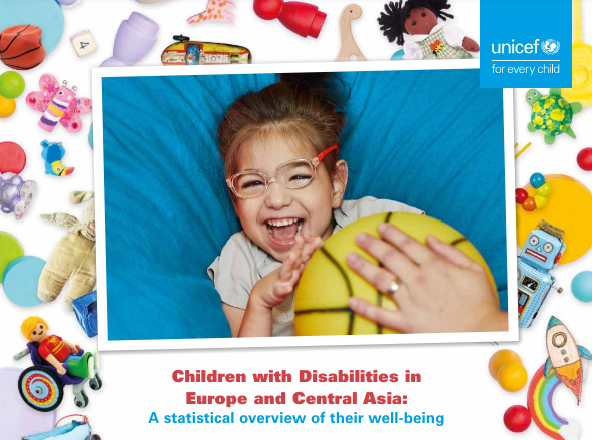 Children with Disabilities in Europe and Central Asia: A Statistical Overview of Their Well-Being 발행 연도: 2023 단체 저자: United Nations (UN) This regional report provides critical evidence for decision-makers across countries to use in both policy and programming. In the context of the Global Disability Inclusion Strategy and Policy, UNICEF in Europe and Central Asia will use this valuable resource to embark on the next level of engagement to give all children with disabilities the opportunity to realize their rights on an equal basis with their peers. Дети с инвалидностью в Европе и Центральной Азии: статистический обзор их благополучия 발행 연도: 2023 단체 저자: United Nations (UN) Данный региональный доклад содержит важные фактические данные, которые лица, принимающие решения в разных странах, могут использовать при разработке политических документов и программ. ЮНИСЕФ в Европе и Центральной Азии в контексте Глобальной стратегии и политики по вовлечению людей с инвалидностью будет использовать этот ценный ресурс, чтобы перейти на следующий уровень взаимодействия, дающий всем детям с инвалидностью перспективы реализации своих прав наравне со сверстниками.
 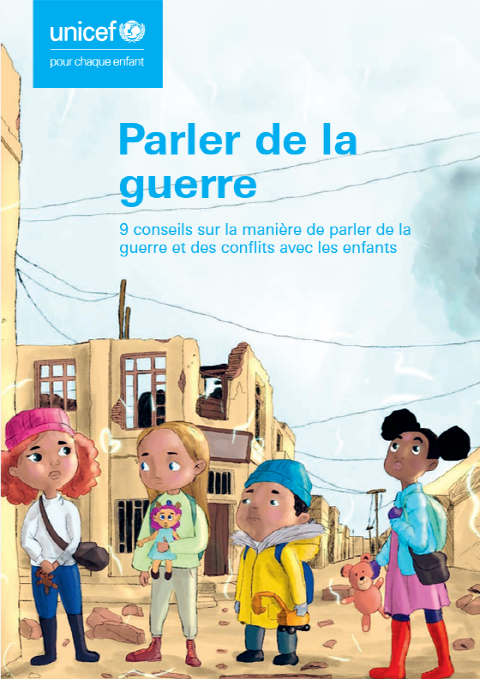 Parler de la guerre: 9 conseils sur la manière de parler de la guerre et des conflits avec les enfants 발행 연도: 2023 단체 저자: United Nations Children's Fund (UNICEF) La guerre est un sujet difficile, souvent lié à des images ou informations perturbantes, en particulier pour les enfants. Comment les parents, les proches et les enseignants doivent-ils/elles se comporter et comment peuvent-ils/elles apaiser les craintes des enfants ?Peur, tristesse, colère, nervosité : ces sentiments ainsi que d’autres peuvent survenir lorsqu’une guerre ou un conflit fait les gros titres. Dès que les enfants ont besoin de sécurité et de protection, ils/elles se tournent vers leurs parents, proches et enseignants - encore plus en périodes de crise. Vous trouverez ici neuf conseils sur la manière de communiquer avec les enfants, les soutenir et leur apporter du réconfort.