
자료
세계시민교육에 대한 이해를 넓히고 연구, 옹호 활동, 교수, 학습 등을 향상시킬 수 있는 다양하고 유용한 자료를 찾아보세요.
3,387 건의 결과가 검색되었습니다
 Sandwatch: adapting to climate change and educating for sustainable development 발행 연도: 2010 저자: Gillian Cambers | Paul Diamond 단체 저자: UNESCO Sandwatch provides a framework for children, youth and adults, with the help of teachers and local communities, to work together to critically evaluate the problems and conflicts facing their beach environments, and to develop sustainable approaches to address these issues. It also helps beaches become more resilient to climate change. The preliminary chapters of this publication focus on how to get started with Sandwatch activities and examine ways to address climate change impacts. The principle aim of this publication is to document the Sandwatch methodology: monitoring, analysing, sharing and taking action. An activities-orientated approach is used to provide step-by-step instructions to cover monitoring methods and data analysis, including observation and recording, erosion and accretion, beach composition, human activities, beach debris, water quality, waves, longshore currents, plants and animals. The activities are related to (a) sustainable development issues, including: beach ownership, mining beaches for construction material, conflict resolution between different beach users, pollution, conservation of endangered species, and (b) climate change adaptation issues: sea level rise, rising temperatures, ocean acidification and increased extreme events. Ways to share findings and create a Sandwatch network are detailed including methods such as the use of local media, websites, social networking and video production. Finally, ways are discussed to design, plan and implement a Sandwatch project to fulfill one or all of the following criteria: (a) addressing a particular beach-related issue, (b) enhancing the beach, and (c) promoting climate change adaptation. Sandwatch stands as an example of Education for Sustainable Development in action, and is being targeted as one of several flagship projects for the United Nations Decade of Education for Sustainable Development (2005–2014). As the world confronts the growing threat of climate change, Sandwatch presents an opportunity to help people and ecosystems respond to present and future changes in a practical manner. Beaches are among the ecosystems most at risk from climate change as they face rising sea levels and increased more intense storms. By contributing to ecosystem health and resilience, Sandwatch can help people from all walks of life learn about climate change and how their actions can contribute to the adaptation process. Fostering peaceful co-existence through analysis and revision of history curricula and textbooks in Southeast Europe: preliminary stocktaking report 발행 연도: 2006 저자: Jean Damascène Gasanabo | Jade Maître 단체 저자: UNESCO To accomplish this aim, the study reviews policies and processes for developing history curricula and producing history textbooks in ten participating countries: Albania, Bosnia and Herzegovina, Bulgaria, Croatia, Greece, Romania, Montenegro, Serbia, Slovenia and The Former Yugoslav Republic of Macedonia (FYROM). The resulting report has been compiled for the dual purpose of (1) presenting a composite picture of the educational policies and practices in these countries with regard to history teaching and textbook production, distribution and use; (2) laying the groundwork for the development of national and/or sub-regional initiatives aimed at improving the processes currently in place. Favoriser la coexistence pacifique par l'analyse et la révision des programmes et manuels d'histoire en Europe du Sud-Est: rapport préliminaire d'inventaire 발행 연도: 2006 저자: Jean Damascène Gasanabo | Jade Maître 단체 저자: Organisation des Nations Unies pour l'éducation, la science et la culture (UNESCO) Pour atteindre cet objectif, l'étude examine les politiques et les processus d'élaboration des programmes d'histoire et de la production de manuels d'histoire dans dix pays participants: Albanie, Bosnie-Herzégovine, Bulgarie, Croatie, Grèce, Roumanie, Monténégro, Serbie, Slovénie et l'ancienne République yougoslave de Macédoine (ARYM). Le rapport qui en résulte a été compilé dans le double but de (1) présentant une image composite des politiques et pratiques éducatives dans ces pays en ce qui concerne l'enseignement de l'histoire et de la production de manuels scolaires, la distribution et l'utilisation; (2) jeter les bases pour le développement d'initiatives nationales et / ou sous-régionaux visant à améliorer les processus actuellement en place.
 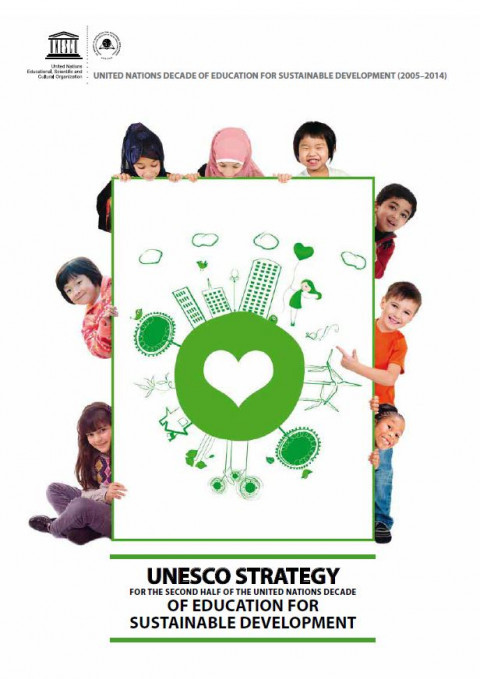 UNESCO strategy for the second half of the United Nations decade of education for sustainable development 발행 연도: 2010 단체 저자: UNESCO The UNESCO Strategy for the Second Half of the United Nations (UN) Decade of Education for Sustainable Development (DESD) draws on the findings and lessons learnt from the first phase of the DESD monitoring and evaluation (M&E) process (as reflected in the 2009 DESD M&E report Learning for a Sustainable World: Review of Contexts and Structures for Education for Sustainable Development. It also builds on the UNESCO World Conference on ESD and the Bonn Declaration as well as on the outcomes of other key international ESD meetings. The Bonn Declaration gives particular emphasis to the importance of education for the global development agenda and underlines the essential contribution of ESD to shaping the purpose, content and quality of all education. The UNESCO strategy will be implemented in line with the International Implementation Scheme (IIS), which, along with the Bonn Declaration, will provide the global strategic framework for UNESCO and its DESD partners during the second half of the Decade. The Strategy takes into account key DESD regional challenges and opportunities. It is also shaped by the shared vision of education emerging from the four 2008-2009 UNESCO international education conferences: one of education systems that encourage equity and inclusion, quality learning, flexibility and innovation. While UNESCO puts highest emphasis on achieving Education for All (EFA), the Organization’s actions in education extend beyond this, to pay explicit attention to inclusion, social cohesion and social justice, to lifelong learning and to the crucial role of higher education and research. The overall goal of the UNESCO Strategy for the Second Half of the DESD is to support Member States and other stakeholders in addressing global sustainable development challenges at regional, national and global level through ESD, thus addressing the challenges of learning for bringing about a more sustainable world.
  Teaching respect for all: implementation guide 발행 연도: 2014 단체 저자: UNESCO Teaching Respect for All is a joint UNESCO-United States of America-Brazil project launched in January 2012 to counteract discrimination both in and through education. Acknowledging that discrimination is on the rise worldwide, Teaching Respect for All promotes an educational response to counter discrimination and violence through strengthening the foundations of mutual tolerance and cultivating respect for all people, regardless of colour, gender, class, sexual orientation, national, ethnic, or religious orientation/identity. Teaching Respect for All has chosen to focus efforts on the formal and informal classroom, targeting learners of 8-16 years old, and aims to build curiosity, openness, critical thinking and understanding among youth learners, thus equipping them with the awareness, knowledge, and skills to cultivate respect and stop discrimination on all levels. The project is founded on the universal values and core principles of human rights, while acknowledging each country has its own history and mechanism for addressing the issue of discrimination in education. Enseigner le respect pour tous: guide de mise en oeuvre 발행 연도: 2014 단체 저자: Organisation des Nations Unies pour l'éducation, la science et la culture (UNESCO) Respect Pédagogique pour Tous est un UNESCO-États-Unis conjointe de projet Amérique-Brésil a lancé en Janvier 2012 pour lutter contre la discrimination à la fois dans et par l'éducation. Reconnaissant que la discrimination est à la hausse dans le monde entier, Respect Pédagogique pour Tous favorise une réponse éducative pour lutter contre la discrimination et la violence en renforçant les fondements de la tolérance mutuelle et de cultiver le respect pour toutes les personnes, indépendamment de la couleur, le sexe, la classe, l'orientation sexuelle, nationale, ethnique ou religieuse orientation / identité. Respect Pédagogique pour Tous a choisi de concentrer les efforts sur la salle de classe formelle et informelle, en ciblant les apprenants de 8-16 ans, et vise à développer la curiosité, l'ouverture, la pensée critique et la compréhension entre les apprenants de la jeunesse, en les dotant ainsi avec la prise de conscience, la connaissance, et les compétences nécessaires pour cultiver le respect et arrêter la discrimination à tous les niveaux. Le projet est fondé sur les valeurs universelles et les principes fondamentaux des droits de l'homme, tout en reconnaissant que chaque pays a sa propre histoire et un mécanisme pour régler le problème de la discrimination dans l'éducation. ‘모두를 존중하는 방법’ 실행 가이드 발행 연도: 2014 단체 저자: 유네스코 ‘모두를 존중하는 방법(Teaching Respect for All)’은 교육을 통해 차별을 근절하기 위하여 2012년 1월에 시작된 유네스코 미국-브라질 합작 프로젝트이다. 차별이 전 세계적으로 부상하고 있음을 인식하는 요즘, ‘모두를 존중하는 방법’은 인종, 성별, 계급, 성적 성향, 국가, 민족 또는 종교적 정체성에 관계없이 상호 관용의 기초 토대를 강화하고 모든 사람들을 존중하는 문화를 배양함으로써 차별과 폭력에 대응하는 교육적 반응을 고취시킨다. ‘모두를 존중하는 방법’은 8~16세 학습자를 대상으로 정식 및 약식 수업을 하도록 포커스를 맞춰, 이들에게 호기심, 개방성, 비판적 사고와 이해심, 의식과 지식을 키워주며 모든 수준에서의 차별을 중단하고 존경심을 키울 수 있는 방법을 가르쳐주는 것이다. 본 프로젝트는 각국이 교육 차별 문제를 해결할 수 있는 자체적 역사와 메커니즘을 소유하고 있음을 인정하며, 인권의 보편적 가치와 그 핵심 원칙에 기초를 두고 있다. Plan de mise en oeuvre international de la décennie des Nations Unies pour l'éducation au service du développement durable, 2005-2014 발행 연도: 2005 단체 저자: Organisation des Nations Unies pour l'éducation, la science et la culture (UNESCO) In December 2002, the UN General Assembly adopted a resolution to put in place a UN Decade of Education for Sustainable Development, lasting from 2005 to 2014. UNESCO was tasked with leading the Decade and developing an International Implementation Scheme (IIS). Buenas prácticas de educación para el desarrollo sostenible en materia de cambio climático 발행 연도: 2012 단체 저자: Organización de las Naciones Unidas para la Educación, la Ciencia y la Cultura (UNESCO) Since the beginning of the UN Decade of Education for Sustainable Development (DESD, 2005-2014), the DESD Secretariat at UNESCO Headquarters in Paris has received numerous requests for case studies and descriptions of good practices in Education for Sustainable Development (ESD). These requests have increasingly included issues of providing an educational response to climate change. The increasing number of requests is only one indicator that climate change education is increasingly recognized in the broader education community as an essential part of ESD and life-long learning. ESD is a complex and evolving subject, and how it is applied and implemented is a challenge for all countries. The Decade aims to see ESD implemented in thousands of local situations on the ground, involving its integration into a multitude of different learning situations. These initiatives can be catalysts for action and contribute to the goals and objectives of the Decade. In such ways, organizations, local communities and individuals can be actors within the global movement for sustainable development. To support the growing interest in climate change issues and ESD, UNESCO is publishing this volume containing 17 examples of programmes addressing climate change in ESD settings and practices. These good practices and shared experiences, which were provided by a range of different stakeholders, are concrete examples of successful implementation of ESD in different fields and sectors, from the political to the school level, and including formal, nonformal and informal learning situations. Education pour le développement durable: bonnes pratiques en matière de changement climatique 발행 연도: 2012 단체 저자: Organisation des Nations Unies pour l'éducation, la science et la culture (UNESCO) Since the beginning of the UN Decade of Education for Sustainable Development (DESD, 2005-2014), the DESD Secretariat at UNESCO Headquarters in Paris has received numerous requests for case studies and descriptions of good practices in Education for Sustainable Development (ESD). These requests have increasingly included issues of providing an educational response to climate change. The increasing number of requests is only one indicator that climate change education is increasingly recognized in the broader education community as an essential part of ESD and life-long learning. ESD is a complex and evolving subject, and how it is applied and implemented is a challenge for all countries. The Decade aims to see ESD implemented in thousands of local situations on the ground, involving its integration into a multitude of different learning situations. These initiatives can be catalysts for action and contribute to the goals and objectives of the Decade. In such ways, organizations, local communities and individuals can be actors within the global movement for sustainable development. To support the growing interest in climate change issues and ESD, UNESCO is publishing this volume containing 17 examples of programmes addressing climate change in ESD settings and practices. These good practices and shared experiences, which were provided by a range of different stakeholders, are concrete examples of successful implementation of ESD in different fields and sectors, from the political to the school level, and including formal, nonformal and informal learning situations.