
자료
세계시민교육에 대한 이해를 넓히고 연구, 옹호 활동, 교수, 학습 등을 향상시킬 수 있는 다양하고 유용한 자료를 찾아보세요.
2,776 건의 결과가 검색되었습니다
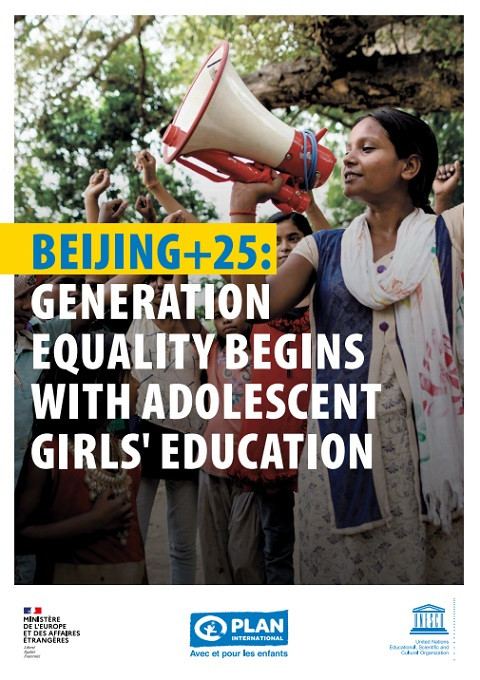 Pékin+25 : La Génération Égalité commence par l’éducation des adolescentes 발행 연도: 2020 단체 저자: Plan International France | France. Ministry for Europe and Foreign Affairs | Organisation des Nations Unies pour l'éducation, la science et la culture (UNESCO) Cette publication examine les progrès et les lacunes persistantes dans nos efforts pour parvenir à l'égalité des genres dans et par l'éducation depuis l'adoption du Programme d'action de Pékin il y a 25 ans. En 2018, 130 millions de filles dans le monde n'étaient pas scolarisées et seules deux filles sur trois étaient inscrites dans l'enseignement secondaire. La crise liée à la pandémie de COVID-19 est susceptible d'élargir encore ces écarts et menace d'interrompre l'éducation de plus de 11 millions de filles.Cette publication démontre l'importance de l'éducation des adolescentes pour l'avancement de l’agenda visionnaire du Programme d'action de Pékin et la réalisation des objectifs de développement durable.Elle formule des recommandations pour accélérer les investissements et les actions en faveur de l’éducation des adolescentes lors du Forum Génération Égalité de 2021 et des coalitions d’action qui seront lancées visant à accélérer les progrès en faveur de l’égalité des genres. Elle promeut des approches intersectorielles et des partenariats multipartites et se concentre sur trois « leviers d'action »: une éducation complète à la sexualité, la participation des adolescentes aux sciences, à la technologie, à l'ingénierie et aux mathématiques, et le développement du leadership des adolescentes. Elle fait part des propres priorités et attentes des adolescentes, ainsi que de leur vision de ce qui est nécessaire pour un avenir égal pour tous et toutes.
 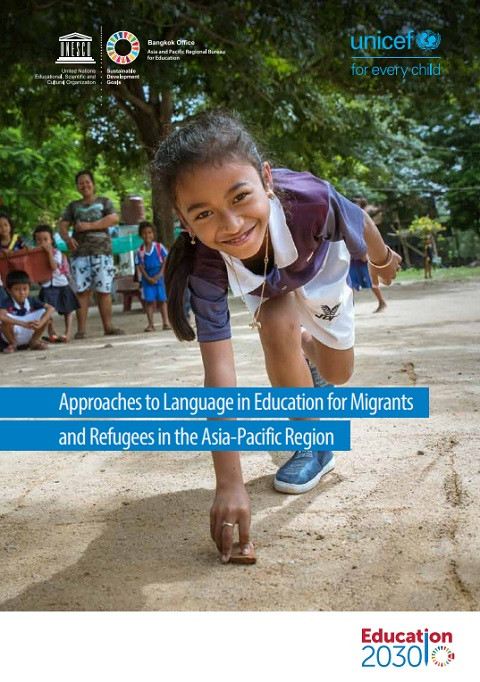 Approaches to Language in Education for Migrants and Refugees in the Asia-Pacific Region 발행 연도: 2020 단체 저자: UNESCO | United Nations Children's Fund (UNICEF) UNESCO Bangkok commissioned this paper to examine strategies for addressing the needs of refugee, migrant and internally displaced children in the Asia-Pacific region. This document aims to create a stronger knowledge base to support Member States as they formulate education policies that are responsive to the needs of such children. This document aims to:Examine how linguistic diversity and human mobility intersect and impact minority, migrant and refugee children’s access to quality, inclusive educationLink policy priorities to promising practices, based on international frameworks and lessons learned from successful programmesRecommend steps for improving language-in-education policies and their implementation. To do this, this paper examines:Global and regional trends in migrationThe impact of migration on children’s educationLinguistic diversity and its implications for language-in-education policies and practicesResearch and resources that support inclusive quality education for migrant and refugee children.
 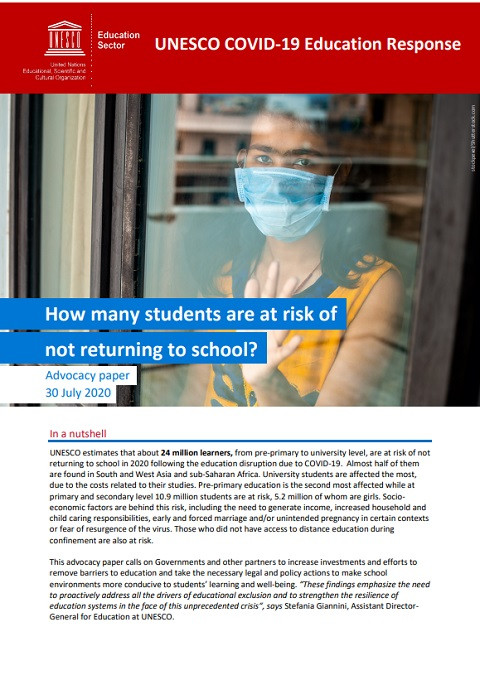 UNESCO COVID-19 Education Response: How Many Students Are at Risk of Not Returning to School?; Advocacy paper 발행 연도: 2020 단체 저자: UNESCO UNESCO estimates that about 24 million learners, from pre-primary to university level, are at risk of not returning to school in 2020 following the education disruption due to COVID-19. Almost half of them are found in South and West Asia and sub-Saharan Africa. University students are affected the most, due to the costs related to their studies. Pre-primary education is the second most affected while at primary and secondary level 10.9 million students are at risk, 5.2 million of whom are girls. Socioeconomic factors are behind this risk, including the need to generate income, increased household and child caring responsibilities, early and forced marriage and/or unintended pregnancy in certain contexts or fear of resurgence of the virus. Those who did not have access to distance education during confinement are also at risk. This advocacy paper calls on Governments and other partners to increase investments and efforts to remove barriers to education and take the necessary legal and policy actions to make school environments more conducive to students’ learning and well-being. “These findings emphasize the need to proactively address all the drivers of educational exclusion and to strengthen the resilience of education systems in the face of this unprecedented crisis“, says Stefania Giannini, Assistant DirectorGeneral for Education at UNESCO.
 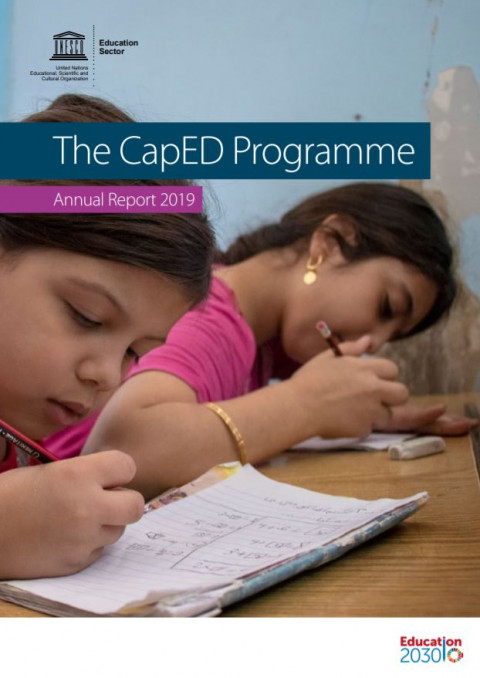 The CapED Programme: Annual Report 2019 발행 연도: 2020 단체 저자: UNESCO UNESCO is the United Nation’s specialized agency for education and is mandated to lead and coordinate progress towards Sustainable Development Goal 4 – “Ensure inclusive and equitable quality education and promote lifelong learning opportunities for all”.The CapED Programme is central to delivering on this mandate through capacity development. It mobilizes UNESCO’s worldwide network of specialized Institutes and offices and works with partners to assist countries as they develop and implement national plans to deliver on SDG4 commitments.The Annual Report 2019 provides information on achievements and progress made in the 26 countries where CapED is operational. Programme CapED: rapport annuel 2019 발행 연도: 2020 단체 저자: UNESCO Institution spécialisée des Nations Unies pour l'éducation, l'UNESCO est chargée de conduire et de coordonner les efforts entrepris pour atteindre l'Objectif de développement durable 4 : « Assurer l'accès de tous à une éducation de qualité, sur un pied d'égalité, et promouvoir les possibilités d'apprentissage tout au long de la vie ».Le Programme CapED de développement des capacités pour l'éducation joue un rôle central dans l'exercice de ce mandat. Il mobilise le réseau mondial des instituts spécialisés et des bureaux de l'UNESCO et, en collaboration avec ses partenaires, aide les pays à élaborer et mettre en oeuvre leurs plans nationaux afin d'honorer les engagements qu'ils ont pris au titre de l'ODD 4.Le Rapport annuel 2019 met en lumière les résultats obtenus et les progrès accomplis dans les 26 pays où le Programme CapED intervient.
  Measuring Intercultural Dialogue: A Conceptual and Technical Framework 발행 연도: 2020 저자: Ciara Aucoin | Euan Mackway-Jones | Marcel Smits 단체 저자: UNESCO | Institute for Economics and Peace The challenges of addressing growing diversity have amply demonstrated that this vision is needed now more than ever. We all have much to gain from more open and connected societies yet misunderstanding, exclusion and discrimination continue to push identity and culture-based grievances towards conflict and violence, challenging the very foundations of sustainable and inclusive development.This report represents a first step in the UNESCO-IEP joint initiative to strengthen the evidence-base on dialogue for peace and development. Through mobilizing better data on effective dialogue, it is our sincere hope that policymakers and practitioners can better support meaningful and transformative dialogue, holistically supporting the aspirations of the 2030 Agenda. Through this, we hope to elevate dialogue as a connecting enabler of all pillars of UN action, accelerating progress towards the Sustainable Development Goals and making good on the promise of ‘leaving no one behind’. Mesurer le dialogue interculturel: cadre conceptuel et technique 발행 연도: 2020 저자: Ciara Aucoin | Euan Mackway-Jones | Marcel Smits 단체 저자: UNESCO | Institute for Economics and Peace Les défis rencontrés pour tenir compte de la diversité croissante ont amplement démontré que cette vision était plus que jamais nécessaire. Nous avons tous beaucoup à gagner de sociétés plus ouvertes et plus connectées, mais l’incompréhension, l’exclusion et la discrimination continuent de nourrir les griefs identitaires et culturels conduisant au conflit et à la violence, en remettant en question les fondements mêmes du développement durable et inclusif.Ce rapport représente une première étape dans l’initiative conjointe UNESCO-IEP visant à renforcer la base de données factuelles sur le dialogue pour la paix et le développement. En favorisant la collecte de données de meilleure qualité sur un dialogue efficace, nous espérons sincèrement que les décideurs politiques et les spécialistes pourront mieux soutenir un dialogue constructif et transformateur, afin d’appuyer de manière globale les objectifs du Programme 2030. Ainsi, nous espérons faire du dialogue un élément essentiel commun à tous les piliers de l’action des Nations Unies, afin d’accélérer les progrès vers la réalisation des objectifs de développement durable et de la promesse de « ne laisser personne de côté ».
  Homophobic and Transphobic Bullying in Educational Centers: Awareness Workshop for its Prevention; Facilitation Guide 발행 연도: 2015 단체 저자: UNESCO This publication presents strategies for teachers and educational authorities with the aim of addressing homophobic and transphobic violence from a Human Rights perspective. Through lessons that incorporate concepts, activities and reflections, it underlines the importance of respect for sexual diversity through the acquisition of knowledge, and the strengthening of teaching skills to overcome stigmas and prejudices. El Bullying Homofóbico y Transfóbico en los Centros Educativos: Taller de Sensibilización Para Su Prevención; Guía de Facilitación 발행 연도: 2015 단체 저자: UNESCO Esta publicación formula estrategias de apoyo a los docentes y las autoridades educativas con el objetivo de abordar la violencia homofóbica y transfóbica desde un enfoque de Derechos Humanos. A través de lecciones que incorporan conceptos, actividades y reflexiones, subraya la importancia del respeto a la diversidad sexual mediante la adquisición de conocimientos, y el fortalecimiento de competencias docentes para superar estigmas y prejuicios.
 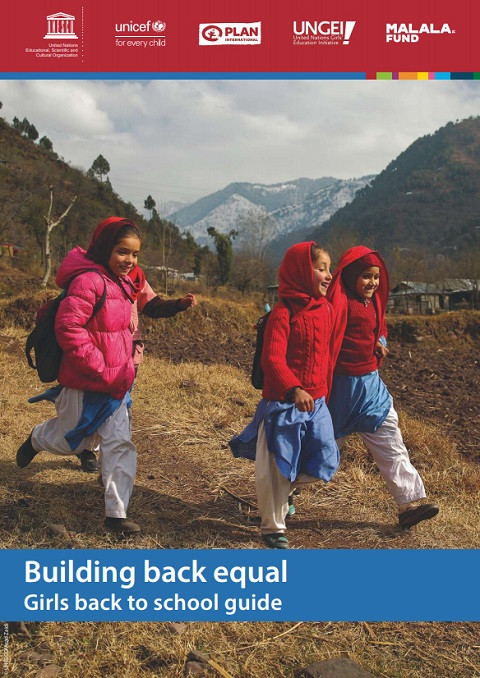 Building Back Equal: Girls Back to School Guide 발행 연도: 2020 단체 저자: UNESCO | United Nations Children's Fund (UNICEF) | Plan International | United Nations Girls' Education Initiative (UNGEI) | Malala Fund The guide provides targeted inputs to ensure continuity of learning during school closures, and comprehensive, timely and evidence-based plans for reopening schools in a way that is safe, gender-responsive and child-friendly, and meets the needs of the most marginalised girls. This guide emphasizes an approach to ‘build back equal’ through gender-responsive measures that transform education systems, prioritise resilience and address the key bottlenecks and barriers to girls’ education, including: Gender-responsive data and evidence to inform action, including data disaggregated by sex and gender-responsive monitoring to identify promising practices to promote gender equality. Policies, laws and plans to advance girls’ rights, including the removal of discriminatory practices that impede girls’ educational participation and completion, and ability to apply their learning. Sustained financing to achieve results, protecting education financing for girls’ education, alongside health, social protection and economy recovery initiatives with an equity lens.