
자료
세계시민교육에 대한 이해를 넓히고 연구, 옹호 활동, 교수, 학습 등을 향상시킬 수 있는 다양하고 유용한 자료를 찾아보세요.
91 건의 결과가 검색되었습니다
 Apprendre à vivre ensemble: un programme interculturel et interreligieux pour l'enseignement de l'éthique 발행 연도: 2008 단체 저자: Arigatou Foundation (Switzerland) | Interfaith Council on Ethics Education for Children Learning to Live Together has been developed for use in different religious and secular contexts as a resource for everyone concerned with promoting ethics and values. The objective has been to develop a resource that is relevant on a global level and yet flexible enough to be interpreted within different cultural and social contexts. The resource has been tested in many different regions and cultural contexts to assure that it is relevant in regional and local contexts (see ‘We did it like this’, p.187). Test workshops have been held in 10 different countries, where the GNRC was able to bring together various religious and secular organisations working with children. During the test workshops, this resource manual was used to the benefit of more than 300 children and youth, representing African Traditional Religions, Bahá’í Faith, Buddhism, Christianity, Hinduism, Islam, Judaism, members of Brahma Kumaris and a number of people of secular thinking. Test workshops as well as input and comments from experts in the area of education, ethics, spirituality, intercultural and interfaith learning and child rights have contributed important experiences and opportunities for learning for the development of this resource. Learning to Live Together is already having an impact. In a GNRC programme in Israel, the resource material was used during a six-day journey made by a group of Jewish, Christian, and Muslim youth to the historical sites of Israel and Palestine, all of which have symbolic relevance to the conflict in their region. At each stop, youth participants discussed their values and their differing perceptions of their shared history. Learning to Live Together is an adaptable resource that can be used with children from many different cultural, religious and social contexts to nurture common values and a mutual respect for different backgrounds and traditions. The resource provides space for enhancing children’s innate potential for spirituality and hope for a better world, as a contribution to changing the situation for children worldwide. The Users Guide provides all necessary information for its use. UNESCO and UNICEF have been closely involved in developing Learning to Live Together and have endorsed the material as an important contribution to a quality education, which takes a multicultural and multi-religious society into consideration. UNESCO’s Guidelines for Intercultural Education underpin the philosophy and the approach of the resource: “Religious education can be described as learning about one’s own religion or spiritual practices, or learning about other religions or beliefs. Interfaith education, in contrast, aims to actively shape the relations between people from different religions”. تعلم العيش معا: برنامج التواصل بين الثقافات والأديان لتعليم الأخلاق 발행 연도: 2008 단체 저자: Interfaith Council on Ethics Education for Children | Arigatou Foundation (Switzerland) Learning to Live Together has been developed for use in different religious and secular contexts as a resource for everyone concerned with promoting ethics and values. The objective has been to develop a resource that is relevant on a global level and yet flexible enough to be interpreted within different cultural and social contexts. The resource has been tested in many different regions and cultural contexts to assure that it is relevant in regional and local contexts (see ‘We did it like this’, p.187). Test workshops have been held in 10 different countries, where the GNRC was able to bring together various religious and secular organisations working with children. During the test workshops, this resource manual was used to the benefit of more than 300 children and youth, representing African Traditional Religions, Bahá’í Faith, Buddhism, Christianity, Hinduism, Islam, Judaism, members of Brahma Kumaris and a number of people of secular thinking. Test workshops as well as input and comments from experts in the area of education, ethics, spirituality, intercultural and interfaith learning and child rights have contributed important experiences and opportunities for learning for the development of this resource. Learning to Live Together is already having an impact. In a GNRC programme in Israel, the resource material was used during a six-day journey made by a group of Jewish, Christian, and Muslim youth to the historical sites of Israel and Palestine, all of which have symbolic relevance to the conflict in their region. At each stop, youth participants discussed their values and their differing perceptions of their shared history. Learning to Live Together is an adaptable resource that can be used with children from many different cultural, religious and social contexts to nurture common values and a mutual respect for different backgrounds and traditions. The resource provides space for enhancing children’s innate potential for spirituality and hope for a better world, as a contribution to changing the situation for children worldwide. The Users Guide provides all necessary information for its use. UNESCO and UNICEF have been closely involved in developing Learning to Live Together and have endorsed the material as an important contribution to a quality education, which takes a multicultural and multi-religious society into consideration. UNESCO’s Guidelines for Intercultural Education underpin the philosophy and the approach of the resource: “Religious education can be described as learning about one’s own religion or spiritual practices, or learning about other religions or beliefs. Interfaith education, in contrast, aims to actively shape the relations between people from different religions”.
 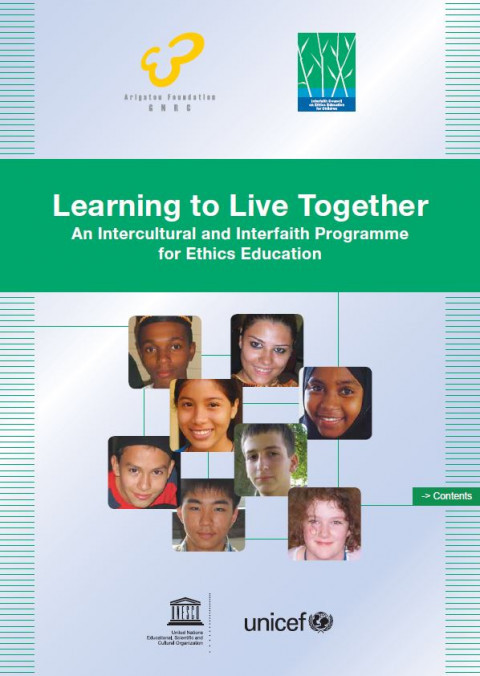 Learning to live together: an intercultural and interfaith programme for ethics education 발행 연도: 2008 단체 저자: Interfaith Council on Ethics Education for Children | Arigatou Foundation (Switzerland) Learning to Live Together has been developed for use in different religious and secular contexts as a resource for everyone concerned with promoting ethics and values. The objective has been to develop a resource that is relevant on a global level and yet flexible enough to be interpreted within different cultural and social contexts. The resource has been tested in many different regions and cultural contexts to assure that it is relevant in regional and local contexts (see ‘We did it like this’, p.187).Test workshops have been held in 10 different countries, where the GNRC was able to bring together various religious and secular organisations working with children. During the test workshops, this resource manual was used to the benefit of more than 300 children and youth, representing African Traditional Religions, Bahá’í Faith, Buddhism, Christianity, Hinduism, Islam, Judaism, members of Brahma Kumaris and a number of people of secular thinking. Test workshops as well as input and comments from experts in the area of education, ethics, spirituality, intercultural and interfaith learning and child rights have contributed important experiences and opportunities for learning for the development of this resource. Learning to Live Together is already having an impact. In a GNRC programme in Israel, the resource material was used during a six-day journey made by a group of Jewish, Christian, and Muslim youth to the historical sites of Israel and Palestine, all of which have symbolic relevance to the conflict in their region. At each stop, youth participants discussed their values and their differing perceptions of their shared history.Learning to Live Together is an adaptable resource that can be used with children from many different cultural, religious and social contexts to nurture common values and a mutual respect for different backgrounds and traditions. The resource provides space for enhancing children’s innate potential for spirituality and hope for a better world, as a contribution to changing the situation for children worldwide. The Users Guide provides all necessary information for its use. UNESCO and UNICEF have been closely involved in developing Learning to Live Together and have endorsed the material as an important contribution to a quality education, which takes a multicultural and multi-religious society into consideration. UNESCO’s Guidelines for Intercultural Education underpin the philosophy and the approach of the resource: “Religious education can be described as learning about one’s own religion or spiritual practices, or learning about other religions or beliefs. Interfaith education, in contrast, aims to actively shape the relations between people from different religions”.
  Global Monitoring of Target 4.7: Themes in National Curriculum Frameworks; Background Paper Prepared for the 2016 Global Education Monitoring Report 발행 연도: 2016 단체 저자: UNESCO International Bureau of Education (IBE) This study is an initial attempt to monitor ESD and GCED content in curricula globally. The goal here is to analyse national curriculum documents to reveal if, how, and to what extent ESD and GCED content is present across the globe. For this purpose, the research team developed a coding scheme based on key ESD and GCED knowledge, skills, behaviours and pedagogies that was used in evaluating the various national curriculum documents for evidence of ESD and GCED content. In this paper, we present the study in the following order. Further explanation of ESD and GCED, and a discussion of issues relating to their implementation and monitoring will come first. Then we will review similar studies that have also attempted to monitor GCED and ESD through content analysis. The study’s methods and findings will then be presented, followed by a discussion of the challenges addressed in developing a coding system to monitor curricula effectively. Finally, we share a series of recommendations that will focus on ways for moving forward in monitoring GCED and ESD effectively, both at a curricular level and beyond.
  Preventing Youth Violence: An Overview of the Evidence 발행 연도: 2015 단체 저자: World Health Organization (WHO) Every year about 200.000 adolescents and young people between the ages of 10 and 29 die, which places homicide in fourth place in the world as cause of death in young population. Several million adolescents and young people suffer from acts of violence, and trauma that require urgent medical and psychological treatment. The emotional imprints that youth volence leaves on its survivors and their loved ones are often profound. Youth violence destroys lives and its consequences have very high economic costs, both for society and for the families of young people. The goal of this manual is to provide a scientific framework that allows us to understand why some people have a greater tendency to be involved in acts of youth violence and how to prevent it. La prevención de la violencia juvenil: Panorama general de la evidencia 발행 연도: 2015 단체 저자: World Health Organization (WHO) Cada año mueren unos 200.000 adolescentes y jovenes entre los 10 y los 29 años de edad, lo cual coloca al homicidio en cuarto lugar en el mundo como causa demuerte en la población joven. Varios millones de adolescentes y jovenes sufren por actos de violencia, traumatismos que exijen tratamiento medico y psicologico urgente. Las huellas emocionales que la violencia juvenil deja en sus sobrevivientes y en los seres queridos de estos suelen ser profundas. La violencia juvenil destroza vidas y sus consecuencias tienen costos economicos muy altos,tanto para la sociedad como para las familias de los jovenes. El objetivo de este manual es ayudar a los formuladores de politicas y planificadores en todas partes a contrarrestar la violencia juvenil mediante estrategias respaldadas por la evidencia. El manual proporciona un marco cientifico que permite entender por qué algunas personas tiene una mayor tendencia a verse involucradas en actos de violencia juvenil y cómo prevenirla.
  Caring for Women Subjected to Violence: A Who Curriculum For Training Health-Care Providers 발행 연도: 2019 단체 저자: World Health Organization (WHO) This curriculum draws on the work of many people around the world dedicated to preventing and responding to all forms of violence against women and girls. WHO would like to thank all of those who contributed and who shared their training exercises and experiences, many of which have been incorporated into this manual. Atención para las mujeres que han sufrido violencia: Programa de capacitación de la OMS dirigido a los prestadores de servicios de salud 발행 연도: 2019 단체 저자: World Health Organization (WHO) Este programa de capacitación se basa en el trabajo de muchas personas de todo el mundo que se dedican a prevenir y responder frente a todas las formas de violencia contra las mujeres y las niñas.
  The Impact of AI on Curriculum Systems: Towards an Orbit-Shifting Dialogue (In-Progress Reflection; no. 32, 2019) 발행 연도: 2019 단체 저자: UNESCO International Bureau of Education (IBE) ‘Artificial Intelligence’ (AI) refers to the theory and development of computer systems able to perform tasks normally requiring human intelligence. In order to achieve transformational change in contemporary curriculum systems and learning environments, we need to engender an orbitshifting dialogue about the potential relationship between AI and education, in terms of both independent variables (threats), and dependent variables (opportunities). Through such a dialogue, we need to create foresight indicators that can predict the process of this relationship. It is, however, crucial that the relationship between AI and education is strong and directly proportionate. If the potential of the relationship is not exploited sufficiently, then underdeveloped education systems will lag behind and fail to achieve their potential for transformation, whether radical or incremental. Indeed, some may even become obsolete. The paper contends that in order to effectively contribute to the knowledge economy and to sustainable development in the age of the 4th Industrial Revolution (characterized by a fusion of cyber-physical technologies) modern educational systems need to overcome obstacles to innovation in order to maximize the potential for transformative change. To achieve this will require an ‘orbital shift’ in educational planning, practice and resourcing, to enable schools to respond more effectively to the rapidly changing needs of young people, society, the economy and environment in the third decade of the 21st century. Schools, educational institutions and environments, need to transform from being primarily spaces for teaching and taking exams, into spaces for innovation and personal learning, based on a culture of actively listening to the voices, choices, needs and goals of learners. Teachers need to become facilitators, coaches and mentors for learners. Schools need to create AI-enabled, flexible, collaborative working spaces. Visionary, energetic educational leaders need to communicate effectively with all stakeholders, including employers and parents, to inspire and manage change and smart decision-making to develop schools of the future. The aim of this reflection is to initiate an ‘orbit-shifting’ dialogue about the potential of AI applications to transform all components of the curriculum system to meet emergent 21st century educational goals. The conceptualization aims to explore the variable roles and impact of curriculum learning and assessment on these emerging educational goals. Theme 1 of the paper outlines the concepts and characteristics of a range of existing AI systems and their potential to enhance teaching learning and assessment. Theme 2 reflects on the potential to embrace AI systems across the curriculum system. Theme 3 proposes an action model to enable AI to have an ‘orbit shifting impact’ on all the components of the curriculum system (i.e. learners, teachers, learning environments, leadership and management, content, pedagogy and assessment) by enhancing opportunities for individualization, creativity and uniqueness.
  Strengthening Social and Emotional Learning in Hybrid Modes of Education: Building Support for Students, Teachers, Schools and Families; A UNESCO-IBE Discussion Paper 발행 연도: 2024 단체 저자: UNESCO International Bureau of Education (IBE) The COVID-19 pandemic intensified existing educational disparities globally, prompting a reevaluation of school curricula to include Social and Emotional Learning (SEL). This shift recognized the holistic needs of learners, teachers, and families, emphasizing competencies beyond traditional knowledge acquisition. Despite SEL's increasing global recognition, it is often absent from formal curricula, prompting the UNESCO-IBE to address this gap. This Discussion Paper explores the crucial role of SEL in the broader transformation of global education, particularly in the post-COVID-19 era. It highlights six key topics, presenting diverse experiences in integrating SEL into education. Experts from various fields contribute insights, focusing on socio-emotional and hybrid learning advancements worldwide. The report aims to inspire global change-makers, advocating for robust policies aligned with UNESCO's Futures of Education framework. This call to action aligns with the UNESCO-IBE's HELA initiative, promoting flexible hybrid learning models for crisis response and sustainable educational strategies in line with the UN Transforming Education Summit's vision.