
자료
세계시민교육에 대한 이해를 넓히고 연구, 옹호 활동, 교수, 학습 등을 향상시킬 수 있는 다양하고 유용한 자료를 찾아보세요.
328 건의 결과가 검색되었습니다
 국가 지속가능발전목표(K-SDGs) 수립보고서 2019 발행 연도: 2019 단체 저자: 대한민국 환경부 지속가능발전위원회 K-SDGs는 국제적 정세에 대응하여 수립한 한국형 SDGs이며, 경제, 사회, 환경 등 국정 전 분야를 아울러 대한민국이 가야 할 2030년까지 이정표를 설정한 것이다.
  2018 국가 지속가능성 보고서 발행 연도: 2018 단체 저자: 대한민국 환경부 지속가능발전위원회 본 보고서는 「지속가능발전법」 제14조에 따라 작성된 것으로, 2018년도 국가 지속가능성 보고서이다. 「지속가능발전법 시행령」에 규정된 국가 이행계획 (지속가능발전 기본계획) 추진상황 점검결과, 국가 지속가능발전 지표에 따른 국가지속가능성 평가 결과, 향후 개선 과제 및 정책 방향 등의 내용을 포함하고 있다.
  Global Citizenship Education in South Korea through Civil Society Organizations: Its Status and Limitation (Asian Journal of Education, Vol.17, Special Issue) 발행 연도: 2016 저자: HeeJung Raina Sim 단체 저자: Asia Development Institute of Seoul National University This study aims to analyze global citizenship education (GCED) content programming offered by civil society organizations (CSOs) in South Korea. Drawing from Andreotti’s (2006) two strands of proposed concept on GCED, the paper identifies the current status and limitations of the GCED programs offered in Korea; thus, draws recommendation for the future GCED program development. The study finds that many GCED programs are heavily focused on humanistic towards a justice-oriented perspective or ‘soft’ approach rather than balancing the fundamental structures that enable learners to recognize global power imbalances, or critical approach. The study argues that providing a well balanced program that integrates two strands of GCED is imperative as CSOs to play a key role through non-formal and informal education that complements formal education’s provision. The study thus suggests that a complex web of cultural and material local/global contexts needs to be examined during the GCED program design in order to further foster ‘critical’ practice of GCED that was identified by Andreotti.
  A Comparative Analysis on Content Elements of Global Citizenship Education in 2009 and 2015 Revised Middle School Social Studies Curriculum (Education Research; Vol. 74) 발행 연도: 2019 저자: Kyunghee Sung | Soyeon Lee 단체 저자: Sungshin Women's University Educational Research Institute This study is a follow-up study of the 2017 research which analyzed content elements of global citizenship education in elementary school Social Studies. Based on the global citizenship education index, the content elements of are analyzed in the 2009 and 2015 revised middle school Social Studies curriculum, and then it was compared to the results of previous research in elementary school. As a result, it can be found that the content elements of global citizenship education in the middle school Social Studies are not increased or strengthened. In terms of 'strong connection', there was almost no change in the proportion of the cognitive domain and the socio-emotional domain, but rather it decreased in the behavioral domain. Compared with the results of elementary school, it is appeared that elementary school showed a larger increase than the middle school in the proportion of content elements depending on the change of curriculum. Through this, it can be confirmed that the global citizenship education was strengthened in elementary school in the 2015 revised Social Studies curriculum. At the time of next curriculum revision, it will be necessary to consider adding and revising the content elements related to global citizenship education to meet the needs of international community. 2009 개정과 2015 개정 중학교 ‘사회’ 교육과정에 나타난 세계시민교육 내용요소 비교 분석 (교육연구; Vol. 74) 발행 연도: 2019 저자: Kyunghee Sung | Soyeon Lee 단체 저자: Sungshin Women's University Educational Research Institute 본 연구는 초등학교 ‘사회’ 교육과정의 세계시민교육 내용요소를 분석한2017년 연구의 후속 연구로, 세계시민교육 지표에 근거하여 2009 개정 및 2015 개정중학교 ‘사회’ 교육과정에 나타난 내용요소를 분석하고, 나아가 이전의 초등학교 연구결과와도 비교⋅분석을 수행하였다. 분석 결과, 2009 개정 대비 2015 개정의 중학교‘사회’에서 세계시민교육 내용요소의 비중이 증가하거나 강화되는 모습을 발견할 수없었다. 강한 관련성을 중심으로 영역별로 살펴보면, 인지 영역과 사회⋅정서적 영역의비중 변화는 거의 없었으며, 행동적 영역에서는 오히려 감소하였다. 초등학교 ‘사회’ 분석 결과와 비교하면, 교육과정 변화에 따른 내용요소 비중의 증가 폭과 내용 심화가중학교급보다 초등학교급이 더 큰 것으로 나타났다. 이를 통해 2015 개정 교육과정에서는 초등학교급에서 세계시민교육이 강화되었음을 확인할 수 있었다. 향후 세계시민교육 차원에서 중학교 ‘사회’가 시대의 흐름 및 국제사회의 요구에 부응할 수 있도록차기 교육과정 개편 시 내용요소 추가 및 수정이 고려될 필요가 있을 것이다.
 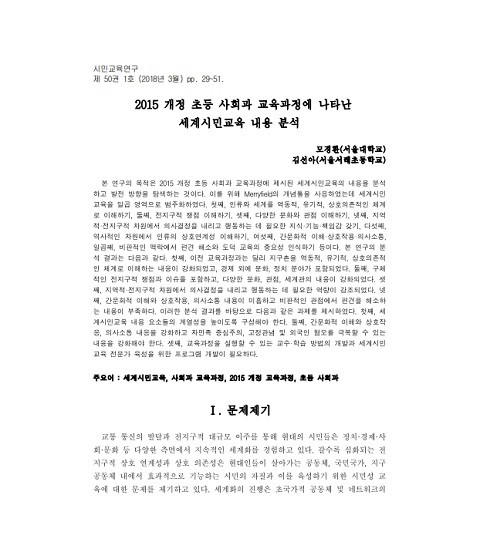 A Critical Analysis of Global Citizenship in 2015 Revised Elementary Social Studies Curriculum (Theory and Research in Citizenship Education; Vol. 50, No. 1) 발행 연도: 2018 저자: Kyunghwan Mo | Sunah Kim 단체 저자: Korea Association of Social Education The purpose of this study was to examine how global citizenship is reflected in the 2015 revised social studies curriculum. The study used the conceptual framework of Merryfield(1998) to analyze the national curriculum. The results of the analysis are as follows. First, in terms of understanding of the world as interdependent systems, contents on politics and culture as well as economy increased. Second, more global issues and problems were included. Third, contents on sustainable development increased. Fourth, the scope of diversity expanded. Fifth, interconnectedness of humans through time was inadequately reflected in the current social studies curriculum. Sixth, contents on values and attitudes, and actions were strengtened. Sixth, contents of cross-cultural understanding, interaction, and communication are not adequately included. The elementary social studies curriculum should strengthen cross-cultural understanding and interaction and prejudice reduction. Also, more instructional methods for global citizenship education should be developed and teacher education programs should be overhauled. 2015 개정 초등 사회과 교육과정에 나타난 세계시민교육 내용 분석 (시민교육연구; Vol. 50, No. 1) 발행 연도: 2018 저자: 모경환 | 김선아 단체 저자: 한국사회과교육학회 본 연구의 목적은 2015 개정 초등 사회과 교육과정에 제시된 세계시민교육의 내용을 분석하고 발전 방향을 탐색하는 것이다. 이를 위해 Merryfield의 개념틀을 사용하였는데 세계시민교육을 일곱 영역으로 범주화하였다. 첫째, 인류와 세계를 역동적, 유기적, 상호의존적인 체계로 이해하기, 둘째, 전지구적 쟁점 이해하기, 셋째, 다양한 문화와 관점 이해하기, 넷째, 지역적·전지구적 차원에서 의사결정을 내리고 행동하는 데 필요한 지식·기능·책임감 갖기, 다섯째, 역사적인 차원에서 인류의 상호연계성 이해하기, 여섯째, 간문화적 이해·상호작용·의사소통, 일곱째, 비판적인 맥락에서 편견 해소와 도덕 교육의 중요성 인식하기 등이다. 본 연구의 분석 결과는 다음과 같다. 첫째, 이전 교육과정과는 달리 지구촌을 역동적, 유기적, 상호의존적인 체계로 이해하는 내용이 강화되었고, 경제 외에 문화, 정치 분야가 포함되었다. 둘째, 구체적인 전지구적 쟁점과 이슈를 포함하고, 다양한 문화, 관점, 세계관의 내용이 강화되었다. 셋째, 지역적·전지구적 차원에서 의사결정을 내리고 행동하는 데 필요한 역량이 강조되었다. 넷째, 간문화적 이해와 상호작용, 의사소통 내용이 미흡하고 비판적인 관점에서 편견을 해소하는 내용이 부족하다. 이러한 분석 결과를 바탕으로 다음과 같은 과제를 제시하였다. 첫째, 세계시민교육 내용 요소들의 계열성을 높이도록 구성해야 한다. 둘째, 간문화적 이해와 상호작용, 의사소통 내용을 강화하고 자민족 중심주의, 고정관념 및 외국인 혐오를 극복할 수 있는 내용을 강화해야 한다. 셋째, 교육과정을 실행할 수 있는 교수·학습 방법의 개발과 세계시민교육 전문가 육성을 위한 프로그램 개발이 필요하다.
 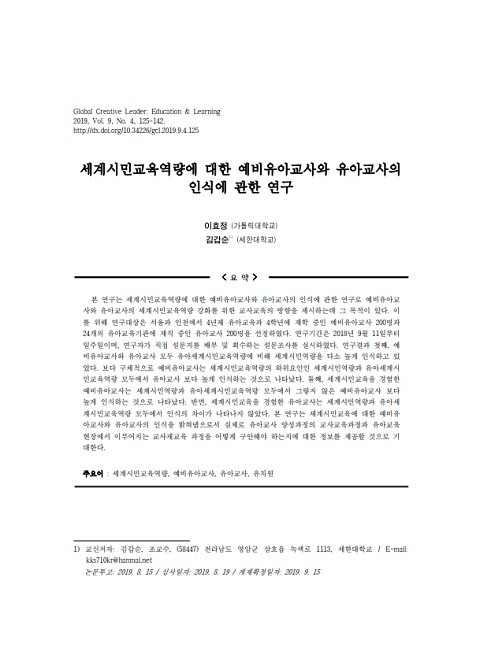 세계시민교육역량에 대한 예비유아교사와 유아교사의 인식에 관한 연구 (Global Creative Leader: Education & Learning; Vol. 9, No. 4) 발행 연도: 2019 저자: 이효정 | 김갑순 단체 저자: 숭실대학교 영재교육연구소 본 연구는 세계시민교육역량에 대한 예비유아교사와 유아교사의 인식에 관한 연구로 예비유아교사와 유아교사의 세계시민교육역량 강화를 위한 교사교육의 방향을 제시하는데 그 목적이 있다. 이를 위해 연구대상은 서울과 인천에서 4년제 유아교육과 4학년에 재학 중인 예비유아교사 200명과 24개의 유아교육기관에 재직 중인 유아교사 200명을 선정하였다. 연구기간은 2018년 9월 11일부터 일주일이며, 연구자가 직접 설문지를 배부 및 회수하는 설문조사를 실시하였다. 연구결과 첫째, 예비유아교사와 유아교사 모두 유아세계시민교육역량에 비해 세계시민역량을 다소 높게 인식하고 있었다. 보다 구체적으로 예비유아교사는 세계시민교육역량의 하위요인인 세계시민역량과 유아세계시민교육역량 모두에서 유아교사 보다 높게 인식하는 것으로 나타났다. 둘째, 세계시민교육을 경험한 예비유아교사는 세계시민역량과 유아세계시민교육역량 모두에서 그렇지 않은 예비유아교사 보다 높게 인식하는 것으로 나타났다. 반면, 세계시민교육을 경험한 유아교사는 세계시민역량과 유아세계시민교육역량 모두에서 인식의 차이가 나타나지 않았다. 본 연구는 세계시민교육에 대한 예비유아교사와 유아교사의 인식을 밝혀냄으로서 실제로 유아교사 양성과정의 교사교육과정과 유아교육현장에서 이루어지는 교사재교육 과정을 어떻게 구안해야 하는지에 대한 정보를 제공할 것으로 기대한다. Perception on Global Citizenship Education Competence between Pre-service Teachers and In-service Teachers in Kindergarten (Global Creative Leader: Education & Learning; Vol. 9, No. 4) 발행 연도: 2019 저자: Hyojeong Lee | Kabsoon Kim 단체 저자: Soongsil University. Research Institute for Gifted & Talented Education The purpose of this study was to establish the direction of teacher education based on global citizenship education competence studying the perception of pre-service teachers and in-service teachers on global citizenship education competence. The 2018 survey was conducted for a week beginning September 11. The respondents who were 200 pre-service teachers and 200 in-service teachers were selected from Seoul and Incheon. The researcher distributed and collected the questionnaire directly. The results of the study were as follows. First, pre-service teachers showed higher cognition than in-service teacher in both global citizenship competence and early childhood global citizenship competence. Second, among pre-service teachers, ones who had experienced global citizenship education showed higher cognition level in both categories than others. On the other hand, in-service teachers who had experienced global citizenship education did not show any difference of cognition in both global citizenship competence and early childhood global citizenship competence. This study was expected to reveal the perceptions of pre-service teachers and when training teachers, the data provided more specific details for early childhood educator curriculums about global citizenship education.
 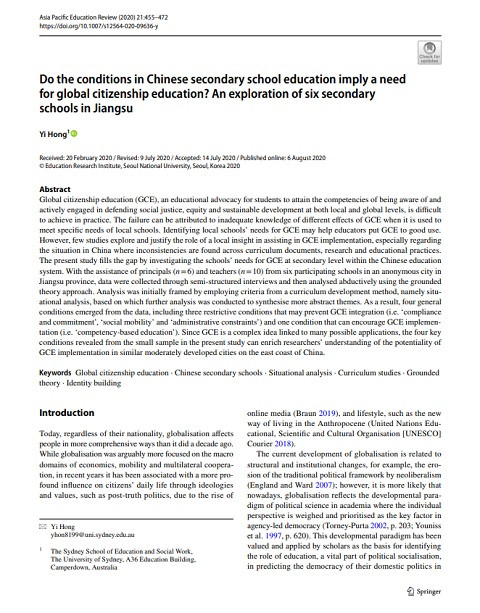 Do the Conditions in Chinese Secondary School Education Imply a Need for Global Citizenship Education? an Exploration of Six Secondary Schools in Jiangsu (Asia Pacifc Education Review; Rev. 21) 발행 연도: 2020 저자: Yi Hong 단체 저자: Seoul National University. Education Research Institute Global citizenship education (GCE), an educational advocacy for students to attain the competencies of being aware of and actively engaged in defending social justice, equity and sustainable development at both local and global levels, is difficult to achieve in practice. The failure can be attributed to inadequate knowledge of different effects of GCE when it is used to meet specific needs of local schools. Identifying local schools’ needs for GCE may help educators put GCE to good use. However, few studies explore and justify the role of a local insight in assisting in GCE implementation, especially regarding the situation in China where inconsistencies are found across curriculum documents, research and educational practices. The present study fills the gap by investigating the schools’ needs for GCE at secondary level within the Chinese education system. With the assistance of principals (n = 6) and teachers (n = 10) from six participating schools in an anonymous city in Jiangsu province, data were collected through semi-structured interviews and then analysed abductively using the grounded theory approach. Analysis was initially framed by employing criteria from a curriculum development method, namely situational analysis, based on which further analysis was conducted to synthesise more abstract themes. As a result, four general conditions emerged from the data, including three restrictive conditions that may prevent GCE integration (i.e. ‘compliance and commitment’, ‘social mobility’ and ‘administrative constraints’) and one condition that can encourage GCE implementation (i.e. ‘competency-based education’). Since GCE is a complex idea linked to many possible applications, the four key conditions revealed from the small sample in the present study can enrich researchers’ understanding of the potentiality of GCE implementation in similar moderately developed cities on the east coast of China.