
자료
세계시민교육에 대한 이해를 넓히고 연구, 옹호 활동, 교수, 학습 등을 향상시킬 수 있는 다양하고 유용한 자료를 찾아보세요.
3,433 건의 결과가 검색되었습니다
 The Concept of Sustainability and Its Contribution Towards Quality Transformative Education: Thematic Paper 발행 연도: 2022 단체 저자: UNESCO This thematic paper explores the concept of sustainability and its contribution towards quality transformative education, and serves as a background document to clarify the scope and depth of the revised 1974 Recommendation. Specifically, this document presents the need to update and broaden the scope of the 1974 Recommendation by introducing the concept of sustainable development, and discussing the role of education in addressing contemporary global challenges in particular climate change and climate justice, peace, biodiversity loss, poverty and inequality, and discriminations and human rights.
 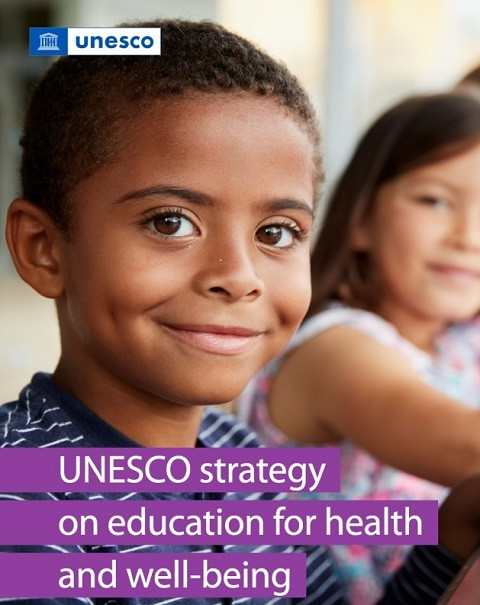 UNESCO Strategy on Education for Health and Well-being 발행 연도: 2022 단체 저자: UNESCO This strategy guides UNESCO to promote the physical and mental health and well-being of learners. By reducing health-related barriers to learning, such as malnutrition, early and unintended pregnancy, HIV and sexually transmitted infections (STIs) and violence and discrimination, UNESCO, governments and school systems can unlock the potential of all learners. The evidence for increased focus on the link between education and health is strong. Education strongly impacts health outcomes and health is equally fundamental to education. This calls for a more comprehensive approach to school health and more coordinated action across sectors.This revised and updated strategy is a roadmap for UNESCO to promote comprehensive sexuality education (CSE) and safe and inclusive learning environments, and place more emphasis on the role of schools and education systems in promoting health and well-being.
  Freedom of Expression, Media and Information Literacy and Digital Competencies to Support Peace and Human Rights: Thematic Paper 발행 연도: 2022 단체 저자: UNESCO This document is part of the thematic papers developed by UNESCO to inform the Revision of the 1974 Recommendation concerning education for international understanding, co-operation and peace. It focuses on Freedom of Expression, Media and Information Literacy and Digital Competencies that are not currently covered in the Recommendation but that require greater attention in the revised version in view of ensuring it addresses contemporary challenges to lasting peace.
  The Relevance and Contributions of Education for Health and Well-Being to the Advancement of Human Rights, Sustainable Development & Peace: Thematic Paper 발행 연도: 2022 단체 저자: UNESCO This document is part of the thematic papers developed by UNESCO to inform the Revision of the 1974 Recommendation concerning education for international understanding, co-operation and peace. This paper aims to provide a few recommendations for revising the 1974 Recommendation.
 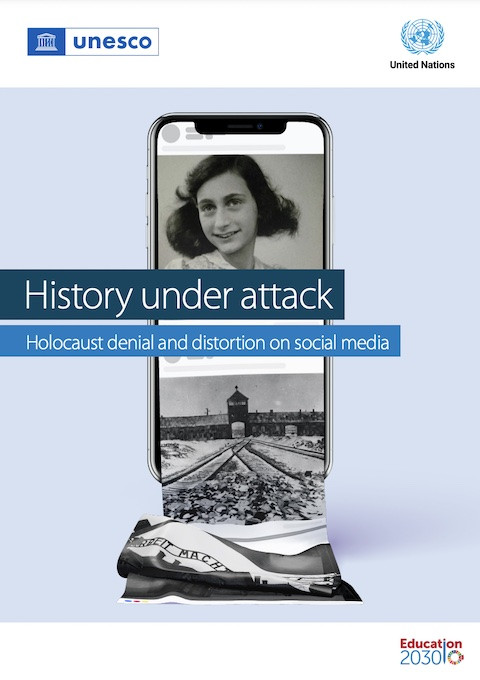 History Under Attack: Holocaust Denial and Distortion on Social Media 발행 연도: 2022 단체 저자: Организация Объединенных Наций по вопросам образования, науки и культуры (UNESCO) | United Nations (UN) Holocaust denial and distortion are dangerous. It is an attack on truth and knowledge. It feeds on and spreads antisemitic tropes and prejudices, and threatens our understanding of one of the most tragic and violent histories: The genocide of six million Jews by Nazi Germany, its allies and collaborators. In countries across Europe, people became complicit in the persecution and murder of their neighbours. Holocaust denial and distortion can prevent society from reckoning with this past. It impedes our comprehension of the causes and warning signs of genocide, and that might strengthen efforts for genocide prevention. It is insulting to the victims and survivors of the Holocaust, and risks the rehabilitation of violent, antisemitic ideologies. At its most extreme, it celebrates and glorifies this history, inciting violence against Jews and calling for another genocide. The United Nations and UNESCO condemn the rise of Holocaust denial and distortion online as a dangerous form of hatred, and commissioned this report in partnership with the World Jewish Congress to raise awareness of the forms and functions of Holocaust denial and distortion on social media, and determine a series of policy and educational responses. This report is a data-driven investigation into the extent and nature of Holocaust denial and distortion on online platforms. It is based on a manual review of almost 4,000 pieces of content collected in June and July 2021 that related to Jews, the Holocaust, antisemitism and Holocaust denial and distortion from five major online platforms and messenger apps. It looks at content posted on Facebook, Instagram, Telegram, TikTok and Twitter: some of the world’s largest online platforms and collectively home to billions of users. It addresses content in four different languages: English, French, Spanish and German, with the aim of providing a wide-ranging review that addresses multiple countries and contexts. This report aims to answer four questions:How much Holocaust-related content on social media either denies the Holocaust or distorts key elements of history?What are the key narratives in contemporary Holocaust denial and distortion?How are Holocaust denial and distortion communicated, and how are they situated within wider discourses and frames?What can online platform companies, policy-makers, educators and organizations promoting Holocaust remembrance, education and research do to tackle the problem? Based on the findings of this report, it provides a series of recommended actions that online platforms, policy-makers, civil society, researchers and educators can implement to prevent and counter Holocaust denial and distortion online.
  Berlin Declaration on Education for Sustainable Development 발행 연도: 2022 단체 저자: 유네스코 In light of the dramatic challenges the world is facing today there is urgent need to transform learning and redesign our societies for the survival of our planet. Education for Sustainable Development (ESD) is key in achieving this change. In May 2021 Ministers of Education from around the world, youth, teachers, scientists and civil society, came together virtually at the UNESCO World Conference on Education for Sustainable Development. They adopted the Berlin Declaration for Sustainable Development, expressing their commitment to harness the power of ESD to build a more just, equal, equitable and sustainable world.The purpose of this online publication is to contextualize the promises made in the Berlin Declaration and explain complex terms and concepts contained in the document, thus rendering its content easily accessible to the wider public. The main body of the text presents the Declaration itself, while the explanatory boxes provide practical background information about sustainable development, Sustainable Development Goal target 4.7 as well as interesting links to find more information about ESD, climate change, green technologies and other related issues.
 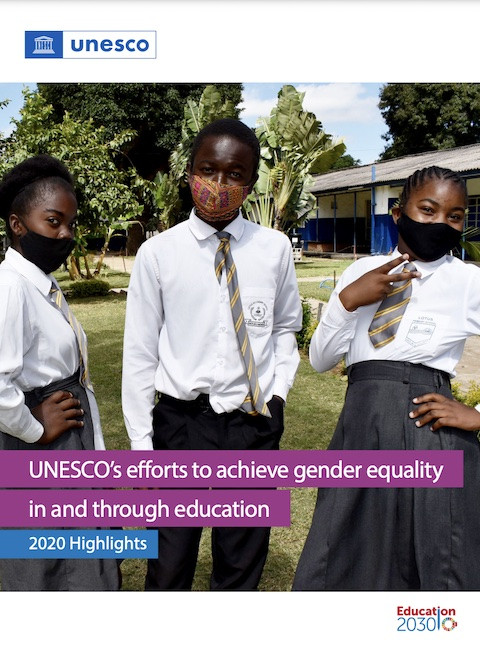 UNESCO’s Efforts to Achieve Gender Equality in and Through Education: 2020 Highlights 발행 연도: 2022 단체 저자: UNESCO This report presents highlights of UNESCO’s work in 2020 to advance gender equality in and through education.UNESCO's work in this area is guided by the UNESCO strategy for gender equality in and through education 2019–2025, and supported by Her Education, Our Future, which was launched in parallel with the strategy, to leverage political and financial commitments, cooperation and joint action for girls’ and women’s education.
  UNESCO in Action for Gender Equality: 2020-2021 발행 연도: 2022 단체 저자: 유네스코 UNESCO’s global priority gender equality took on new meaning over the past biennium. The years 2020 and 2021 have been marked by dramatic social, political, environmental, and economic changes across countries resulting from an unprecedented pandemic: COVID-19. The COVID-19 pandemic magnified deep rooted structural gender inequalities across societies and forced the world to question the degree to which advances towards achieving gender equality had been made since the first UN World Conference on Women held in Beijing. This publication shows how a collective work by all structures of UNESCO has mobilized an extraordinary effort to go beyond a necessary adaptation to a multi-faceted crisis and counter backlashes and strengthen the resilience of women and girls and the systems which protect and empower them around the world through education, sciences, culture, communication, and information.
 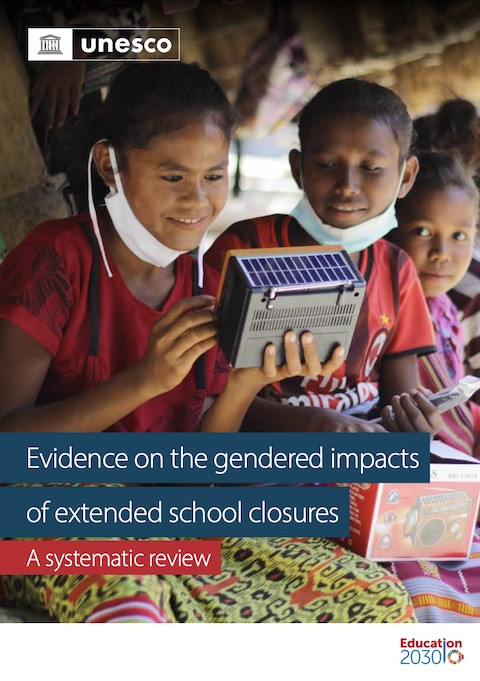 Evidence on the Gendered Impacts of Extended School Closures: A Systematic Review 발행 연도: 2022 단체 저자: UNESCO School closures to mitigate the spread of COVID-19 have affected nearly 1.6 billion learners across the globe. While the scale of these closures is unprecedented, in recent decades children in many contexts have been out of school for long periods due to other pandemics, disruptions and disasters such as floods, earthquake and conflicts – with marked gender effects.Building on the findings of 154 studies from every region of the world, this study investigates the evidence on the gendered impacts of extended school closures and periods out of school. Through a systematic review of the evidence, it highlights how these can deepen gendered exclusions and vulnerabilities – with the poorest children being the most affected.Undertaken by a team of leading academic experts on gender equality and education, Evidence on the gendered impacts of extended school closures: A systematic review aims to prevent and mitigate adverse outcomes arising from extended periods of time out of school, by ensuring that responses to current and future crises are informed by a solid understanding of their effects on children’s education, health, well-being and protection.
  Los actores no estatales en la educación superior: ¿Una visión compartida de la calidad y la asequibilidad? (Policy Paper 47) 발행 연도: 2022 단체 저자: UNESCO Los actores no estatales acogen a más de un tercio del alumnado de educación superior en todo el mundo, un porcentaje considerablemente más elevado que en la educación primaria o secundaria. Los proveedores son diversos y responden a una variedad de necesidades, y a menudo no hay una división clara entre los sectores estatal y no estatal. Los actores no estatales son además protagonistas importantes en la financiación de la educación superior a través de los hogares, los mecanismos de mercado y las alianzas público-privadas. A raíz de ello, estos actores desempeñan un papel significativo e influyen en la elaboración de normativas y políticas, así como en la configuración del sistema de educación superior en su conjunto. Los gobiernos deben garantizar la calidad y equidad —las dimensiones clave de la meta 4.3 de los Objetivos de Desarrollo Sostenible (ODS)—, independientemente del modo en que los actores estatales y no estatales compartan responsabilidades.