
자료
세계시민교육에 대한 이해를 넓히고 연구, 옹호 활동, 교수, 학습 등을 향상시킬 수 있는 다양하고 유용한 자료를 찾아보세요.
3,433 건의 결과가 검색되었습니다
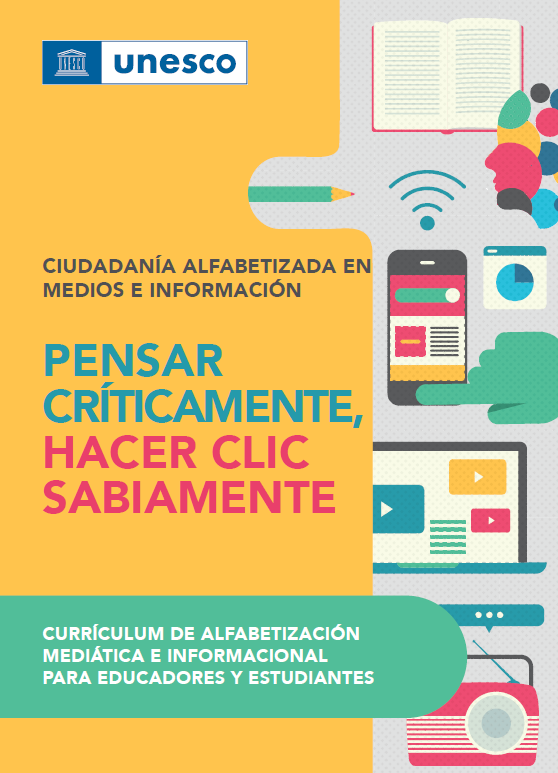 Ciudadanía alfabetizada en medios e información: pensar críticamente, hacer clic sabiamente 발행 연도: 2023 저자: Alton Grizzle | Carolyn Wilson | Ramon Tuazon | C.K. Cheung | Jesus Lau | Rachel Fischer | Dorothy Gordon | Kwame Akyempong | Jagtar Singh | Paul R. Carr | Kristine Stewart | Samy Tayie | Olunifesi Suraj | Maarit Jaakkola | Gina Thésée | Curmira Gulston 단체 저자: UNESCO ¿Podemos mejorar nuestras sociedades haciendo clic sabiamente?Los proveedores de contenidos como bibliotecas, archivos, museos, medios y empresas de comunicación digital pueden permitir un desarrollo inclusivo y sostenible. Sin embargo, no siempre están a la altura de estos ideales, lo que crea desafíos para los usuarios de estos servicios. Los proveedores de contenidos de todo tipo abren nuevas oportunidades para el aprendizaje permanente. Pero al mismo tiempo, plantean desafíos como la información falsa y la desinformación, el discurso de odio y la violación de la privacidad en línea, entre otros.La Alfabetización Mediática e Informacional es un conjunto de competencias que ayudan a las personas a maximizar las ventajas y minimizar los daños. La Alfabetización Mediática e Informacional abarca las competencias que permiten a las personas interactuar de manera crítica y efectiva con el contenido de las comunicaciones; las instituciones que facilitan este contenido y el uso de tecnologías digitales. Las capacidades en estos ámbitos son indispensables para la ciudadanía, independientemente de su edad o procedencia. Este Currículum pionero presenta un marco integral de competencias de Alfabetización Mediática e Informacional y ofrece a educadores y estudiantes sugerencias pedagógicas estructuradas. Cuenta con varios módulos detallados que cubren la gama de competencias necesarias para navegar por el ecosistema de comunicaciones de hoy.Este recurso vincula la Alfabetización Mediática e Informacional con cuestiones emergentes como la Inteligencia Artificial, la educación para la ciudadanía digital, la educación para el desarrollo sostenible, la alfabetización cultural y el aumento exponencial de la información falsa y la desinformación. Con el uso efectivo de este Currículum de Alfabetización Mediática e Informacional, todos pueden volverse alfabetizados mediáticos e informacionales, así como educadores pares de la Alfabetización Mediática e Informacional.
 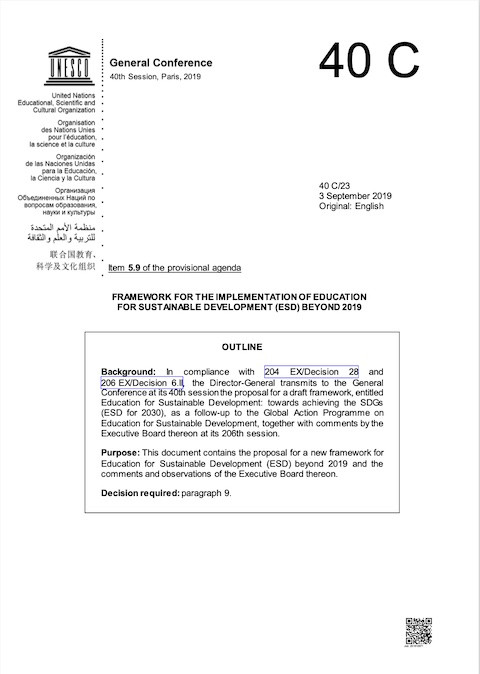 Framework for the Implementation of Education for Sustainable Development (ESD) Beyond 2019 발행 연도: 2019 단체 저자: UNESCO This document contains the proposal for a new framework for Education for Sustainable Development (ESD) beyond 2019 and the comments and observations of the Executive Board thereon. Marco de aplicación de la Educación para el Desarrollo Sostenible (EDS) después de 2019 발행 연도: 2019 단체 저자: Organización de las Naciones Unidas para la Educación, la Ciencia y la Cultura (UNESCO) El presente documento contiene la propuesta de un nuevo marco de educación para el desarrollo sostenible (EDS) después de 2019 y los comentarios y observaciones del Consejo Ejecutivo al respecto. Cadre pour la mise en oeuvre de l'éducation en vue du développement durable (EDD) après 2019 발행 연도: 2019 단체 저자: Organisation des Nations Unies pour l'éducation, la science et la culture (UNESCO) Le présent document contient une proposition de cadre pour l’éducation en vue du développement durable (EDD) après 2019, ainsi que les commentaires et observations du Conseil exécutif à ce sujet. Рамочная основа деятельности в области образования в интересах устойчивого развития (ОУР)в период после 2019 г 발행 연도: 2019 단체 저자: Организация Объединенных Наций по вопросам образования, науки и культуры (UNESCO) В настоящем документе содержатся предложение отно- сительно новой рамочной основы деятельности в области образования в интересах устойчивого развития (ОУР), а также комментарии и заме- чания Исполнительного совета.
  الاستعراض الدوري الشامل وقدرته على تعزيز حرية التعبير والنفاذ إلى المعلومة وسالمة الصحفيين 발행 연도: 2022 저자: Hina Jilani 단체 저자: UNESCO This document introduces The Universal Periodic Review (UPR), including its function, content and guideline for practice, and evaluates its positive contributions to global human rights. The Universal Periodic Review (UPR) and its Potential to Foster Freedom of Expression, Access to Information and Safety of Journalists: Guidelines for National Human Rights Institutions (NHRIs) 발행 연도: 2022 저자: Hina Jilani 단체 저자: UNESCO This document introduces The Universal Periodic Review (UPR), including its function, content and guideline for practice, and evaluates its positive contributions to global human rights. El examen Periódico Universal (EPU) y su capacidad para promover la libertad de expresión, el acceso a la información y la seguridad de los periodistas : directrices para las instituciones nacionales de derechos humanos (INDH) 발행 연도: 2022 저자: Hina Jilani 단체 저자: UNESCO This document introduces The Universal Periodic Review (UPR), including its function, content and guideline for practice, and evaluates its positive contributions to global human rights. ’Examen périodique universel (EPU) et son potentiel pour la liberté d’expression, l’accès à l’information et la sécurité des journalistes : directives à l’intention des institutions nationales des droits de l’homme (INDH) 발행 연도: 2022 저자: Hina Jilani 단체 저자: UNESCO This document introduces The Universal Periodic Review (UPR), including its function, content and guideline for practice, and evaluates its positive contributions to global human rights.
 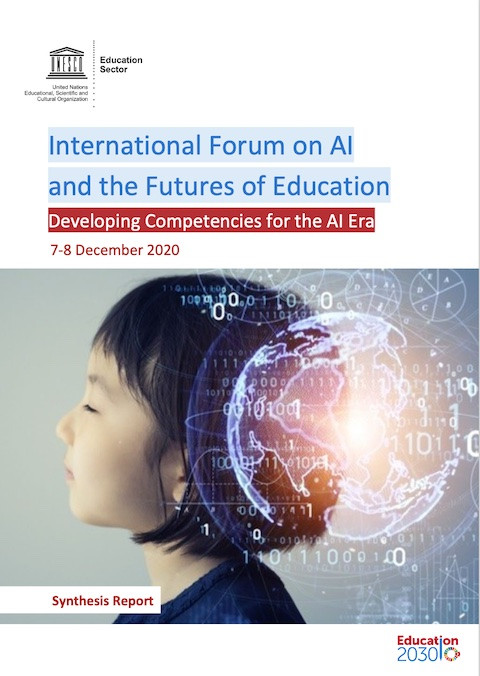 International Forum on AI and the Futures of Education: Developing Competencies for the AI Era Synthesis Report; 7-8 December 2020 발행 연도: 2021 저자: Fengchun Miao | Wayne Holmes 단체 저자: UNESCO This synthesis report has been developed by the UNESCO Unit for Technology and Artificial Intelligence in Education within the Future of Learning and Innovation Team, drawing on the International Forum on AI and the Futures of Education held in Beijing and simultaneously online from 7 to 8 December 2020.The Forum underlined the importance of reviewing the very purpose of education, together with the opportunity for real transformation, and the role that AI might play. It is widely acknowledged that current educational practices and educational environment are very rigid, and that the future of education should be more flexible and responsive to changing circumstances and innovation. National education authorities should identify what skills young people need to enable them to live and thrive in the new realities of a constantly changing world, and what digital transformation makes possible in the national and international context. In short, new education models are needed to put students at the centre, to move away from a focus on memorizing content, to integrate the digital and the analogue, and to foster human cognitive, socioemotional and critical skills, all of which might – with foresight and careful attention – be enabled by AI and other digital technologies.