
자료
세계시민교육에 대한 이해를 넓히고 연구, 옹호 활동, 교수, 학습 등을 향상시킬 수 있는 다양하고 유용한 자료를 찾아보세요.
661 건의 결과가 검색되었습니다
 Address by Irina Bokova, Director-General of UNESCO, on the occasion of the Ethics in Action event, Casina Pio IV in the Vatican Gardens; Vatican, 16 October 2017 발행 연도: 2017 단체 저자: UNESCO. Director-General, 2009-2017 (Bokova, I.G.) This address was delivered by Irina Bokova, Director-General of UNESCO, on the occasion of the Ethics in Action event, Casina Pio IV in the Vatican Gardens; Vatican, on 16 October 2017.
  Metadata for the Global and Thematic Indicators for the Follow-up and Review of SDG 4 and Education 2030 발행 연도: 2017 단체 저자: UNESCO Institute for Statistics (UIS) This document contains standardised metadata for each of the proposed global and thematic indicators for monitoring Sustainable Development Goal 4 (SDG 4) and the Education 2030 Agenda.The metadata included in this document have been developed by the UIS and are based on the set of thematic indicators approved by the Technical Cooperation Group on SDG 4–Education 2030 Indicators, a group set up in 2016 to provide the technical platform to support the implementation of the thematic indicator framework for the follow-up and review of SDG 4 and the Education 2030 Agenda. Метаданные глобальных и тематических показателей для сопровождения и обзора "ЦУР 4" и программы «Образование-2030" 발행 연도: 2017 단체 저자: UNESCO Institute for Statistics (UIS) Этот документ содержит стандартизованные метаданные для каждого из предлагаемых глобальных и тематических показателей для мониторинга Цели 4 устойчивого развития (SDG 4) и Повестки дня "Образование-2030".Метаданные, включенные в этот документ, были разработаны Институтом статистики ЮНЕСКО и основаны на наборе тематических показателей, одобренных Группой технического сотрудничества по индикаторам ЦУР 4 - "Образование-2030", созданной в 2016 году для предоставления технической платформы по поддержке реализации структуры тематических показателей для последующей деятельности и обзора ЦУР 4 и Повестки дня "Образование-2030".
  Review of Curricula and Curricular Frameworks: Report to Inform the Update of the UNESCO International Technical Guidance on Sexuality Education 발행 연도: 2018 저자: Nicole Cheetham | Nora Gelperin 단체 저자: Advocates for Youth In 2009, UNESCO published the International Technical Guidance on Sexuality Education (ITGSE): An evidence-informed approach for schools, teachers and health educators. The purpose of the ITGSE is to assist education, health and other relevant authorities in the development and implementation of school-based sexuality education programmes and materials (UNESCO, 2009). The publication was released in two volumes: Volume I, which focuses on the rationale for sexuality education and provides sound technical advice on the characteristics of effective programmes; and Volume II, which focuses on the topics and learning objectives to be covered in a ‘basic minimum package’ on sexuality education for children and young people from 5 to 18+ years of age, and includes a bibliography of useful resources.In 2016, UNESCO began a process to update the ITGSE, consisting of a literature review of the evidence and lessons learned since the release of the original publication; a stakeholder consultation on sexuality education held in October of 2016; an online user survey; and an expert, Comprehensive Sexuality Education (CSE) Advisory Group established to inform the process and its findings.This report summarizes evidence-informed conclusions, expert recommendations and current practice for curriculum-based sexuality education for ages 5-18+ and provides preliminary, overarching changes to Volume II of the ITGSE for consideration by the UNESCO CSE Advisory Group.
  Address by Irina Bokova, Director-General of UNESCO on the occasion of the Presentation of the UNESCO World Report: Investing in Cultural Diversity and Intercultural Dialogue, during UNESCO Week at the Shanghai World EXPO 2010; Shanghai, 21 May 2010 발행 연도: 2010 단체 저자: UNESCO. Director-General, 2009-2017 (Bokova, I.G.) This address was delivered by Irina Bokova, Director-Geneeral of UNESCO on the occasion of the presentation of the UNESCO world report in investing in cultural diversity and intercultural dialogue during UNESCO week at the Shanghai World Expo 2010. In this address she highlited the importance of cultural diversity and intercultural communication, and requested the protection of Chinese cultural heritage by Chinese governments. Discours de Mme Irina Bokova, Directrice Générale de l'UNESCO à l'occasion de la Présentation du Rapport Mondial de l'UNESCO: Investir dans la Diversité Culturelle et le Dialogue Interculturel, au cours de la Semaine de l'UNESCO à l'EXPO Shanghai 2010 발행 연도: 2010 단체 저자: UNESCO. Director-General, 2009-2017 (Bokova, I.G.) Cette adresse a été prononcé par Irina Bokova, Directrice Geneeral de l'UNESCO à l'occasion de la présentation du rapport mondial de l'UNESCO à investir dans la diversité culturelle et le dialogue interculturel pendant la semaine de l'UNESCO à l'Exposition Universelle de Shanghai 2010. Dans cette adresse, elle a souligné l'importance de la diversité culturelle et la communication interculturelle, et a demandé la protection du patrimoine culturel chinois par les gouvernements chinois.
  Publications Series within the CAREC Environment and Health Program 발행 연도: 2018 저자: Irina Bekmirzaeva 단체 저자: Regional Environmental Centre for Central Asia (CAREC) This publication was prepared by CAREC Environment and Health Program which aims to inform and raise awareness and knowledge among interested stakeholders on the interrelationship between environment and medicine. These publications are primarily developed to respond to numerous requests from representatives of Central Asian countries working on environmental and health issues in the region. The narrative style, language and terminology of the information have been designed for a wider audience. All information presented in these publications is based on the CAREC’s expertise and experience, as well as data from World Health Organization (WHO), the United Nations Development Program (UNDP) and the United Nations Environment Program (UNEP) and other international organizations.In the next issues of CAREC Environment and Health Program publications, we will focus on selected environmental health issues, including air quality and health, water and health, waste and health, sustainable development goals (SDGs), etc. Серия информационных публикаций в рамках программы "окружающая среда и здоровье" 발행 연도: 2018 저자: Irina Bekmirzaeva 단체 저자: Regional Environmental Centre for Central Asia (CAREC) РЭЦЦА представляет серию публикаций, подготовленную в рамках Программы «Окружающая среда и здоровье», целью которой является информирование и повышение осведомленности и знаний по вопросам взаимосвязи и взаимозависимости экологии и медицины. Данные публикации разрабатываются, в первую очередь, для стран Центральной Азии. Они являются ответом на многочисленные запросы представителей стран ЦА, интересующихся вопросами охраны окружающей среды и здоровья в регионе. Стиль, язык и терминология, а также детальность информации были подобраны специально для широкой категории читателей. Вся представленная в публикациях информация базируется на экспертизе и опыте РЭЦЦА и данных Всемирной организации здравоохранения (ВОЗ), Программы развития ООН (ПРООН) и Программы ООН по окружающей среде (ЮНЕП) и других международных организаций.
  L’éducation à la citoyenneté : regards sur la situation international et française 발행 연도: 2013 단체 저자: Centre international d'études pédagogiques La notion d'éducation à la citoyenneté revêt des sens différents suivant les contextes et les acteurs. Cette bibliographie propose une série de documents sur les thèmes de l'éducation à la citoyenneté et de l'instruction civique et morale dans le monde. Elle recense des publications récentes sélectionnées dans la base de données bibliographiques du Centre de ressources et d'ingénierie documentaires du CIEP. On trouvera dans une première partie des études concernant plusieurs pays, complétée de quelques études nationales.
 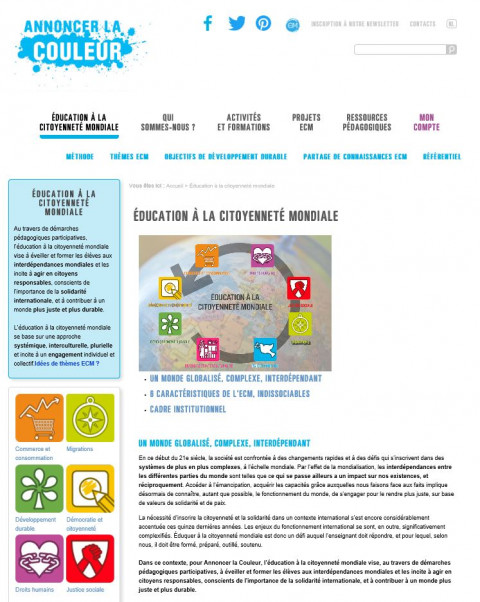 Éducation à la citoyenneté mondiale 단체 저자: Annoncer la Couleur (ALC) En ce début du 21e siècle, la société est confrontée à des changements rapides et à des défis qui s'inscrivent dans des systèmes de plus en plus complexes, à l'échelle mondiale. Par l’effet de la mondialisation, les interdépendances entre les différentes parties du monde sont telles que ce qui se passe ailleurs a un impact sur nos existences, et réciproquement. Accéder à l’émancipation, acquérir les capacités grâce auxquelles nous faisons face aux faits implique désormais de connaître, autant que possible, le fonctionnement du monde, de s'engager pour le rendre plus juste, sur base de valeurs de solidarité et de paix.La nécessité d’inscrire la citoyenneté et la solidarité dans un contexte international s’est encore considérablement accentuée ces quinze dernières années. Les enjeux du fonctionnement international se sont, en outre, significativement complexifiés. Éduquer à la citoyenneté mondiale est donc un défi auquel l’enseignant doit répondre, et pour lequel, selon nous, il doit être formé, préparé, outillé, soutenu.Dans ce contexte, pour Annoncer la Couleur, l’éducation à la citoyenneté mondiale vise, au travers de démarches pédagogiques participatives, à éveiller et former les élèves aux interdépendances mondiales et les incite à agir en citoyens responsables, conscients de l'importance de la solidarité internationale, et à contribuer à un monde plus juste et plus durable.