
자료
세계시민교육에 대한 이해를 넓히고 연구, 옹호 활동, 교수, 학습 등을 향상시킬 수 있는 다양하고 유용한 자료를 찾아보세요.
1,180 건의 결과가 검색되었습니다
 Adult education and development: global citizenship education (no 82, 2015) 발행 연도: 2015 단체 저자: DVV International Issue 82/2015 of the international journal Adult Education and Development (AED) explores the topic global citizenship education. In the international debates, we are witnessing a growing interest in the concept of global citizenship education. It is one of the three pillars of the Global Education First Initiative (GEFI) launched by the United Nations Secretary-General in 2012 and is being internationally promoted by the work of UNESCO. According to the GEFI, education that fosters global citizenship “must fully assume its central role in helping people to forge more just, peaceful, tolerant and inclusive societies”. The 2030 Agenda for Sustainable Development, adopted by the United Nations General Assembly in September 2015, refers to global citizenship as one tool to “ensure that all learners acquire the knowledge and skills needed to promote sustainable development”. The ambitions are high, but the concrete understanding of global citizenship education and its implications differ widely. Is it just another abstract concept? What meaning can the word citizenship have if it does not refer to a specific nation? What do people in different parts of the world understand by global citizenship? And how can global citizenship education be put into practice? Adult Education and Development decided to engage in the debate and invited authors from different regions, backgrounds and disciplines to share their thoughts and experiences on the topic and related questions such as identity, migration, peace, the meaning of citizenship, globalisation and sustainable development. Irina Bokova, Director-General of UNESCO, explains the organisation’s understanding of global citizenship education, and why adult education and “learning beyond the classrooms” are crucial when it comes to promoting global citizenship. Canadian author and journalist Doug Saunders (“Arrival City: How the Largest Migration in History Is Reshaping Our World”) talks about the challenges and opportunities of what he refers to as the last great human migration, that from the countryside to the cities, and about the positive role adult education can play during this transition. In the section “Citizens’ voices” people from all over the world talk about what global citizenship means to them and in what ways they see themselves as global citizens. And photographer Viktor Hilitksi travelled through Belarus and captured with his camera how villages rediscover their local traditions and cultures. Éducation des adultes et développement: L'éducation à la citoyenneté mondiale (ECM) (no 82, 2015) 발행 연도: 2015 단체 저자: DVV International Le numéro 82/2015 de la revue internationale l’Éducation des Adultes et Développement(AED) explore le sujet de l'éducation à la citoyenneté mondiale. Dans les débats internationaux, nous assistons à un intérêt croissant pour le concept d'éducation à la citoyenneté mondiale. Il est l'un des trois piliers de l'Initiative Mondiale pour l'Éducation Avant Tout (GEFI) lancé par le Secrétaire général des Nations Unies en 2012 et est promu à l'échelle internationale par le travail de l'UNESCO. Selon le GEFI, l'éducation qui favorise la citoyenneté mondiale "doit assumer pleinement son rôle central en aidant les gens à forger plus justes, des sociétés pacifiques, tolérantes et inclusives". L'Agenda 2030 pour le développement durable, adoptée par l'Assemblée générale des Nations Unies en Septembre 2015, se réfère à la citoyenneté mondiale comme un outil pour «faire en sorte que tous les apprenants à acquérir les connaissances et les compétences nécessaires pour promouvoir le développement durable». Les ambitions sont grandes, mais la compréhension concrète de L'éducation à la citoyenneté mondiale(ECM) et ses implications diffèrent largement. Est-il juste un autre concept abstrait? Quel sens le mot citoyenneté peut avoir si elle ne se réfère pas à une nation spécifique? Qu'est-ce que les gens dans les différentes parties du monde comprennent par la citoyenneté mondiale? Comment l'éducation à la citoyenneté mondiale(ECM) peut-elle être mise en pratique? Education des adultes et développement ont décidé de participer au débat et a invité les auteurs de différentes régions, milieux et disciplines à partager leurs réflexions et expériences sur le sujet et les questions connexes telles que l'identité, la migration, la paix, le sens de la citoyenneté, la mondialisation et le développement durable. Irina Bokova, Directrice générale de l'UNESCO, explique la compréhension de l'organisation de l'éducation à la citoyenneté mondiale, et pourquoi l'éducation des adultes et de «l'apprentissage au-delà des salles de classe" sont cruciales en matière de promotion de la citoyenneté mondiale. L'auteur et journaliste canadien Doug Saunders ( «La ville d'arrivée: comment la plus grande migration dans l'histoire remodèle notre monde») parle des défis et des opportunités de ce qu'il appelle la dernière grande migration humaine, celle des campagnes aux villes et Sur le rôle positif que l'éducation des adultes peut jouer au cours de cette transition. Dans la section «La voix des citoyens», des gens du monde entier parlent de ce que la citoyenneté mondiale signifie pour eux et de la manière dont ils se perçoivent comme des citoyens du monde. Et le photographe Viktor Hilitksi a parcouru la Biélorussie et a capturé avec sa caméra comment les villages redécouvrent leurs traditions et cultures locales.
  Éducation des adultes et développement: l’éducation à la citoyenneté mondiale (no 82, 2015) 발행 연도: 2015 단체 저자: DVV International Issue 82/2015 of the international journal Adult Education and Development (AED) explores the topic global citizenship education. In the international debates, we are witnessing a growing interest in the concept of global citizenship education. It is one of the three pillars of the Global Education First Initiative (GEFI) launched by the United Nations Secretary-General in 2012 and is being internationally promoted by the work of UNESCO. According to the GEFI, education that fosters global citizenship “must fully assume its central role in helping people to forge more just, peaceful, tolerant and inclusive societies”. The 2030 Agenda for Sustainable Development, adopted by the United Nations General Assembly in September 2015, refers to global citizenship as one tool to “ensure that all learners acquire the knowledge and skills needed to promote sustainable development”. The ambitions are high, but the concrete understanding of global citizenship education and its implications differ widely. Is it just another abstract concept? What meaning can the word citizenship have if it does not refer to a specific nation? What do people in different parts of the world understand by global citizenship? And how can global citizenship education be put into practice? Adult Education and Development decided to engage in the debate and invited authors from different regions, backgrounds and disciplines to share their thoughts and experiences on the topic and related questions such as identity, migration, peace, the meaning of citizenship, globalisation and sustainable development. Irina Bokova, Director-General of UNESCO, explains the organisation’s understanding of global citizenship education, and why adult education and “learning beyond the classrooms” are crucial when it comes to promoting global citizenship. Canadian author and journalist Doug Saunders (“Arrival City: How the Largest Migration in History Is Reshaping Our World”) talks about the challenges and opportunities of what he refers to as the last great human migration, that from the countryside to the cities, and about the positive role adult education can play during this transition. In the section “Citizens’ voices” people from all over the world talk about what global citizenship means to them and in what ways they see themselves as global citizens. And photographer Viktor Hilitksi travelled through Belarus and captured with his camera how villages rediscover their local traditions and cultures.
  Digital Citizenship in Asia-Pacific: Translating Competencies for Teacher Innovation and Student Resilience 발행 연도: 2023 단체 저자: UNESCO Bangkok A digitally-equipped and competent teaching force is crucial for cultivating students' digital citizenship skills. This UNESCO report, consisting of a comprehensive analysis comprising 15 countries in the Asia-Pacific region, unveils compelling evidence pertaining to what factors influence teachers' Information and Communication Technology (ICT) skills and their impact on students’ digital citizenship competencies. Perhaps unsurprisingly, the findings of this report show that students are developing most of their digital citizenship competencies through self-directed learning and outside of school. Nevertheless, teachers still play an important role, particularly in coaching students to use technology safely and effectively. Thus as UNESCO reports, Digital Creativity and Innovation remains relatively underdeveloped in all participating research countries. Additionally, female students tend to benefit more from teachers' guidance and advice, especially in terms of Digital Safety and Resilience. Support for teachers in terms of access to ICT infrastructure and training on ICT and pedagogical skills will contribute towards improving their ability to effectively guide and mentor their students, ultimately leading to better outcomes in terms of digital citizenship competencies. To achieve this, it is important for education systems to develop comprehensive and contextualized approaches to enhance digital citizenship capacities in teachers. Education policymakers and leaders are encouraged to use the 10 recommendations herein as a ‘roadmap’ to ensure that teachers are equipped with the necessary skills and knowledge to effectively integrate digital citizenship education into their teaching practices. This will ultimately help prepare students for the digital world and ensure their safety and well-being online.
  Citizens as Users of Languages and Digital Technology 발행 연도: 2021 단체 저자: European Centre for Modern Languages (ECML) | Council of Europe A recent meta-analysis of the literature portrays male and female citizens who are users of languages and digital technologies. This helps to understand the goals of an education aimed at developing male and female citizens capable of using digital technology in a competent, informed, safe, responsible, ethical, and critical manner. Citoyens et citoyennes usagers et usagères des langues 발행 연도: 2021 단체 저자: European Centre for Modern Languages (ECML) | Conseil de l'Europe Une méta-analyse de la littérature récente dresse le portrait des citoyens et citoyennes usagers et usagères de langues et du numérique. Cela permet de connaitre les objectifs d’une éducation qui vise le développement de citoyens et citoyennes capables d’utiliser le numérique d’une façon compétente, informée, sûre, responsable, éthique et critique.
  Thinking Beyond What I See: What Is Critical Thinking? 발행 연도: 2018 단체 저자: Siente, Piensa y Actua This video is intended to exemplify critical thinking. We also share some strategies that will allow you to promote it in boys and girls. Pensando más allá de lo que veo: ¿Qué es el pensamiento crítico? 발행 연도: 2018 단체 저자: Siente, Piensa y Actua Este video tiene la finalidad de ejemplificar el pensamiento crítico. Además te compartimos algunas estrategias que te permitirán promoverlo en niños y niñas.
 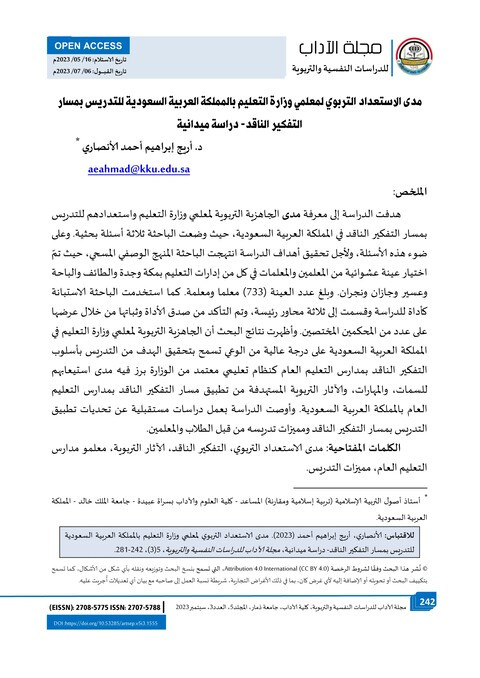 The Extent of Educational Readiness of Using Thinking Skills Strategy among Teachers at the Ministry of Education, Saudi Arabia: A Field Study (Arts for Educational & Psychological Studies; Vol.5, No.3) 발행 연도: 2023 저자: Areej Ibrahim Ahmed Al Ansari 단체 저자: Dhamar University This study aimed to identify educational readiness and willingness of teachers affiliated to the Ministry of Education to use critical thinking in their teaching, in Saudi Arabia. To achieve the study objectives, the descriptive survey method was adopted, and a questionnaire was used to collect data from the study sample which consisted of (733) male and female teachers, randomly selected from education directorates of Makkah, Jeddah, Taif, Al-Baha, Asir, Jazan, and Najran. The questionnaire included three main dimensions;and after testing its validity, and reliability, it was administered to the sample. The study results showed that teachers’ educational readiness scored a high degree of awareness that would allow achieving the goal of teaching by using critical thinking in schools as a teaching strategy approved by the Ministry of Education. The teachers also showed their understanding of the characteristics, skills and educational effects of the application of the critical thinking strategy in schools. The study recommended conducting future studies on the challenges and advantages of applying the critical thinking strategy from the perspective of students and teachers.Keywords: Extent of educational readiness, Critical thinking, Educational effects, School teachers. مدى الاستعداد التربوي لمعلمي وزارة التعليم بالمملكة العربية السعودية للتدريس بمسار التفكير الناقد- دراسة ميدانية (مجلة الآداب للدراسات النفسية والتربوية; Vol.5, No.3) 발행 연도: 2023 저자: Areej Ibrahim Ahmed Al Ansari 단체 저자: Dhamar University هدفت الدراسة إلى معرفة مدى الجاهزية التربوية لمعلمي وزارة التعليم واستعدادهم للتدريس بمسار التفكير الناقد في المملكة العربية السعودية، حيث وضعت الباحثة ثلاثة أسئلة بحثية. وعلى ضوء هذه الأسئلة، ولأجل تحقيق أهداف الدراسة انتهجت الباحثة المنهج الوصفي المسحي، حيث تمّ اختيار عينة عشوائية من المعلمين والمعلمات في كل من إدارات التعليم بمكة وجدة والطائف والباحة وعسير وجازان ونجران. وبلغ عدد العينة (733) معلما ومعلمة. كما استخدمت الباحثة الاستبانة كأداة للدراسة وقسمت إلى ثلاثة محاور رئيسة، وتم التأكد من صدق الأداة وثباتها من خلال عرضها على عدد من المحكمين المختصين. وأظهرت نتائج البحث أن الجاهزية التربوية لمعلمي وزارة التعليم في المملكة العربية السعودية على درجة عالية من الوعي تسمح بتحقيق الهدف من التدريس بأسلوب التفكير الناقد بمدارس التعليم العام كنظام تعليمي معتمد من الوزارة برز فيه مدى استيعابهم للسمات، والمهارات، والآثار التربوية المستهدفة من تطبيق مسار التفكير الناقد بمدارس التعليم العام بالمملكة العربية السعودية. وأوصت الدراسة بعمل دراسات مستقبلية عن تحديات تطبيق التدريس بمسار التفكير الناقد ومميزات تدريسه من قبل الطلاب والمعلمين.