
자료
세계시민교육에 대한 이해를 넓히고 연구, 옹호 활동, 교수, 학습 등을 향상시킬 수 있는 다양하고 유용한 자료를 찾아보세요.
874 건의 결과가 검색되었습니다
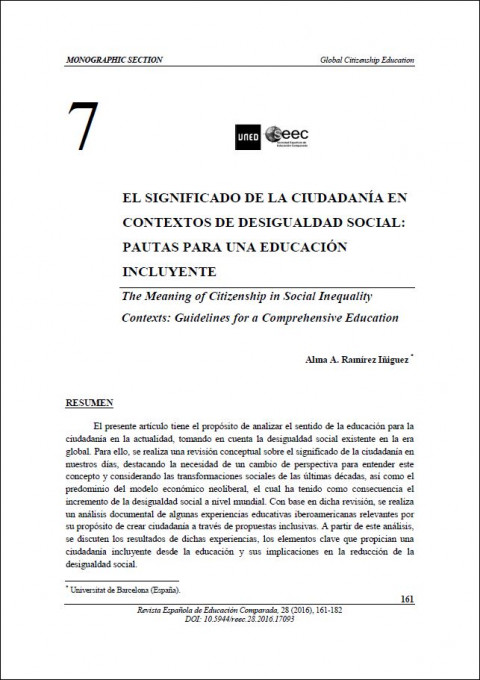 El significado de la ciudadanía en contextos de desigualdad social: pautas para una educación incluyente 발행 연도: 2016 저자: Alma A Ramírez Iñiguez El presente artículo tiene el propósito de analizar el sentido de la educación para la ciudadanía en la actualidad, tomando en cuenta la desigualdad social existente en la era global. Para ello, se realiza una revisión conceptual sobre el significado de la ciudadanía en nuestros días, destacando la necesidad de un cambio de perspectiva para entender este concepto y considerando las transformaciones sociales de las últimas décadas, así como el predominio del modelo económico neoliberal, el cual ha tenido como consecuencia el incremento de la desigualdad social a nivel mundial. Con base en dicha revisión, se realiza un análisis documental de algunas experiencias educativas iberoamericanas relevantes por su propósito de crear ciudadanía a través de propuestas inclusivas. A partir de este análisis, se discuten los resultados de dichas experiencias, los elementos clave que propician una ciudadanía incluyente desde la educación y sus implicaciones en la reducción de la desigualdad social.
 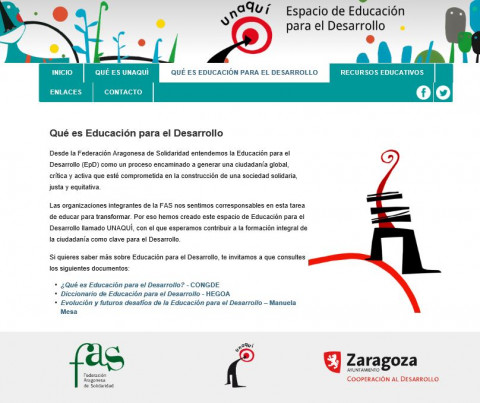 What is Education for Development? 발행 연도: 2019 단체 저자: UNAQUÍ The blog of Unaquí informs that the Aragones Federation of Solidarity understands that Education for Development (ED) is a process which fosters critical and active global citizenship, that promotes more just, equal and cooperative societies. The blog also informs that the organizations that are part of the FAS believe that they are responsible of the education in order to transform societies, therefore, they created this space, called UNAQUÍ, to promote Education for Development and contribute to the promotion of citizenship.The blog provides information about different projects that are carried out. Qué es Educación para el Desarrollo 발행 연도: 2019 단체 저자: UNAQUÍ El blog de Unaquí informa que desde la Federación Aragonesa de Solidaridad se entiende a la Educación para el Desarrollo (EpD) como un proceso encaminado a generar una ciudadanía global, crítica y activa que esté comprometida en la construcción de una sociedad solidaria, justa y equitativa. También informa que las organizaciones integrantes de la FAS se sienten corresponsables en la tarea de educar para transformar por lo que crearon ese espacio de Educación para el Desarrollo llamado UNAQUÍ para contribuir a la formación integral de la ciudadanía como clave para el Desarrollo. En el blog colocan información sobre distintos proyectos que son llevados a cabo.
 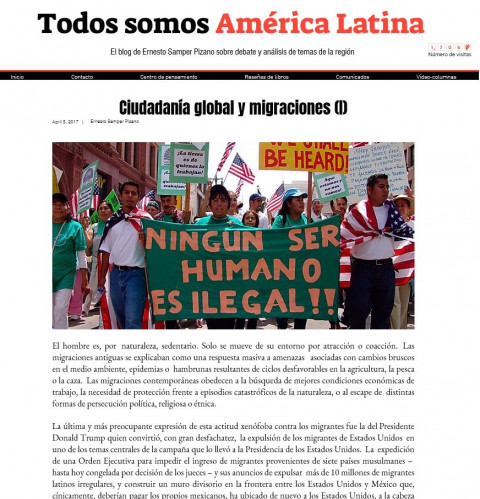 Global Citizenship and Migration 발행 연도: 2017 저자: Ernesto Samper Pizano The news is a conference proclame in defense of migrants at a global scale. It was elaborated for the World People's Conference that took place in Bolivia in 2017 and it describes, very briefly, the situation of many inmigrants around the world, especially latinamericans. Ciudadanía global y migraciones 발행 연도: 2017 저자: Ernesto Samper Pizano La noticia es una proclama a favor y defensa de los migrantes a nivel global. Esta fue elaborada para la Conferencia Mundial de los Pueblos que tuvo lugar en 2017 en Bolivia y describe muy brevemente la situación de los inmigrantes en el mundo, sobre todo de los latinoamericanos.
  La convivencia escolar, cuestión humana; manual: orientación escolar en asuntos de convivencia 발행 연도: 2014 단체 저자: Secretaría de Educación del Distrito (SED) | Ficonpaz | District Secretariat of Education of Bogotá This manual, complementary to the module of the Integral Plans of Education for Citizenship and Civic Coexistence, has conceptual and methodological tools that support the reconstruction and systematization process. It’s a guide that is recommends to be employed with creativity, open dialogues with other participants and most of all, with constant territorial contextualization of the concepts, activities and tool-kits that are used. Citizenship education and coexistence: my body, my first territory; initial cycle (early education) 발행 연도: 2014 단체 저자: Secretaría de Educación del Distrito (SED) | Fe y Alegría These twelve modules make reference to a series of activities that focus on how children from all the educative grades understand and live citizenship, strengthening and facilitating the learning processes based on autonomy. This educative materials, which are aimed at being implemented inside the classrooms, attempt to serve as input resources for educators and other agents that work on or are interested in working with citizenship education and coexistence. The overall objective is to provide quality education. Educación para la ciudadanía y la convivencia: mi cuerpo, mi primer territorio; ciclo inicial (prejardín, jardín y transición) 발행 연도: 2014 단체 저자: Secretaría de Educación del Distrito (SED) | Fe y Alegría These twelve modules make reference to a series of activities that focus on how children from all the educative grades understand and live citizenship, strengthening and facilitating the learning processes based on autonomy. This educative materials, which are aimed at being implemented inside the classrooms, attempt to serve as input resources for educators and other agents that work on or are interested in working with citizenship education and coexistence. The overall objective is to provide quality education. School coexistence, human inquiries: reflections about the role and function of school orientations towards issues of coexistence 발행 연도: 2014 단체 저자: Bogotá. Secretaría de Educación del Distrito (SED) | Fundación para la Reconciliación In this module, the Secretariat of Education of Bogotá, presents pedagogical instruments and activities that seek to support the educative communities in the creation and implementation process of the Integral Plans of Education for Citizenship and Civic Coexistence, strategy developed by the Secretariat of Education of Bogotá with the intention of installing the education for citizenship and civic coexistence in all public schools of the city. This material is expected to be used by school managers, teachers and interested people in the elaboration and development of the plans in each school. La convivencia escolar, cuestión humana: reflexión acerca del rol y función de la orientación escolar en asuntos de convivencia 발행 연도: 2014 단체 저자: Bogotá. Secretaría de Educación del Distrito (SED) | Fundación para la Reconciliación In this module, the Secretariat of Education of Bogotá, presents pedagogical instruments and activities that seek to support the educative communities in the creation and implementation process of the Integral Plans of Education for Citizenship and Civic Coexistence, strategy developed by the Secretariat of Education of Bogotá with the intention of installing the education for citizenship and civic coexistence in all public schools of the city. This material is expected to be used by school managers, teachers and interested people in the elaboration and development of the plans in each school.