
자료
세계시민교육에 대한 이해를 넓히고 연구, 옹호 활동, 교수, 학습 등을 향상시킬 수 있는 다양하고 유용한 자료를 찾아보세요.
328 건의 결과가 검색되었습니다
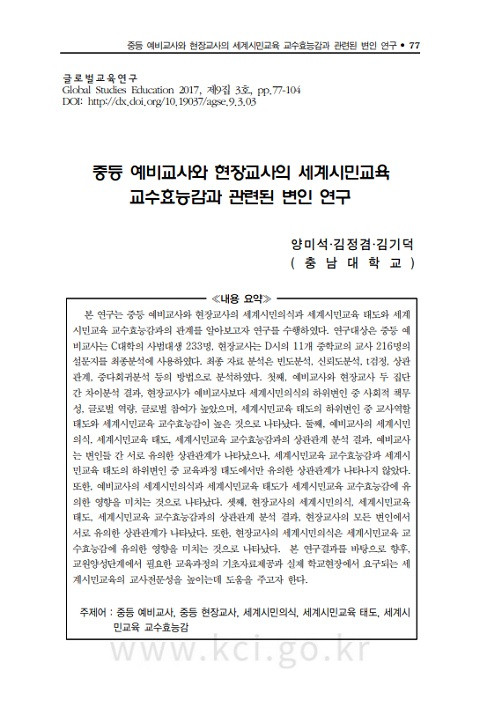 A Study on Variables Related to Global Citizenship Teaching Efficacy of Secondary School Pre-service Teachers and In-service Teachers (Global studies Education; Vol. 9, No. 3) 발행 연도: 2017 저자: MiSeok Yang | JeongKyoum Kim | KiDuck Kim 단체 저자: Association of College and Research Libraries (ACRL) This study explores relations between global citizenship and global citizenship education attitude of pre-service and in-service secondary teachers and their global citizenship education teaching efficacy. The subjects of this study were 233 students majoring in education of University C as pre-service secondary teachers and 216 teachers of 11 middle schools in City D as in-service teachers. of whom questionnaires were used for final analysis. The final analytic methods of data include frequency analysis. reliability analysis. T-test. correlations and multiple regression analysis. First. the result of difference analysis of the two groups of pre-service and in-service teachers shows that in-service teachers are more scored in social responsibility. global capacity and global participation among the lower factors of the global citizenship and in teacher role attitude and global citizenship education teaching efficacy among the lower factors of the global citizenship education attitude than pre-service teachers are. Second. the result of analysis of correlations among global citizenship. global citizenship education attitude and global citizenship education teaching efficacy for pre-service teachers shows that the factors of pre-service teachers have mutually significant correlations except for curriculum attitude among the lower factors of the global citizenship education teaching efficacy and of the global citizenship education attitude. Furthermore. global citizenship and global citizenship education attitude of pre-service teachers affect significantly their global citizenship education teaching efficacy. Third. the result of analysis of correlations among global citizenship. global citizenship education attitude and global citizenship education teaching efficacy for in-service teachers shows that all the factors of in-service teachers have mutually significant correlations. And global citizenship of in-service teachers has significant influence on their global citizenship education teaching efficacy. The results of this study are expected to help provide fundamental data for curriculums required in teacher training courses and enhance teachers’ professionalism on global citizenship education in the future. 중등 예비교사와 현장교사의 세계시민교육 교수효능감과 관련된 변인 연구 (글로벌교육연구; Vol. 9, No. 3) 발행 연도: 2017 저자: 양미석 | 김정겸 | 김기덕 단체 저자: 글로벌교육연구학회 본 연구는 중등 예비교사와 현장교사의 세계시민의식과 세계시민교육 태도와 세계시민교육 교수효능감과의 관계를 알아보고자 연구를 수행하였다. 연구대상은 중등 예비교사는 C대학의 사범대생 233명, 현장교사는 D시의 11개 중학교의 교사 216명의 설문지를 최종분석에 사용하였다. 최종 자료 분석은 빈도분석, 신뢰도분석, t검정, 상관관계, 중다회귀분석 등의 방법으로 분석하였다. 첫째, 예비교사와 현장교사 두 집단 간 차이분석 결과, 현장교사가 예비교사보다 세계시민의식의 하위변인 중 사회적 책무성, 글로벌 역량, 글로벌 참여가 높았으며, 세계시민교육 태도의 하위변인 중 교사역할 태도와 세계시민교육 교수효능감이 높은 것으로 나타났다. 둘째, 예비교사의 세계시민의식, 세계시민교육 태도, 세계시민교육 교수효능감과의 상관관계 분석 결과, 예비교사는 변인들 간 서로 유의한 상관관계가 나타났으나, 세계시민교육 교수효능감과 세계시민교육 태도의 하위변인 중 교육과정 태도에서만 유의한 상관관계가 나타나지 않았다. 또한, 예비교사의 세계시민의식과 세계시민교육 태도가 세계시민교육 교수효능감에 유의한 영향을 미치는 것으로 나타났다. 셋째, 현장교사의 세계시민의식, 세계시민교육 태도, 세계시민교육 교수효능감과의 상관관계 분석 결과, 현장교사의 모든 변인에서 서로 유의한 상관관계가 나타났다. 또한, 현장교사의 세계시민의식은 세계시민교육 교수효능감에 유의한 영향을 미치는 것으로 나타났다. 본 연구결과를 바탕으로 향후, 교원양성단계에서 필요한 교육과정의 기초자료제공과 실제 학교현장에서 요구되는 세계시민교육의 교사전문성을 높이는데 도움을 주고자 한다.
 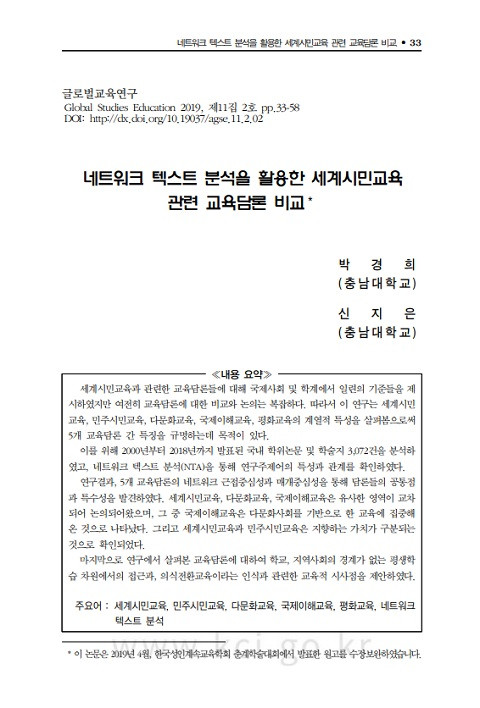 Comparison on Educational Discourses About Global Citizenship Education Using Network Text Analysis (Global Studies Education; Vol. 11, No. 2) 발행 연도: 2019 저자: Kyunghee Park | JiEun Shin 단체 저자: Association of | Global Studies Education The purpose of this study is to analyze the differences between ‘global citizenship education’, ‘democratic civic education’, ‘multicultural education’, ‘education for international understanding’, and ‘peace education’. For this, 3,072 research papers from 2000 to 2018 selected, and network text analysis(NTA) was conducted to confirm the characteristics and changes of the five educational discourses. As a result, the commonness and specificities of them were derived through the ‘closeness centrality’ and ‘betweenness centrality’ on the NTA. ‘Global citizenship education’, ‘multicultural education’, and ‘education for international understanding’ have crossed the content area. And ‘education for international understanding’ was based on a multicultural society. The values-oriented between ‘global citizenship education’ and ‘democratic civic education’ were distinguished. Finally, it is suggested that the five educational discourses need to be on the approach of lifelong learning, and they are education oriented toward change in consciousness. 네트워크 텍스트 분석을 활용한 세계시민교육 관련 교육담론 비교 (글로벌교육연구; Vol. 11, No. 2) 발행 연도: 2019 저자: 박경희 | 신지은 단체 저자: 글로벌교육연구학회 세계시민교육과 관련한 교육담론들에 대해 국제사회 및 학계에서 일련의 기준들을 제시하였지만 여전히 교육담론에 대한 비교와 논의는 복잡하다. 따라서 이 연구는 세계시민교육, 민주시민교육, 다문화교육, 국제이해교육, 평화교육의 계열적 특성을 살펴봄으로써 5개 교육담론 간 특징을 규명하는데 목적이 있다. 이를 위해 2000년부터 2018년까지 발표된 국내 학위논문 및 학술지 3,072건을 분석하였고, 네트워크 텍스트 분석(NTA)을 통해 연구주제어의 특성과 관계를 확인하였다. 연구결과, 5개 교육담론의 네트워크 근접중심성과 매개중심성을 통해 담론들의 공통점과 특수성을 발견하였다. 세계시민교육, 다문화교육, 국제이해교육은 유사한 영역이 교차되어 논의되어왔으며, 그 중 국제이해교육은 다문화사회를 기반으로 한 교육에 집중해 온 것으로 나타났다. 그리고 세계시민교육과 민주시민교육은 지향하는 가치가 구분되는 것으로 확인되었다. 마지막으로 연구에서 살펴본 교육담론에 대하여 학교, 지역사회의 경계가 없는 평생학습 차원에서의 접근과, 의식전환교육이라는 인식과 관련한 교육적 시사점을 제안하였다.
 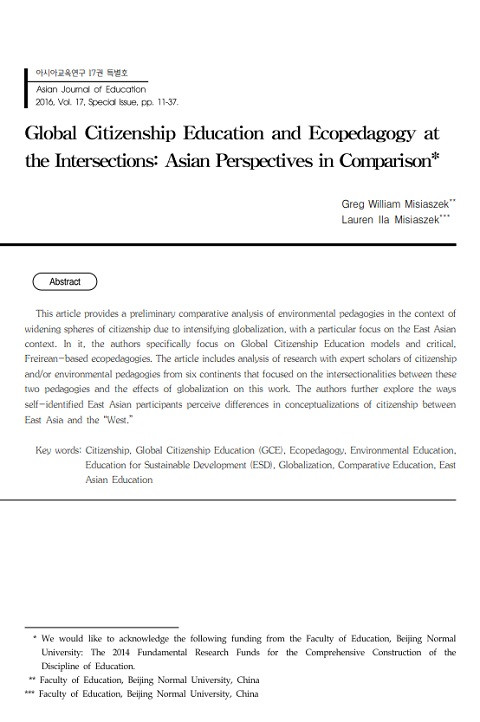 Global Citizenship Education and Ecopedagogy at the Intersections: Asian Perspectives in Comparison (Asian Journal of Education; Vol. 17, Special Issue) 발행 연도: 2016 저자: Greg William Misiaszek | Lauren Ila Misiaszek 단체 저자: Seoul National University. Education Research Institute This article provides a preliminary comparative analysis of environmental pedagogies in the context of widening spheres of citizenship due to intensifying globalization, with a particular focus on the East Asian context. In it, the authors specifically focus on Global Citizenship Education models and critical, Freirean-based ecopedagogies. The article includes analysis of research with expert scholars of citizenship and/or environmental pedagogies from six continents that focused on the intersectionalities between these two pedagogies and the effects of globalization on this work. The authors further explore the ways self-identified East Asian participants perceive differences in conceptualizations of citizenship between East Asia and the “West.”
 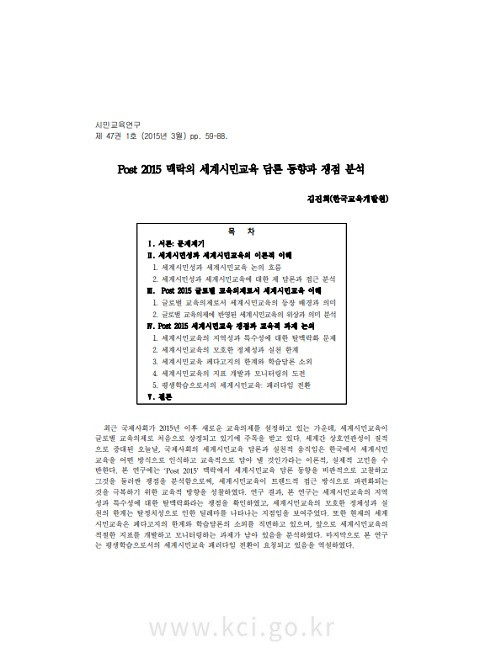 Critical Understanding on Global Citizenship Education in Post 2015 Context (Theory and Research in Citizenship Education; Vol. 57, No. 1) 발행 연도: 2015 저자: Jinhee Kim 단체 저자: Korea Association of Social Education It is notable that global citizenship education has recently gained prominence in Post 2015 context. This study attempted to explore diverse discourses of global citizenship education in theoretical dimension and it also analyzed the current status of global citizenship education as a new global education agenda. Major findings displayed issues and challenges; de-contextualization against local dimension; vague conceptualization of global citizenship education; limitation of transformative pedagogy and learning discourse; indicator development and monitoring issues; a paradigm shift for global citizenship education engaging with lifelong learning. Eventually, this study argues that comprehensive vision and long term road-map should be established to enhance global citizenship education. Lifelong learning approach is crucial to reshape global citizenship education while interacting with life-world context and life experience, which can promote an epistemology of learning to live together.
  세계시민교육과 국제 바칼로레아의 지리교육과정 (국토지리학회지; Vol. 53, No. 4) 발행 연도: 2019 저자: 김부성 단체 저자: 국토지리학회 본 연구는 ‘세계시민교육(국제이해교육)’의 관점에서 ‘국제 바칼로레아’의 지리교육과정을 검토해본다. 세계시민교육은 세계화의 도전에 대한 커리큘럼 대응책으로 국제적· 상호 문화적· 세계적인 감수성, 지식, 의사소통 및 이해를 촉구한다. 즉 세계시민교육은 미래의 세계시민을 육성하는 것이다. 1968년에 설립된 국제 바칼로레아(현재 IB, 예전엔 IBO)는 비영리 교육재단으로 세계시민교육(국제이해교육)을 위한 4종류의 프로그램을 제공한다. 국제 바칼로레아재단의 공인을 받은 학교만이 이 프로그램을 운영할 수 있으며 세계 150여 개국에 공인 받은 5,000 여 개의 IB 학교가 있고, 일종의 대학입학자격증인 국제 바칼로레아 디플로마는 세계 많은 대학에서 인정해주고 있다. 국제 바칼로레아는 높은 수준의 교육수준과 학생들의 성취도 뿐 만 아니라 문화 간 이해와 존중을 강조하는 것으로 유명하다. 국제 바칼로레아 디플로마 과정에서 ‘개인과 사회’ 라는 그룹 중의 하나로 선택하는 지리 교과과정은 주제(계통지리)별로, 인간에 초점을 맞추어 조직되어 있고 다루는 범위는 전 세계를 망라한다. 그 핵심에는 인구, 환경, 자원 과 발전이라는 상호 연관된 주제들이 있다. 국제 바칼로레아 지리과정의 주요목적은 학생들에게 세계적인 시각을 갖추게 하고 세계의 상호의존성 에 대해 인식하며 당면한 세계 문제를 분석함에 있어 지리의 유용성을 평가할 수 있는 능력을 개발하는 것이다. Global Citizenship Education and Geography Curricula in International Baccalaureate (Geographical Journal of Korea; Vol. 53, No. 4) 발행 연도: 2019 저자: Boosung Kim 단체 저자: Korean Association of Professional Geographers This study aims to examine the geography curricula in International Baccalaureate(IB) from the viewpoint of ‘Global Citizenship Education(GCE)’. GCE purports to address the challenges of globalization through curricular that promote international, intercultural, and global sensitivity, knowledge, communication, and understanding. In short, GCE is concerned with educating the global citizens of tomorrow. Founded in 1968, IB(formerly IBO) is a non-profit educational foundation offering four highly respected programmes of International Education. The IB has a presence in over 150 countries throughout the world. IB World Schools must be authorized, by the IB organization, to offer any of the programmes and universities worldwide recognize the strength of IB Diploma Programme. The IB has a hard-earned reputation not only for high standards of teaching and student achievement, but also for intercultural understanding and respect it promotes. As part of the curriculum group ‘Individuals and Societies’, geography is thematic (systematic) in organization, human in focus, global in coverage. At its core are the interrelated themes of population, environment, resources and development. The aims of geography course in IB are to enable students to develop a global perspective and a sense of world interdependence and to appreciate the relevance of geography in analysing contemporary world issues. Post 2015 맥락의 세계시민교육 담론 동향과 쟁점 분석 (시민교육연구; Vol. 57, No. 1) 발행 연도: 2015 저자: 김진희 단체 저자: 한국사회과교육학회 최근 국제사회가 2015년 이후 새로운 교육의제를 설정하고 있는 가운데, 세계시민교육이 글로벌 교육의제로 처음으로 상정되고 있기에 주목을 받고 있다. 세계간 상호연관성이 질적으로 증대된 오늘날, 국제사회의 세계시민교육 담론과 실천적 움직임은 한국에서 세계시민교육을 어떤 방식으로 인식하고 교육적으로 담아 낼 것인가라는 이론적, 실제적 고민을 수반한다. 본 연구에는 ‘Post 2015’ 맥락에서 세계시민교육 담론 동향을 비판적으로 고찰하고 그것을 둘러싼 쟁점을 분석함으로써, 세계시민교육이 트렌드적 접근 방식으로 파편화되는 것을 극복하기 위한 교육적 방향을 성찰하였다. 연구 결과, 본 연구는 세계시민교육의 지역성과 특수성에 대한 탈맥락화라는 쟁점을 확인하였고, 세계시민교육의 모호한 정체성과 실천의 한계는 탈정치성으로 인한 딜레마를 나타나는 지점임을 보여주었다. 또한 현재의 세계시민교육은 페다고지의 한계와 학습담론의 소외를 직면하고 있으며, 앞으로 세계시민교육의 적절한 지표를 개발하고 모니터링하는 과제가 남아 있음을 분석하였다. 마지막으로 본 연구는 평생학습으로서의 세계시민교육 패러다임 전환이 요청되고 있음을 역설하였다.
  Promotional and Constraint Factors of Global Citizenship Education (GCED) Theme Selection: Focusing on GCED of Leading Teacher’s awareness (The Journal of Korean Teacher Education; Vol.35, No.4) 발행 연도: 2018 저자: Keunah Park | Soonyoung Oh | Jaewoon Hwang 단체 저자: The Korean Society for the Study of Teacher Education The purpose of this study is to analyze the factors that affect the selection of the themes of Global Citizenship Education (GCED). Specifically, it tried to help teachers to select the themes of GCED and explored specific factors that restrict the selection. For the goal of this study, it interviewed 13 researchers who participated in GCED as leading teachers. It collected data, performed coding of extracting core phrases and analyzed the transcribed interviews. The main analysis results are as follows. First, the factors that promote teachers to choose the themes of GCED were the experience of teachers, students, social issues, areas and teaching and learning materials. Second, the factors that restrict teachers to choose the themes of GCED were institution, parents of students and areas. Based on the result of the study, it described the necessity of developing field-friendly teaching and learning materials in relation to GCED and the importance of raising awareness among the educational players on GCED.