
자료
세계시민교육에 대한 이해를 넓히고 연구, 옹호 활동, 교수, 학습 등을 향상시킬 수 있는 다양하고 유용한 자료를 찾아보세요.
2,161 건의 결과가 검색되었습니다
 T-KIT 4: Intercultural Learning 발행 연도: 2018 저자: Oana Nestian Sandu | Nadine Lyamouri-Bajja 단체 저자: Council of Europe | European Commission Intercultural learning is an important topic for the priorities of both the European Commission and the Council of Europe, and of their partnership in the field of youth.Intercultural learning is an educational approach that can lead to social transformation, so that people from different cultural backgrounds can develop positive relations based on the values and principles of human rights and on seeing cultural differences as positive things. It is a form of political and social education that needs to pay attention not only to intercultural relations, but also to different understandings of culture and diversity, power relations, distribution of resources, political and social context, human rights, discrimination, history and daily interactions among different groups.This T-Kit was developed for the context of youth work and non-formal education with young people, both of which support the personal development, social integration and active citizenship of young people. Educators and youth workers have an important role in addressing intercultural learning in their work with young people. They can stimulate young people’s learning in their daily lives, so that they can question and extend their perception, develop competences to interact positively with people from different cultural backgrounds and embrace the values of diversity, equality and dignity. In today’s Europe, these values and skills are fundamental for young people and for society as a whole in order to continue building peace and mutual understanding.
  Peace Education: Handbook for Educators 발행 연도: 2015 단체 저자: International Falcon Movement-Socialist Educational International (IFM-SEI) | Council of Europe This document presents peace education tools so that children and adolescents can play a vital role, changing individual attitudes and examining the social, economic and political context to understand where conflicts come from and how to transform them. Education à la Paix: Manuel de l’éducatrice et de l’éducateur 발행 연도: 2015 단체 저자: International Falcon Movement-Socialist Educational International (IFM-SEI) | Conseil de l'Europe Cet ouvrage en deux parties est basé sur les résultats de notre travail, ainsi que des outils developpés et testés par certaines de nos organisations membres: • De la matière à réflexion, des conseils et des informations pour les éducateurs·trices à la paix. Des activités éducatives que vous pouvez réaliser avec les enfants, les jeunes ou les autres chefs de groupe et les pairs éducateurs·trices. La deuxième partie comprend trois chapitres. Chacun de ces derniers se concentre sur un aspect différent de l’éducation de la paix. Comprendre le conflit introduit différentes questions sur le conflit et la guerre, la sensibilisation sur ses causes et ses conséquences. Transformer le conflit met l’accent sur la dynamique du conflit et les différentes façons dont nous pouvons traiter avec elle - de manière agressive ou constructive. Faire la paix vous invite à réfléchir et à développer des idées pour la paix et donne des outils pour la consolidation de la paix, comme la communication et le dialogue compétences. Educación por la Paz: Guía para educadores y educadoras 발행 연도: 2015 단체 저자: International Falcon Movement-Socialist Educational International (IFM-SEI) | Council of Europe Este documento presenta herrameintas de ediuación para la paz de manera que niñas, niños y adolescentes puedan jugar un papel vital, cambiando las actitudes individuales y examinando el contexto social, económico y político para comprender de dónde provienen los conflictos y cómo transformarlos.
  Media Literacy for Global Education: Toolkit for Youth Multipliers 발행 연도: 2022 단체 저자: North-South Centre of the Council of Europe | Council of Europe | European Union (EU) This toolkit targets youth multipliers and educators and gathers practical and contextual information about Media Literacy (ML) and its contribution to the field of Global Education (GE). Its activities and fact sheets are focused on non-formal learning contexts, but they can also be implemented in schools since the toolkit combines the most recent developments in GE, ML and Digital Citizenship Education useful to enrich formal school curricula. All the practical activities proposed in the toolkit are in line with the Competences for Democratic Culture and the Human Rights approach of the Council of Europe.The toolkit’s main aim is to empower practitioners on ML, but also to provide the wider public with the knowledge and tools to become more responsible and active citizens, offering activities focused on the critical analysis and production of media messages, analysis of algorithms, active participation in societies, maintenance of privacy, maintenance of well-being and management of e-identity.
 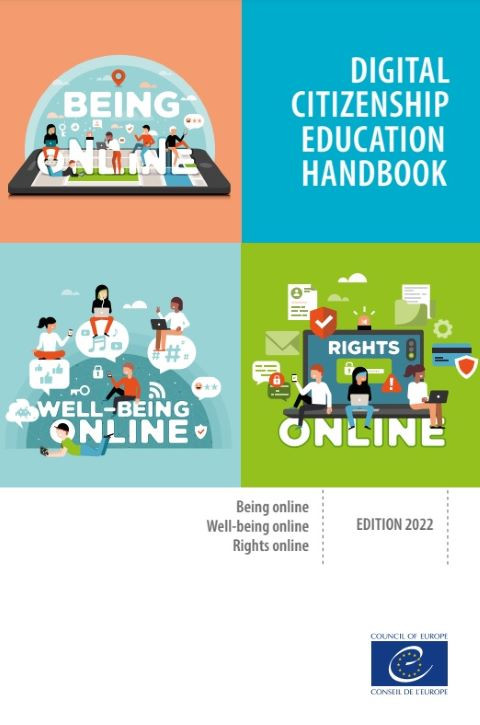 Digital Citizenship Education Handbook (Edition 2022) 발행 연도: 2022 저자: Janice Richardson | Elizabeth Milovidov 단체 저자: Council of Europe Digital citizenship competences define how we act and interact online. They comprise the values, attitudes, skills and knowledge and critical understanding necessary to responsibly navigate the constantly evolving digital world, and to shape technology to meet our own needs rather than to be shaped by it. The Digital citizenship education handbook offers information, tools and good practice to support the development of these competences in keeping with the Council of Europe’s vocation to empower and protect children, enabling them to live together as equals in today’s culturally diverse democratic societies, both on- and offline.The Digital citizenship education handbook is intended for teachers and parents, education decision makers and platform providers alike. It describes in depth the multiple dimensions that make up each of 10 digital citizenship domains, and includes a fact sheet on each domain providing ideas, good practice and further references to support educators in building the competences that will stand children in good stead when they are confronted with the challenges of tomorrow’s digital world. The Digital citizenship education handbook is consistent with the Council of Europe’s Reference Framework of Competences for Democratic Culture and compatible for use with the Internet literacy handbook.
  Resilience Against Anti-Democratic Tendencies through Education: Competences for Democratic Culture in European Social and Youth Work 발행 연도: 2021 저자: Markus Pausch | Patricia Hladschik | Filip Pazderski | Rasha Nagem 단체 저자: Council of Europe In this handbook the authors focus on competences for democracy and thus on how to prevent and avoid anti-democratic phenomena like authoritarianism, violent radicalisation, extremism, hate speech or conspiracy theories. This material contains a set of new or refreshed educational methods, tailored to work specifically with social workers and youth workers. All of them should help them prepare to counter these tendencies. Handbook was developed in the project “Resilience through Education for Democratic Citizenship” (REDE), implemented in the programme “Democratic and Inclusive School Culture in Operation” (DISCO) of the European Commission and the Council of Europe.
  Tool for quality assuarance of education for democratic citizenship in schools 발행 연도: 2005 단체 저자: Council of Europe This Tool for Quality Assurance of Education for Democratic Citizenship (EDC) in Schools was prepared as a response to the compliance gap between policies and practices of EDC in various countries. While EDC policies are well developed, EDC practices in schools present significant weaknesses. The Tool was also prepared as part of the current interest and implementation of quality assurance in education. This Tool is designed as a reference document. It focuses on education for democratic citizenship and applies the principles and processes of quality assurance to EDC.
  Astrolabe: a guide to education for sustainable development coordination in Asia and the Pacific 발행 연도: 2011 단체 저자: UNESCO Bangkok An astrolabe is an ancient instrument used to measure the position of the sun and stars. In the past it was used for a number of purposes, such as determining the time of day or night and measuring one’s current position in relation to the north and south poles. A mariner’s astrolabe was used to determine the latitude of a ship at sea and guide its direction. Similar to the mariner’s astrolabe, the Asia-Pacific Education for Sustainable Development (ESD) Astrolabe aims to assist UNESCO Member States in determining the current position of ESD in their country and guiding education and learning in a desired direction, so as to support the advancement of sustainable development in the national context. The ESD Astrolabe is also intended to complement ongoing efforts to enhance the quality of education throughout the Asia-Pacific region. Astrolabe: un guide de l'éducation pour la coordination du développement durable en Asie et dans le Pacifique 발행 연도: 2011 단체 저자: UNESCO Bangkok Un astrolabe est un instrument ancien utilisé pour mesurer la position du soleil et des étoiles. Dans le passé, il a été utilisé pour un certain nombre de buts, tels que la détermination de l'heure du jour ou de nuit et la mesure de sa position actuelle par rapport aux pôles nord et sud. Un astrolabe de marin a été utilisé pour déterminer la latitude d'un navire en mer et de guider sa direction. Similaire à l'astrolabe du marins, l'Astrolabe de l'Asie-Pacifique pour le développement durable (EDD) vise à aider les États membres de l'UNESCO à déterminer la position actuelle de l'EDD dans leur pays et à orienter l'éducation et l'apprentissage dans une direction souhaitée, Développement durable dans le contexte national. L'EDD Astrolabe est également destiné à compléter les efforts en cours pour améliorer la qualité de l'éducation dans toute la région Asie-Pacifique.