
자료
세계시민교육에 대한 이해를 넓히고 연구, 옹호 활동, 교수, 학습 등을 향상시킬 수 있는 다양하고 유용한 자료를 찾아보세요.
1,451 건의 결과가 검색되었습니다
 “Racism, Sexism, Homophobia, Which Card do You Want?” The Post-Migration Experience of Northern LGBTQ People Global and Global South 발행 연도: 2021 저자: Barbara Andrade de Sousa | Line Chamberland 단체 저자: Alterstice This article examines the life stories of seven LGBTQ immigrants, from the Global North and South, who live in Montreal. The research on immigration has long been carried out according to a framework heteronormative, which sets aside a whole series of questions relating to the impact of sexual orientation and non-normative gender identity on the migratory experience. Societies impose distinct constraints on LGBTQ people. Once settled in the host society, these subjects can experience more sexual possibilities. However, their origin can become a marker that places them inside a relationship of power with the majority group. This article aims to shed light on how LGBTQ immigrants construct their life stories in a context where their experience is crossed by the interweaving of several aspects of identities such as sexual orientation, gender identity, ethnicity, and religion, to name a few. The intersectional approach makes it possible to identify the systems of binding powers which participants face daily. The thematic analysis gave us allowed to listen to individuals to know the categories of power and the systems of oppression they talk about — the goal being to position respondents as knowledgeable subjects, not mere study objects. Analysis of the interviews shows that LGBTQ individuals who express a diverse combination of identities face specific challenges linked to the migratory route. « Racisme, sexisme, homophobie, quelle carte tu veux ? » L’expérience post-migratoire des personnes LGBTQ du Nord global et du Sud global 발행 연도: 2021 저자: Barbara Andrade de Sousa | Line Chamberland 단체 저자: Alterstice Cet article examine l’histoire de vie de sept immigrants ou immigrantes LGBTQ, originaires du Nord et du Sud global, qui habitent à Montréal. Les recherches sur l’immigration ont longtemps été réalisées selon un cadrage hétéronormatif, ce qui met à l’écart toute une série de questions relatives à l’impact de l’orientation sexuelle et de l’identité de genre non normative sur l’expérience migratoire. Les sociétés imposent des contraintes distinctes vis-à-vis des personnes LGBTQ. Une fois installées dans la société d’accueil, ces sujets peuvent expérimenter plus de possibilités sur le plan sexuel ; néanmoins leur origine peut devenir un marqueur qui les place à l’intérieur d’un rapport de pouvoir avec le groupe majoritaire. Notre article vise à mettre en lumière la manière dont les immigrants LGBTQ construisent leurs histoires de vie dans un contexte où leur vécu est traversé par l’imbrication de plusieurs aspects identitaires comme l’orientation sexuelle, l’identité de genre, l’ethnicité et la religion, pour n’en nommer que quelques-uns. L’approche intersectionnelle rend possible l’identification des systèmes de pouvoirs contraignants auxquels les participants font face quotidiennement. L’analyse thématique nous a permis d’être à l’écoute des individus afin de connaître les catégories de pouvoir et les systèmes d’oppression dont ils parlent — le but étant de positionner les répondants comme des sujets connaissants, et non de simples objets d’étude. L’analyse des entrevues montre que les individus LGBTQ qui expriment une combinaison variée d’identités affrontent des défis spécifiques liés au parcours migratoire.
  GE2050: The European Declaration on Global Education to 2050; The Dublin Declaration 발행 연도: 2022 단체 저자: Global Education Network Europe (GENE) A new European Declaration on Global Citizenship Education to 2050 has been adopted in Dublin, Ireland on the 20th anniversary of the Maastricht Declaration. The new strategy set out how education will encourage the public to act, individually and collectively, to help build a fairer, more tolerant and more sustainable world for all.
 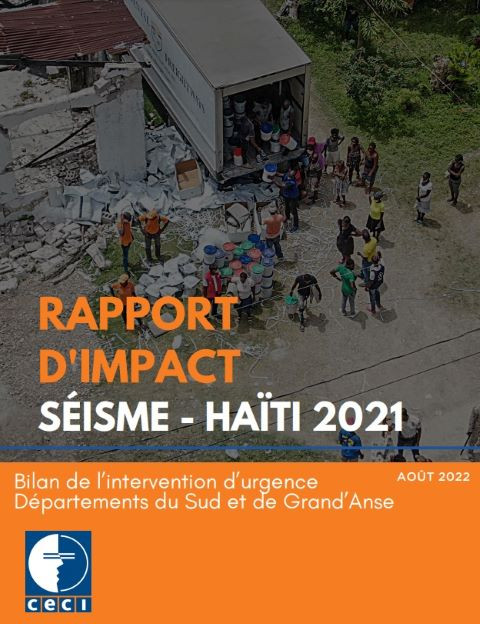 Impact Report-Earthquake-Haiti 2021 발행 연도: 2022 단체 저자: Centre for International Cooperation and Study (CECI) On August 14, 2021, a magnitude 7.2 earthquake struck the Great South of Haiti with full force, causing nearly of 2,300 dead and considerable material damage. This new natural disaster has come to worsen an already difficult socio-economic situation for families in this region of Haiti, which was barely within the devastating aftermath caused by Hurricane Matthew in 2016. From the first hours following the earthquake, CECI-Haiti, which was already carrying out 6 development in the departments of Grand-Anse and Sud, mobilized its teams to support government authorities, assess the needs of the population, in particular those of families and women, take stock of the damage and establish an action plan for recovery. The cities the most affected in the eastern region of the Grand'Anse department were the municipalities of Camp-Perrin, Roseaux, Coral, Beaumont, and Pestel.For the first emergency, the following priorities had been identified: Need for water supply; Need for drugs and agricultural inputs; Need for food and milk for the children; Need for tents and tarpaulins for temporary shelters; Need for sanitary products and clothing, portable toilets, etc.; Need for psychosocial support;To provide a rapid and significant response to urgent needs, CECI received funds from the public Canadian and obtained funding from the Ministry of International Relations and La Francophonie of the Government of Quebec. Rapport d'impact: SÉISME - HAÏTI 2021 발행 연도: 2022 단체 저자: Centre for International Cooperation and Study (CECI) Le 14 août 2021, un séisme de magnitude 7,2 a frappé de plein fouet le Grand Sud d’Haïti causant près de 2 300 morts et des dégâts matériels considérables. Cette nouvelle catastrophe naturelle est venue aggraver une situation socio-économique déjà difficile pour les familles de cette région d’Haïti qui se relevaient à peine des conséquences dévastatrices causées par l'ouragan Matthew en 2016.Dès les premières heures ayant suivi le passage du séisme, le CECI-Haïti qui menait déjà 6 projets de développement dans les départements de la Grand-Anse et du Sud, a mobilisé ses équipes pour appuyer les autorités gouvernementales, évaluer les besoins de la population, en particulier ceux des familles et des femmes, dresser un bilan des dégâts et établir un plan d’action pour le relèvement. Les communes les plus touchées dans la région Est du département de la Grand’Anse ont été les communes de Camp-Perrin, Roseaux, Corail, Beaumont et Pestel. Pour la première urgence, les priorités suivantes avaient été identifiées: Besoin d’approvisionnement en eau ; Besoin en médicaments et intrants agricoles ; Besoin en nourriture et lait pour les enfants ; Besoin en tentes et bâches pour des abris provisoires ; Besoin en produits hygiéniques et vêtements, toilettes portatives, etc. ; Besoin en appui psychosocial ;Pour apporter une réponse rapide et significative aux besoins urgents, le CECI a reçu des fonds du public canadien et obtenu un financement du ministère des Relations Internationales et de la Francophonie du gouvernement du Québec.
  International News, Reading Notes : From Restricted Citizenship to Citizenship Education (Nathanaël Wallenhorst et Éric Mutabazi (dir.), Le Bord de l’eau, 2021, 230 p.) 발행 연도: 2021 저자: Jean-Pierre Véran 단체 저자: Revue internationale d’éducation de Sèvres For readers of the Revue Internationale d’éducation de Sèvres, it should first be emphasized that this work raises the question of citizenship in the era of globalization. And, as an example, we will give chapter 2, which answers the question posed by its title: "How ethnicity prevented the realization of a community of citizens in Rwanda? It should also be emphasized that the thinkers called upon, from Kant to Arendt via Gramsci, have in common that they have considered the question of citizenship in very diverse historical and national contexts, but on a scale exceeding the national borders.We will also underline the second merit of this collective work of eleven researchers. It first paints a picture of the impeded citizenship of our present time before proposing an overcoming of these various impediments through cosmopolitical and existential citizenship. Actualité internationale, Notes de lecture: D’une citoyenneté empêchée à une éducation citoyenne (Nathanaël Wallenhorst et Éric Mutabazi (dir.), Le Bord de l’eau, 2021, 230 p.) 발행 연도: 2021 저자: Jean-Pierre Véran 단체 저자: Revue internationale d’éducation de Sèvres Pour les lecteurs de la Revue internationale d’éducation de Sèvres, on soulignera d’abord que cet ouvrage pose la question de la citoyenneté à l’ère de la mondialisation. Et, à titre d’exemple, on donnera le chapitre 2, qui répond à la question posée par son titre : « Comment l’ethnicité a empêché la réalisation d’une communauté de citoyens au Rwanda ? » On soulignera aussi que les penseurs à qui il est fait appel, de Kant à Arendt en passant par Gramsci, ont en commun d’avoir pensé la question de la citoyenneté dans des contextes historiques et nationaux très divers, mais à une échelle dépassant les frontières nationales.2On soulignera également un second mérite de ce travail collectif de onze chercheurs. Il dresse d’abord un tableau de la citoyenneté empêchée de notre temps présent avant de proposer un dépassement de ces empêchements divers au travers d’une citoyenneté cosmopolitique et existentielle.
  Indicators for Monitoring the Sustainable Development Goals 발행 연도: 2019 저자: Frédéric Vey | Anne-Sophie Hesse 단체 저자: Université Virtuelle Environnement et Développement durable (UVED) Frédéric Vey and Anne-Sophie Hesse, from the Ministry of Ecological and Solidarity Transition, discuss in this video (12'40) the indicators for monitoring the Sustainable Development Goals (SDGs). After a theoretical approach aimed at defining and showing the limits of the indicators, they show how the "SDG" indicators are available from the international scale to the national scale. Les indicateurs de suivi des Objectifs de Développement Durable 발행 연도: 2019 저자: Frédéric Vey | Anne-Sophie Hesse 단체 저자: Université Virtuelle Environnement et Développement durable (UVED) Frédéric Vey et Anne-Sophie Hesse, du Ministère de la transition écologique et solidaire, discutent dans cette vidéo (12'40) des indicateurs de suivi des Objectifs de développement durable (ODD). Après une approche théorique visant à définir et à montrer les limites des indicateurs, ils montrent comment les indicateurs "ODD" se déclinent de l'échelle internationale à l'échelle nationale.
  Global Citizenship: A Path to a Better World 발행 연도: 2022 단체 저자: NGO-UNESCO Liaison Committee Presentation at the Forum of NGO Liaison Committee (UNESCO) by Stefania Giannini, Deputy Secretary General, UNESCO. The need for new pedagogies and solidarity that respects diversity. Education must also aim to develop peace, gender equity, and the meaning of the ODDs, notably 4.7 in relation to Global Citizenship Education. Civil society partners are critical to fighting extremism and hate.