
자료
세계시민교육에 대한 이해를 넓히고 연구, 옹호 활동, 교수, 학습 등을 향상시킬 수 있는 다양하고 유용한 자료를 찾아보세요.
1,300 건의 결과가 검색되었습니다
 Handbuch Nationalsozialismus und Holocaust. Historisch-politisches Lernen in Schule, außerschulischer Bildung und Lehrerbildung. The educational field of National Socialism and the Holocaust is an indispensable part of historical-political learning in schools, non-formal education and teacher training. This manual gives new impetus to the theoretical discussion as well as to the practical educational work. Basic theoretical texts are complemented by methodological suggestions as well as by accounts based on personal experience and presentations of projects with national and international perspectives. The fact that today, more than sixty years after the events, adolescents have hardly any direct access to this phase of German and European history, and the question of how to deal with this challenge, are here of central importance. The contributions in the manual focus on the following themes: The fundamentals of National Socialism and the Holocaust as an educational field. School practices: Learning from classroom instruction. School practices: Learning from projects. Practices in teacher education. Practices in memorial sites and non-formal educational institutions. International approaches. (By the publisher)
  The Education We Want: An Advocacy Toolkit 발행 연도: 2014 저자: James Edleston | Dan Smith | Sumaya Saluja | David Crone | Chernor Bah | Emily Laurie 단체 저자: A World at School | UN Global Education First Initiative - Youth Advocacy Group (YAG) | Plan International Developed by Plan International, A World at School and the Youth Advocacy Group of the Global Education First Initiative, this toolkit was made for and by young people to advocate for quality education.Packed full of ideas, tools and inspiring stories, it helps children and youth to effectively carry out their own advocacy campaign.Although this advocacy toolkit focuses on education, its tips and ideas are applicable to young people advocating for a variety of development and rights issues.
  The Education We Want: Workshop Facilitator Guide For the Advocacy Toolkit 발행 연도: 2014 저자: Daniel Smith | James Edleston | Tom Burke | Emily Laurie 단체 저자: A World at School | UN Global Education First Initiative - Youth Advocacy Group (YAG) | Plan International This guide is intended as a resource to accompany the ‘Education we want: An Advocacy’. It aims to provide a wide range of workshop activities for those who intend to Understand, Plan or Do their education advocacy using workshop based approaches.Workshops are an effective way of involving others in advocacy. They can support you in carrying out research, drafting a plan and building skills for action.The successful delivery of workshops relies on effective preparation, good facilitation skills and a commitment to support people’s learning and development.
  Solution Fluency Quickstart Skills Guide 단체 저자: Global Digital Citizen Foundation What is Solution Fluency? What are the specific skills it develops? Why are they important? The answers are right here in the Solution Fluency Quickstart Skills Guide.In this free guide, we’ll introduce you to the basics of Solution Fluency. You'll learn about the 6Ds process, the skills each phase develops, and why Solution Fluency skills are a crucial part of modern learning.With this free Quickstarter Guide you can: Get to know Solution Fluency skillsets Develop them with students Cultivate critical thinking Give students problem-solving superpowers
 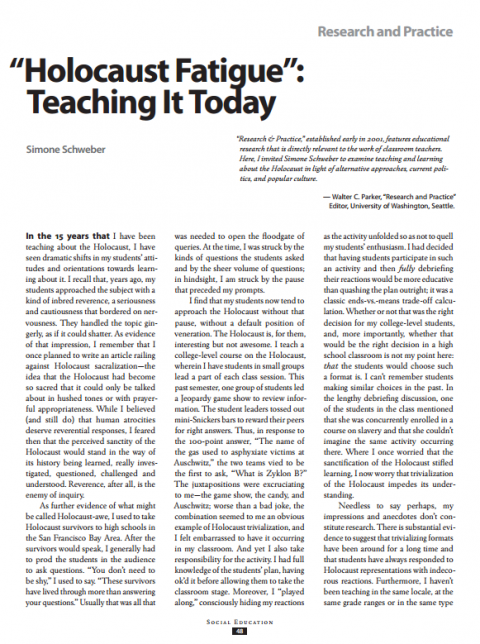 ´Holocaust Fatigue': Teaching it today The review "Research & Practice", established early in 2001, features educational research that is directly relevant to the work of classroom teachers. Here, I invited Simone Schweber to examine teaching and learning about the Holocaust in light of alternative approaches, current politics, and popular culture. (By the publisher)
  The Holocaust Museum as an Educational Resource: A View from New York City This article deals with the role of the Holocaust museum as an educational resource. It presents a case study of the Museum of Jewish Heritage in New York City and considers its strengths and weaknesses in the light of research into how the Holocaust is taught in British and North American high schools. Among other things, the research shows that Jewish history tends to be equated with persecution and that anti-Semitism and the role of the church in sustaining it are often ignored. It further shows superficial treatment of a range of topics including Jewish resistance, rescue and the fate of non-Jewish minorities under the Nazis. The article pays particular attention to the way the museum deals with these issues and with the question of Jewish renewal in the post-Holocaust period. (By the author) Authentic Pedagogy and the Holocaust: A Critical Review of State Sponsored Holocaust Curricula 발행 연도: 2005 저자: Samuel Totten | Karen L. Riley Over the past decade and a half, states in all regions of the United States have formed Holocaust councils, advisory groups, and other agencies for the purpose of developing educational programs in response to a growing interest in the Holocaust. Some states have called upon educators and Holocaust agencies within the state to develop curricula and/or resource materials for use in social studies and English classrooms. Furthermore, many states now either strongly recommend the teaching of the Holocaust or mandate that it be taught in their public schools. In the present paper, we present a critical analysis of the instructional strategies advocated in state–sponsored Holocaust curricula. We ground our evaluation within the framework of authentic pedagogy—particularly the work of Fred Newmann. More than an attempt to simply criticize these works, we offer constructive alternatives to inadequate and/or poorly designed instructional strategies. Fundamental to the intent of this paper is its usefulness as a guide for evaluating instructional activities designed to support the teaching of content knowledge about the Holocaust. (By the author)
  Regional thematic consultation of Western European and North American States (Group I Countries) on Education in the Post-2015 Development Agenda, Paris, France, 5-6 December 2013: background paper 발행 연도: 2013 저자: François Leclercq 단체 저자: United Nations Children's Fund (UNICEF) This paper first describes ongoing trends affecting education systems in Western Europe and North America , as well as Turkey, and reflects on their policy implications. The paper then analyses current indicators of education in the region and mentions key existing strategies and policies. Finally, it reflects on the relevance of the emerging post-2015 agenda for the region.
  What Makes a Quality Curriculum?: In-Progress Reflection No.2 on Current and Critical Issues in Curriculum and Learning 발행 연도: 2016 저자: Philip Stabback 단체 저자: UNESCO International Bureau of Education (IBE) Sustainable Development Goal Four has to do with education in the post-2015 development agenda. It aims to “ensure inclusive and equitable quality education and promote lifelong learning opportunities for all”.Given the essential role of curriculum in enabling quality learning and in articulating and supporting education that is relevant to holistic development, our purpose in this paper is to identify what makes a quality curriculum, so as to support curricular innovation in UNESCO Member States to the end of the realization of Sustainable Development Goal Four.In this we are assuming that curriculum, given its essential role in the provision of quality learning for all children and young people, and in articulating and supporting education that is relevant to holistic development, is critical in the realization of SDG 4. It is the curriculum that determines to a large extent whether education is inclusive, thus playing a significant role in ensuring that provision is equitable. It is the curriculum that provides the structure for the provision of quality learning, especially where teachers might be under-qualified and inexperienced, their classrooms under-resourced, and their students lacking the prior frameworks within which to situate their learning. And it is the curriculum that articulates both the competencies necessary for lifelong learning and the competencies needed for holistic development.We thus argue that curriculum lies at the crossroads of these four key aspects of SDG 4: that education should be (1) inclusive and equitable, (2) characterized by quality learning, (3) promoting lifelong learning, and (4) relevant to holistic development. Curriculum, in other words, provides the bridge between education and development – and it is the competencies associated with lifelong learning and aligned with development needs, in the broadest, holistic sense of the term, that span that bridge.
 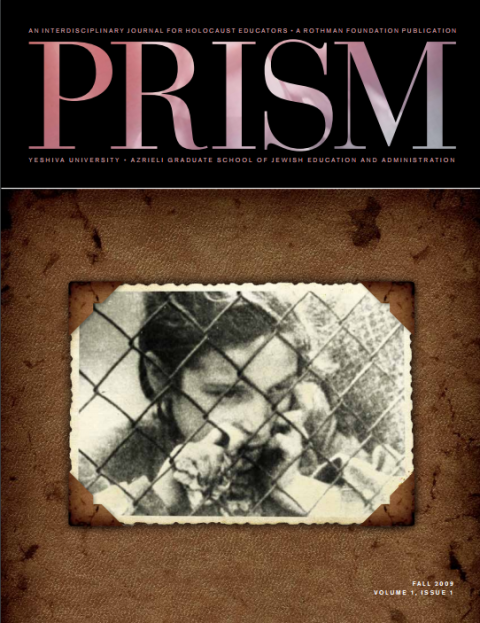 The necessity of darkness. The pedagogic imperative to teach about the death camps How much knowledge about the Holocaust is too much for students? How early is too early to begin to teach about the event? How do we find the correct balance between teaching about the atrocities and teaching about Jewish agency? The Azrieli Graduate School of Jewish Education and Administration debate these and other pedagogical questions in these pages. (By the publisher)