
자료
세계시민교육에 대한 이해를 넓히고 연구, 옹호 활동, 교수, 학습 등을 향상시킬 수 있는 다양하고 유용한 자료를 찾아보세요.
1,187 건의 결과가 검색되었습니다
 Mosaico Metodológico: Camino 3; Niñas, niños y jóvenes expertos en la Comisión de la Verdad 발행 연도: 2019 단체 저자: EDUCAPAZ Esta publicación recoje el trabajo desarrollado por el Programa Nacional de Educación para la Paz EDUCAPAZ y a Comisión de la Verdad en Colombia, para el trabajo pedagógico en escuelas que quieran reflexionar sobre el valor de la verdad en la reconstrucción de la memoria, el perdón y la reconciliación. Este módulo presenta estrategias para educar a niños, niñas y jóvenes sobre la comisión de la verdad.
  Methodological Mosaic: Path 4; The Bridges Between Memory and the Right to the Truth 발행 연도: 2019 단체 저자: EDUCAPAZ This publication reflects the work carried out by the National Program of Education for Peace EDUCAPAZ and the Truth Commission in Colombia, for education in schools that want to reflect on the value of truth in the reconstruction of memory, forgiveness and reconciliation. This module investigates the relationship between truth and memory. Mosaico Metodológico: Camino 4; Los puentes entre la memoria y el derecho a la verdad 발행 연도: 2019 단체 저자: EDUCAPAZ Esta publicación recoje el trabajo desarrollado por el Programa Nacional de Educación para la Paz EDUCAPAZ y a Comisión de la Verdad en Colombia, para el trabajo pedagógico en escuelas que quieran reflexionar sobre el valor de la verdad en la reconstrucción de la memoria, el perdón y la reconciliación. Este módulo indaga sobre la relación entre la verdad y la memoria.
  Methodological Mosaic: Path 5; The School as a Collective Subject in the Armed Conflict and Peace Building 발행 연도: 2019 단체 저자: EDUCAPAZ This publication reflects the work carried out by the National Program of Education for Peace EDUCAPAZ and the Truth Commission in Colombia, for education in schools that want to reflect on the value of truth in the reconstruction of memory, forgiveness and reconciliation. This module explores the relationship of the school to the armed conflict.
  Mosaico Metodológico: Camino 1; El valor de la verdad en la convivencia escolar 발행 연도: 2019 단체 저자: EDUCAPAZ Esta publicación recoje el trabajo desarrollado por el Programa Nacional de Educación para la Paz EDUCAPAZ y a Comisión de la Verdad en Colombia, para el trabajo pedagógico en escuelas que quieran reflexionar sobre el valor de la verdad en la reconstrucción de la memoria, el perdón y la reconciliación. En este módulo se explora la relación con la convivencia escolar.
 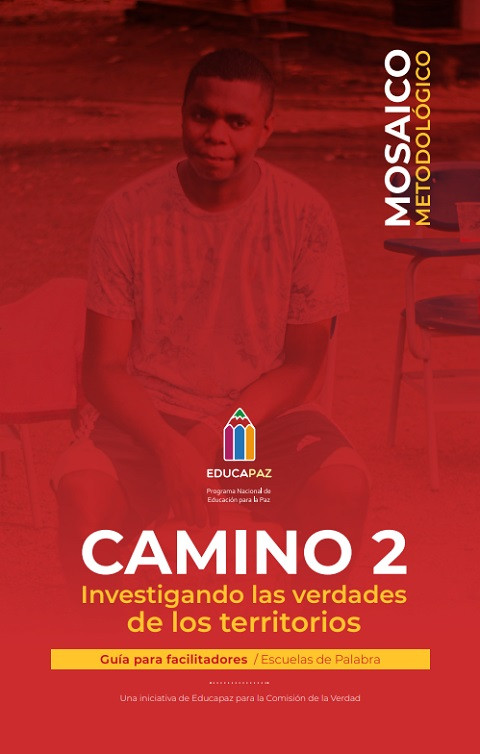 Methodological Mosaic: Path 2; Investigating the Truths of the Territories 발행 연도: 2019 단체 저자: EDUCAPAZ This publication reflects the work carried out by the National Program of Education for Peace EDUCAPAZ and the Truth Commission in Colombia, for education in schools that want to reflect on the value of truth in the reconstruction of memory, forgiveness and reconciliation. This module explores the relationship with territories and the construction of truth. Mosaico Metodológico: Camino 2; Investigando las verdades de los territorios 발행 연도: 2019 단체 저자: EDUCAPAZ Esta publicación recoje el trabajo desarrollado por el Programa Nacional de Educación para la Paz EDUCAPAZ y a Comisión de la Verdad en Colombia, para el trabajo pedagógico en escuelas que quieran reflexionar sobre el valor de la verdad en la reconstrucción de la memoria, el perdón y la reconciliación. Este módulo explora la relación con los territorios y la construcción de la verdad. Methodological Mosaic: Path 3; Girls, Boys and Young Experts in the Truth Commission 발행 연도: 2019 단체 저자: EDUCAPAZ This publication reflects the work carried out by the National Program of Education for Peace EDUCAPAZ and the Truth Commission in Colombia, for education in schools that want to reflect on the value of truth in the reconstruction of memory, forgiveness and reconciliation. This module presents strategies to educate children and young people about the truth commission.
  Audacious Education Purposes: How Governments Transform the Goals of Education Systems 발행 연도: 2020 저자: Fernando Reimers This open access book offers a comparative study of eight ambitious national reforms that sought to create opportunities for students to gain the necessary breath of skills to thrive in a rapidly changing world. It examines how national governments transform education systems to provide students opportunities to develop such skills. It analyses comprehensive education reforms in Brazil, Finland, Japan, Mexico, Peru, Poland, Portugal and Russia and yields original and important insights on the process of educational change. The analysis of these 21st century skills reforms shows that reformers followed approaches which are based on the five perspectives: cultural, psychological, professional, institutional and political. Most reforms relied on institutional and political perspectives. They highlight the systemic nature of the process of educational change, and the need for alignment and coherence among the various elements of the system in order. They underscore the importance of addressing the interests of various stakeholders of the education system in obtaining the necessary impetus to initiate and sustain change. In contrast, as the book shows, the use of a cultural and psychological frame proved rarer, missing important opportunities to draw on systematic analysis of emerging demands for schools and on cognitive science to inform the changes in the organization of instruction. Drawing on a rich array of sources and evidence the book provides a careful account of how education reform works in practice.
  Empowering Teachers to Build a Better World: How Six Nations Support Teachers for 21st Century Education; Springer Briefs in Education 발행 연도: 2020 저자: Fernando Reimers This open access book presents a comparative study on how large-scale professional development programs for teachers are designed and implemented. Around the world, governments and educators are recognizing the need to educate students in a broad range of higher order cognitive skills and socio-emotional competencies, and providing effective opportunities for teachers to develop the expertise needed to teach these skills is a crucial aspect of effective implementation of curricula which include those goals. This study examines how large-scale efforts to empower teachers for deeper instruction have been designed, how they have been implemented, and their outcomes. To do so, it investigates six programs from England, Colombia, Mexico, India, and the United States. Though all six are intended to broaden and deepen students’ curricular aspirations, each takes this expansion of curricular goals in a different direction.The ambitious education reforms studied here explicitly focus on building teachers’ capacity to teach on a broader set of goals. Through a discerning analysis of program documents, evaluations, and interviews with senior leaders and participants in the programs, the book identifies the various theories of action used in these programs, examines how they were implemented, and discusses what they achieved. As such, it offers an indispensable resource for education leaders interested in designing and implementing professional development programs for teachers that are aligned with ambitious instructional goals.