
자료
세계시민교육에 대한 이해를 넓히고 연구, 옹호 활동, 교수, 학습 등을 향상시킬 수 있는 다양하고 유용한 자료를 찾아보세요.
3,433 건의 결과가 검색되었습니다
 الحوار الصعب في الصف: مورد لمنح المُعلِّمي المهارات إ لدارة الحوار الصعب في الصف 발행 연도: 2017 단체 저자: Tony Blair Institute for Global Change يعتمد هذا الكتاب على المنهج الأساسي لدعم المعلمين في إدارة المحادثات الصعبة المتعلقة بالقضايا والمواضيع الصعبة. من خلال تقنيات التيسير العملية وسهلة الاستخدام ، يستطيع المعلمون نقل الشباب إلى عمق أكبر في الحوار والتأكد من أنهم يتعلمون المساءلة عما يقولونه.
  Consultation Paper on AI Regulation: Emerging Approaches Across the World 발행 연도: 2024 저자: Juan David Gutiérrez 단체 저자: UNESCO Since 2016, over thirty countries have passed laws explicitly mentioning AI, and in 2024, the discussion about AI bills in legislative bodies has increased globally. This policy brief aims to inform legislators about the different regulatory approaches to artificial intelligence (AI) being considered worldwide by legislative bodies. The brief explains nine emerging regulatory approaches, each illustrated with specific cases worldwide. The order in which the nine AI regulatory approaches are presented is deliberately structured to guide readers from less interventionist, light-touch regulatory measures to more coercive, demanding approaches. These regulatory approaches are not mutually exclusive and AI bills often combine two or more approaches:1. Principles-Based Approach2. Standards-Based Approach3. Agile and Experimentalist Approach4. Facilitating and Enabling Approach5. Adapting Existing Laws Approach6. Access to Information and Transparency Mandates Approach7. Risk-Based Approach8. Rights-Based Approach9. Liability Approach The policy brief suggests parliamentarians how they can address three key questions before adopting AI regulations:1. Why regulate? Determine whether regulation is needed to address public problems, fundamental and collective rights, or desirable futures.2. When to regulate? Reach a consensus on why regulation is needed, map available regulatory instruments, compare them with other policy instruments, and assess the feasibility of adopting the former.3. How to regulate? Identify a combination of AI regulatory approaches that are tailored to specific contexts.
  Education sector responses to climate change: background paper with international examples 발행 연도: 2012 단체 저자: UNESCO Bangkok Through a review of academic articles and project documents, this paper explores the relationship between the education sector and climate change. It introduces how education is both impacted by and has an impact on this phenomenon, and proposes various sector responses. Different theoretical frameworks for where and how climate change education fits into the education sector are made concrete with case studies from across the globe. An essential introduction to climate change and education, this paper brings together theory, policy and practice. A useful read for those working in either the education sector or on climate change. Les réponses du secteur de l'éducation au changement climatique: document d'information avec des exemples internationaux 발행 연도: 2012 단체 저자: UNESCO Bangkok Grâce à un examen des articles universitaires et des documents de projet, cet article explore la relation entre le secteur de l'éducation et le changement climatique. Il introduit comment l'éducation est à la fois touchée par et a un impact sur ce phénomène, et propose diverses réponses du secteur. Différents cadres théoriques pour où et comment le changement climatique l'éducation inscrit dans le secteur de l'éducation sont en béton avec des études de cas à travers le monde. Une introduction essentielle au changement climatique et de l'éducation, ce document rassemble la théorie, la politique et la pratique. Une lecture utile pour ceux qui travaillent soit dans le secteur de l'éducation ou sur le changement climatique.
  UNESCO Women for Ethical AI: Outlook Study on Artificial Intelligence and Gender 발행 연도: 2024 단체 저자: UNESCO The gender chapter of the UNESCO Recommendation on the Ethics of AI is a concrete commitment by 194 Member States to advance gender equality in the AI ecosystem. To track progress in the implementation of the gender provisions of UNESCO’s Recommendation, and to assess the impacts of AI on gender equality, the UNESCO Women for Ethical AI (W4EAI) Platform has been established. This report advances the workstream through evidence-based insights in three critical areas: women’s participation in AI development and deployment, the inclusion of gender equality concerns in AI governance and the impact of AI on gender equality. It highlights the significant underrepresentation of women in AI, the lack of gender-disaggregated data, and the compounded challenges women face in the field. The report also addresses the neglect of gender dimensions in AI policy, the risks posed by AI systems to women, and the need for responsible and ethical AI governance to promote gender equality. Finally, it outlines actionable recommendations to enhance gender equality through and in AI, emphasizing the importance of comprehensive data collection, targeted interventions, and inclusive policy-making.
 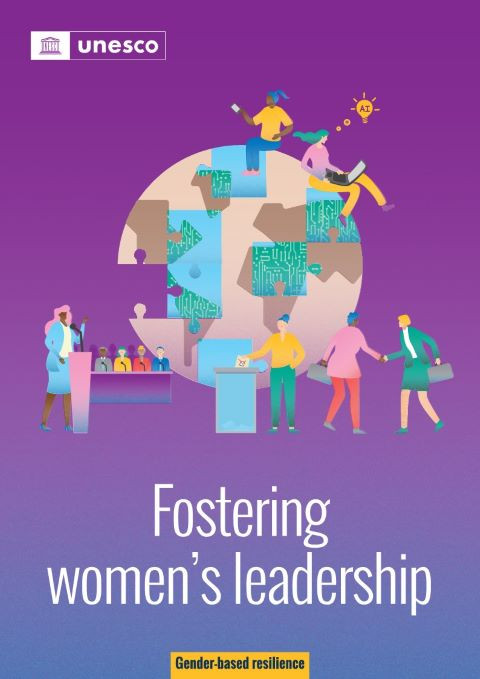 Fostering Women's Leadership 발행 연도: 2024 저자: Mariagrazia Squicciarini | Anna Rita Manca | Garance Sarlat 단체 저자: UNESCO No (leadership) share no gain (for societies and economies)! Leveraging UNESCO’s unique Gender-Based Resilience Framework, this report explores the role of women in leadership positions in both decision-making and high-tech, including in artificial intelligence-related innovations. It further highlights progress towards the G20 Brisbane Target, aimed to accelerate progress on gender equality by reducing the gender gap in labour market participation rates by 25% by 2025. Women remain underrepresented in decision-making, holding only about 26% of seats in national parliaments worldwide on average. In the world of work, female labour participation continues to lag behind men’s, at 47% for women against 72% for men on average. Despite progress by G20 members towards the Brisbane Target, a 2% average gap in absolute terms remained to be filled in 2022. In the high-tech world, women make up only 30% of AI professionals, and even less of leaders. Female inventors in AI account for about 37% of patents filed in 2022-23. Mudança climática em sala de aula: curso da UNESCO para professores secundários (fundamental II e ensino médio) sobre educação em mudança climática e desenvolvimento sustentável (EMCDS) 발행 연도: 2014 저자: David Selby | Fumiyo Kagawa 단체 저자: UNESCO Brasilia This course has been created with the goal of bringing climate change education outside the science classroom into the many other subject areas upon which climate change now has an impact, or will impact in the future, such as ethics, social studies, economics, political science, among others. The course materials are organized into four parts: 1. Course Framework and Overview, 2. Teachers’ Education Course daily materials, 3. Regional Resource Packs, 4. Daily Classroom Materials for teachers. These materials are all described in more detail and can be accessed from the Start Menu found on the following pages. This course is designed to enable teachers at the secondary level from diverse subject areas to introduce climate change education for sustainable development (CCESD) across the curriculum. UNESCO has identified the professional development of teachers in education for sustainable development as the top priority in recognition of the transformative role that teachers and teacher educators need to play in re-orienting education to help realize a sustainable future (UNESCO, 2005, p. 19). But good intentions for the professional development of teachers have fallen short in practice. Although taken up by enthusiasts, teacher education for sustainable development has rarely been mainstreamed, and, where there are courses, is often approached within a disciplinary as opposed to an interdisciplinary frame (Wals, A., 2009). If professional development in education for sustainable development is at an adolescent stage, teacher education in climate change education for sustainable development is in its infancy. For instance, according to a 2009 international comparative study on climate change education and sustainable development in ten countries, climate change education has peripheral status in educational research and practice, and when it is addressed it is only within science education (Læssøe,J. Schnack, K., Breiting, S. & Rolls, S., 2009). There is a clear and present need to respond to climate change challenges through systematic teacher education programmes that are not restricted to a single subject area. This teacher education course is an attempt to fill the current gap and is in line with one of UNESCO’s key objectives for climate change education for sustainable development, that is, to support teacher training on climate change for sustainable development (UNESCO, 2010, p. 9). The programme has four distinctive features: 1. It helps teachers to understand the causes, dynamics and impacts of climate change through a holistic approach. 2. Teachers are exposed to, and experience, a range of pedagogical approaches and techniques, that they can use in their own school environment. This includes engagement of themselves and their students in whole school and school-in-community approaches. 3. Teachers will develop their capacities to facilitate students’ community based learning. 4. Teachers will develop future-oriented and transformative capacities in facilitating climate change mitigation, adaptation, and disaster risk reduction learning. Outcome document on education and biodiversity conservation, adopted at the parallel event: international conference on biodiversity conservation and education for sustainable development: learning to conserve biodiversity in a rapidly changing world 발행 연도: 2012 단체 저자: Centre for Environment Education The Outcome Document from the two day International Conference on Biodiversity Conservation and ESD, attended by over 250 participants including educators and held as a parallel event inside COP 11, outlines a way forward by providing recommendations towards a strategic plan of action for ESD in the context of biodiversity conservation. Discours de M. Koïchiro Matsuura, Directeur général de l'UNESCO, à l'occasion du lancement international de la Décennie pour l'éducation au service du développement durable (2005-2014), Siège de l'Organisation des Nations Unies, New York, 1er mars 2005 발행 연도: 2005 단체 저자: UNESCO. Director-General, 1999-2009 (Matsuura, K.) This speech was presented by Mr Koïchiro Matsuura, Director-General of the United Nations Educational, Scientific and Cultural Organization (UNESCO), on the occasion of the International launch of the United Nations Decade on Education for Sustainable Development (2005-2014). Address by Mr Koïchiro Matsuura, Director-General of UNESCO, on the occasion of the International Launch of the United Nations Decade on Education for Sustainable Development (2005-2014); United Nations Headquarters, New York, 1 March 2005 발행 연도: 2005 단체 저자: UNESCO. Director-General, 1999-2009 (Matsuura, K.) This speech was presented by Mr Koïchiro Matsuura, Director-General of the United Nations Educational, Scientific and Cultural Organization (UNESCO), on the occasion of the International launch of the United Nations Decade on Education for Sustainable Development (2005-2014).