
자료
세계시민교육에 대한 이해를 넓히고 연구, 옹호 활동, 교수, 학습 등을 향상시킬 수 있는 다양하고 유용한 자료를 찾아보세요.
1,322 건의 결과가 검색되었습니다
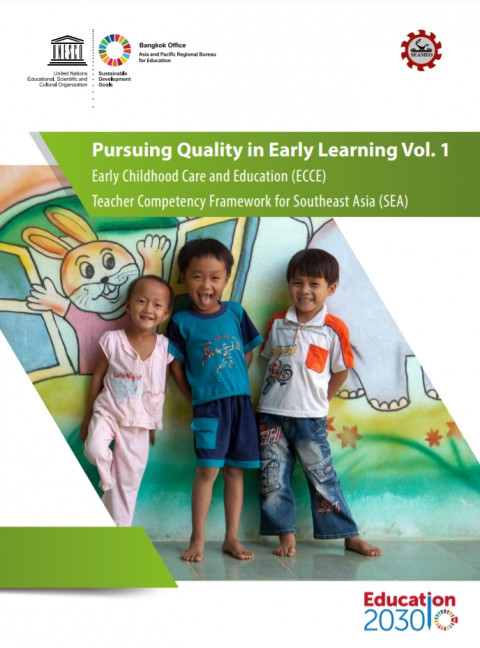 Pursuing quality in early learning, vol. 1: Early childhood care and education (ECCE) teacher competency framework for Southeast Asia (SEA) 발행 연도: 2018 단체 저자: Southeast Asian Ministers of Education Organization (SEAMEO) | UNESCO Bangkok With the United Nation’s (UN) Sustainable Development Goals (SDGs) as a platform for achieving quality early childhood care and education outcomes by 2030, ECCE policy-makers, practitioners, and academicians from Asia-Pacific countries gathered at the second Asia-Pacific Regional Policy Forum on Early Childhood Care and Education in Putrajaya, Malaysia in 2016 to share experiences, innovations, and lessons learned in developing and implementing ECCE policies and initiatives. This document first provides a brief background, and discusses the purposes and intended audience for which the framework was developed (Section I). A succeeding section reflects on the regional ECCE landscape (Section II), before proceeding to a discussion of the ECCE teacher competency framework for Southeast Asia (Section III). Section IV suggests possible uses of the ECCE teacher competency framework; a final section concludes with areas for future action.
  Une planète pour nos besoins 발행 연도: 2017 단체 저자: Bruxelles Environnement Ce jeu de rôle permet de comprendre notre dépendance à notre environnement et de réfléchir à la manière dont l’être humain exploite celui-ci pour sa survie et son bien-être. Les élèves devront coopérer pour espérer gagner!
  Tajik cultural identity and multiculturalism 발행 연도: 2014 저자: Khamrokhon Zarifi The article is devoted to issues of history, cultural identity and the heritage of the Tajik people. The issues of preservation and continuity of cultural diversity, as well as the phenomenon of multiculturalism are discussed.
  [Video] We must act now - for people and our planet 발행 연도: 2019 단체 저자: UN. Department of Economic and Social Affairs (UN. DESA) The world is facing challenges of an unprecedented nature. A polarized political landscape, worrisome signs of a global economic slow-down, growing inequalities, conflicts and a global environmental crisis. The evidence is clear: we must act now. The international community has a brief window of opportunity to accelerate action, using the plan in place to achieve a positive outcome for everyone: the 2030 Agenda for Sustainable Development and its 17 transformative Sustainable Development Goals (SDGs).
 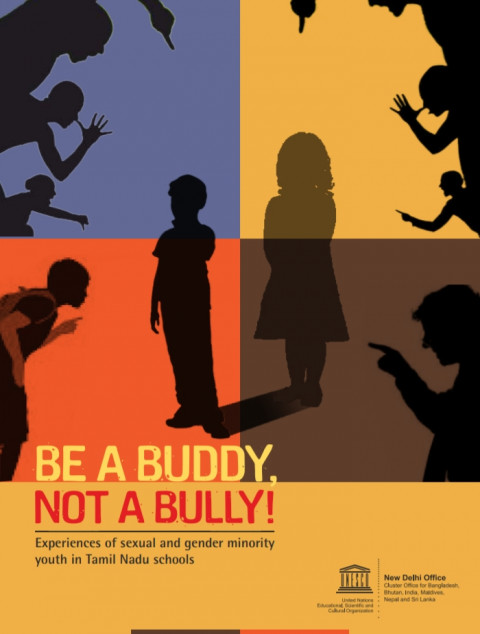 Be a buddy, not a bully: experiences of sexual and gender minority youth in Tamil Nadu schools 발행 연도: 2019 저자: Menon C. Sunil, Chakrapani. Venkatesan, Jadav. Sarita 단체 저자: UNESCO New Delhi We at UNESCO recognize that no country can achieve Sustainable Development Goal 4 - to ensure inclusive and equitable quality education and promote lifelong learning opportunities for all - if students are discriminated against or experience violence because of their actual or perceived sexual orientation and gender identity. This study conducted under the overall guidance of the School Education Department, Government of Tamil Nadu highlights our shared commitment to prevent and address bullying in educational institutions. We are confident that this report will be an effective tool for evidence based advocacy with school education departments and go a long way in promoting a comprehensive education sector response to SOGIE-based bullying, which includes enabling policy environments; inclusive curriculum and learning materials; professional development programmes for teachers and other school staff; support for learners including awarenessraising activities; and an overall school environment that is safe, nonviolent and that understands and appreciates diversity.
  Innovative Educational Reforms in Uzbekistan 발행 연도: 2019 저자: Kh. Khakimjonova The article reveals the most important stages of reforming the education system of the Republic of Uzbekistan. The structure of the education system and the basic principles on which state reforms in the educational sphere are based are revealed. Describes the changes taking place in the education system of Uzbekistan in the light of recent government decrees and the challenges facing ministries and departments whose activities are directly or partially related to the education system of the Republic of Uzbekistan. Инновационные образовательные реформы в Узбекистане 발행 연도: 2019 저자: Kh. Khakimjonova В статье раскрываются важнейшие этапы реформирования системы образования Республики Узбекистан. Раскрывается структура системы образования и основные принципы, на которых основываются государственные реформы в образовательной сфере. Описываются изменения, происходящие в системе образования Узбекистана в свете последних правительственных указов и задачи, стоящие перед министерствами и ведомствами, деятельность которых связана непосредственно или частично соприкасается с системой образования Республики Узбекистан.
 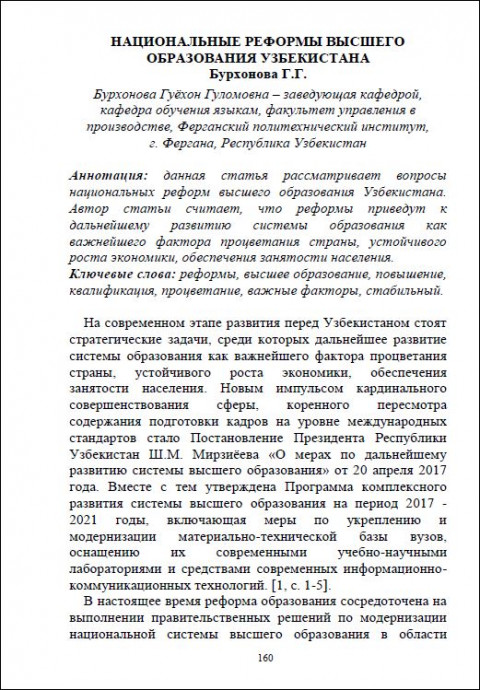 National Reforms of the Higher Education in Uzbekistan 발행 연도: 2019 저자: G. Burkhonova This article addresses the issues of national reform of higher education in Uzbekistan. The author of the article believes that the reforms will lead to the further development of the education system as an important factor in the country's prosperity, sustainable economic growth, and employment. Национальные реформы высшего образования Узбекистана 발행 연도: 2019 저자: G. Burkhonova Данная статья рассматривает вопросы национальных реформ высшего образования Узбекистана. Автор статьи считает, что реформы приведут к дальнейшему развитию системы образования как важнейшего фактора процветания страны, устойчивого роста экономики, обеспечения занятости населения.
  Identifying with Horror: Teaching about the Holocaust - A response to Simone Schweber's "Simulating Survival" The author responds to Simone Schweber's article "Simulating Survival", an article that praised the use of a simulation about the Holocaust by a public school teacher. In her response, Ben-Peretz discusses the impact of Schweber's article, some issues concerning the public school teacher's mode of teaching, why the Holocaust should be taught, and implications for teacher education. (Abstract In : Educating about Social Issues in the 20th and 21st Centuries: A Critical Annotated Bibliography)