
자료
세계시민교육에 대한 이해를 넓히고 연구, 옹호 활동, 교수, 학습 등을 향상시킬 수 있는 다양하고 유용한 자료를 찾아보세요.
950 건의 결과가 검색되었습니다
 Strategy to Combat Desertification to Achieve Sustainable Development in the Arab World: A Study of Algeria 's National Program to Combat Desertification 발행 연도: 2019 저자: Boshwait Qairouz Regarding to its impacts on the economic, social and environnemental levels, desertification became one of critical environnemental issue that disturbs the international community. Especially in the dry land, semi dry land and semi humid dry lands. Desertification is the great durable development challenge based on three dimensions: economical efficiency, social justice and nature protection. Viewing the international trends towards achieving durable development, the Arab countries must create new durable strategies and methods, in order to face the phenomenon, these strategies should include the following dimensions: economical, social and environnemental one. Accounting the different reasons of desertification, its intensity and considering the financing capacity, it so difficult to expect one typical strategy that suits each Arab countries. To face such problem, Algeria like the other damaged countries takes needful procedures to combat this problem following a national programme which started in the sixteenth oh last century. To sum up, now days desertification till now a global issue, but the question which rest posing, If may we remove definitely such problem?
  المواطنة في العصر الرقمي: نموذج مملكة البحرين 발행 연도: 2017 저자: ندى علي حسن بن شمس 단체 저자: معهد البحرين للتنمية السياسية البحث يجيب عن التساؤل الرئيس التالي: ما فعالية برنامج مقترح قائم على الشبكة العالمية لتنمية قيم المواطنة لطالب جامعة البحرين في ضوء متطلبات العصر الرقمي؟ ويتفرع من التساؤل الرئيس للبحث التساؤلات الفرعية الآتية: 1 -ما قائمة قيم المواطنة اللازمة لطالب جامعة البحرين في ضوء متطلبات العصر الرقمي؟ 2 -ما صورة البرنامج المقترح القائم على الشبكة العالمية) بالأنشطة الحوارية – بدون الأنشطة الحوارية( لتنمية قيم المواطنة لطالب جامعة البحرين في ضوء متطلبات العصر الرقمي؟ 3 –ما فعالية البرنامج المقترح القائم على الشبكة العالمية بصورتيه )بالأنشطة الحوارية – بدون الأنشطة الحوارية( لتنمية قيم المواطنة لطالب جامعة البحرين في ضوء متطلبات العصر الرقمي؟ Citizenship in the Digital Age: The Model of the Kingdom of Bahrain 발행 연도: 2017 저자: ندى علي حسن بن شمس 단체 저자: معهد البحرين للتنمية السياسية The research answers the following main question: What is the effectiveness of a proposed program based on the global network for developing citizenship values for students of the University of Bahrain in light of the requirements of the digital age? The main question of the research is divided into the following sub-questions: 1- What is the list of citizenship values required for a student at the University of Bahrain in light of the requirements of the digital age? 2- What is the image of the proposed program based on the global network (with dialogue activities - without the dialogue activities) to develop citizenship values for students of the University of Bahrain in light of the requirements of the digital age? 3 - What is the effectiveness of the proposed program based on the global network in its two forms (with dialogue activities - without the dialogue activities) to develop Citizenship values for a University of Bahrain student in light of the requirements of the digital age?
  مؤتمر ومعرض التنمية المستدامة 발행 연도: 2018 단체 저자: Arab Internatiional يأتي تنظيم المؤتمر دعماً لتوجيهات السيد الرئيس عبد الفتاح السيسي لتحقيق رؤية مصر 2030في إستراتيجية التنمية المستدامة بما يحقق إقتصاد تنافس متوازن ومتنوع للإرتقاء بجودة حياه المصريين عن طريق إستثمار عبقرية المكان والإنسان مع الأعتماد علي الإبتكار والمعرفه والعدالة الإجتماعية .
  Sustainable Development Goal 4: The Dubai Roadmap for Education 2030 in the Arab Region (2017-2018) 발행 연도: 2017 단체 저자: UNESCO Beirut SDG 4 agenda inspires us to pursue a humanistic vision of education and development based on human rights and dignity, social justice, protection, cultural diversity, and shared responsibility and accountability. Also, it is underpinned by the principle that education is a public good, a fundamental human right and a basis for guaranteeing the realization of other rights. Furthermore, it is essential for peace, human fulfillment and sustainable development. Having adopted the Arab Regional Roadmap for SDG 4 and Education 2030 (Cairo Roadmap) at ARMED I, we, Arab Member States and partners, have since commenced implementation of the Agenda as appropriate and relevant to national contexts.
 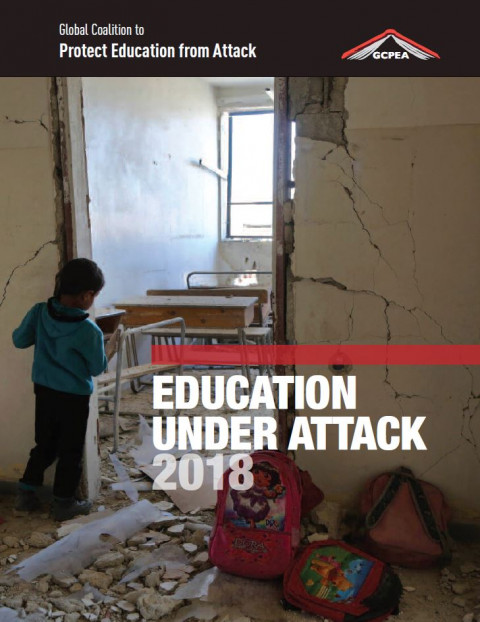 Education Under Attack 2018 발행 연도: 2018 단체 저자: Global Coalition to Protect Education from Attack (GCPEA) This report is the fourth edition of Education under Attack. It builds on the 2014 study published by the Global Coalition to Protect Education from Attack and the 2007 and 2010 publications by the United Nations Educational, Scientific and Cultural Organization (UNESCO). The present edition covers the five-year period from January 2013 to December 2017. The previous edition included profiles of 30 countries that had experienced at least five incidents of attacks on education in which students or education personnel were harmed, including at least one direct attack or one person killed, between 2009 and mid-2013. The current study includes profiles of 28 countries that experienced at least 20 attacks on education during the 2013-2017 reporting period, regardless of the severity of the incidents. Although significant data gaps remain and data quality varies, reporting of attacks on education has become more comprehensive and systematic over the last five years.Each country profile includes information on six categories of attacks on education, as relevant: Physical attacks or threats of attacks on schools Physical attacks or threats directed at students, teachers, and other education personnel Military use of schools and universities Child recruitment at, or en route to or from, school or university Sexual violence by armed parties at, or en route to or from, school or university Attacks on higher education
 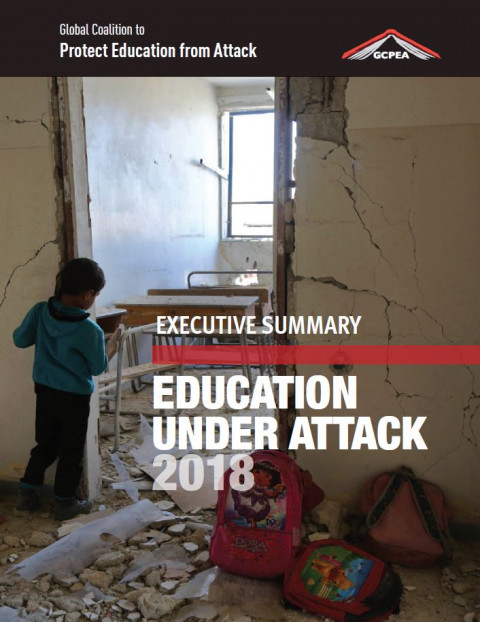 [Summary] Education Under Attack 2018; Executive Summary 발행 연도: 2018 단체 저자: Global Coalition to Protect Education from Attack (GCPEA) A global study of threats or use of force, either deliberate or indiscriminate, against students, teachers, academics, education support and transport staff or education officials, and against schools, universities and other education institutions carried out for political military, ideological, sectarian, ethnic or religious reasons from 2013 to 2017. [Resumen] Ataques a la Educación 2018; Resumen Ejecutivo 발행 연도: 2018 단체 저자: Global Coalition to Protect Education from Attack (GCPEA) Estudio global de las amenazas o instancias de uso deliberado o indiscriminado de la fuerza contra estudiantes, docentes, académicos, personal auxiliar educativo y de transporte o funcionarios de educación, y contra escuelas, universidades y otras instituciones educativas, perpetradas con fines políticos, militares, ideológicos, sectarios, étnicos o religiosos entre 2013 y 2017. [Résumé] L’education prise pour cible 2018; Un résumé de 발행 연도: 2018 단체 저자: Global Coalition to Protect Education from Attack (GCPEA) Une étude globale des menaces ou de l'usage de la force, délibérée ou non, contre les élèves, les enseignants, les universitaires, le personnel scolaire et des transports ou les agents de l'éducation; et contre les écoles, les universités et autres institutions éducatives, menées pour des raisons politiques, militaires, idéologiques, sectaires, ethniques ou religieuses de 2013 à 2017.
  Perceptions of the Holocaust in Europe and Muslim communities : Sources, Comparisons and Educational challenges 발행 연도: 2012 저자: Gunther Jikeli | Joëlle Allouche-Benayoun The way people think about the Holocaust is changing. The particular nature of the transformation depends on people’s historical perspectives and how they position themselves and their nation or community vis-à-vis the tragedy. Understandably, European Muslims perceive the Holocaust as less central to their history than do other Europeans. Yet while the acknowledgement and commemoration of the horrors of the Holocaust are increasingly important in Europe, Holocaust denial and biased views on the Holocaust are widespread in European Muslims’ countries of origin. In this book, a number of distinguished scholars and educators of various backgrounds discuss views of the Holocaust. Problematic views are often influenced by a persistent attitude of Holocaust denial, which is derived, in part, from discourses in the Muslim communities in their countries of origin. The essays collected here explore the backgrounds of these perceptions and highlight positive approaches and developments. Many of the contributions were written by people working in the field and reflecting on their experiences. This collection also reveals that problematic views of the Holocaust are not limited to Muslim communities. (By the publisher)