
자료
세계시민교육에 대한 이해를 넓히고 연구, 옹호 활동, 교수, 학습 등을 향상시킬 수 있는 다양하고 유용한 자료를 찾아보세요.
1,448 건의 결과가 검색되었습니다
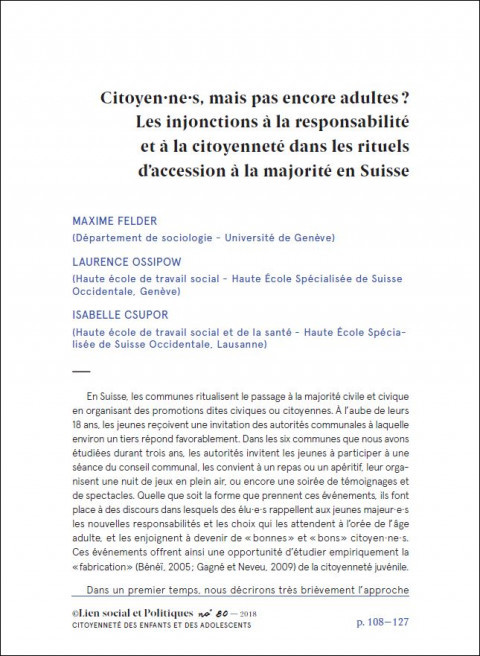 Citizens but not Adults? Injunction to be Responsible and Citizens in Official Coming of Age Rituals in Switzerland 발행 연도: 2018 저자: Maxime Felder | Laurence Ossipow | Isabelle Csupor 단체 저자: Lien social et Politiques Swiss municipalities organize ceremonies for their residents reaching the official age of full citizenship. In the six studied municipalities, local authorities invite them to a municipal council’s meeting, offer them a dinner or an aperitif, or organize them a show and a debate with role models. Speeches are central to these ceremonies, and authority representatives encourage their audience to be “good” citizens. Call to vote is the leitmotiv, but discourses reveal broader definitions of citizenship, insisting sometimes on a local commitment and volunteering, and sometimes on the necessity to fight climate change and inequalities. Comparing officials’ speeches to statements of young people participating in these events reveals “tensions”. Indeed, authority representatives address young citizens without considering them as fully adult, and they do not consider themselves as such neither. However, some of them are already involved in forms of vernacular citizenship, and are progressively leaving the municipality to study, work or travel. Ultimately, these ceremonies allow officials to stage their interest in the youth, which they consider as both uncompleted and essential to the renewal of democracy. Citoyen·ne·s, mais pas encore adultes ? Les injonctions à la responsabilité et à la citoyenneté dans les rituels d’accession à la majorité en Suisse 발행 연도: 2018 저자: Maxime Felder | Laurence Ossipow | Isabelle Csupor 단체 저자: Lien social et Politiques Les communes suisses organisent un rituel pour célébrer l’accession à la majorité civile et civique de leurs résident·e·s qui atteignent l’âge de dix-huit ans. Dans les six communes que nous avons étudiées, les autorités invitent les jeunes à participer à une séance du conseil communal, les convient à un repas ou un apéritif, ou leur organisent une soirée de témoignages, de spectacle ou encore de jeux en plein air. Ces événements font place à des discours dans lesquels des représentant·e·s des autorités enjoignent les jeunes à être de « bonnes » et « bons » citoyens. Si l’appel au vote est toujours le leitmotiv, les discours se centrent aussi sur des définitions plus larges de la citoyenneté, insistant tantôt sur l’engagement associatif et local, tantôt sur la nécessité d’agir pour l’écologie ou contre les inégalités. Le croisement de ces analyses avec celles des entretiens menés avec de jeunes participant·e·s fait émerger des tensions. En effet, les autorités s’adressent à des jeunes qu’elles ne considèrent pas tout à fait comme des adultes (et qui ne se considèrent pas non plus comme tel·le·s), qui sont pour certain·e·s déjà engagé·e·s dans ces formes de citoyenneté vernaculaire, et qui s’apprêtent à quitter leur commune pour étudier ou voyager. Ces promotions citoyennes permettent ainsi de mettre en scène l’intérêt des élu·e·s pour les jeunes, considéré·e·s comme des citoyen·ne·s en apprentissage dont dépend le renouvellement de la démocratie.
  Enseigner la Shoah au college et au lycee - De la parole antisemite a la destruction des juifs d'Europe - Livret du Professeur 발행 연도: 2009 저자: Joel Kotek, Iannis Roder This teacher booklet published by the Mémorial de la Shoah contains well-constructed lessons to use entirely or partially, based on photographs and literature extracts. This guideline offers pedagogical and scientific reflections on the Holocaust’s historical treatment.
 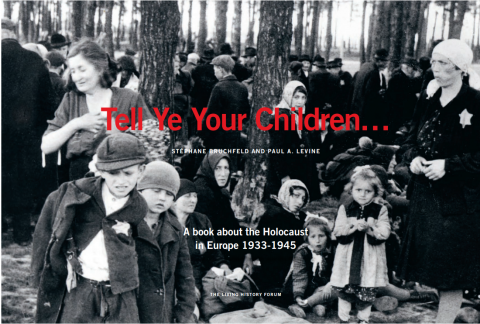 Tell Ye Your Children - A book about the Holocaust in Europe 1933-1945 발행 연도: 2012 저자: Stephane Bruchfeld, Paul. A. Levine This book is published by the Living History Forum. This Swedish public authority uses the teaching of the Holocaust and other crimes against humanity to promote tolerance, democracy and human rights. This booklet covers the rise of National Socialism until the end of the war, providing facts and information to encourage discussions. Dites-le à vos enfants - Un livre sur l'Holocauste en Europe 1933-1945 발행 연도: 2012 저자: Stephane Bruchfeld, Paul. A. Levine Ce livre est publié par le Forum d'histoire vivante. Cette autorité publique suédoise utilise l'enseignement de l'Holocauste et d'autres crimes contre l'humanité pour promouvoir la tolérance, la démocratie et les droits de l'homme. Ce livret couvre la montée du national-socialisme jusqu'à la fin de la guerre, fournissant des faits et de l'information pour encourager les discussions.
 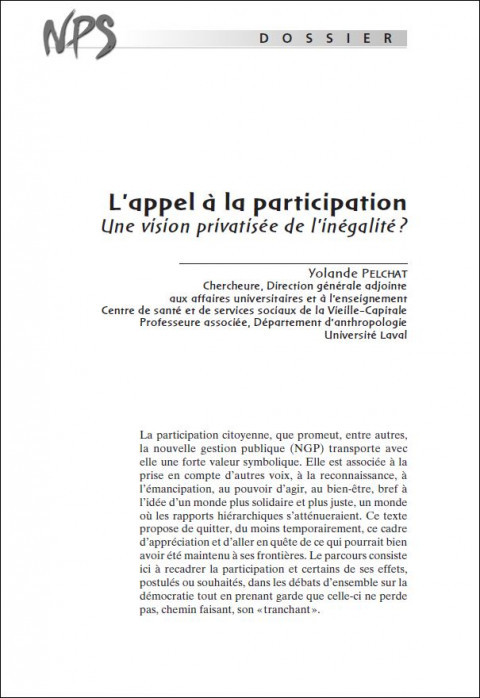 The Call for Participation: A Vision Exempt from Inequality? 발행 연도: 2010 저자: Yolande Pelchat 단체 저자: Nouvelles pratiques sociales Citizen participation, which is promoted by the New Public Management, conveys a high symbolic value. Citizen participation is generally associated with the consideration of others’ voices, recognition, emancipation, empowerment and well-being. In short, it carries the promise of a more just world with greater social solidarity and less hierarchic social relations. This paper proposes to leave aside this fashionable rhetoric, at least temporarily, and to search for what might have been left at its borders. This exploratory journey aims to reframe, within larger debates about democracy, the call for participation and its assumed or desired effects. The invitation to beware of losing, on the way, the radical nature of democracy, is issued. L’appel à la participation: Une vision privatisée de l’inégalité ? 발행 연도: 2010 저자: Yolande Pelchat 단체 저자: Nouvelles pratiques sociales La participation citoyenne, que promeut, entre autres, la nouvelle gestion publique (NGP) transporte avec elle une forte valeur symbolique. Elle est associée à la prise en compte d’autres voix, à la reconnaissance, à l’émancipation, au pouvoir d’agir, au bien-être, bref à l’idée d’un monde plus solidaire et plus juste, un monde où les rapports hiérarchiques s’atténueraient. Ce texte propose de quitter, du moins temporairement, ce cadre d’appréciation et d’aller en quête de ce qui pourrait bien avoir été maintenu à ses frontières. Le parcours consiste ici à recadrer la participation et certains de ses effets, postulés ou souhaités, dans les débats d’ensemble sur la démocratie tout en prenant garde que celle-ci ne perde pas, chemin faisant, son « tranchant ».
  Learning the lessons of the Holocaust? A critical consideration of the antiracist and citizenship potential of Holocaust education in English secondary schools 발행 연도: 2010 저자: Alice Pettigrew In this paper I draw upon data collected as part of a national study of current practice in Holocaust education within English secondary schools. The paper emphasises the importance placed by teachers from a variety of subject backgrounds upon study of the Holocaust as an opportunity to explore citizenship related and antiracist concerns. However, the paper also identifies and discusses a number of potential challenges and possible limitations apparent in this approach. (By the author) Tirer les leçons de l'Holocauste? Un examen critique du racisme et de la citoyenneté potentiel anti enseignement de l'Holocauste dans les écoles secondaires anglaises 발행 연도: 2010 저자: Alice Pettigrew Dans cet article, je dessine sur les données recueillies dans le cadre d'une étude nationale de la pratique actuelle dans l'enseignement de l'Holocauste dans les écoles secondaires anglaises. Le document met l'aCECnt sur l'importance accordée par les enseignants à partir d'une variété de sujets d'horizons sur l'étude de l'Holocauste comme une occasion d'explorer la citoyenneté préoccupations connexes et antiracistes. Toutefois, le document identifie et examine un certain nombre de défis potentiels et les limites possibles apparentes dans cette approche également. (Par l'auteur)
 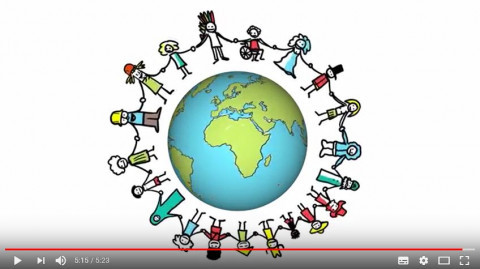 [Vidéo] L'éducation à la citoyenneté mondiale et solidaire 발행 연도: 2015 단체 저자: Îles de Paix Iles de Paix a produit ce petit film pour présenter ce qu’est l’éducation à la citoyenneté mondiale et solidaire aux futurs enseignants. Ceux-ci n’ont toutefois pas le monopole de l’action en cette matière. Chacun – qu’il soit enseignant ou non – peut en prendre connaissance avant d’agir, agir, et encore agir, sans relâche.