
자료
세계시민교육에 대한 이해를 넓히고 연구, 옹호 활동, 교수, 학습 등을 향상시킬 수 있는 다양하고 유용한 자료를 찾아보세요.
1,448 건의 결과가 검색되었습니다
 From Ethnocultural Diversity to Living Together: Examples of Future Teachers Using a Multicultural Approach to Education 발행 연도: 2010 저자: Mirela Moldoveanu 단체 저자: McGill University. Faculty of Education This text looks at how future teachers define multicultural education in order to discover its relevance and objectives in the context of living together. Nine masters students in an initial teacher training program at an Ontario university participated in an exploratory research study using qualitative data. The interpretation of the results led to the construction of a multicultural education model that attempts to legitimize the data within the framework of a differentiated pedagogical approach.
  Journée de la mémoire des génocides et de la prévention des crimes contre l'humanité 발행 연도: 2017 단체 저자: éduscol Le travail de mémoire passe prioritairement par l'éducation des enfants et des adolescents. Depuis 2003, la journée du 27 janvier est l'occasion pour la communauté éducative d'engager une réflexion sur les génocides et de rappeler les valeurs humanistes qui fondent notre démocratie. Une démarche à destination des jeunes générations qui, près de soixante-dix ans après la découverte des crimes commis par les nazis reste toujours aussi importante en termes d'éducation à la citoyenneté.
  Inégalités sociales et migratoires : Comment l’école amplifie-t-elle les inégalités ? 발행 연도: 2016 단체 저자: Conseil natiional d'évaluation du système scolaire (CNESCO) En se fondant sur 22 contributions commandées pour l’occasion par le Cnesco à près de 40 chercheurs français et étrangers, ainsi que sur des enquêtes, des études et des articles publiés par des chercheurs ou des organismes, le Cnesco présente dans ce rapport un bilan global des inégalités scolaires d’origines sociale et migratoire en France aujourd’hui. Cette analyse à visée holistique se déroule en trois parties : tout d’abord, une définition conceptuelle des inégalités sociales à l’école et des approches de la justice scolaire ; ensuite, un état des lieux quantitatif présentant ces inégalités scolaires ; enfin, une présentation des politiques scolaires entreprises depuis quatre décennies dans l’objectif de combattre les injustices sociales à l’école tant au primaire qu’au secondaire, ainsi qu’un bilan sur leur efficacité.Qu’est-ce qu’une école juste ? Comment décrire, observer les inégalités ? Toutes les inégalités scolaires sont-elles illégitimes ? Dans une approche historique, les différences de parcours selon les niveaux scolaires ont longtemps eu lieu dès la fin de l’école primaire. L’avènement du collège unique en 1975 marque un tournant majeur dans la recherche de davantage d’égalité des chances à l’école.La massification de l’enseignement secondaire permet à davantage d’élèves d’accéder au baccalauréat, les inégalités sociales face à ce diplôme reculent plus encore avec la création du baccalauréat professionnel. Le socle commun de connaissances, de compétences et de culture, l’adaptation de l’école à l’élève, la différenciation pédagogique, la revalorisation des parcours individuels : autant de concepts plus récents, reflets d’une école du 21e siècle, qui ont pour objet un apprentissage minimum de certaines connaissances pour tous, et qui tendent donc à plus de justice.Mais si l’école française ségrégue moins les élèves de façon flagrante qu’il y a 50 ans, elle tend cependant à maintenir de nombreuses inégalités sociales et migratoires en son sein, plus cachées, moins observables, mais pourtant bien présentes. Ce sont ces inégalités que le Cnesco souhaite étudier.
  Éducation à la citoyenneté à l’école : Politiques, pratiques scolaires et effets sur les élèves 발행 연도: 2016 저자: Géraldine Bozec 단체 저자: Conseil natiional d'évaluation du système scolaire (CNESCO) Ce rapport de recherche, commandé par le CNESCO, constitue une revue de la littérature à la fois française et internationale portant sur l’éducation à la citoyenneté. Il vise à avancer dans la compréhension d’un objet de recherche encore délaissé à ce jour dans les études françaises et à identifier des pistes de recherche qui pourraient s’avérer fécondes à l’avenir. Il privilégie les travaux mobilisant des données empiriques. Le rapport dresse d’abord un état de lieux de l’apprentissage de la citoyenneté à l’école française, à partir d’une analyse des politiques, des programmes et des pratiques scolaires (Partie I). Il met ensuite en perspective le cas français en resituant ses spécificités et les points communs qu’il partage avec d’autres cas nationaux en matière d’éducation à la citoyenneté (Partie II). Enfin, il présente un bilan des recherches visant à évaluer les effets de l’éducation à la citoyenneté sur les représentations, les attitudes et les pratiques des élèves (Partie III). En conclusion, des orientations de recherche qui apparaissent, à l’issue de cet état des lieux, comme encore peu explorées et potentiellement fructueuses, sont identifiées.
 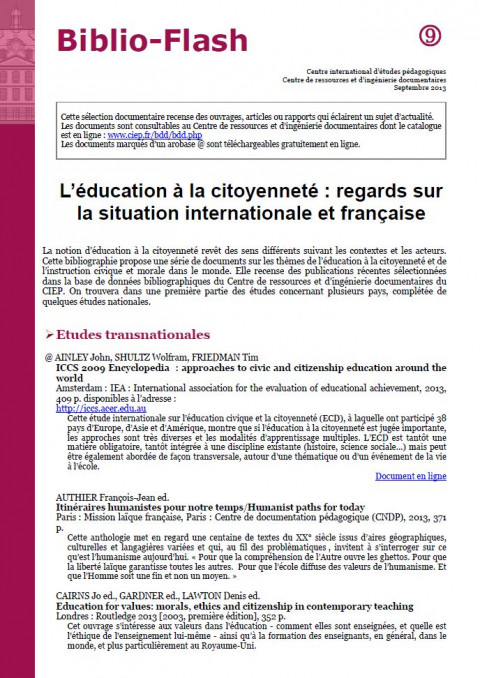 L’éducation à la citoyenneté : regards sur la situation international et française 발행 연도: 2013 단체 저자: Centre international d'études pédagogiques La notion d'éducation à la citoyenneté revêt des sens différents suivant les contextes et les acteurs. Cette bibliographie propose une série de documents sur les thèmes de l'éducation à la citoyenneté et de l'instruction civique et morale dans le monde. Elle recense des publications récentes sélectionnées dans la base de données bibliographiques du Centre de ressources et d'ingénierie documentaires du CIEP. On trouvera dans une première partie des études concernant plusieurs pays, complétée de quelques études nationales.
 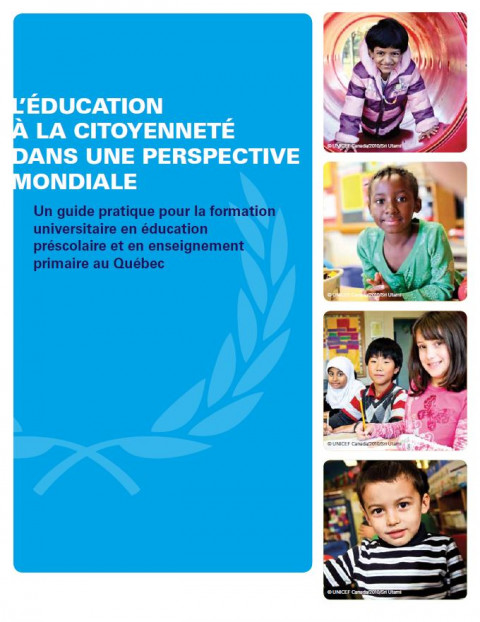 L’éducation à la citoyenneté dans une perspective mondiale : Un guide pratique pour la formation universitaire en éducation préscolaire et en enseignement primaire au Québec 발행 연도: 2011 단체 저자: UNICEF Canada Ce guide permet au corps enseignant universitaire, aux étudiantes et étudiants en éducation, ainsi qu’aux enseignantes et enseignants en formation continue, d’acquérir une bonne compréhension des concepts de l’éducation à la citoyenneté dans une perspective mondiale, d’en connaître la pertinence dans tous les aspects de leur enseignement, peu importe le domaine, et ce, afin qu’ils puissent agir en enseignantes et enseignants responsables et informés, et puissent développer des compétences similaires chez leurs élèves.Le guide est divisé en trois parties. La première, intitulée Soutien à la formation initiale, permet de faire un examen des besoins pour la formation initiale et continue au sujet de l’éducation à la citoyenneté dans une perspective mondiale. C’est dans cet esprit que les compétences professionnelles ont été ciblées et que des outils pédagogiques ont été élaborés : l’outil diagnostique et de pratique réflexive. C’est dans cette partie que vous trouverez un tableau indiquant les rubriques du guide et la ou les compétences professionnelles qu’elles permettent de développer.La deuxième partie du guide présente la notion d’éducation à la citoyenneté dans une perspective mondiale. En plus de définir cette notion, elle fait des liens avec le Programme de formation de l’école québécoise. C’est aussi dans cette section que le lecteur se familiarisera avec les six concepts centraux de l’éducation à la citoyenneté dans une perspective mondiale.La troisième partie du guide est divisée en six sections; chacune d’elle présente un des six concepts centraux de l’éducation à la citoyenneté dans une perspective mondiale, soit : droits de l’enfant, interdépendance, images et perceptions, conflits et leur résolution, justice sociale et action viable.
  ÉDUCATION A LA PHILOSOPHIE ET A LA CITOYENNETÉ : AVEC LES PARENTS ? (Analyse UFAPEC 2016) 발행 연도: 2016 저자: Bernard Hubien 단체 저자: Union francophone des associations de parents de l'enseignement catholique (UFAPEC) L'éducation à la philosophie et à la citoyenneté est une mission fondamentale de l'école. En septembre dernier, la Fédération Wallonie-Bruxelles a publié un référentiel qui décrit les objectifs et les contenus attendus de cette éducation. Si l'école a donc son rôle dans cet apprentissage fondamental, on peut se demander où sont les parents. Un partenariat positif et une école qui met en cohérence cette éducation avec ses pratiques devrait permettre à chaque enfant de grandir en devenant un citoyen, responsable, actif, critique et solidaire, enjeu sociétal plus que jamais d'actualité.
  MODÈLES DE RECHERCHE: Démocratie, citoyenneté mondiale et éducation transformatoire 발행 연도: 2018 저자: Paul R. Carr | Gina Thésée 단체 저자: Chaire UNESCO Démocratie, citoyenneté mondiale et éducation transformatoire (DCMÉT) Les modèles conceptuels et théoriques présentés dans ce document ont été élaborés sur une période d’environ douze ans, commençant en 2005, par le titulaire (Paul R. Carr, Université du Québec en Outaouais) et la co-titulaire (Gina Thésée, Université du Québec à Montréal) de la Chaire UNESCO. Ces modèles ont été publiés dans diverses revues académiques, en anglais ou en français et ont été traduits et adaptés ici pour produire une représentation mise à jour et bilingue de la recherche sur l’éducation pour la démocratie que Carr et Thésée ont réalisée. Certains de ces modèles ont été affinés (et améliorés) avec le temps et sont des moyens qui aident à élucider, interroger et mettre en évidence le sens des trois thèmes qui sous-tendent la Chaire UNESCO DCMÉT.
 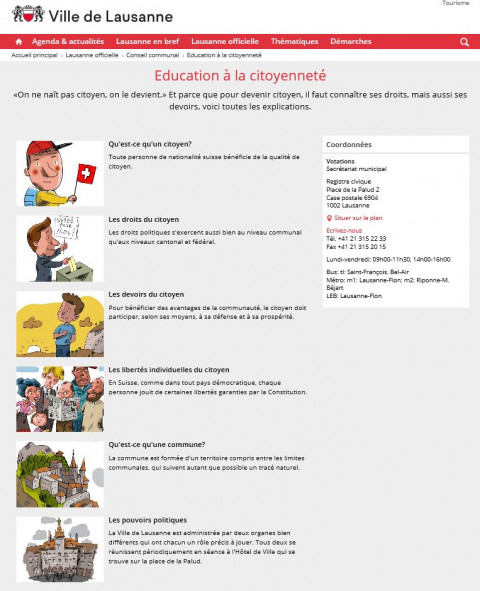 Éducation à la citoyenneté 단체 저자: Ville de Lausanne «On ne naît pas citoyen, on le devient.» Et parce que pour devenir citoyen, il faut connaître ses droits, mais aussi ses devoirs, voici toutes les explications.
 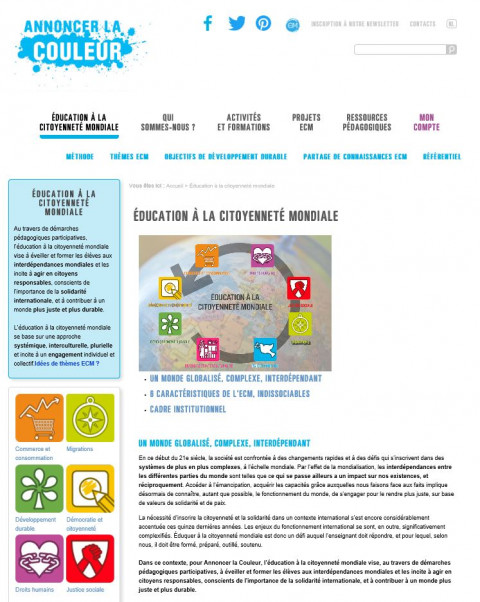 Éducation à la citoyenneté mondiale 단체 저자: Annoncer la Couleur (ALC) En ce début du 21e siècle, la société est confrontée à des changements rapides et à des défis qui s'inscrivent dans des systèmes de plus en plus complexes, à l'échelle mondiale. Par l’effet de la mondialisation, les interdépendances entre les différentes parties du monde sont telles que ce qui se passe ailleurs a un impact sur nos existences, et réciproquement. Accéder à l’émancipation, acquérir les capacités grâce auxquelles nous faisons face aux faits implique désormais de connaître, autant que possible, le fonctionnement du monde, de s'engager pour le rendre plus juste, sur base de valeurs de solidarité et de paix.La nécessité d’inscrire la citoyenneté et la solidarité dans un contexte international s’est encore considérablement accentuée ces quinze dernières années. Les enjeux du fonctionnement international se sont, en outre, significativement complexifiés. Éduquer à la citoyenneté mondiale est donc un défi auquel l’enseignant doit répondre, et pour lequel, selon nous, il doit être formé, préparé, outillé, soutenu.Dans ce contexte, pour Annoncer la Couleur, l’éducation à la citoyenneté mondiale vise, au travers de démarches pédagogiques participatives, à éveiller et former les élèves aux interdépendances mondiales et les incite à agir en citoyens responsables, conscients de l'importance de la solidarité internationale, et à contribuer à un monde plus juste et plus durable.