
자료
세계시민교육에 대한 이해를 넓히고 연구, 옹호 활동, 교수, 학습 등을 향상시킬 수 있는 다양하고 유용한 자료를 찾아보세요.
875 건의 결과가 검색되었습니다
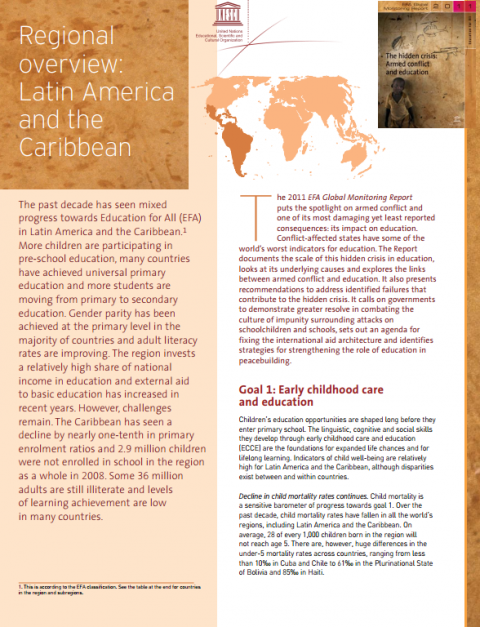 Regional overview: Latin America and the Caribbean 발행 연도: 2011 단체 저자: UNESCO The past decade has seen mixed progress towards Education for All (EFA) in Latin America and the Caribbean. More children are participating in pre-school education, many countries have achieved universal primary education and more students are moving from primary to secondary education. Gender parity has been achieved at the primary level in the majority of countries and adult literacy rates are improving. The region invests a relatively high share of national income in education and external aid to basic education has increased in recent years. However, challenges remain. The Caribbean has seen a decline by nearly one-tenth in primary enrolment ratios and 2.9 million children were not enrolled in school in the region as a whole in 2008. Some 36 million adults are still illiterate and levels of learning achievement are low in many countries. The 2011 EFA Global Monitoring Report puts the spotlight on armed conflict and one of its most damaging yet least reported consequences: its impact on education. Conflict-affected states have some of the world’s worst indicators for education. The Report documents the scale of this hidden crisis in education, looks at its underlying causes and explores the links between armed conflict and education. It also presents recommendations to address identified failures that contribute to the hidden crisis. It calls on governments to demonstrate greater resolve in combating the culture of impunity surrounding attacks on schoolchildren and schools, sets out an agenda for fixing the international aid architecture and identifies strategies for strengthening the role of education in peacebuilding. Aperçu régional: Amérique latine et les Caraïbes 발행 연도: 2011 단체 저자: UNESCO La dernière décennie a vu des progrès mitigés vers l'Education Pour Tous (EPT) en Amérique latine et dans les Caraïbes. Plus d'enfants participent à l'éducation préscolaire, de nombreux pays ont réalisé l'enseignement primaire universel et plus d'étudiants sont en mouvement du primaire au secondaire. La parité des sexes a été atteint au niveau primaire dans la majorité des pays et les taux d'alphabétisation des adultes sont l'amélioration. La région investit une part relativement élevée du revenu national dans l'éducation et l'aide extérieure à l'éducation de base a augmenté ces dernières années. Cependant, les défis demeurent. Les Caraïbes ont connu une baisse de près d'un dixième des taux de scolarisation primaire et 2,9 millions d'enfants ne sont pas inscrits à l'école dans la région dans son ensemble en 2008. Quelque 36 millions d'adultes sont encore analphabètes et les niveaux de résultats de l'apprentissage sont faibles dans de nombreux pays . Rapport Mondial de Suivi sur L'EPT 2011 met l'aCECnt sur les conflits armés et l'un de ses plus dommageables conséquences encore moins signalés: son impact sur l'éducation. États touchés par un conflit ont certains des pires indicateurs au monde pour l'éducation. Le rapport documente l'ampleur de cette crise cachée de l'éducation, se penche sur ses causes sous-jacentes et explore les liens entre les conflits armés et l'éducation. Il présente également des recommandations aux échecs d'adresses identifiées qui contribuent à la crise cachée. Il appelle les gouvernements à démontrer une plus grande détermination dans la lutte contre la culture de l'impunité des attaques contre des écoliers et des écoles environnantes, établit un ordre du jour pour la fixation de l'architecture de l'aide internationale et identifie des stratégies pour renforcer le rôle de l'éducation dans la paix.
  Educación para Todos (EPT) en América Latina y el Caribe: Balance y Desafíos post-2015, 30-31 de Octubre del 2014, Lima, Perú: Declaración de Lima 발행 연도: 2014 단체 저자: Organización de las Naciones Unidas para la Educación, la Ciencia y la Cultura (UNESCO) The Ministers of Education of Latin America and the Carribean (LAC), high-level government officials, UN agencies, representatives of civil society organizations and development partners, gathered at th meeting on "Education for All (EFA) in Latin America and the Carribean: Assessment of progress and post-2015 challenges", in Lima, Peru, from 30 to 31 October 2014. Having deliberated on progress towards EFA in the region, the Muscat Agreement adopted at the Global EFA Meeting (GEM) in Muscat, Oman, 12-14 May 2014, and the outcome document of the UN General Assembly Open Working Group for Sustainable Development Goals, and having examined the unfinished EFA tasks in the region, as well as the challenges and priorities that will configure the post-2015 education agenda for the region, the Lima Statement was adopted. L'Education pour tous (EPT) en Amérique latine et dans les Caraïbes: Évaluation des Progrès et Enjeux de l'après-2015, 30-31 Octobre 2014, Lima, Pérou: Déclaration de Lima 발행 연도: 2014 단체 저자: Organisation des Nations Unies pour l'éducation, la science et la culture (UNESCO) The Ministers of Education of Latin America and the Carribean (LAC), high-level government officials, UN agencies, representatives of civil society organizations and development partners, gathered at th meeting on "Education for All (EFA) in Latin America and the Carribean: Assessment of progress and post-2015 challenges", in Lima, Peru, from 30 to 31 October 2014. Having deliberated on progress towards EFA in the region, the Muscat Agreement adopted at the Global EFA Meeting (GEM) in Muscat, Oman, 12-14 May 2014, and the outcome document of the UN General Assembly Open Working Group for Sustainable Development Goals, and having examined the unfinished EFA tasks in the region, as well as the challenges and priorities that will configure the post-2015 education agenda for the region, the Lima Statement was adopted. Education for All (EFA) in Latin America and the Caribbean: Assessment of Progress and Post-2015 Challenges, 30-31 October 2014, Lima, Peru: Lima Statement 발행 연도: 2014 단체 저자: UNESCO The Ministers of Education of Latin America and the Carribean (LAC), high-level government officials, UN agencies, representatives of civil society organizations and development partners, gathered at th meeting on "Education for All (EFA) in Latin America and the Carribean: Assessment of progress and post-2015 challenges", in Lima, Peru, from 30 to 31 October 2014. Having deliberated on progress towards EFA in the region, the Muscat Agreement adopted at the Global EFA Meeting (GEM) in Muscat, Oman, 12-14 May 2014, and the outcome document of the UN General Assembly Open Working Group for Sustainable Development Goals, and having examined the unfinished EFA tasks in the region, as well as the challenges and priorities that will configure the post-2015 education agenda for the region, the Lima Statement was adopted. Education for All (EFA) in Latin America and the Caribbean: Assessment of Progress and Post-2015 Challenges, 30-31 October 2014, Lima, Peru: Lima Statement 발행 연도: 2014 단체 저자: Organisation des Nations Unies pour l'éducation, la science et la culture (UNESCO) Les ministres de l'éducation de l'Amérique latine et les Caraïbes (ALC), les responsables gouvernementaux de haut niveau, les organismes de l’ONU, des représentants d'organisations de la société civile et les partenaires au développement, réunis à e réunion sur "l'Éducation Pour Tous (EPT) en Amérique latine et les Caraïbes : évaluation des progrès et des défis de l'après-2015 ", à Lima, Pérou, du 30 au 31 Octobre 2014. après en avoir délibéré sur les progrès vers l'EPT dans la région, l'accord Muscat adopté lors de la Réunion Mondiale sur l'EPT (RME) à Muscat, Oman, 12-14 mai 2014, et le document final du Groupe de travail à composition Assemblée générale de l'ONU pour les objectifs de développement durable, et après avoir examiné les tâches inachevées de l'EPT dans la région, ainsi que les défis et les priorités qui configureront l'ordre du jour de l'éducation post-2015 pour la région, la Déclaration de Lima a été adopté. Recorridos nacionales rumbo a la educación para el desarrollo sostenible, 2011: análisis de las experiencias de los países Chile, Indonesia, Kenya, Omán, Países Bajos 발행 연도: 2011 저자: I. Mulà | Daniella Tilbury 단체 저자: UNESCO This publication has sourced information from a series of national reviews commissioned by UNESCO in 2010 and written by authoritative stakeholders in Chile, Indonesia, Kenya, the Netherlands and Oman. The selection of countries was based on: i) work showcased at the 2009 World Conference on Education for Sustainable Development held in Bonn, Germany; ii) submissions to the monitoring and evaluation process for the Decade of Education for Sustainable Development (DESD); as well as iii) through evaluation material submitted by UNESCO staff in regional bureaux of education. The countries showcased in this report are not necessarily the ‘best’ examples of the region, as many other countries are also progressing effectively towards implementing ESD. Rather, the countries selected illustrate the wide diversity of ESD approaches and initiatives taking place in different parts of the learnt world. The national studies were then edited and harmonized before common themes and lessons learned were identified to support other national efforts in moving towards the second half of the UN Decade of Education for Sustainable Development. Des pays en marche vers l'éducation pour le développement durable, 2011: examen des expériences nationales; Chili, Indonésie, Kenya, Oman, Pays-Bas 발행 연도: 2011 저자: I. Mulà | Daniella Tilbury 단체 저자: UNESCO This publication has sourced information from a series of national reviews commissioned by UNESCO in 2010 and written by authoritative stakeholders in Chile, Indonesia, Kenya, the Netherlands and Oman. The selection of countries was based on: i) work showcased at the 2009 World Conference on Education for Sustainable Development held in Bonn, Germany; ii) submissions to the monitoring and evaluation process for the Decade of Education for Sustainable Development (DESD); as well as iii) through evaluation material submitted by UNESCO staff in regional bureaux of education. The countries showcased in this report are not necessarily the ‘best’ examples of the region, as many other countries are also progressing effectively towards implementing ESD. Rather, the countries selected illustrate the wide diversity of ESD approaches and initiatives taking place in different parts of the learnt world. The national studies were then edited and harmonized before common themes and lessons learned were identified to support other national efforts in moving towards the second half of the UN Decade of Education for Sustainable Development.
  [Summary] Re|shaping Cultural Policies: Advancing Creativity for Development; 2005 Convention Global Report, 2018: Summary 발행 연도: 2017 단체 저자: UNESCO The Global Report series has been designed to monitor the implementation of the UNESCO Convention on the Protection and Promotion of the Diversity of Cultural Expressions (2005). It also provides evidence of how this implementation process contributes to attaining the United Nations 2030 Sustainable Development Goals and targets.The 2018 Global Report analyses progress achieved in implementing the 2005 Convention since the first Global Report was published in 2015.Grounded in the analysis of the Quadrennial Periodic Reports submitted by Parties to the Convention and relevant new findings, this report examines how the 2005 Convention has inspired policy change at the global and country level in ten areas of monitoring. It puts forward a set of policy recommendations for the future, addressing the adaptation of cultural policies to rapid change in the digital environment, based on human rights and fundamental freedoms.When deployed together, the two editions of the Global Report are beginning to produce new and valuable evidence to inform cultural policy making and advance creativity for development. [Résumé] Re|penser les politiques culturelles: la créativité au coeur du développement, Rapport mondial Convention 2005, 2018: résumé 발행 연도: 2017 단체 저자: UNESCO Le Rapport mondial 2018 analyse les progrès accomplis dans la mise en oeuvre de la Convention de 2005 depuis la publication du premier Rapport mondial en 2015.A partir des rapports périodiques quadriennaux soumis par les Parties à la Convention et de nouvelles analyses, ce Rapport examine comment la Convention de 2005 a inspiré des changements politiques aux niveaux mondial et national dans dix domaines clés de l’action politique. Il propose un ensemble de recommandations politiques pour le futur et met l’accent sur l’adaptation des politiques culturelles, fondées sur les droits de l’homme et les libertés fondamentales, afin de faire face aux transformations rapides suscitées par l’environnement numérique.Prises ensemble, les deux éditions du Rapport mondial offrent un ensemble de données et d’informations nouvelles et précieuses qui permettent d’éclairer l’élaboration des politiques culturelles et de placer la créativité au coeur du développement.