
자료
세계시민교육에 대한 이해를 넓히고 연구, 옹호 활동, 교수, 학습 등을 향상시킬 수 있는 다양하고 유용한 자료를 찾아보세요.
2,781 건의 결과가 검색되었습니다
 Corto de animación sobre bullying: No juegues conmigo 발행 연도: 2018 단체 저자: Sociescuela Esta animación presenta una situación de bullying en un colegio, de manera clara y en un lenguaje accesible. Incluye características para entender el fenómeno y saber cómo actuar para detenerlo, desde una perspectiva de terceros.
  Child and Youth Participation – Options for Action: Child Friendly Cities Initiative 발행 연도: 2019 저자: Gerison Lansdown 단체 저자: United Nations Children's Fund (UNICEF) This report summarises practical experiences and recommendations for the development of child-friendly cities, which aimed at enabling children to become active citizens through participation. 促进儿童和青年参与——备选行动方案:儿童友好型城市倡议 발행 연도: 2019 저자: Gerison Lansdown 단체 저자: United Nations Children's Fund (UNICEF) 本报告总结了儿童友好型城市发展的实践经验并提出相关建议,致力于促使儿童通过参与行使其积极公民权。
  Promoting the Development and Implementation of the Putting Children First (PCF) Principle in China Advocacy Note 발행 연도: 2020 단체 저자: UNICEF China This report summarises UNICEF's policy recommendations for promoting the well-being of children in China and the implementation of the Children First principle, including the pathway for macro policy development in China, the challenges faced, and related policy recommendations. 推动中国贯彻和实施 “儿童优先”原则倡导建议书 발행 연도: 2020 단체 저자: UNICEF China 本报告总结了联合国儿基会关于推动中国儿童福祉发展和落实“儿童优先“原则的相关政策建议,包括中国宏观政策的发展路径,所面临的挑战,以及相关的政策建议。
  Educational Function of Museum in American: A Overall History (Modern Education Review; no. 5) 발행 연도: 2021 저자: Jinyuan Tian The article reviews the history of museum-school partnerships in the US, looks at the evolution of their educational function and the changing role of government, and makes recommendations for the educational function of museums. 美国博物馆教育功能的演变 (现代教育论丛; no.5) 발행 연도: 2021 저자: Jinyuan Tian 该文回顾了美国博物馆与学校合作的发展历史,关注其教育功能的演变以及政府角色的变化,并对博物馆教育的教育功能提出建议。
 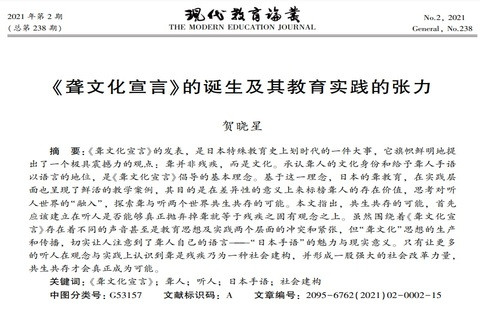 The Birth of “Manifesto of the Deaf Community” and its Tension for Educational Practice (Modern Education Review; no. 2) 발행 연도: 2021 저자: Xiaoxing He This article introduces the content and publication of Japan's “Manifesto of the Deaf Community", reflects on social structures and culture, and explores the educational implications of the Manifesto. 《聋文化宣言》的诞生及其教育实践的张力 (现代教育论丛; no. 2) 발행 연도: 2021 저자: Xiaoxing He 该文介绍了日本的《聋文化宣言》的内容与发表情况,反思社会结构与文化,并探索该《宣言》的教育意义。
 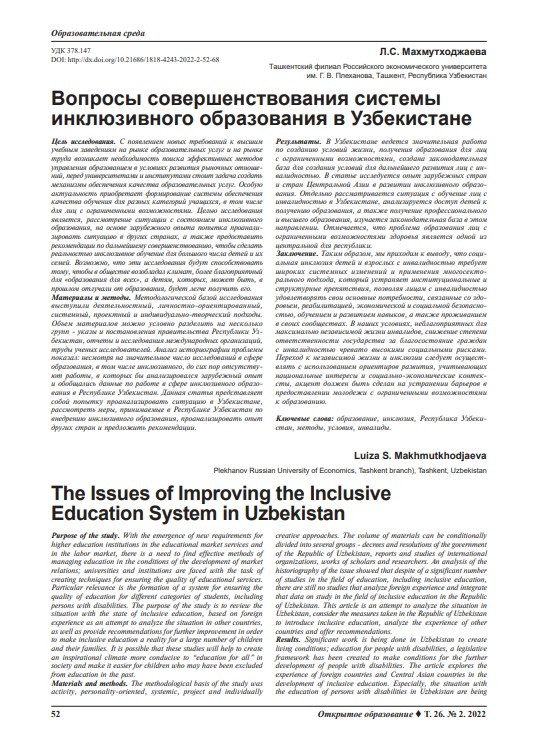 The Issues of Improving the Inclusive Education System in Uzbekistan (Open Education; vol. 26, no. 2) 발행 연도: 2022 저자: Makhmutkhodjaeva L.S. The article explores the experience of foreign and Central Asian countries in developing inclusive education. Especially, the situation with the education of persons with disabilities in Uzbekistan is being reviewed, besides, the access of children to get an education, as well as receiving vocational and higher education is being studied in addition to the legislative framework in this specialty. It is noted that the problem of education for disabled people is one of the central issues for the republic.