
자료
세계시민교육에 대한 이해를 넓히고 연구, 옹호 활동, 교수, 학습 등을 향상시킬 수 있는 다양하고 유용한 자료를 찾아보세요.
518 건의 결과가 검색되었습니다
 Education à la culture de la paix, aux droits humains, à la citoyenneté, à la démocratie et à l'intégration régionale: manuel de référence de la CEDEAO, à l'usage de la formatrice/du formateur de formateurs/formatrices 발행 연도: 2013 단체 저자: UNESCO Dakar | Economic Community of West African States (ECOWAS) The manual comprises seven modules dealing with the Culture of Peace and Conflict Management; Human Rights; Civism and Citizenship; Democracy and Good Governance; Gender and Development; Public Health, Environment and Sustainable Development; and Regional Integration. Each module has sub-themes with introductions, reference materials, general objectives to guide the trainer and generic pedagogical tables that are flexible enough to be adapted to available teaching resources in the different ECOWAS countries. It is also suitable and adaptable to the training of teachers involved in both formal and non-formal education delivery at different levels of teaching and learning. The ultimate goal of the Manual is to build a critical mass of ECOWAS citizens equipped with competent skills, not only for cognitive and psycho-motor domains of education, but also affective skills for positive values, attitudes and behaviors that promote peace, tolerance and peaceful co-existence of community citizens. Forum panafricain: sources et ressources pour une culture de la Paix 발행 연도: 2013 단체 저자: African Union The Pan-African Forum “ Sources and resources for a culture of peace” was held in Luanda, Angola, from 26 to 28 March 2013, and was jointly organized by UNESCO, the African Union and the Government of Angola, under the High Patronage of H. E. Mr José Eduardo dos Santos, President of the Republic of Angola. This forum was the result of a close cooperation between UNESCO and the African Union, one of their main objectives being building peace in Africa, through the promotion of a culture of peace based on the intrinsic values of African societies. The Republic of Angola Government, through its President of the Republic H. E. Mr José Eduardo dos Santos, resolutely engaged in this process with major financial and technical support for the organization of the Forum in the Angolan capital city. As indicated in the Action Plan adopted by the participants in plenary (Annex I), recommendations made during the Forum are directed at all components of African society : political leaders, national and regional institutions, civil society, community associations, youth movements and women’s organizations, religious and traditional leaders, entrepreneurs and leaders from the private sector, etc. The implementation of the Action Plan will be continuously monitored by the two institutions that jointly organized the Luanda Forum, the African Union and UNESCO. Representatives from the 55 African countries participating in the Forum will both contribute to the proposal for action by bringing their national experience and take the lead in the follow‐up of the recommendations made at country level. In order to ensure this follow‐up it will be important to link together the participants by the creation of an African Network for the Promotion of a Culture of Peace and Non‐violence. The representatives of African countries will play the role of focal points of the awareness campaign at the national level. Finally, the agenda of the Forum includes a plan to hold a roundtable on the establishment of a multi-stakeholder partnership for action. Organized with the participation of regional institutions, public and private economic actors as well as representatives of Governments and Civil Society, this session will be the occasion to launch a continental and lasting Movement for the promotion of a culture of peace. For this round table and for the Campaign, the stakeholders can now witness the action as their Foundation / Company / Institution / Organization leads to help in building the defence of peace in the minds of men and women and ensure that peace is a reality: "Make Peace Happen".
 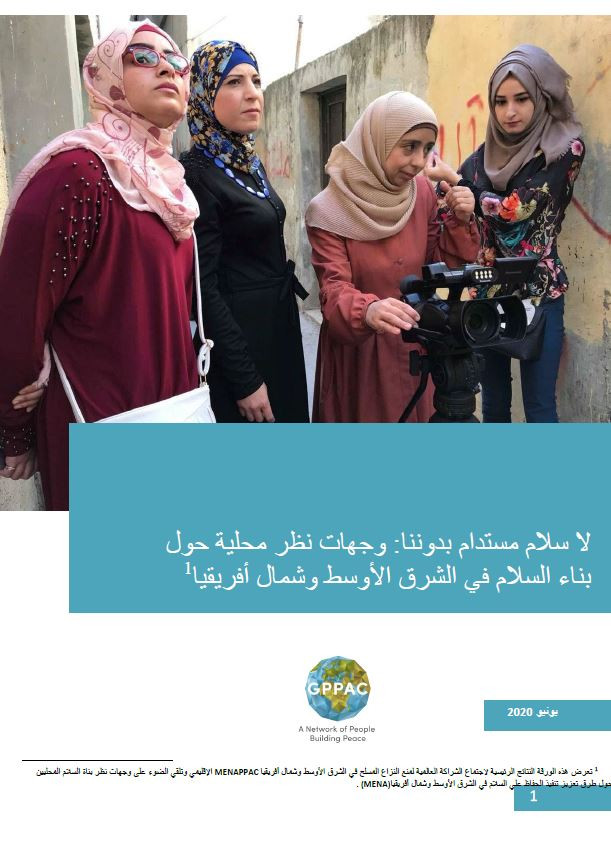 No Sustainable Peace Without Us: Local Perspectives on Peacebuilding in the Middle East and North Africa 발행 연도: 2020 단체 저자: Global Partnership for the Prevention of Armed Conflict (GPPAC) This paper presents the main outcomes of the Global Partnership for the Prevention of Armed Conflict in the Middle East and North Africa meeting. The paper sheds light on the perspectives of local peacebuilders on ways to promote peacekeeping in the Middle East and North Africa region. لا سلام مستدام بدوننا: وجهات نظر محلية حول بناء السلام في الشرق الأوسط وشمال أفريقيا 발행 연도: 2020 단체 저자: Global Partnership for the Prevention of Armed Conflict (GPPAC) تعرض هذه الورقة النتائج الرئيسية لاجتماع الشراكة العالمية لمنع النزاع المسلح في الشرق الأوسط وشمال أفريقيا. وتلقي الورقة الضوء على وجهات نظر بناة السلام المحليين حول طرق تعزيز الحفاظ على السلام في منطقة الشرق الأوسط وشمال أفريقيا. Fórum Panafricano: fundamentos e recursos para uma cultura de paz 발행 연도: 2013 단체 저자: African Union The Pan-African Forum “ Sources and resources for a culture of peace” was held in Luanda, Angola, from 26 to 28 March 2013, and was jointly organized by UNESCO, the African Union and the Government of Angola, under the High Patronage of H. E. Mr José Eduardo dos Santos, President of the Republic of Angola. This forum was the result of a close cooperation between UNESCO and the African Union, one of their main objectives being building peace in Africa, through the promotion of a culture of peace based on the intrinsic values of African societies. The Republic of Angola Government, through its President of the Republic H. E. Mr José Eduardo dos Santos, resolutely engaged in this process with major financial and technical support for the organization of the Forum in the Angolan capital city. As indicated in the Action Plan adopted by the participants in plenary (Annex I), recommendations made during the Forum are directed at all components of African society : political leaders, national and regional institutions, civil society, community associations, youth movements and women’s organizations, religious and traditional leaders, entrepreneurs and leaders from the private sector, etc. The implementation of the Action Plan will be continuously monitored by the two institutions that jointly organized the Luanda Forum, the African Union and UNESCO. Representatives from the 55 African countries participating in the Forum will both contribute to the proposal for action by bringing their national experience and take the lead in the follow‐up of the recommendations made at country level. In order to ensure this follow‐up it will be important to link together the participants by the creation of an African Network for the Promotion of a Culture of Peace and Non‐violence. The representatives of African countries will play the role of focal points of the awareness campaign at the national level. Finally, the agenda of the Forum includes a plan to hold a roundtable on the establishment of a multi-stakeholder partnership for action. Organized with the participation of regional institutions, public and private economic actors as well as representatives of Governments and Civil Society, this session will be the occasion to launch a continental and lasting Movement for the promotion of a culture of peace. For this round table and for the Campaign, the stakeholders can now witness the action as their Foundation / Company / Institution / Organization leads to help in building the defence of peace in the minds of men and women and ensure that peace is a reality: "Make Peace Happen".
 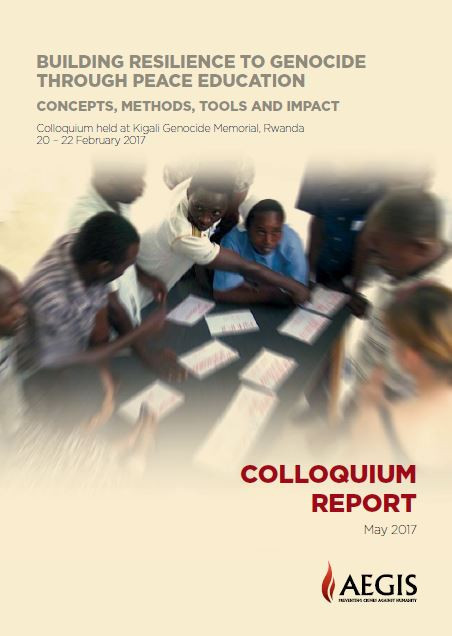 Colloquium Report: Building Resilience to Genocide through Peace Education: Concepts, Methods, Tools and Impact 발행 연도: 2017 저자: Jonathan Bower, Mariana Goetz 단체 저자: Aegis Trust A three-day Colloquium in Kigali in February brought together academics and practitioners in and around the field of peace education to share concepts, methods and means of measuring impact, contributing to a stronger evidence base for the effectiveness of peace education. Three interesting takeaways from the Colloquium: 1. Building resilience against genocide requires critical thinking about the process of identity-based violence and its reversal.2. The content of peace education programmes matters: interactive role-play type activities have been shown to have a longer lasting impact.3. Unhealed wounds need to be addressed to prevent a repeat of violence; psychosocial support must accompany peace education to reduce anxiety, which can be an obstacle when accessing empathy. A major achievement resulting from the consortium’s advocacy has been that the Government of Rwanda through the Ministry of Education has integrated Peace and Values education into the school curriculum. In a new phase of work Aegis is now supporting the implementation of the revised national curriculum that has integrated peace and values education (2016-19).
 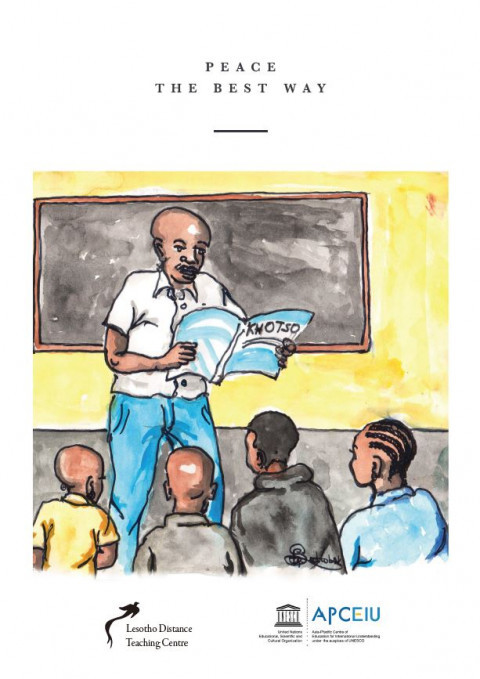 Peace the Best Way 발행 연도: 2017 단체 저자: Lesotho Distance Teaching Centre (LDTC) The storybook titled “Peace, the Best Way (Ngoan’a Khotso Ha a Lebale Tsa Khotso)” is an end-product of Workshop in Lesotho on GCED: Teacher Training on Peace Education & GCED Learning Material Development held between 12 and 14 of July 2017. During the workshop, participants created learning materials on peace and conflict transformation based on what they have learned throughout the sessions.The authors share their stories of conflicts that they encounter in their everyday lives and further identify ways of managing and resolving the conflicts in a peaceful manner to let everyone live in harmony. They hope to instill the importance of peace not only to the adults reading the book, but also to the younger generation who learn from their parents and adults of the community.The book published in English as well as Sesotho, will be used as teaching and learning resources for learners and also be disseminated to public locations including schools, community centers and libraries.For more information on the Workshop, Please click here.
  Protection of Victims of Sexual Violence in Côte d'Ivoire: Progress Made, but Many Gaps Remain (FIDH; no. 818f) 발행 연도: 2023 저자: Alice Mogwe | Eléonore Morel 단체 저자: International Federation for Human Rights (FIDH) The International Federation for Human Rights (FIDH) has published a follow-up report on sexual violence protection measures in Côte d'Ivoire, in association with several other local associations. The aim of this note is to study these new measures in the light of the recommendations in the FIDH report, in order to gain an overall view of the situation, draw up an initial assessment of the progress made, and highlight the points to be strengthened in order to improve the status of women in the country. Protection des victimes de violences sexuelles en Côte d’Ivoire : des avancées mais encore de nombreuses lacunes (FIDH; n° 818f) 발행 연도: 2023 저자: Alice Mogwe | Eléonore Morel 단체 저자: International Federation for Human Rights (FIDH) La Fédération internationale pour les droits humains (FIDH) publie une note de suivi des dispositifs de protection des violences sexuelles en Côte d’Ivoire avec plusieurs autres associations locales associées. Cette note vise à étudier ces nouveaux dispositifs à l’aune des recommandations du rapport de la FIDH afin d’avoir une vision globale de la situation, de dresser un premier bilan des avancées réalisées et de souligner les points à renforcer pour améliorer la condition des femmes dans le pays.
  How Are Vocational Institutions Innovating, Evolving and Changing as a Result of COVID-19?: A Study of Practice and Perspectives in Five Countries 발행 연도: 2021 단체 저자: British Council As an international problem, Covid-19 requires international cooperation. The social, economic and educational recovery from the pandemic can be enhanced by knowledge transfer and exchange. This research brought together 15 technical and vocational education and training (TVET) institutions from the five countries in the British Council’s I-WORK Programme (Improving Work Opportunities - Relaying Knowledge) to explore innovation, evolution and change stemming from the pandemic. TVET practitioners and leaders from Ghana, India, Malaysia, South Africa and the UK were asked to reflect on five key questions: How are institutional policy and structures likely to change to reflect the changing situation? Is this different for private institutions? What changes are proposed to the curriculum/ occupational areas to reflect the rapidly changing demand and how are they identifying this demand? How will learners get the practical and work-based experience they need and what changes to work- based learning and apprenticeships are needed? What changes are needed to the skills and type of staff in the teaching institution? How can new delivery models and ways of working promote more inclusive practice? The research took place as institutions approached almost a year of adapting their teaching, learning and support to localised lockdowns and the restrictions of the pandemic. The national policy context may have been different in each country, but the research findings pointed to a single conclusion: that across the board, the move to digital learning and teaching had brought benefits, opportunities and challenges that might not otherwise have been realised.