
자료
세계시민교육에 대한 이해를 넓히고 연구, 옹호 활동, 교수, 학습 등을 향상시킬 수 있는 다양하고 유용한 자료를 찾아보세요.
3,790 건의 결과가 검색되었습니다
 Unlocking the Transformative Potential of Education: The Alliance Between Lifelong Learning and SDG Target 4.7 발행 연도: 2021 저자: Chris Millora 단체 저자: Bridge 47 This paper has found that Lifelong learning as a spectrum of formal, informal and non-formal learning, offers a framework to embrace different forms of learning people gain in various spaces across their lifespan. While several lifelong learning policies emphasise economic benefits, evidence shows that lifelong learning also facilitates active citizenship, tolerance to diversity, empathy, learning to live together, leadership, intergenerational learning, and awareness of social injustices. This paper demonstrated the impact of ALE provisions that bring to centre stage the needs of adults – particularly women – in resource-poor contexts. These programmes recognise the ‘funds of knowledge’ and ‘banks of skills’ already existing in these communities – challenging the deficit discourse that is dominant particularly in development circles even today.Based on these findings, this paper puts forward seven interrelated policy recommendations: (1) acknowledgement, within SDG 4.7 policies, that learning occurs in all life stages, forms and spaces; (2) prioritisation of lifelong learning and transformative approaches to education into local, national, regional and global level policies, including provisions of funding; (3) a focus on the transformative competencies and outcomes of lifelong learning; (4) positioning lifelong learning as a cross- cutting (rather than separate) approach to achieving the SDGs; (5) increased attention to recognising, validating and accrediting (RVA) non-formal and informal learning; (6) involving marginalised groups as stakeholders that can shape policy and not only recipients; (7) increased government support and financing to adult educators and literacy facilitators.
  Transformative Competencies: How to Define and Implement Competencies for SDG Target 4.7 발행 연도: 2021 저자: Johanna Helin 단체 저자: Bridge 47 This paper was commissioned to support advocacy for SDG Target 4.7 in European and global policies by exploring the concept of ‘Competencies for SDG Target 4.7’. This advocacy paper draws from a desk review of existing global and regional competency frameworks at national, regional and global levels. The aim is to get a clearer understanding of these transformative competencies and how they help the implementation and assessment of Target 4.7.This paper is divided in three sections. The first section provides background to the different world views that frame the discussion on competencies, before turning to presenting some of the competency frameworks for Target 4.7. The second section gives some examples of how these competencies are being introduced into national education policies, professional skills training and lifelong learning. The paper finishes with conclusions and policy recommendations.
  Indicators: The Need and Challenges of Tracking Implementation of Target 4.7 발행 연도: 2021 저자: Johanna Helin 단체 저자: Bridge 47 This paper investigates the existing and proposed indicators and monitoring frame- works for 4.7. Examining efforts at national, regional, and global levels will identify the main challenges in measurement initiatives. The paper will start by looking at the context of SDGs and the special character of Target 4.7. Thereafter, it will discuss the process and limitations of defining the indicators at the global level. It will also review regional developments, tools, and ideas for national and local level assessment frameworks in Asia-Pacific and Europe. The paper ends with conclusions and policy recommendations.
  Resources: For SDG Target 4.7 발행 연도: 2021 저자: Sandra Oliveira 단체 저자: Bridge 47 This paper is part of a series of publications commissioned to support advocacy for more space for SDG Target 4.7 of Agenda 2030 in European and global policies. In November 2019, Bridge 47 organised an event called Envision 4.7, which brought together civil society organisations, national governments, MEPs, European and global organisations, and together wrote a Roadmap for SDG Target 4.7 for Europe.Focusing on the key themes of this Envision 4.7 Roadmap and drawing on the Envision 4.7. policy papers as key references, this paper focuses on providing a global overview and identification of the types of resources re- quired to achieve this target.\
 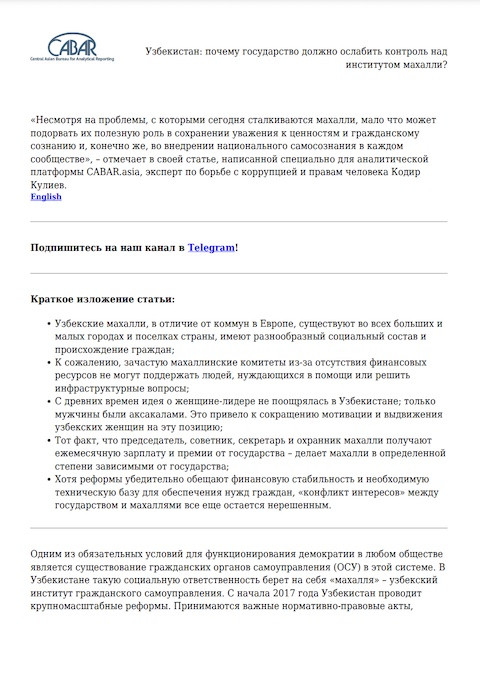 Uzbekistan: Why Should the State Weaken Control Over the Institute of Makhalla? 발행 연도: 2019 저자: Kodir Kuliev 단체 저자: Central Asian Bureau for Analytical Reporting (CABAR) | Institute for War and Peace Reporting (IWPR) One of the vital conditions for the functioning of democracy in any society is the existence of citizens’ self-governing bodies (CSB) within that system. In Uzbekistan, such social responsibility is assumed by “mahalla” – the Uzbek citizens’ self-governing institution. Since the beginning of 2017 Uzbekistan has been carrying out large-scale reforms. Important laws and regulations are being adopted, which should create favorable conditions for quality life and ensure freedom for the Uzbek people. With mahallas, however, such positive change in the long-run seems to be just a lip-service. The main challenges mahallas are facing today are, inter alia, obscured freedom they have in ruling themselves and controlling their own affairs and incapability to effectively tackle citizens’ problems, thus leaving people’s trust unjustified. Узбекистан: Почему государство должно ослабить контроль над институтом махалли? 발행 연도: 2019 저자: Kodir Kuliev 단체 저자: Central Asian Bureau for Analytical Reporting (CABAR) | Institute for War and Peace Reporting (IWPR) Одним из обязательных условий для функционирования демократии в любом обществе является существование гражданских органов самоуправления (ОСУ) в этой системе. В Узбекистане такую социальную ответственность берет на себя «махалля» – узбекский институт гражданского самоуправления. С начала 2017 года Узбекистан проводит крупномасштабные реформы. Принимаются важные нормативно-правовые акты, которые должны создать благоприятные условия для качественной жизни и обеспечить свободу узбекскому народу. Однако с махаллей такое положительное изменение в долгосрочной перспективе кажется неоднозначным. Основные проблемы, с которыми сегодня сталкиваются махалли – это ограниченная свобода и контроль собственных дел и неспособноть эффективно решать проблемы граждан, что не оправдывает доверия людей.
  Youth Activist Toolkit: A Digital Guide 발행 연도: 2021 단체 저자: Scotdec | European Union (EU) This toolkit is designed to empower young people to campaign for positive change around local and global issues and to use the learning to form social media actions for change.
 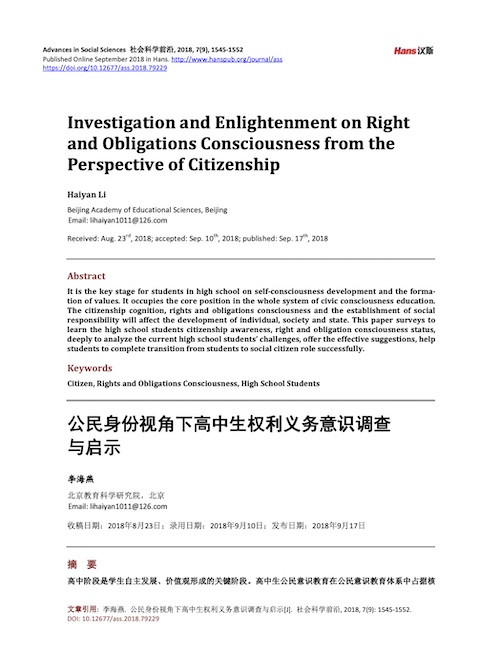 公民身份视角下高中生权利义务意识调查与启示 (社会科学前沿; vol. 7, no. 9) 발행 연도: 2018 저자: Li Haiyan 高中阶段是学生自主发展、价值观形成的关键阶段。高中生公民意识教育在公民意识教育体系中占据核心地位。当代高中生对公民身份的认识、权利意识的知觉及社会责任感的建立会影响到国家、社会和个 人发展。本文采取问卷调查的形式,了解高中生公民身份认知、权利义务意识现状,深入分析当前高中 生存在的问题和面临的挑战,提出高中阶段加强公民教育的对策,实现高中生顺利完成由学生到社会公 民角色的过渡。
 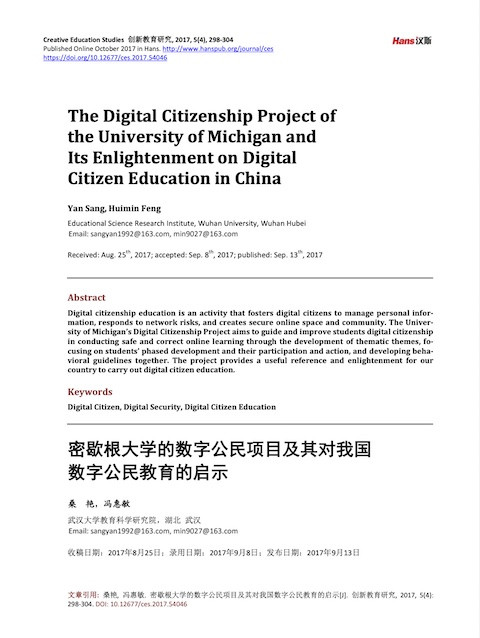 The Digital Citizenship Project of the University of Michigan and Its Enlightenment on Digital Citizen Education in China (Creative Education Studies; vol. 5, no. 4) 발행 연도: 2017 저자: Yan Sang | Huimin Feng Digital citizenship education is an activity that fosters digital citizens to manage personal infor- mation, responds to network risks, and creates secure online space and community. The Univer- sity of Michigan’s Digital Citizenship Project aims to guide and improve students digital citizenship in conducting safe and correct online learning through the development of thematic themes, fo- cusing on students’ phased development and their participation and action, and developing beha- vioral guidelines together. The project provides a useful reference and enlightenment for our country to carry out digital citizen education. 密歇根大学的数字公民项目及其对我国数字公民教育的启示 (创新教育研究; vol. 5. no. 4) 발행 연도: 2017 저자: Yan Sang | Huimin Feng 数字公民教育是培养数字公民管理个人信息、应对网络风险、打造安全的在线空间和社区的活动。密歇 根大学的数字公民项目,通过制定特色主题、关注学生的阶段性发展、注重学生参与和行动、共同制定 行为准则等活动,旨在引导学生进行安全的、正确的在线方式的学习,提高学生的数字公民素养。该项 目为我国开展数字公民教育提供了有益的借鉴和启示。