
자료
세계시민교육에 대한 이해를 넓히고 연구, 옹호 활동, 교수, 학습 등을 향상시킬 수 있는 다양하고 유용한 자료를 찾아보세요.
1,187 건의 결과가 검색되었습니다
 Document final de la Consultation technique sur l'éducation à la citoyenneté mondiale: Education à la citoyenneté mondiale: une nouvelle vision 발행 연도: 2013 단체 저자: Organisation des Nations Unies pour l'éducation, la science et la culture (UNESCO) This document draws on inputs to, and common perspectives emerging from, a Technical Consultation on Global Citizenship Education organized by UNESCO and the Republic of Korea (i.e., the Ministries of Foreign Affairs and of Education, and the Asia-Pacific Centre of Education for International Understanding) in Seoul on 9-10 September 2013 . Informing this draft document are: a) responses from the expert participants to a questionnaire circulated by UNESCO in advance of the consultation; b) presentations from experts during the consultation; c) discussions during the consultation; and d) reference material contributing to, and prepared for, the consultation. The final draft of this document was prepared by UNESCO’s Division of Education for Peace and Sustainable Development at Headquarters in Paris, with the assistance of a drafting team.
 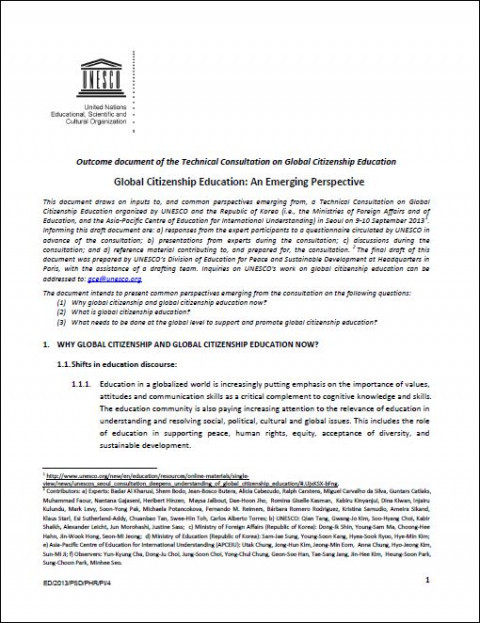 Outcome Document of the Technical Consultation on Global Citizenship Education: Global Citizenship Education: An Emerging Perspective 발행 연도: 2013 단체 저자: UNESCO This document draws on inputs to, and common perspectives emerging from, a Technical Consultation on Global Citizenship Education organized by UNESCO and the Republic of Korea (i.e., the Ministries of Foreign Affairs and of Education, and the Asia-Pacific Centre of Education for International Understanding) in Seoul on 9-10 September 2013 . Informing this draft document are: a) responses from the expert participants to a questionnaire circulated by UNESCO in advance of the consultation; b) presentations from experts during the consultation; c) discussions during the consultation; and d) reference material contributing to, and prepared for, the consultation. The final draft of this document was prepared by UNESCO’s Division of Education for Peace and Sustainable Development at Headquarters in Paris, with the assistance of a drafting team. Document final de la Consultation technique sur l’éducation à la citoyenneté mondiale: Éducation à la citoyenneté mondiale : Une nouvelle vision 발행 연도: 2013 단체 저자: Organisation des Nations Unies pour l'éducation, la science et la culture (UNESCO) Le présent document s’inspire des contributions et des perspectives communes issues d’une Consultation technique sur l’éducation à la citoyenneté mondiale organisée par l’UNESCO et la République de Corée (à savoir, par les ministères des Affaires étrangères et de l’Éducation et le Centre Asie-Pacifique d'éducation pour la compréhension internationale) à Séoul, les 9 et 10 septembre 20131. Ce projet de document s’appuie sur : (a) les réponses des experts participants à un questionnaire envoyé par l’UNESCO avant la consultation ; (b) les présentations des experts durant la consultation; (c) les débats qui ont eu lieu pendant la consultation ; et sur (d) les documents de référence préparés pour la consultation. Le projet final du présent document a été préparé par la Division de l'éducation pour la paix et le développement durable, au Siège de l’UNESCO, à Paris, avec le soutien d’une équipe de rédaction. Documento Final de la Consulta técnica Sobre Educación para la Ciudadanía Mundial - Educación para la Ciudadanía Mundial: una Perspectiva Emergente 발행 연도: 2013 단체 저자: Organización de las Naciones Unidas para la Educación, la Ciencia y la Cultura (UNESCO) En el presente documento se toman como base los aportes y las perspectivas comunes que surgen de la consulta técnica sobre la educación para la ciudadanía mundial, organizada por la UNESCO y la República de Corea (los Ministerios de Relaciones Exteriores y de Educación y el Centro de Asia y el Pacífico de Educación para el Entendimiento Internacional) en Seúl los días 9 y 10 de septiembre de 2013.A lo largo de la elaboración del borrador de este documento se utilizaron: a) las respuestas de expertos a un cuestionario circulado por la UNESCO previo a la consulta; b) las ponencias realizadas por los expertos durante la consulta; c) las discusiones que se efectuaron durante la consulta; y d) el material de referencia que respaldó y fue preparado para la consulta. El borrador final del presente documento fue preparado por la División de la Educación para la Paz y el Desarrollo Sostenible en la sede de la UNESCO en París, con la asistencia de un equipo de redacción. En este documento se presentan las perspectivas comunes que emanaron de la consulta.
  UNESCO and Education 발행 연도: 2017 단체 저자: UNESCO Education is a fundamental human right and
a public good and, as such, has been at the core of UNESCO’s work since its inception.Education is also the path to sustainability – to poverty alleviation, better health, environmental protection and gender equality.As the only United Nations agency with a mandate to cover all aspects of education, UNESCO was entrusted in 2015 to lead the coordination and monitoring of Sustainable Development Goal 4, as part of the new Global Education 2030 Agenda.Goal 4 aims to “ensure inclusive and equitable quality education and promote lifelong learning opportunities for all,” and renewed UNESCO’s and Member States’ commitment to a vision of education that is holistic, inspirational and which leaves no one behind.This commitment is reflected in the size and scope of the Education Sector, the largest in UNESCO, with staff working at its Paris Headquarters and spread across a global network of field offices and specialized institutes and centres. With its close links with education ministries and other partners, UNESCO is strongly placed to press for action and change.UNESCO’s Education Sector supports Member States in developing education systems that foster high-quality and inclusive lifelong learning for all, empowering learners to be creative and responsible global citizens while leading the debate to help shape the future international education agenda.There is no stronger, no more lasting, investment a country can make than educating its citizens. The Education Sector exists to further this collective vision worldwide by transforming lives one by one. L'UNESCO et l'éducation 발행 연도: 2017 단체 저자: Organisation des Nations Unies pour l'éducation, la science et la culture (UNESCO) Education is a fundamental human right and
a public good and, as such, has been at the core of UNESCO’s work since its inception.Education is also the path to sustainability – to poverty alleviation, better health, environmental protection and gender equality.As the only United Nations agency with a mandate to cover all aspects of education, UNESCO was entrusted in 2015 to lead the coordination and monitoring of Sustainable Development Goal 4, as part of the new Global Education 2030 Agenda.Goal 4 aims to “ensure inclusive and equitable quality education and promote lifelong learning opportunities for all,” and renewed UNESCO’s and Member States’ commitment to a vision of education that is holistic, inspirational and which leaves no one behind.This commitment is reflected in the size and scope of the Education Sector, the largest in UNESCO, with staff working at its Paris Headquarters and spread across a global network of field offices and specialized institutes and centres. With its close links with education ministries and other partners, UNESCO is strongly placed to press for action and change.UNESCO’s Education Sector supports Member States in developing education systems that foster high-quality and inclusive lifelong learning for all, empowering learners to be creative and responsible global citizens while leading the debate to help shape the future international education agenda.There is no stronger, no more lasting, investment a country can make than educating its citizens. The Education Sector exists to further this collective vision worldwide by transforming lives one by one. 우리가 원하는 미래를 조성하자: 유엔 지속가능 발전교육 10년 최종 보고서 발행 연도: 2014 저자: Carolee Buckler | Heather Creech 단체 저자: 유네스코 유엔 지속가능 발전교육10년은(2005-2014, 이하DESD) 교육과 학습의 모든 측면에서 지속가능한 발전의 원칙과 관행의 통합, 모두를 위한 정의로운 사회, 보다 지속가능한 비전을 가지고 지식과 가치와 태도의 변화를 독려하는 것을 그 목적으로 한다. 지속가능 발전교육의 권한은 지속가능한 교육 시스템에 새로운 방향을 제시함으로 파트너십을 발휘하는 다수의 이해 당사자당들- UN 회원국, UN 기관, 교육분과, 민간 부문 및 시민 사회-에 동력을 공급한다. 이 최종 지속가능 발전교육 글로벌 모니터링 및 평가 보고서(이하GME)는 지속가능한 발전 노력과 교육 시스템으로 지속가능 발전교육(이하 ESD)을 포함한 진행 평가를 제공한다.지난 DESD, GME, 이 두 개의 보고서는 회원국과 ESD현상황에 대한 평가를 하는 이해 당사자들에 의존하여 세계, 국가 및 모든 지역과 교육 수준에서의 ESD 성과와 10년의 진행 경과에 대해서 그 지도를 그리고 있다. مرحلة ما بعد عام 2015: التعليم الذي نصبو إليه 발행 연도: 2014 단체 저자: منظمة الأمم المتحدة للتربية والعلم والثقافة (UNESCO) | United Nations Children's Fund (UNICEF) The post-2015 education agenda should be aspirational, transformative and holistic, and an integral part of the broader post-2015 development agenda. It should be of universal relevance and mobilize all stakeholders in all countries. Education must be a stand-alone goal in the broader post-2015 development agenda and should be framed by a comprehensive overarching goal, with measurable global targets and related indicators. In addition, education must be integrated into other development goals. The future education agenda should be rights-based and reflect a perspective based on equity and inclusion, with particular attention to gender equality and to overcoming all forms of discrimination in and through education, ensuring that no-one is left behind. It must support free and compulsory basic education. It should expand the vision of access for all to reflect relevant learning outcomes through the provision of quality education at all levels, from early childhood to higher education, in safe and healthy environments. It should take a holistic and lifelong learning approach, and provide multiple pathways of learning using innovative methods and information and communication technologies. It should reinforce approaches such as global citizenship education and education for sustainable development, which foster attitudes and behaviours that promote peace, conflict resolution and mutual understanding, tolerance, critical thinking, and respect for cultural diversity and for the environment. Más allá de 2015: la educación que queremos 발행 연도: 2014 단체 저자: Organización de las Naciones Unidas para la Educación, la Ciencia y la Cultura (UNESCO) | United Nations Children's Fund (UNICEF) The post-2015 education agenda should be aspirational, transformative and holistic, and an integral part of the broader post-2015 development agenda. It should be of universal relevance and mobilize all stakeholders in all countries. Education must be a stand-alone goal in the broader post-2015 development agenda and should be framed by a comprehensive overarching goal, with measurable global targets and related indicators. In addition, education must be integrated into other development goals. The future education agenda should be rights-based and reflect a perspective based on equity and inclusion, with particular attention to gender equality and to overcoming all forms of discrimination in and through education, ensuring that no-one is left behind. It must support free and compulsory basic education. It should expand the vision of access for all to reflect relevant learning outcomes through the provision of quality education at all levels, from early childhood to higher education, in safe and healthy environments. It should take a holistic and lifelong learning approach, and provide multiple pathways of learning using innovative methods and information and communication technologies. It should reinforce approaches such as global citizenship education and education for sustainable development, which foster attitudes and behaviours that promote peace, conflict resolution and mutual understanding, tolerance, critical thinking, and respect for cultural diversity and for the environment. L'Après-2015: l'éducation que nous voulons 발행 연도: 2014 단체 저자: Organisation des Nations Unies pour l'éducation, la science et la culture (UNESCO) | United Nations Children's Fund (UNICEF) The post-2015 education agenda should be aspirational, transformative and holistic, and an integral part of the broader post-2015 development agenda. It should be of universal relevance and mobilize all stakeholders in all countries. Education must be a stand-alone goal in the broader post-2015 development agenda and should be framed by a comprehensive overarching goal, with measurable global targets and related indicators. In addition, education must be integrated into other development goals. The future education agenda should be rights-based and reflect a perspective based on equity and inclusion, with particular attention to gender equality and to overcoming all forms of discrimination in and through education, ensuring that no-one is left behind. It must support free and compulsory basic education. It should expand the vision of access for all to reflect relevant learning outcomes through the provision of quality education at all levels, from early childhood to higher education, in safe and healthy environments. It should take a holistic and lifelong learning approach, and provide multiple pathways of learning using innovative methods and information and communication technologies. It should reinforce approaches such as global citizenship education and education for sustainable development, which foster attitudes and behaviours that promote peace, conflict resolution and mutual understanding, tolerance, critical thinking, and respect for cultural diversity and for the environment.
UNESCO and Education 발행 연도: 2017 단체 저자: UNESCO Education is a fundamental human right and
a public good and, as such, has been at the core of UNESCO’s work since its inception.Education is also the path to sustainability – to poverty alleviation, better health, environmental protection and gender equality.As the only United Nations agency with a mandate to cover all aspects of education, UNESCO was entrusted in 2015 to lead the coordination and monitoring of Sustainable Development Goal 4, as part of the new Global Education 2030 Agenda.Goal 4 aims to “ensure inclusive and equitable quality education and promote lifelong learning opportunities for all,” and renewed UNESCO’s and Member States’ commitment to a vision of education that is holistic, inspirational and which leaves no one behind.This commitment is reflected in the size and scope of the Education Sector, the largest in UNESCO, with staff working at its Paris Headquarters and spread across a global network of field offices and specialized institutes and centres. With its close links with education ministries and other partners, UNESCO is strongly placed to press for action and change.UNESCO’s Education Sector supports Member States in developing education systems that foster high-quality and inclusive lifelong learning for all, empowering learners to be creative and responsible global citizens while leading the debate to help shape the future international education agenda.There is no stronger, no more lasting, investment a country can make than educating its citizens. The Education Sector exists to further this collective vision worldwide by transforming lives one by one. L'UNESCO et l'éducation 발행 연도: 2017 단체 저자: Organisation des Nations Unies pour l'éducation, la science et la culture (UNESCO) Education is a fundamental human right and
a public good and, as such, has been at the core of UNESCO’s work since its inception.Education is also the path to sustainability – to poverty alleviation, better health, environmental protection and gender equality.As the only United Nations agency with a mandate to cover all aspects of education, UNESCO was entrusted in 2015 to lead the coordination and monitoring of Sustainable Development Goal 4, as part of the new Global Education 2030 Agenda.Goal 4 aims to “ensure inclusive and equitable quality education and promote lifelong learning opportunities for all,” and renewed UNESCO’s and Member States’ commitment to a vision of education that is holistic, inspirational and which leaves no one behind.This commitment is reflected in the size and scope of the Education Sector, the largest in UNESCO, with staff working at its Paris Headquarters and spread across a global network of field offices and specialized institutes and centres. With its close links with education ministries and other partners, UNESCO is strongly placed to press for action and change.UNESCO’s Education Sector supports Member States in developing education systems that foster high-quality and inclusive lifelong learning for all, empowering learners to be creative and responsible global citizens while leading the debate to help shape the future international education agenda.There is no stronger, no more lasting, investment a country can make than educating its citizens. The Education Sector exists to further this collective vision worldwide by transforming lives one by one. 우리가 원하는 미래를 조성하자: 유엔 지속가능 발전교육 10년 최종 보고서 발행 연도: 2014 저자: Carolee Buckler | Heather Creech 단체 저자: 유네스코 유엔 지속가능 발전교육10년은(2005-2014, 이하DESD) 교육과 학습의 모든 측면에서 지속가능한 발전의 원칙과 관행의 통합, 모두를 위한 정의로운 사회, 보다 지속가능한 비전을 가지고 지식과 가치와 태도의 변화를 독려하는 것을 그 목적으로 한다. 지속가능 발전교육의 권한은 지속가능한 교육 시스템에 새로운 방향을 제시함으로 파트너십을 발휘하는 다수의 이해 당사자당들- UN 회원국, UN 기관, 교육분과, 민간 부문 및 시민 사회-에 동력을 공급한다. 이 최종 지속가능 발전교육 글로벌 모니터링 및 평가 보고서(이하GME)는 지속가능한 발전 노력과 교육 시스템으로 지속가능 발전교육(이하 ESD)을 포함한 진행 평가를 제공한다.지난 DESD, GME, 이 두 개의 보고서는 회원국과 ESD현상황에 대한 평가를 하는 이해 당사자들에 의존하여 세계, 국가 및 모든 지역과 교육 수준에서의 ESD 성과와 10년의 진행 경과에 대해서 그 지도를 그리고 있다. مرحلة ما بعد عام 2015: التعليم الذي نصبو إليه 발행 연도: 2014 단체 저자: منظمة الأمم المتحدة للتربية والعلم والثقافة (UNESCO) | United Nations Children's Fund (UNICEF) The post-2015 education agenda should be aspirational, transformative and holistic, and an integral part of the broader post-2015 development agenda. It should be of universal relevance and mobilize all stakeholders in all countries. Education must be a stand-alone goal in the broader post-2015 development agenda and should be framed by a comprehensive overarching goal, with measurable global targets and related indicators. In addition, education must be integrated into other development goals. The future education agenda should be rights-based and reflect a perspective based on equity and inclusion, with particular attention to gender equality and to overcoming all forms of discrimination in and through education, ensuring that no-one is left behind. It must support free and compulsory basic education. It should expand the vision of access for all to reflect relevant learning outcomes through the provision of quality education at all levels, from early childhood to higher education, in safe and healthy environments. It should take a holistic and lifelong learning approach, and provide multiple pathways of learning using innovative methods and information and communication technologies. It should reinforce approaches such as global citizenship education and education for sustainable development, which foster attitudes and behaviours that promote peace, conflict resolution and mutual understanding, tolerance, critical thinking, and respect for cultural diversity and for the environment. Más allá de 2015: la educación que queremos 발행 연도: 2014 단체 저자: Organización de las Naciones Unidas para la Educación, la Ciencia y la Cultura (UNESCO) | United Nations Children's Fund (UNICEF) The post-2015 education agenda should be aspirational, transformative and holistic, and an integral part of the broader post-2015 development agenda. It should be of universal relevance and mobilize all stakeholders in all countries. Education must be a stand-alone goal in the broader post-2015 development agenda and should be framed by a comprehensive overarching goal, with measurable global targets and related indicators. In addition, education must be integrated into other development goals. The future education agenda should be rights-based and reflect a perspective based on equity and inclusion, with particular attention to gender equality and to overcoming all forms of discrimination in and through education, ensuring that no-one is left behind. It must support free and compulsory basic education. It should expand the vision of access for all to reflect relevant learning outcomes through the provision of quality education at all levels, from early childhood to higher education, in safe and healthy environments. It should take a holistic and lifelong learning approach, and provide multiple pathways of learning using innovative methods and information and communication technologies. It should reinforce approaches such as global citizenship education and education for sustainable development, which foster attitudes and behaviours that promote peace, conflict resolution and mutual understanding, tolerance, critical thinking, and respect for cultural diversity and for the environment. L'Après-2015: l'éducation que nous voulons 발행 연도: 2014 단체 저자: Organisation des Nations Unies pour l'éducation, la science et la culture (UNESCO) | United Nations Children's Fund (UNICEF) The post-2015 education agenda should be aspirational, transformative and holistic, and an integral part of the broader post-2015 development agenda. It should be of universal relevance and mobilize all stakeholders in all countries. Education must be a stand-alone goal in the broader post-2015 development agenda and should be framed by a comprehensive overarching goal, with measurable global targets and related indicators. In addition, education must be integrated into other development goals. The future education agenda should be rights-based and reflect a perspective based on equity and inclusion, with particular attention to gender equality and to overcoming all forms of discrimination in and through education, ensuring that no-one is left behind. It must support free and compulsory basic education. It should expand the vision of access for all to reflect relevant learning outcomes through the provision of quality education at all levels, from early childhood to higher education, in safe and healthy environments. It should take a holistic and lifelong learning approach, and provide multiple pathways of learning using innovative methods and information and communication technologies. It should reinforce approaches such as global citizenship education and education for sustainable development, which foster attitudes and behaviours that promote peace, conflict resolution and mutual understanding, tolerance, critical thinking, and respect for cultural diversity and for the environment.