
자료
세계시민교육에 대한 이해를 넓히고 연구, 옹호 활동, 교수, 학습 등을 향상시킬 수 있는 다양하고 유용한 자료를 찾아보세요.
1,477 건의 결과가 검색되었습니다
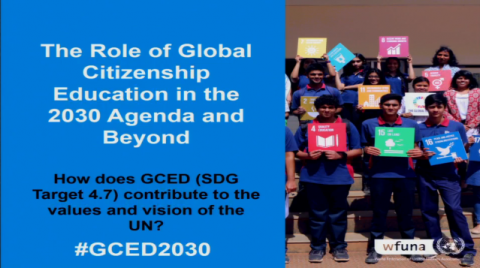 2017 UN Global Citizenship Education Seminar 발행 연도: 2017 단체 저자: United Nations (UN) 2017 UN GCED SeminarThe Role of Global Citizenship Education in the 2030 Agenda and Beyond: How does global citizenship education (SDG Target 4.7) contribute to the values and vision of the United Nations? 2017联合国全球公民教育研讨会 발행 연도: 2017 단체 저자: United Nations (UN) 2017联合国全球公民教育研讨会全球公民教育在2030年议程及其后的作用:全球公民教育(可持续发展目标4.7)如何促进联合国的价值观和愿景?
  Educar para una ciudadanía global: construir un mundo justo desde la escuela 발행 연도: 2009 저자: Colette Grech | Roderick Mallia | William Grech 단체 저자: Conectando Mundos Consortium (Cidac, inizjamed, Intermon Oxfam, Ucodep) This publication is based on an initiative about the development education, intercultural education, popular education, the education of values, human rights education, education for sustainability, education for peace, education for gender equality, etc. The pedagogical proposal of Global Citizenship Education aspires to integrate in a coherent and challenging vision all these themes, keeping them in a close relationship with one another and taking into consideration the (increasing) interdependence of human beings living in a planet whose sustainability is under threat. This book is the fruit of a process that was triggered off by the joint effort of four European development NGOs, namely Cidac, Inizjamed, Intermón Oxfam and Ucodep within the frame of a project co-financed by the European Commission. These organisations set for themselves the objective to promote the acknowledgment and the inclusion of the contents and the methodology of Global Citizenship Education in the formal educational contexts in their respective countries, in order to kick-start a process of change in attitudes, values, and the beliefs of the pupils. Thanks to the initiative and efforts of the above-mentioned four organisations, and through various meetings and seminars carried out over the last three years in Spain, Italy, Portugal and Malta, groups of educators have been able to come face-to-face with each other, exchange experiences and reflect on the role of formal education with respect to the challenges of our times. Among the other experiences, the publication contains that of a key moment in the process. This took place in July 2008 in Cortona, a small and beautiful Tuscan city close to the border with Umbria, and in which many educators shared the benefit of what was the first international encounter of educators for global citizenship. The Cortona experience, in which around ninety teachers coming from Spain, Portugal, Malta, Italy, the Dominican Republic and Costa Rica have participated, was one of the stages – the starting point, in fact – of a process and a relationship that it is our aim to develop at the regional, national and international levels. In this publication, therefore, one can find theoretical cues put forward at Cortona that encourage educators to share their experiences and to compare the work done by different groups.This publication has two parts. The first part contains contributions of a theoretical type, whereas the second part concentrates on the educational experiences of the participants in the Cortona meeting.
  2016 UN Global Citizenship Education Seminar 발행 연도: 2016 단체 저자: United Nations (UN) 2016 UN Global Citizenship Education SeminarSeminar on “Global Citizenship Education: An emerging agenda for peace and preventing violent extremism and promoting sustainable development and human dignity”. This seminar was co-organized by the Permanent Missions of Andorra, Croatia, Jordan and the Republic of Korea; and the Asia-Pacific Centre of Education for International Understanding (APCEIU), the United Nations Educational, Scientific and Cultural Organization/Global Education First Initiative (UNESCO/GEFI), the United Nations Academic Impact (UNAI), the UN-Women, InterPress Service, and the Coalition for Global Citizenship 2030.
  Empowering Global Citizens: A World Course 발행 연도: 2016 저자: Fernando Reimers | Vidur Chopra | Connie K. Chung | Julia Higdon | E. B. O'Donnell The world is changing rapidly and shcools must evolve to prepare young people to invent the future. Reinventing education requires thinking anew about how to help students develop competencies that will empower them as architects of their own lives and contributing members of their communities. Drawing on a synthesis of research and practice in global citizenship education, this book presents The World Course - a rigorous and coherent curriculum to foster student agency, empathy, and deep knowledge and skills to recognize the biggest global challenges and opportunities of our times, and to advance sustainability, human rights, and peace. Integrating current thinking on twenty-first-centry competencies and deeper learning, and deploying pedagogies that cultivate student responsibility, imagination, and creativity, such as project-based learning and design thinking, this book is a blueprint to reinvent education to empower global citizens.
  평등교육실천론 발행 연도: 2020 저자: 백병부 | 권순정 | 심재휘 | 윤선인 | 이혜정 단체 저자: 경기도교육연구원 이 연구는 평등과 관련된 교육 영역에서의 논의가 가지고 있는 한계를 극복하기 위해서 수행되었다. 즉 기존의 논의는 대체로 능력주의를 전제로 교육기회의 분배 실태와 구조를 분석하는 데 집중하고 있다는 것이다. 구체적으로 이 연구에서는 독립적이고 이성적인 존재로 인간을 규정했던 근대적 인간관을 의존적이고 관계적인 존재로 전환해야 한다고 주장했다. 이 연구에서는 정의의 개념이 확장되어온 과정을 정리함으로써 평등이 적용되어야 할 영역의 다차원성을 확인하고, 앞에서 정리한 현대철학의 인간관에 근거하여 평등의 영역을 경제적 자원이나 사회적 지위뿐만 아니라 사회적 인정과 정치적 대표, 애정, 돌봄 등과 같은 정동적 영역으로 확장할 수 있음을 정리하였다. 마지막으로 이 연구에서는 기존의 평등에 대한 논의가 국민국가를 배경으로 하고 있기 때문에 여러 한계를 안고 있음을 지적하고, 세계시민교육과 평화교육의 맥락에서 평등의 적용 범위가 지구공동체 전체로 확장되어야 한다는 점을 강조하였다. 출처: 경기도교육연구원 홈페이지
  깊은 자기이해에서 세계 알기를 시작하다: D대학의 ‘세계시민과 회복적 평화’ 교양 수업을 중심으로 (교양교육연구; Vol. 18, No. 1) 발행 연도: 2024 저자: 신난희 | 유득규 | 박난희 단체 저자: 한국교양교육학회 본 논문은 회복적 평화 관점으로 설계된 수업 과정에서 학습자들이 어떻게 자기 내면과 연결하게 되고 자기에 대한 깊은 이해를 경험하게 되며 나아가 세계 알기로 인식의 확장을 시작하는지에 관하여 살펴보았다. 분석에 의하면, 학습자들은 관찰하기-느낌 표현-욕구 알기-핵심가치 찾기-부탁하기 활동을 통하여 이제까지 자기를 구성해 온 문화적 가치와 양식에 구속되어 있던 자기를 발견하고 표현하며 자유로움을 경험할 수 있었다. 자문화기술지 작성 활동은 이 작업을 수행하는데 중요한 전환점이 되었다. 조별 활동은 자기 내면에 대한 깊은 이해 과정의 힘든 순간을 함께 나누는 공감과 연대감을 생성하며 세계 알기의 힘든 작업을 해나가는 데 중요한 기반을 제공하였다. 본 교과목 활동은 본격적으로 세계시민으로서의 인식과 활동을 전개하는데 전제가 되는 깊은 자기이해를 경험하는 데 주안점이 놓인 것으로 이후 이러한 내적 역량을 성취한 학습자들이 보다 적극적으로 세계 알기에 관한 인식과 탐구를 어떻게 성취하는지에 관한 후속 작업의 필요성을 제기한다.
 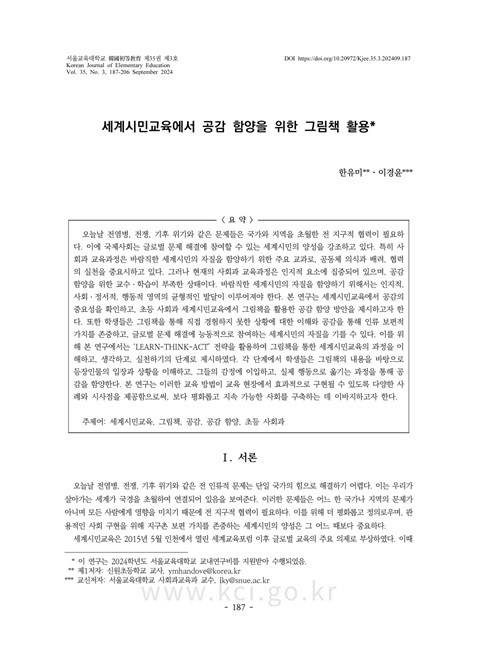 세계시민교육에서 공감 함양을 위한 그림책 활용 (한국초등교육; Vol. 35, No. 3) 발행 연도: 2024 저자: 한유미 | 이경윤 단체 저자: 서울교육대학교 초등교육연구원 오늘날 전염병, 전쟁, 기후 위기와 같은 문제들은 국가와 지역을 초월한 전 지구적 협력이 필요하다. 이에 국제사회는 글로벌 문제 해결에 참여할 수 있는 세계시민의 양성을 강조하고 있다. 특히 사회과 교육과정은 바람직한 세계시민의 자질을 함양하기 위한 주요 교과로, 공동체 의식과 배려, 협력의 실천을 중요시하고 있다. 그러나 현재의 사회과 교육과정은 인지적 요소에 집중되어 있으며, 공감함양을 위한 교수ㆍ학습이 부족한 상태이다. 바람직한 세계시민의 자질을 함양하기 위해서는 인지적, 사회ㆍ정서적, 행동적 영역의 균형적인 발달이 이루어져야 한다. 본 연구는 세계시민교육에서 공감의중요성을 확인하고, 초등 사회과 세계시민교육에서 그림책을 활용한 공감 함양 방안을 제시하고자 한다. 또한 학생들은 그림책을 통해 직접 경험하지 못한 상황에 대한 이해와 공감을 통해 인류 보편적가치를 존중하고, 글로벌 문제 해결에 능동적으로 참여하는 세계시민의 자질을 기를 수 있다. 이를 위해 본 연구에서는 ‘LEARN-THINK-ACT’ 전략을 활용하여 그림책을 통한 세계시민교육의 과정을 이해하고, 생각하고, 실천하기의 단계로 제시하였다. 각 단계에서 학생들은 그림책의 내용을 바탕으로등장인물의 입장과 상황을 이해하고, 그들의 감정에 이입하고, 실제 행동으로 옮기는 과정을 통해 공감을 함양한다. 본 연구는 이러한 교육 방법이 교육 현장에서 효과적으로 구현될 수 있도록 다양한 사례와 시사점을 제공함으로써, 보다 평화롭고 지속 가능한 사회를 구축하는 데 이바지하고자 한다.
  Case Studies in Action: Youth Empowerment for a Peaceful Caribbean 발행 연도: 2024 저자: Gizem Kilinç 단체 저자: UNESCO Kingston This compilation, titled “Case Studies in Action: Youth Empowerment for a Peaceful Caribbean” presents fourteen concise case studies highlighting (sub-)regional, national, and local initiatives that contribute to the operationalisation of the Youth, Peace, and Security (YPS) agenda. It features a combination of initiatives led by government, regional organisations, the United Nations, youth organisations, civil society, and multi-stakeholder groups across the Dutch and English-speaking Caribbean. The primary objective of this overview is to enrich the knowledge base on meaningful youth engagement in peace and security issues within the region, shedding light on successful approaches, obstacles encountered, and lessons learned. Organised into five sections aligned with the pillars of the YPS agenda—prevention, protection, disengagement and reintegration, partnership, and participation—the case studies are accompanied by an introduction and a summary of recommendations.
  Social Media to P/CVE: Toolkit for Practitioners 발행 연도: 2017 단체 저자: Search for Common Ground This Toolkit has been created on the basis of the key findings obtained in the framework of the Search for Common Ground (Search) “Social Media for De-Radicalization in Kyrgyzstan: A Model for Central Asia’s” pilot project funded by the Bureau of Counterterrorism, US Department of State. The project is based on two parts: a participatory approach, focused on UN Resolution 2250, and a professional approach aimed at creating and conducting social media campaigns in Kyrgyzstan.Extremist and terrorist groups use the Internet to radicalize and recruit young people through social media and instant messaging applications. Therefore, it is important to create new methods to combat online extremist propaganda, focusing not only on measures such as blocking and filtering content, or counter-narratives which are very popular and come naturally in response to radicalization and violent extremism, but also offering a positive alternative to extremist propaganda, while challenging their ideology and messages.