
자료
세계시민교육에 대한 이해를 넓히고 연구, 옹호 활동, 교수, 학습 등을 향상시킬 수 있는 다양하고 유용한 자료를 찾아보세요.
1,407 건의 결과가 검색되었습니다
 UNESCO guidelines on intercultural education 발행 연도: 2006 단체 저자: UNESCO This paper aims to synthesize the central issues surrounding Intercultural Education, and presents the fundamental guiding principles for an intercultural approach to education as viewed by UNESCO. It is divided into three parts. Part I outlines the key issues surrounding Intercultural Education, as well as its objectives and basic operating principles. Part II contains a short presentation of the normative framework for Intercultural Education, based on an analysis of international standard-setting instruments that make reference to education and intercultural issues, and on outcomes from International Conferences. Part III synthesizes the international position on this issue and provides a set of three basic principles that should guide educational policies with regard to Intercultural Education.
  Kit pédagogique pour les pays situés en zones montagneuses: une approche créative de l'éducation à l'environnement 발행 연도: 2010 저자: Thomas Schaaf 단체 저자: Organisation des Nations Unies pour l'éducation, la science et la culture (UNESCO) Entitled: A Teaching Resource Kit for Mountain Countries, it is a new environmental education kit similar to the Teaching Resource Kit for Dryland Countries published by UNESCO in 2008. It is based on the same innovative approach appealing to the creativity and artistic sensibility of pupils aged around 10 to 15, and is intended for secondary-school (and late primary-school) teachers and their pupils, this time living in mountain ecosystems, where climate and environmental conditions are harsh, often varying between extremes, and which are subject to the problems of erosion. As an educational tool, the kit offers a practical and attractive way of helping teachers and their pupils towards a better understanding of the environmental problems of their region and to stimulate their quest for possible solutions. In this respect, its content is a further contribution to the United Nations General Assembly’s resolution proclaiming 2002 the International Year of Mountains and is also consistent with the activities developed as part of the United Nations Decade of Education for Sustainable Development (2005-2014), the promotion of which is UNESCO’s responsibility. A teaching resource kit for mountain countries: a creative approach to environmental education 발행 연도: 2010 저자: Thomas Schaaf 단체 저자: UNESCO Entitled: A Teaching Resource Kit for Mountain Countries, it is a new environmental education kit similar to the Teaching Resource Kit for Dryland Countries published by UNESCO in 2008. It is based on the same innovative approach appealing to the creativity and artistic sensibility of pupils aged around 10 to 15, and is intended for secondary-school (and late primary-school) teachers and their pupils, this time living in mountain ecosystems, where climate and environmental conditions are harsh, often varying between extremes, and which are subject to the problems of erosion. As an educational tool, the kit offers a practical and attractive way of helping teachers and their pupils towards a better understanding of the environmental problems of their region and to stimulate their quest for possible solutions. In this respect, its content is a further contribution to the United Nations General Assembly’s resolution proclaiming 2002 the International Year of Mountains and is also consistent with the activities developed as part of the United Nations Decade of Education for Sustainable Development (2005-2014), the promotion of which is UNESCO’s responsibility. Kit pédagogique pour les pays situés en zones sèches: une approche créative de l'éducation à l'environnement 발행 연도: 2007 저자: Thomas Schaaf 단체 저자: Organisation des Nations Unies pour l'éducation, la science et la culture (UNESCO) Entitled A Creative Approach to Environmental Education/Teaching Resource Kitfor Dryland Countries, the kit is intended for secondary-school teachers in countries affected by desertification and is based on an innovative approach appealing to the creativity and artistic sensibility of pupils aged 10 to 15 years. This approach favours discovery of the environment through the senses, and emphasizes the visual and exploratory aspects of environmental study. The idea of using creativity and artistic sensibility to promote ecological awareness may in the future become a source of collaboration to be explored in detail by the different sectors of UNESCO. L'Education au Changement Climatique en vue du Développement Durable: l'Initiative de l'UNESCO pour Faire Face au Changement Climatique 발행 연도: 2010 단체 저자: Organisation des Nations Unies pour l'éducation, la science et la culture (UNESCO) The UNESCO Climate Change Initiative was launched by Director-General Irina Bokova in Copenhagen during the 15th Conference of the Parties to the UN Framework Convention on Climate Change (UNFCCC COP15). It seeks to reinforce the scientific, mitigation and adaptation capacities of countries and communities that are most vulnerable to the effects of climate change. It focuses on a select number of strategic issues in line with The UN System Delivering as One on Climate Change action plan and The UNESCO Strategy for Action on Climate Change. The Initiative is based on four thematic areas: scientific, educational, environmental and ethical. Key objectives will be achieved through intersectoral and interdisciplinary cooperation, coordinated field activities, and networking. Special attention is given to UNESCO’s two global priorities, Africa and gender equality, as well as to the increased vulnerability of Small Island Developing States (SIDS). The UN System “Delivering as One” on Climate Change During the 13th session of the Conference of Parties to the UNFCCC in Bali, Indonesia, UN Secretary General Ban Ki-Moon presented an unprecedented coordination effort to bring together all the diverse perspectives, expertise and strengths of the UN system so as to deliver as one in the critical area of climate change. The initiative brings together expertise and ongoing work in diverse areas ranging from science and technology to agriculture, transport, forestry and disaster risk reduction, to address both mitigation and adaptation. It brings together the normative, standard setting and knowledge sharing capacities of the system with its operational reach in order to support the most vulnerable. The overall objective is to maximize existing synergies, eliminate duplication and overlap, and optimize the impact of the collective effort of the UN system. To ensure better coordination, convening responsibilities were assigned to UN system entities with a large volume of activities in the five focus areas and four cross-cutting areas. Focus areas ㆍAdaptation – High-Level Committee on Programmes collectively ㆍ Technology transfer – UNIDO, UN-DESA ㆍReduction of emissions from deforestation and degradation (REDD) – UNDP, FAO, UNEP ㆍ Financing mitigation and adaptation action – UNDP, World Bank Group ㆍCapacity building – UNDP, UNEP Cross-cutting areas ㆍClimate knowledge: science, assessment, monitoring and early warning – WMO, UNESCO ㆍSupporting global, regional and national action – UN-DESA, UN Regional Commissions, UNDP ㆍClimate-neutral UN – UNEP ㆍPublic awareness – UNCG, UNEP.
 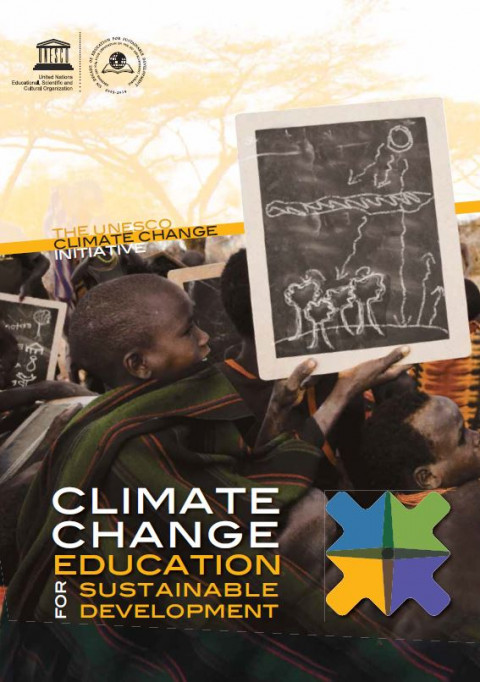 Climate Change Education for Sustainable Development: the UNESCO Climate Change Initiative 발행 연도: 2010 단체 저자: UNESCO The UNESCO Climate Change Initiative was launched by Director-General Irina Bokova in Copenhagen during the 15th Conference of the Parties to the UN Framework Convention on Climate Change (UNFCCC COP15). It seeks to reinforce the scientific, mitigation and adaptation capacities of countries and communities that are most vulnerable to the effects of climate change. It focuses on a select number of strategic issues in line with The UN System Delivering as One on Climate Change action plan and The UNESCO Strategy for Action on Climate Change. The Initiative is based on four thematic areas: scientific, educational, environmental and ethical. Key objectives will be achieved through intersectoral and interdisciplinary cooperation, coordinated field activities, and networking. Special attention is given to UNESCO’s two global priorities, Africa and gender equality, as well as to the increased vulnerability of Small Island Developing States (SIDS).The UN System “Delivering as One” on Climate Change During the 13th session of the Conference of Parties to the UNFCCC in Bali, Indonesia, UN Secretary General Ban Ki-Moon presented an unprecedented coordination effort to bring together all the diverse perspectives, expertise and strengths of the UN system so as to deliver as one in the critical area of climate change. The initiative brings together expertise and ongoing work in diverse areas ranging from science and technology to agriculture, transport, forestry and disaster risk reduction, to address both mitigation and adaptation. It brings together the normative, standard setting and knowledge sharing capacities of the system with its operational reach in order to support the most vulnerable. The overall objective is to maximize existing synergies, eliminate duplication and overlap, and optimize the impact of the collective effort of the UN system.To ensure better coordination, convening responsibilities were assigned to UN system entities with a large volume of activities in the five focus areas and four cross-cutting areas. Focus areas ㆍAdaptation – High-Level Committee on Programmes collectively ㆍ Technology transfer – UNIDO, UN-DESA ㆍReduction of emissions from deforestation and degradation (REDD) – UNDP, FAO, UNEP ㆍ Financing mitigation and adaptation action – UNDP, World Bank Group ㆍCapacity building – UNDP, UNEP Cross-cutting areas ㆍClimate knowledge: science, assessment, monitoring and early warning – WMO, UNESCO ㆍSupporting global, regional and national action – UN-DESA, UN Regional Commissions, UNDP ㆍClimate-neutral UN – UNEP ㆍPublic awareness – UNCG, UNEP. Human rights education: learning counts! 발행 연도: 2006 단체 저자: UNESCO This poster was originally published in 2006 and reissued for UNESCO Works for Human Rights: a Poster Exhibition on the Street, held at UNESCO, Paris, 2 December 2008 to 27 February 2009. Éducation sur droits de l'homme: les chiffres d'apprentissage! 발행 연도: 2006 단체 저자: Organisation des Nations Unies pour l'éducation, la science et la culture (UNESCO) Cette affiche a été initialement publié en 2006 et réédité pour l'UNESCO Works pour les droits de l'homme: une exposition d'affiches sur la rue, tenue à l'UNESCO, Paris, le 2 Décembre 2008 au 27 Février de 2009. The round table: putting human rights into practice-the role of education; report 발행 연도: 2008 단체 저자: UNESCO This publication highlights some of the key ideas and features of the events based on the theme “60 years of Human Rights Education” at UNESCO headquarters in Paris from the 2nd of December 2008 till the 27th of February 2009. In addition to substantial opening and closing sessions, the Round Table consisted of four panels, the reporting of each consists of Summary, Introduction, Case Studies, Discussion and Recommendations. This publication can be read on a number of levels: as a retrospective commemoration of human rights education; as a celebration of current good practice; and, through its discussion and recommendations, as a source of guidance for future directions in human right education. The round table: putting human rights into practice-the role of education; report 발행 연도: 2008 단체 저자: Organisation des Nations Unies pour l'éducation, la science et la culture (UNESCO) Cette publication met en lumière quelques-unes des idées et des caractéristiques des événements clés sur le thème "60 ans d'Éducation aux Droits de l’Homme" au siège de l'UNESCO à Paris du 2 Décembre 2008 au 27 Février 2009. En plus importante ouverture et de fermeture sessions, la Table Ronde se composait de quatre panneaux, les rapports de chaque compose de Résumé, Introduction, Étude de Cas, Discussion et Recommandations. Cette publication peut être lue sur un certain nombre de niveaux: comme une commémoration rétrospective de l'éducation des droits de l'homme; comme une célébration de la bonne pratique actuelle; et, à travers la discussion et des recommandations, comme une source de conseils pour les orientations futures en matière d'éducation droit humain.