
자료
세계시민교육에 대한 이해를 넓히고 연구, 옹호 활동, 교수, 학습 등을 향상시킬 수 있는 다양하고 유용한 자료를 찾아보세요.
11 건의 결과가 검색되었습니다
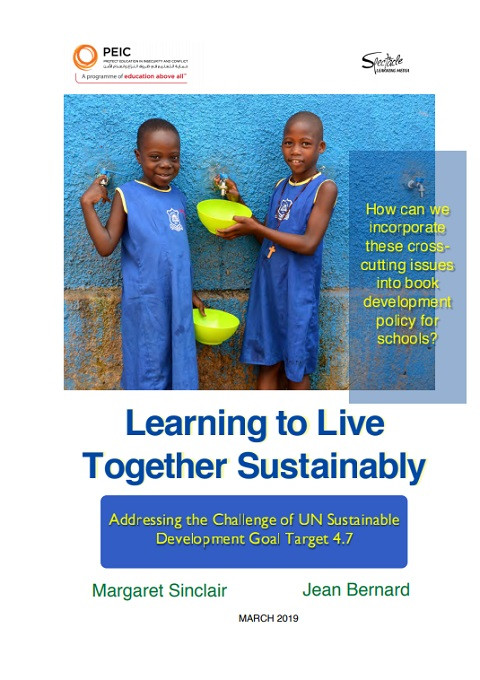 Learning to Live Together Sustainably: Addressing the Challenge of UN Sustainable Development Goal Target 4.7 발행 연도: 2019 저자: Margaret Sinclair | Jean Bernard 단체 저자: Protect Education in Conflict and Insecurity (PEIC) | Spectacle Learning Media The practical advice and guidelines in this book help support learning to live together, conflict transformation and peace at the individual, group and community levels. The framework for developing widely accessible, high quality learning materials supports the UN Sustainable Development Goals and is relevant to formal and non-formal education activities and projects. This document also raises important issues about the professional responsibilities of policy-makers at global and national level, who determine what content is addressed in the classroom. In particular, it addresses the need for education materials that support cross-cutting issues such as learning to live together, global citizenship education, and education for sustainable development.
  Learning to live together: education for conflict resolution, responsible citizenship, human rights and humanitarian norms 발행 연도: 2013 저자: Margaret Sinclair 단체 저자: Education Above All (Qatar) Education cannot offer immediate remedies to the local and global problems that we see on the news screens every day, but it can contribute to solving them over the longer term. This book examines specifically the contribution that education for learning to live together can make, even in countries where teacher training and classroom resources are limited. Many countries have diverse populations (ethnic, linguistic, religious, etc) and seek to maintain harmony among the different groups. In some countries, however, especially where economic stress or climate change have intensified arguments over resources, tensions have led to armed conflict. This brings with it all the misery of death, injury, displacement and poverty, along with disruption of education systems. In some instances education itself has been a contributory factor to the outbreak of conflict, notably through unequal education opportunities for different groups, and through biased school curricula.Civil conflict has brought untold suffering in recent years, and in a globalised world it has negative spill-over effects to neighbouring and other countries. It is vital to develop education policies and curricular reforms that can help convey values and skills for learning to live together to young people, to help lessen tensions, within and between countries.Education policy-makers can help lay the foundations for a better future by adjusting the content and process of education to reflect skills and values for human rights, humanitarian norms, peaceful resolution of conflicts, sustainable development and other issues as elements of local, national and global citizenship.Education reform is not enough, of course, to resolve the numerous problems of our times. The focus of this volume is on the contribution that can be made through aligning the content of education to the goal of learning to live together. This work will have greater impact when it takes place within education systems and policies that are consistent with human rights values and of course when other sectors besides education make their respective contributions.This book shows that transformative education for conflict resolution and peace, for local, national and global citizenship, for human rights and humanitarian values can be implemented even under difficult conditions if there is a policy commitment to do so. Authors have provided examples and lessons learned from their own experiences as eminent practitioners in the field. Learning to live together: education for conflict resolution, responsible citizenship, human rights and humanitarian norms 발행 연도: 2013 저자: Margaret Sinclair 단체 저자: Education Above All (Qatar) L'éducation ne peut offrir des remèdes immédiats aux problèmes locaux et mondiaux que nous voyons sur les écrans d'information tous les jours, mais elle peut contribuer à les résoudre sur le long terme. Ce livre examine spécifiquement la contribution que l'éducation peut apporter pour vivre ensemble même dans les pays où la formation des enseignants et les ressources en classe sont limitées.De nombreux pays ont des populations diverses (ethniques, linguistiques, religieuses, etc.) cherchent à maintenir l'harmonie entre les différents groupes. Dans certains pays, cependant, en particulier lorsque le stress économique ou les changements climatiques ont intensifié les arguments sur les ressources, les tensions ont conduit à des conflits armés. Cela apporte avec elle toute la misère de la mort, les blessures, le déplacement et la pauvreté, ainsi que la perturbation des systèmes éducatifs. Dans certains cas, l'éducation elle-même a été un facteur contributif à l'éclatement du conflit, notamment grâce à des possibilités d'éducation inégales pour les différents groupes, et à travers les programmes scolaires biaisés.La guerre civile a causé des souffrances indicibles au cours des dernières années, et dans un monde globalisé, il a des effets négatifs de débordement vers les pays voisins et d'autres pays. Il est essentiel d'élaborer des politiques de l'éducation et la réforme des programmes qui peuvent aider à transmettre les valeurs et les compétences pour apprendre à vivre ensemble pour les jeunes, pour aider à réduire les tensions, à l'intérieur et entre les pays.Education décideurs politiques peuvent aider à jeter les bases d'un avenir meilleur en ajustant le contenu et le processus de l'éducation afin de refléter les compétences et les valeurs des droits de l'homme, des normes humanitaires, la résolution pacifique des conflits, le développement durable et d'autres questions comme éléments de local, national et citoyenneté mondiale.Réforme de l'éducation ne suffit pas, bien sûr, de résoudre les nombreux problèmes de notre temps. L'objectif de ce volume est sur la contribution qui peut être faite par le biais d'aligner le contenu de l'éducation à l'objectif d'apprendre à vivre ensemble. Ce travail aura un plus grand impact quand il a lieu au sein des systèmes et politiques d'éducation qui sont conformes aux valeurs des droits de l'homme et bien sûr, quand d'autres secteurs en dehors de l'éducation font leurs contributions respectives.Ce livre montre que l'éducation transformatrice pour la résolution des conflits et la paix, à la citoyenneté locale, nationale et mondiale, des droits de l'homme et des valeurs humanitaires peut être appliqué même dans des conditions difficiles, s'il y a un engagement politique de le faire. Les auteurs ont fourni des exemples et les enseignements tirés de leurs propres expériences en tant que praticiens éminents dans le domaine.
  العدالة الاجتماعية وسياسات الإنفاق العام في دول الثورات العربية 발행 연도: 2014 저자: Ali Abdul Qadir Ali 단체 저자: Arab Center for Research and Policy Studies تهدف هذه الورقة إلى إبراز التحدّي الذي سيواجه دول الثورات العربية في صوْغها سياسات إنفاقٍ عامّ تلبّي ما طالبت به الثورات. في سبيل ذلك، تنظر الورقة إلى الثورات العربية بوصفها سعيًا نحو تأسيس أنظمة حكم ديمقراطية؛ بمعنى إنشاء مؤسسات سياسية تعددية وما يعني ذلك لكفاءة المؤسسات الاقتصادية. وتقترح الورقة أن طبيعة تحدّي صوْغ إنفاق عامّ ملائمة لطموحات الثورات في تحقيق عدالة اجتماعية تتمثّل في خلوّ جعبة المؤسسات الدولية المانحة للعون التنموي، كما يمثّلها صندوق النقد الدولي، من فكرٍ تنموي جديد في مجال صوْغ سياسات الإنفاق العامّ على الرغم من وجود الشواهد التطبيقية التي توضح نجاعة سياسات الإنفاق العامّ التوزيعية في تحقيق العدالة الاجتماعية. وهي شواهد تستعرضها الورقة، التي تعرض أيضًا نتائج تطبيقية ناجمة عن حجم الطبقة الوسطى في عيّنة دول الثورات العربية، وتوضح أن هذه الطبقة تمثّل أغلبية السكّان في هذه الدول، وتقترح أن الانتقال إلى نظام حكم ديمقراطي يستند إلى تفضيلات الناخبين من شأنه أن يفرض اتّباع سياسات إنفاق عامّ توزيعية، حيث يقوم الناخب الوسيط بدور محوري في اختيار مثل هذه السياسات. Social Justice and Public Expenditure Policies in the Arab Revolutions 발행 연도: 2014 저자: Ali Abdul Qadir Ali 단체 저자: Arab Center for Research and Policy Studies This paper examines the challenges faced by Arab spring states when formulating public expenditure policies that meet the revolutions’ demands. In an attempt to establish democratic regimes, the Arab revolutions dictated the creation of pluralist political institutions with concomitant implications for economic institutions. The paper suggests that the challenge of formulating a public expenditure policy in line with the revolutions’ aspirations for social justice lies in the inability of international development agencies, such as the IMF, to propose new and innovative ideas for formulating development policy. However, there are successful applied examples of distributive public expenditure policies for creating social justice. The paper reviews these examples in addition to the results of a survey identifying the size of the middle class in samples of Arab spring states. The survey demonstrates that the middle class represents a majority of population in these countries, suggesting that the transition to electoral democracy requires adopting distributional public expenditure policies in which the middle class voter occupies a central role.
  Education Disrupted Education Reimagined: Responses from Education’s Frontline During the COVID-19 Pandemic and Beyond 발행 연도: 2020 단체 저자: WISE | Salzburg Global Seminar | Diplomatic Courier The special edition E-Book you are reading about today was produced in real time, as WISE, in partnership with Salzburg Global Seminar, convened key stakeholders and education leaders from over 98 countries in a three-part series of global conferences aimed at bringing the global education community together. The result is a contemporary historical record of how schools, NGOs, governments, and international organizations responded to school closures during the crisis and how they are attempting to use this crisis as a springboard to reimagine—and even transform—education in their communities and countries.The E-Book offers an opportunity to a global audience to make sense of what happened but it also offers a breeding ground of ideas from some of the world’s top education thinkers. It is the editors’ sincere hope that through this publication we provide the education community with a reference point from the crisis from which future research, policy, and innovation can grow.
  تعزيز رفاه الشباب عبر الصحة والتعليم: رؤى وفرص 발행 연도: 2019 저자: Wing Yi Chan | Jennifer Sloan | Anita Chandra 단체 저자: RAND Corporation أضحى الرفاه، باعتباره ركيزة أساسية في عمليات التخطيط وصناعة السياسات وتخصيص الموارد، ضرورةً لا غنى عنها لتنمية المجتمعات والدول التي تسير في درب الازدهار، مما دفعنا في هذا التقرير لدراسة المؤلفات الأكاديمية وغير الأكاديمية وثيقة الصلة بالموضوع لتحديد الأطر النظرية التي تحقق التكامل بين الصحة والتعليم داخل منظومة واحدة. Promoting Youth Well-Being Through Health and Education: Insights and Opportunities 발행 연도: 2019 저자: Wing Yi Chan | Jennifer Sloan | Anita Chandra 단체 저자: RAND Corporation Putting well-being at the heart of planning, policy making, and resource allocation is emerging as critical to the development of thriving communities and nations. We examined the academic and grey literature to identify theoretical frameworks that integrate health and education. We identified and described policies and programs supporting well-being around the world, and interviewed experts from each location to gain a deeper understanding of them.The report found that although wellbeing frameworks that integrate education and health exist, few of them have been examined rigorously to reveal how both educational and health outcomes can be achieved together.
  Ensuring High Quality Primary Education for Children from Mobile Populations: A Desk Study 발행 연도: 2017 저자: Stephanie Bengtsson | Caroline Dyer 단체 저자: Educate A Child (EAC) | German Federal Ministry for Economic Cooperation and Development (GIZ) This study focuses on provision for primary school-aged children amongst communities of refugees and Internally Displaced People (IDPs), mobile pastoralists and seasonally migrating workers. For refugee and IDP children, policy, coordination and implementation challenges include: inconsistent ratification and enforcement of conventions and agreements protecting refugees and IDPs; the disproportionate impact of forced displacement on low and middle income countries (LMICs); the lack of a shared agenda among a wide range of stakeholders with differing mandates; and inadequate forced displacement terminology. Promising and emerging policy, coordination and implementation strategies include: expanding existing rights documents and agreements and building policy from the ground up; enshrining forcibly displaced people’s rights to education in national laws and policy; genuine engagement with affected communities; utilising the Education Cluster and other existing multi-stakeholder networks for knowledge sharing and collaboration; and collaborating across sectors to address the needs of the whole child. Financing challenges include: unpredictable and low funding for refugee and IDP education; weak capacity to absorb funds at the national and local level; an over-reliance on short-term financing mechanisms; donor dependence and a lack of funding sustainability; and inappropriate distribution of funds within education programming.
  Education for Global Citizenship 발행 연도: 2012 단체 저자: Education Above All (Qatar) This book shows that transformative education for local, national and global citizenship and peace can be implemented even under difficult conditions if there is a policy commitment to do so. Authors have provided examples and lessons learned from their own experiences as eminent practitioners in the field. The book is divided into three parts: Part One provides a brief overview of education for global citizenship; including in chapter 1, the subject matter and sub-themes; in chapter 2 the challenges of teaching for personal values and behavior development; and in chapter 3 the importance of having a clearly defined and holistic policy accepted by key stakeholders, and effective implementation.Part Two comprises chapters contributed by practitioners and specialists. Section A of Part Two presents some reflections on the challenges of teaching for values development and behavior change, and on the use of textbooks in this regard. Section B comprises four case studies that focus on or include education for citizenship and civics. Section C presents three cases focused on education for peace, together with a review of peace education in Muslim societies. Section D introduces human rights education and education designed to explore humanitarian law. Section E reviews problems of and possibilities for teaching about a conflictual past. Section F focuses on the development of national and international policy and planning for education to be supportive of peacebuilding and of respect for human rights.Finally, Part Three offers some recommendations for future action