
Ресурсы
Изучайте широкий спектр ценных ресурсов ВГГ, чтобы углубить своё понимание и повысить эффективность исследований, просветительской деятельности, преподавания и обучения.
Найдено: 21
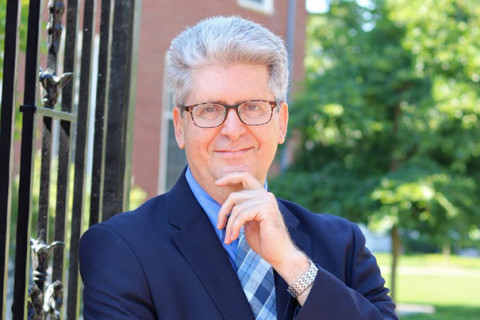 Turning Students into Global Citizens Год публикации: 2016 Автор: Fernando Reimers Prof. Fernando M. Remiers made the case for global citizenship education and shared his experiences through Ed Week.
  Citizenship, identity and education: examining the public purposes of schools in an age of globalization Год публикации: 2006 Автор: Fernando Reimers Организация-автор: UNESCO International Bureau of Education (IBE) Educational institutions exist to achieve public purposes. One of those purposes is to develop citizenship. In the 21st century, citizenship includes global citizenship. In an era of globalization effective citizenship includes the knowledge, ability and disposition to engage peacefully and constructively across cultural differences for purposes of addressing personal and collective needs and of achieving sustainable human–environmental interactions, this requires internalizing global values. Addressing these challenges of globalization will require making citizenship education and the development of global values an explicit objective of efforts to improve quality throughout the world, critically examining theories and evidence about the effectiveness of various approaches to developing citizenship and global citizenship and supporting activities aligned with this public purpose. This public purpose should support the development of a political culture that fosters the rule of national and international law and respect of human rights, the development of understanding to support trade and economic and peaceful bilateral and international diplomacy as the preferred means to solve international disputes, the development of the capability to understand and address the serious environmental challenges facing humanity and to collaborate across national boundaries in the creation of sustainable forms of human–environmental interactions and in the development of the skills to promote rationality in deliberation and action, and to advance science and technology as means to improve human health and well-being. At present, however, many education systems and reforms are insufficiently focused on quality, or focus instead on a very narrow and self-referenced definition of quality. It is possible to educate people to understand and appreciate cultural differences and to understand and accept human rights in a framework of global values that includes compassion and caring, concern for others, respect and reciprocity. These values, dispositions, knowledge and skills can be developed in a range of institutions that societies have to pass on what they value to the young, and to re-create culture: families, religious institutions, the media, workplaces, political institutions and also schools. While there is no reason to assume that schools can be more effective in this task than any of these other institutions, they have greater potential to be aligned with transnational efforts to promote global civility. They are a public space, and consequently also a globally public space, in ways in which families and religious institutions are not. If schools actively engage in teaching hatred or intolerance, or if they fail to prepare students adequately for global civility, these failures can be noted by international institutions that can potentially mobilize resources to support national and local efforts to prepare students for global citizenship. There is not a similar network linking national and transnational institutions, public and private, governmental and non-governmental, that attends to the dynamics of families and other ‘‘private’’ spaces. Citoyenneté, identité et de l'éducation: l'examen des fins publiques des écoles à l'ère de la mondialisation Год публикации: 2006 Автор: Fernando Reimers Организация-автор: UNESCO International Bureau of Education (IBE) Les établissements d'enseignement existent pour parvenir à des fins publiques. L'un de ces objectifs est de développer la citoyenneté. Au 21e siècle, la citoyenneté comprend la citoyenneté mondiale. Dans une ère de mondialisation citoyenneté effective comprend les connaissances, la capacité et la disposition à engager pacifique et constructive entre les différences culturelles aux fins de répondre aux besoins personnels et collectifs et de réaliser des interactions humaines-environnementales durables, ce qui nécessite l'intériorisation des valeurs globales. Pour relever ces défis de la mondialisation, il faudra faire de l'éducation à la citoyenneté et le développement des valeurs mondiales un objectif explicite des efforts pour améliorer la qualité dans le monde entier, l'examen critique des théories et des preuves sur l'efficacité des différentes approches pour développer la citoyenneté et la citoyenneté mondiale et soutenir les activités alignées cet effet public. Cet objectif public devrait soutenir le développement d'une culture politique qui favorise la primauté du droit national et international et le respect des droits de l'homme, le développement de la compréhension pour soutenir le commerce et la diplomatie bilatérale et internationale économique et pacifique comme le moyen privilégié pour résoudre les conflits internationaux, le développement de la capacité à comprendre et à relever les défis environnementaux humanité face à de graves et de collaborer à travers les frontières nationales dans la création de formes durables d'interactions homme-environnement et dans le développement des compétences pour promouvoir la rationalité dans la délibération et de l'action, et de faire avancer la science et la technologie comme moyen d'améliorer la santé humaine et le bien-être. À l'heure actuelle, cependant, de nombreux systèmes d'éducation et les réformes ne sont pas suffisamment axées sur la qualité, ou se concentrent plutôt sur une définition très étroite et auto-référencé de la qualité. Il est possible d'éduquer les gens à comprendre et à apprécier les différences culturelles et à comprendre et à acept droits de l'homme dans un cadre de valeurs globales qui comprend la compassion et la compassion, le souci des autres, le respect et la réciprocité. Ces valeurs, les dispositions, les connaissances et les compétences peuvent être développées dans un éventail d'institutions que les sociétés doivent passer sur ce qu'ils apprécient le jeune, et de recréer la culture: les familles, les institutions religieuses, les médias, les milieux de travail, les institutions politiques et aussi écoles. Bien qu'il n'y ait aucune raison de supposer que les écoles peuvent être plus efficaces dans cette tâche que l'une de ces autres institutions, ils ont un plus grand potentiel pour être aligné avec les efforts transnationaux visant à promouvoir la civilité mondiale. Ils sont un espace public, et par conséquent aussi un espace public à l'échelle mondiale, dans les façons dont les familles et les institutions religieuses ne sont pas. Si les écoles participent activement à l'enseignement à la haine ou l'intolérance, ou si elles ne parviennent pas à préparer les étudiants de manière adéquate pour la civilité mondiale, ces échecs peuvent être notées par les institutions internationales qui peuvent potentiellement mobiliser des ressources pour soutenir les efforts nationaux et locaux pour préparer les élèves à la citoyenneté mondiale. Il n'y a pas un réseau similaire reliant les institutions nationales et transnationales, publiques et privées, gouvernementales et non-gouvernementales, qui assiste à la dynamique des familles et d'autres «espaces» «privés».
 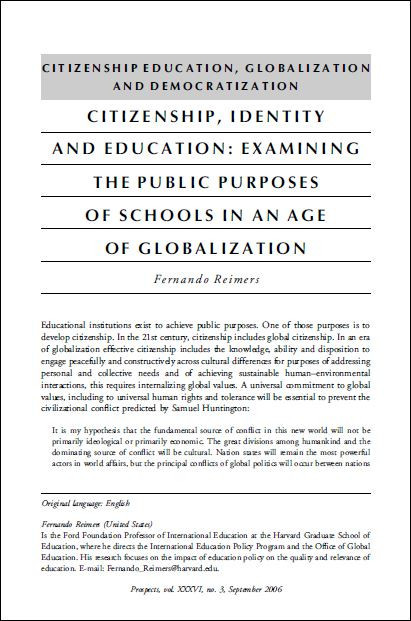 Citizenship, Identity, and Education: Examining the Public Purposes of Schools in an Age of Globalization Год публикации: 2006 Автор: Fernando Reimers Организация-автор: UNESCO International Bureau of Education (IBE) One of the purposes of educational institutions is to develop citizenship. In the 21st century, citizenship includes global citizenship. Addressing the challenges of globalization will require making citizenship education and the development of global values an explicit objective of efforts to improve quality throughout the world, critically examining theories and evidence about the effectiveness of various approaches to developing citizenship and global citizenship and supporting activities aligned with this public purpose. In this article, the author does not argue for an exclusive effort to focus schools on civic education, but rather for a balanced effort to elevate educational quality making it more relevant to address global challenges and opportunities, of which civic education and global education are components, much neglected at present. The author also does not suggest making civic education the only purpose of the curriculum or making it a priority to the expense of science, math, arts or physical and health education, but he thinks that helping students develop a sense of purpose, situated within broader civic and global purposes, would also facilitate high level engagement with science, mathematical and artistic pursuits.
  Teaching Two Lessons about UNESCO and Other Writings on Human Rights Год публикации: 2017 Автор: Fernando Reimers This book presents two lessons for use in college or high school, to educate students on the mission and work of UNESCO as it relates to the advancement of Human Rights. It includes also a series of a short essays on Human Rights, the Right to Education, Teaching Human Rights and the role of Teachers and Universities in Teaching Human Rights which will be useful to educators interested in educating their students to advance the values of freedom and justice. For more information about this book, please visit the link below.URL: https://www.amazon.com/Teaching-Lessons-Unesco-writings-Rights/dp/1978367996#reader_1978367996 The lessons(Two Lessons About UNESCO) are designed to help high school and college students understand the mission of UNESCO, the reason the organization was created, the work it does, how it is structured and funded, and how its work relates to the Universal Declaration of Human Rights. The lessons can be taught at the High School or College level. They can be taught in a variety of courses including social studies, history, humanities, and can be integrated in courses in other disciplines. For more information, please visit the link below.URL: https://medium.com/@fernandomreimers/teaching-two-lessons-about-unesco-7531c5fe9395
 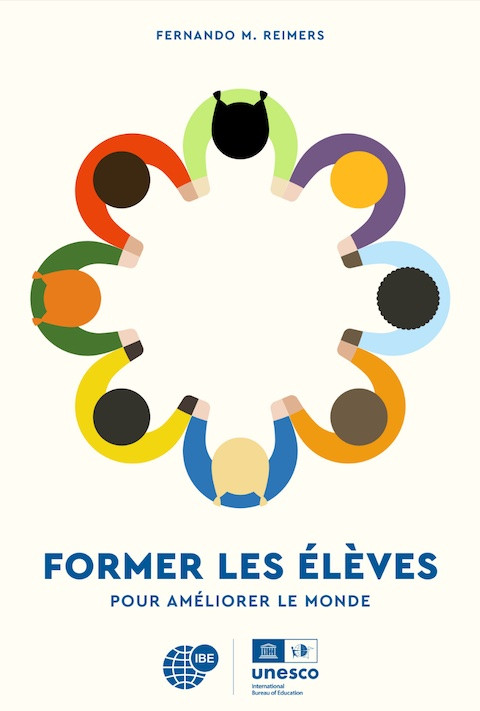 Educating Students to Improve the World Год публикации: 2021 Автор: Fernando Reimers Организация-автор: UNESCO International Bureau of Education (IBE) This book highlights the key role of global citizenship education to prepare learners for a rapidly changing world. In a probing and visionary analysis of the field of global education Fernando Reimers explains how to lead the transformation of schools and school systems in order to more effectively prepare students to address today’s most urgent challenges and to invent a better future. It discusses several global citizenship curricula that have been adopted by schools and school networks, and ties them into an approach to lead school change into the uncharted territory of the future. Former les élèves pour améliorer le monde Год публикации: 2021 Автор: Fernando Reimers Организация-автор: UNESCO International Bureau of Education (IBE) Ce livre porte sur la manière d’aider les élèves à trouver un sens à leur vie dans un monde un mutation rapide. Par une analyse approfondie et visionnaire du domaine de l’éducation à la citoyenneté mondiale, Fernando Reimers explique comment conduire la transformation des écoles et des systèmes scolaires afin de préparer plus efficacement les élèves à relever les défis actuels les plus urgents et à inventer un avenir meilleur.
 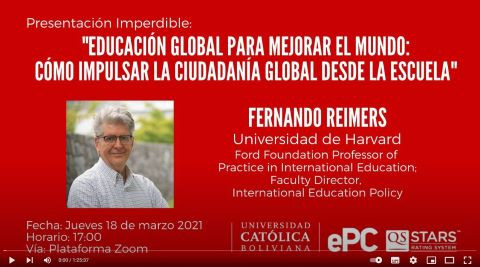 Global Education to Improve the World: How to Promote Citizenship from School Год публикации: 2021 Автор: Fernando Reimers Giving priority to global education would help make what is learned in school relevant, more current and attractive for both male and female students and their educators. This video offers an overview of this topic and the multidimensional theoretical model of global education that places teachers, administrators and other members of the educational community at the center of the definition of what the education of global citizens should be and how should develop. Its objective is to provide guidance on how to educate students with a global mindset so that they are competent and responsible when acting in the face of the global challenges of their time. Educación global para mejorar el mundo: Como impulsar la ciudadania desde la escuela Год публикации: 2021 Автор: Fernando Reimers Dar prioridad a la educación global ayudaría a hacer relevante lo que se aprende en la escuela, más actual y atractivo tanto para las alumnas y los alumnos como para sus educadores. Este video ofrece una visión sobre este tema y el modelo teórico multidimensional de la educación global que sitúa a docentes, directivos y otros integrantes de la comunidad educativa en el centro de la definición de lo que debería ser la educación de ciudadanas y ciudadanos globales y cómo debería desarrollarse. Su objetivo es dar orientaciones acerca de cómo educar al alumnado con una mentalidad global para que sea competente y responsable a la hora de actuar ante los desafíos mundiales de su tiempo.
 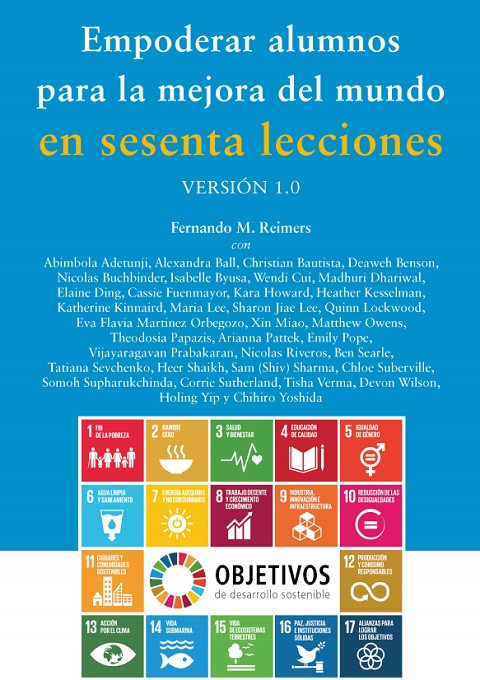 Empowering Students for the Improvement of the World in 60 Lessons: Version 1.0 Год публикации: 2017 Автор: Fernando Reimers Организация-автор: Centro de Cooperación Regional para la Educación de Adultos en América Latina y el Caribe (CREFAL) This book presents tools for creating and adapting curriculum for Global Citizenship Education as well as a 60-lesson prototype for all grades, from 1th to 12th.