
Ресурсы
Изучайте широкий спектр ценных ресурсов ВГГ, чтобы углубить своё понимание и повысить эффективность исследований, просветительской деятельности, преподавания и обучения.
Найдено: 89
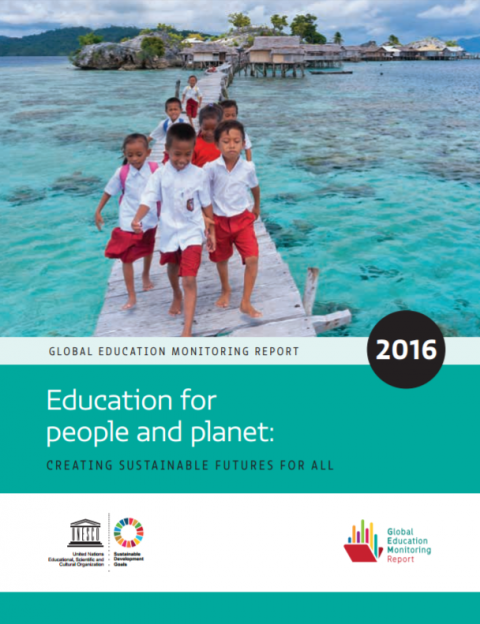 L'Education pour les peuples et la planète: créer des avenirs durables pour tous; Rapport mondial de suivi sur l'éducation, 2016 Год публикации: 2016 Организация-автор: Organisation des Nations Unies pour l'éducation, la science et la culture (UNESCO) | Global Education Monitoring Report Team The GEM Report provides an authoritative account of how education is the most vital input for every dimension of sustainable development. Better education leads to greater prosperity, improved agriculture, better health outcomes, less violence, more gender equality, higher social capital and an improved natural environment. Education is key to helping people around the world understand why sustainable development is such a vital concept for our common future. Education gives us the key tools – economic, social, technological, even ethical – to take on the SDGs and to achieve them. These facts are spelled out in exquisite and unusual detail throughout the report. Yet the report also emphasizes the remarkable gaps between where the world stands today on education and where it has promised to arrive as of 2030. Informe de Seguimiento de la Educación en el Mundo, 2016: La Educación al servicio de los pueblos y el planeta: creación de futuros sostenibles para todos Год публикации: 2016 Организация-автор: UNESCO | Global Education Monitoring Report Team Education for People and Planet: Creating Sustainable Futures for All explores the complex relationship between education and the new 2030 Agenda for Sustainable Development, covering six fundamental pillars – Planet, Prosperity, People, Peace, Place and Partnerships. This report shows that education will not deliver its full potential unless participation rates increase dramatically and sustainable development guides education system reform. It also warns of the destructive impact that climate change, conflict, unsustainable consumption and the increasing gap between rich and poor have on education. A huge transformation is needed if we are to create sustainable futures for all. Education for People and Planet: Creating Sustainable Futures for All, Global Education Monitoring Report, 2016 Год публикации: 2016 Организация-автор: UNESCO | Global Education Monitoring Report Team Education for People and Planet: Creating Sustainable Futures for All explores the complex relationship between education and the new 2030 Agenda for Sustainable Development, covering six fundamental pillars – Planet, Prosperity, People, Peace, Place and Partnerships. This report shows that education will not deliver its full potential unless participation rates increase dramatically and sustainable development guides education system reform. It also warns of the destructive impact that climate change, conflict, unsustainable consumption and the increasing gap between rich and poor have on education. A huge transformation is needed if we are to create sustainable futures for all.
 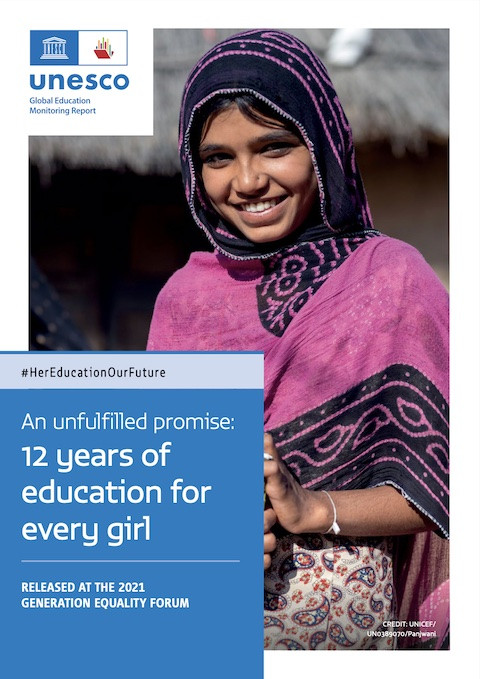 An Unfulfilled Promise: 12 Years of Education for Every Girl Год публикации: 2021 Организация-автор: Global Education Monitoring Report Team | UNESCO Just over 25 years ago in 1995, 189 governments adopted the Beijing Declaration and Platform for Action – a visionary agenda for women’s empowerment and the most comprehensive global policy framework to advance gender equality to date. Girls’ and women’s education and training featured in the document as one of 12 key areas where urgent action was needed to ensure greater equality.Since Beijing, the international community has emphasized the transformative power of girls’ and women’s education and its benefits – not only for girls and women, but for entire societies and even future generations. Under the 2030 Agenda for Sustainable Development, Sustainable Development Goal (SDG) 4 on inclusive, equitable quality education and lifelong learning sets ambitious targets to ensure equality of opportunity – including a target aiming to ensure that all girls and boys complete 12 years of education by 2030.This short paper explores the evolution of girls’ and boys’ completion rates in primary and secondary education since 1995 – and calls for action to deliver on our commitments to leaving no one behind.
  Inclusion in Early Childhood Care and Education in High-Income Countries Год публикации: 2021 Организация-автор: Global Education Monitoring Report Team | UNESCO | Deloitte Access Economics This report reviews the international research and policy literature concerning approaches to inclusion in early childhood care and education (ECCE) in different high-income jurisdictions globally. Each chapter highlights examples of policies and practices which can foster inclusion in ECCE across the themes set out in the Global Education Monitoring (GEM) Report in 2020.As a critical period for children’s intellectual, emotional, social, physical and moral development, supporting inclusion in ECCE is of particular importance for supporting lifelong learning and equitable opportunities for all children. A number of key messages emerging from this review that are instructive to designing policies to promote inclusion in ECCE are summarised below. Inclusion in ECCE is fostered through complementary universal and targeted approaches to most aspects of ECCE governance, financing, policy and service delivery. The implementation of ECCE laws and policies is key to supporting inclusion. As the central actors delivering ECCE services, collaboration within the ECCE workforce is crucial to supporting a community of practice which leads and shares inclusion, while avoiding risks of specialisation. Finally, while many existing ECCE policies, resources and tools are grounded in a deficits-based approach to understanding need, inclusion may be better supported through an approach which focusses on child learning needs and strengths.
 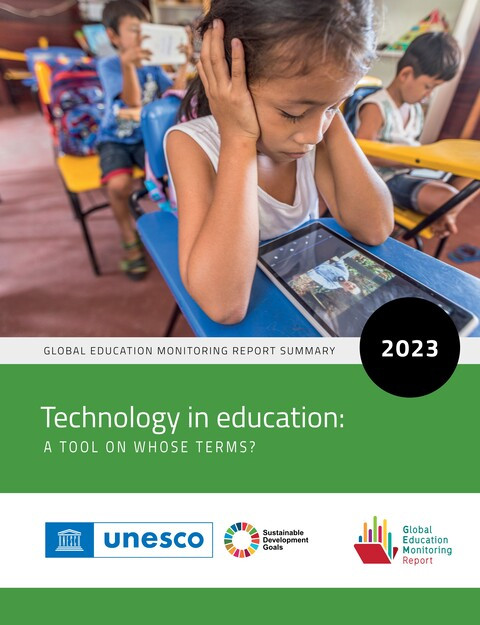 [Résumé] Résumé du rapport mondial de suivi sur l’éducation 2023 : les technologies dans l’éducation; qui est aux commandes? Год публикации: 2023 Организация-автор: UNESCO | Global Education Monitoring Report Team Le rôle de la technologie dans l’éducation suscite depuis longtemps un débat intense. Est-ce qu’elle démocratise le savoir ou menace la démocratie en permettant à quelques-uns de contrôler l’information? Offre-t-elle des opportunités sans limite ou mène-t-elle vers un avenir dépendant de la technologie sans retour en arrière possible ? Est-ce qu’elle égalise les chances ou aggrave les inégalités? Devrait-elle être utilisée pour enseigner aux jeunes enfants ou présente-t-elle des risques pour leur développement? Ce débat a été alimenté par les fermetures d’écoles dues à la COVID-19 et l’émergence de l’intelligence artificielle générative. Mais comme les développeurs sont souvent en avance sur les décideurs, la recherche sur la technologie éducative est complexe. Les preuves solides et impartiales sont rares. Les sociétés posent-elles même les bonnes questions sur l’éducation avant de se tourner vers la technologie comme solution? Reconnaissent-elles ses risques tout en cherchant ses avantages? Les technologies de l’information et de la communication ont le potentiel de favoriser l’équité et l’inclusion en permettant d’atteindre les apprenants défavorisés et de diffuser plus de connaissances dans des formats attrayants et abordables. Dans certains contextes et pour certains types d’apprentissage, elles peuvent améliorer la qualité de l’enseignement et l’apprentissage des compétences de base. De toute évidence, les compétences numériques font désormais partie des compétences de base. La technologie numérique peut également soutenir la gestion et accroître l’efficacité en aidant à traiter de plus grands volumes de données éducatives. Mais la technologie peut également exclure, être inappropriée et pesante, voire carrément nuisible. Les gouvernements doivent veiller à créer les bonnes conditions pour assurer un accès équitable à l’éducation pour tous, réguler l’utilisation de la technologie afin de protéger les apprenants de ses influences négatives, et former les enseignants. Ce rapport recommande que la technologie soit introduite dans l’éducation sur la base de preuves montrant qu’elle serait appropriée, équitable, évolutive et durable. En d’autres termes, son utilisation devrait être dans l’intérêt des apprenants et compléter l’interaction en face-à-face avec les enseignants. Elle devrait être considérée comme un outil à utiliser dans ces conditions. À mi-parcours de l’échéance, le Rapport mondial de suivi sur l'éducation 2023 évalue la distance qu’il reste à parcourir pour atteindre les objectifs éducatifs de 2030. L’éducation est la clé pour débloquer la réalisation d’autres objectifs de développement, notamment le progrès technologique.
 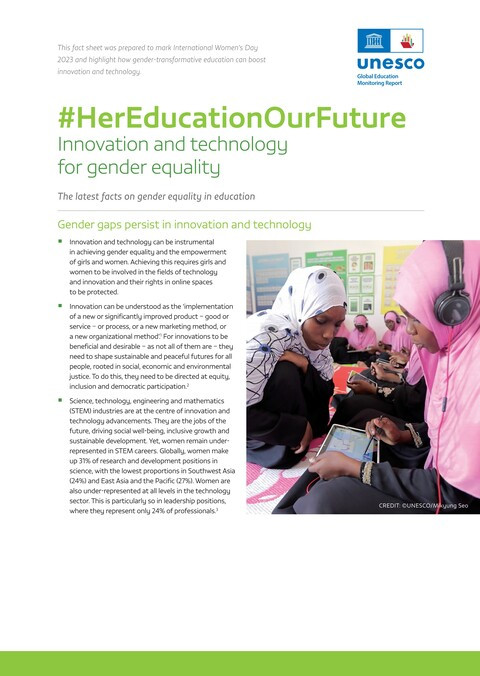 #HerEducationOurFuture: Innovation and Technology for Gender Equality; the Latest Facts on Gender Equality in Education Год публикации: 2023 Организация-автор: UNESCO | Global Education Monitoring Report Team Gender gaps persist in innovation and technology Innovation and technology can be instrumental in achieving gender equality and the empowerment of girls and women. Achieving this requires girls and women to be involved in the fields of technology and innovation and their rights in online spaces to be protected. #SuEducaciónNuestroFuturo: Innovación y tecnología para la igualdad de género: últimos datos sobre la igualdad de género en la educación Год публикации: 2023 Организация-автор: UNESCO | Global Education Monitoring Report Team La brecha de género persiste en la innovación y la tecnología La innovación y la tecnología pueden ser decisivas a la hora de lograr la igualdad de género y empoderar a las niñas y las mujeres. Para lograrlo, es necesario que las niñas y las mujeres participen en los ámbitos de la tecnología y la innovación y que se protejan sus derechos en los espacios en línea. #SonÉducationNotreAvenir: l’innovation et la technologie au service de l’égalité des genres: derniers développements sur l’égalité des genres dans l’éducation Год публикации: 2023 Организация-автор: UNESCO | Global Education Monitoring Report Team Les inégalités entre les genres persistent dans les domaines de l’innovation et de la technologie L’innovation et la technologie peuvent jouer un rôle essentiel en faveur de l’égalité des genres et de l’autonomisation des filles et des femmes. Pour que ces objectifs soient atteints, il faut que les filles et les femmes participent dans les domaines de la technologie et de l’innovation, mais aussi que leurs droits dans les espaces en ligne soient protégés. [резюме] ВСЕМИРНЫЙ ДОКЛАД ПО МОНИТОРИНГУ ОБРАЗОВАНИЯ РЕЗЮМЕ 2023: Технологии в образовании; НА ЧЬИХ УСЛОВИЯХ? Год публикации: 2023 Организация-автор: UNESCO | Global Education Monitoring Report Team Вопрос о роли технологий в образовании уже давно вызывает бурные дискуссии. Способствуют ли они распространению знаний или же ставят под угрозу доступ к ним, позволяя избранному кругу лиц контролировать информацию? Открывают ли они безграничные возможности или же безвозвратно ведут нас к зависимому от технологий будущему? Уравнивают ли они возможности или же усугубляют неравенство? Следует ли использовать их при воспитании детей младшего возраста или же существуют риски для нормального развития детей? Закрытие школ в связи с пандемией COVID-19 и развитие генеративного искусственного интеллекта придали новый импульс обсуждению этих вопросов. Однако учитывая, что разработчики технологий зачастую идут на шаг впереди ответственных за принятие решений лиц, исследования в области образовательных технологий сопряжены с определенными трудностями. Надежных, объективных данных крайне мало. Задается ли общество правильными вопросами об образовании, прежде чем прибегнуть к помощи технологий? Информационно-коммуникационные технологии способны содействовать обеспечению справедливости и инклюзивности с точки зрения охвата находящихся в неблагоприятном положении учащихся и более широкого распространения знаний в удобных и доступных форматах. В определенных условиях и в рамках некоторых видов обучения они могут повышать качество преподавания и изучения базовых навыков. Так или иначе, цифровые компетенции становятся неотъемлемой частью набора базовых навыков. Цифровые технологии также могут способствовать управлению и повышению эффективности, помогая обрабатывать большие объемы данных об образовании. В то же время технологии могут приводить к изоляции, не соответствовать потребностям и быть обременительными, а иногда даже вредными. Правительства должны создавать надлежащие условия для обеспечения справедливого доступа к образованию для всех, регулировать использование технологий, с тем чтобы защитить учащихся от их негативного воздействия, и заниматься подготовкой учителей. В данном докладе рекомендуется внедрять технологии в образование на основании данных, подтверждающих их целесообразность, соответствие принципам справедливости, применимость и устойчивость. Иными словами, они должны использоваться с учетом интересов учащихся и в качестве дополнения к образованию, основанному на человеческом взаимодействии. Их следует рассматривать как инструмент, использование которого должно осуществляться на этих условиях. Во Всемирном докладе по мониторингу образования 2023 года приводится анализ того, что еще предстоит сделать для достижения к 2030 году целей в области образования, в то время, когда мир находится на полпути к установленному сроку. Образование играет не последнюю роль в технологическом прогрессе, однако оно также имеет решающее значение для достижения других целей в области развития.